Italy Processed Fruit Market Size (2020-2030)
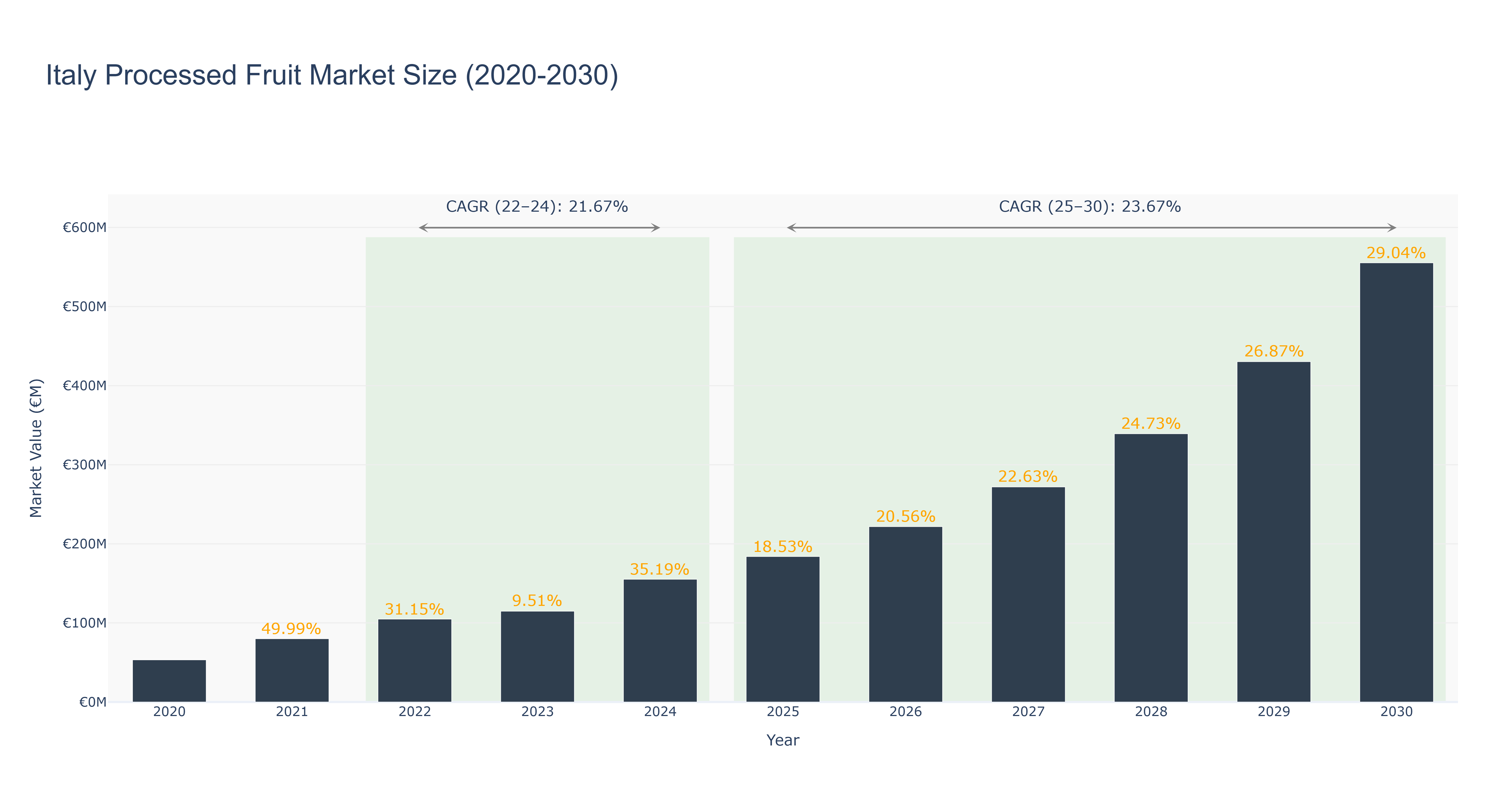
Italy's Processed Fruit Market has shown a steady growth trajectory over the years. The market peaked at €555.32 million in 2030, with a notable CAGR of 29.04% from 2025 to 2030. The actual market size saw consistent increases from €53.30 million in 2020 to €155.21 million in 2024. The forecasted growth from 2025 to 2030 is promising, with a CAGR of 23.67%. This growth can be attributed to increasing consumer demand for healthy and convenient food options, as well as technological advancements in food processing. In the near future, Italy's Processed Fruit Market is set to witness the launch of innovative product lines focusing on organic and sustainable practices, further driving market expansion. The industry drivers behind this positive trend include changing consumer preferences towards healthier snack options, the convenience factor of processed fruits, and a growing awareness of the importance of a balanced diet.
Italy Processed Fruit Market: Production & Trade Performance (2019-2025)
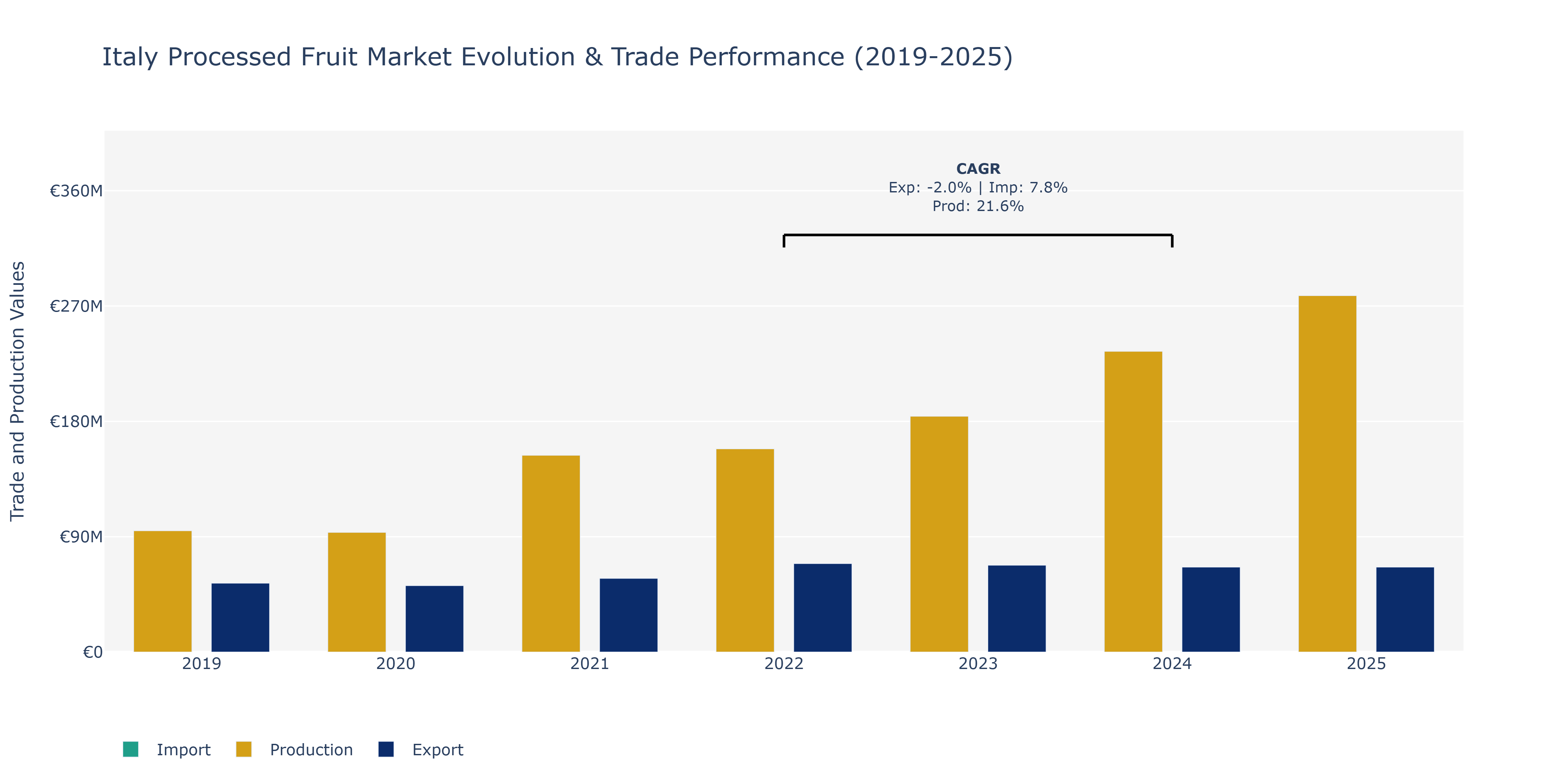
The Italy Processed Fruit Market witnessed fluctuations in Exports, Imports, and Production from 2019 to 2025. Exports showed a slight decrease from €53.73 million in 2019 to €66.24 million in 2024 before stabilizing at around €66.24 million in 2025. Imports experienced a gradual increase from €11.63 million in 2019 to €12.5 million in 2025, with a peak in 2025. Production demonstrated steady growth, rising from €94.64 million in 2019 to €278.11 million in 2025. The surge in production can be attributed to increasing consumer demand for processed fruit products, driven by the growing preference for healthy and convenient snacking options. Import growth could be linked to the need for a diverse range of fruits not readily available domestically. The stability in exports post-2024 may indicate a maturing market seeking to maintain its position in the global processed fruit trade, despite facing challenges such as changing consumer preferences and evolving trade regulations.
Key Highlights of the Report:
- Italy Processed Fruit Market Outlook
- Market Size of Italy Processed Fruit Market, 2025
- Forecast of Italy Processed Fruit Market, 2032
- Historical Data and Forecast of Italy Processed Fruit Revenues & Volume for the Period 2022-2032F
- Italy Processed Fruit Market Trend Evolution
- Italy Processed Fruit Market Drivers and Challenges
- Italy Processed Fruit Price Trends
- Italy Processed Fruit Porter's Five Forces
- Italy Processed Fruit Industry Life Cycle
- Historical Data and Forecast of Italy Processed Fruit Market Revenues & Volume By Product for the Period 2022-2032F
- Historical Data and Forecast of Italy Processed Fruit Market Revenues & Volume By Fresh for the Period 2022-2032F
- Historical Data and Forecast of Italy Processed Fruit Market Revenues & Volume By Fresh- Cut for the Period 2022-2032F
- Historical Data and Forecast of Italy Processed Fruit Market Revenues & Volume By Canned for the Period 2022-2032F
- Historical Data and Forecast of Italy Processed Fruit Market Revenues & Volume By Frozen for the Period 2022-2032F
- Historical Data and Forecast of Italy Processed Fruit Market Revenues & Volume By Drying &Dehydration for the Period 2022-2032F
- Historical Data and Forecast of Italy Processed Fruit Market Revenues & Volume By Processing Equipment for the Period 2022-2032F
- Historical Data and Forecast of Italy Processed Fruit Market Revenues & Volume By Pre-processing for the Period 2022-2032F
- Historical Data and Forecast of Italy Processed Fruit Market Revenues & Volume By Processing for the Period 2022-2032F
- Historical Data and Forecast of Italy Processed Fruit Market Revenues & Volume By Washing for the Period 2022-2032F
- Historical Data and Forecast of Italy Processed Fruit Market Revenues & Volume By Filling for the Period 2022-2032F
- Historical Data and Forecast of Italy Processed Fruit Market Revenues & Volume By Seasoning for the Period 2022-2032F
- Historical Data and Forecast of Italy Processed Fruit Market Revenues & Volume By Packaging for the Period 2022-2032F
- Italy Processed Fruit Import Export Trade Statistics
- Market Opportunity Assessment By Product
- Market Opportunity Assessment By Processing Equipment
- Italy Processed Fruit Top Companies Market Share
- Italy Processed Fruit Competitive Benchmarking By Technical and Operational Parameters
- Italy Processed Fruit Company Profiles
- Italy Processed Fruit Key Strategic Recommendations






































