Italy Risk Analytics Market Size & Growth Rate (2026-2032)
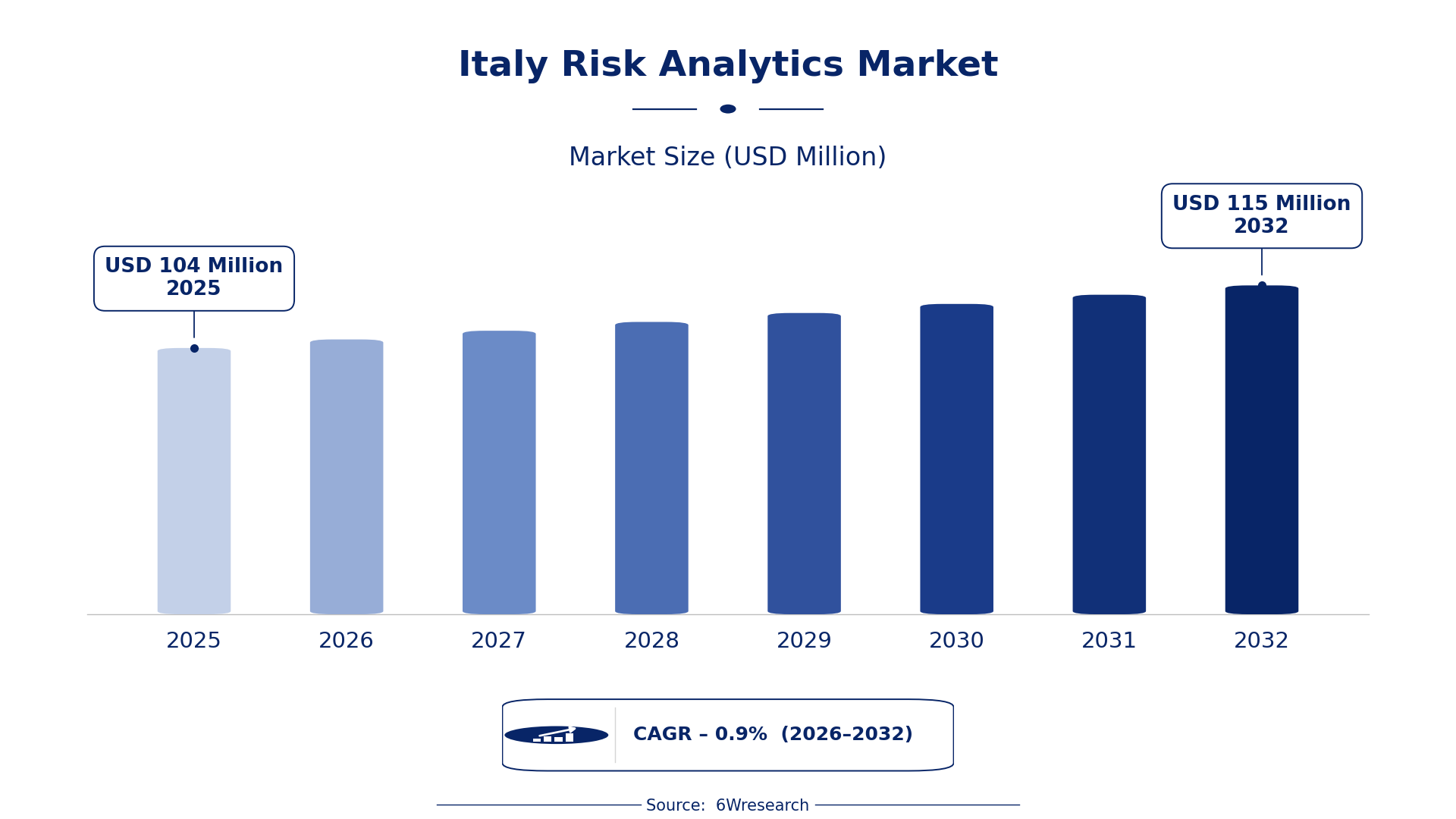
The Italy Risk Analytics Market was estimated at USD 104 Million in 2025 and is projected to reach USD 115 Million by 2032, growing at a CAGR of 0.9% from 2026 to 2032.
Italy Risk Analytics Market Synopsis
In Italy, the most influential factor shaping the Risk Analytics Market is the increasing adoption of advanced analytics tools across multiple sectors. Organizations recognize the need to mitigate risks effectively while enhancing their decision-making capabilities. This trend is particularly evident in industries such as finance, healthcare, and manufacturing, where risk management is becoming integral to operational success.
Additionally, the rise in cybersecurity threats and stringent regulatory frameworks are driving demand for sophisticated risk analytics solutions. As businesses strive to comply with regulations like GDPR, the necessity for real-time risk monitoring becomes paramount, creating opportunities for innovative analytics solutions that address these evolving challenges.
Italy Risk Analytics Market Year-wise Growth Rate and Key Drivers
This graph illustrates the annual growth rates of the Italy Risk Analytics Market from 2021 to 2032, highlighting a steady upward trajectory and projected expansion over the forecast period.
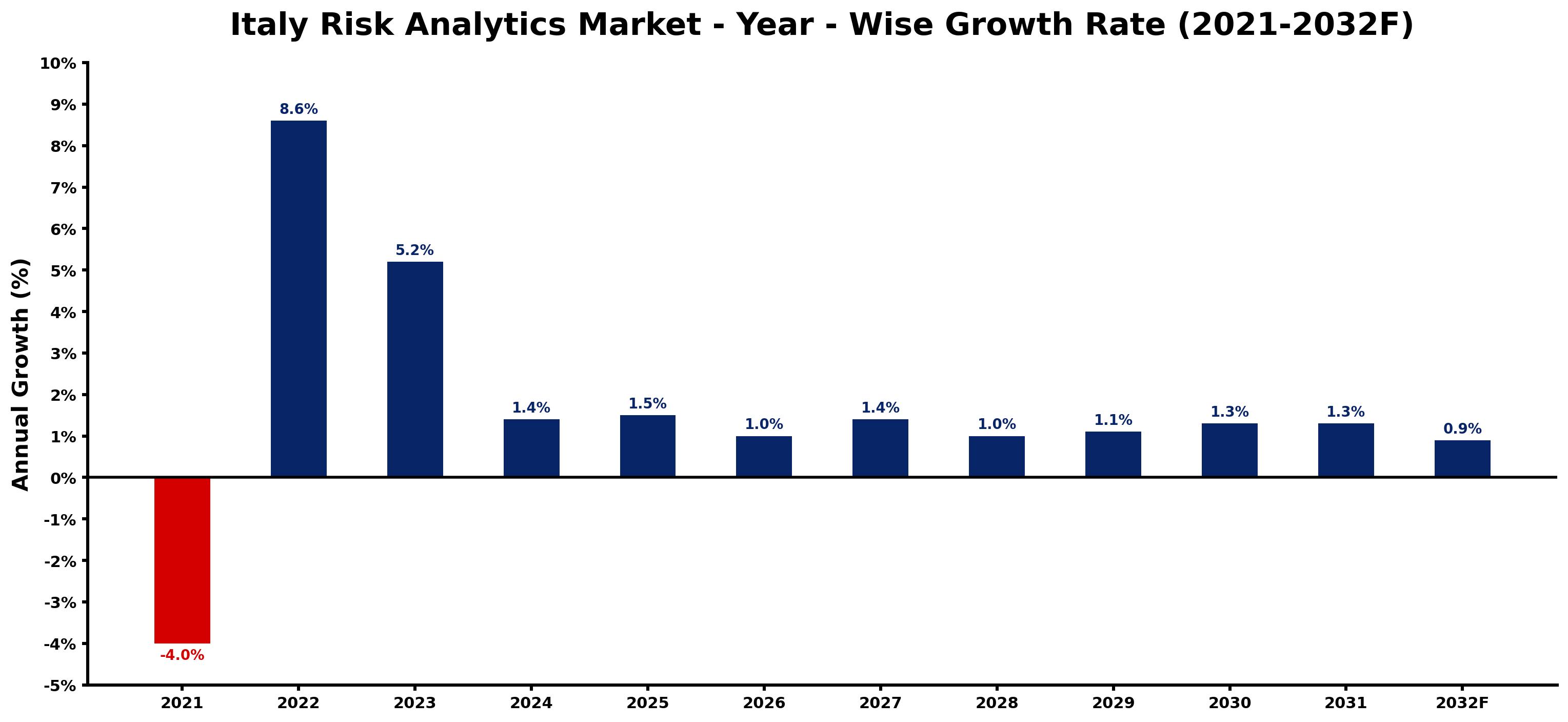
The table below presents the year‑wise growth rates along with the key drivers influencing the market
| Year | Growth Rate | Major Drivers |
| 2021 | -4.0% | Regulatory shifts by IVASS hindered risk implementation efforts. |
| 2022 | 8.6% | Enhanced EU regulatory frameworks on financial risk management. |
| 2023 | 5.2% | Increase in local startups focusing on digital risk solutions. |
| 2024 | 1.4% | Rising awareness of data privacy risks among businesses. |
| 2025 | 1.5% | Investment in AI for predictive risk analytics tools. |
| 2026 | 1.0% | Growing need for compliance with Italy's anti-money laundering laws. |
| 2027 | 1.4% | Increasing reliance on cloud-based risk management platforms. |
| 2028 | 1.0% | Demand surge after recent high-profile cybersecurity breaches. |
| 2029 | 1.1% | Integration of risk analytics into corporate governance frameworks. |
| 2030 | 1.3% | Local banks enhancing risk models amid economic uncertainty. |
| 2031 | 1.3% | Focus on regulatory compliance driven by EU directives. |
| 2032 | 0.9% | Continued growth in demand for tailored risk assessment services. |
Note: Market size estimations and growth projections presented in this report are based on 6Wresearch's proprietary forecasting methodology, utilizing the latest available industry data, government publications, and primary research inputs.
Italy Risk Analytics Market Key Takeaways
Below are some of the specific key takeaways from the market, including:
- Growing emphasis on artificial intelligence and machine learning for improved risk assessment.
- Increased integration of risk analytics across various industries to enhance decision-making.
- Demand for real-time risk monitoring tools to address regulatory and cybersecurity challenges.
- Cloud-based solutions gaining traction due to cost efficiency and scalability.
- Investment opportunities emerging in sectors such as finance, insurance, and healthcare.
Evaluation of Restraints in Italy Risk Analytics Market
The Italy Risk Analytics Market faces several restraints that could hinder its growth. One significant issue is the complexity surrounding data privacy regulations, particularly the stringent requirements of GDPR. This can create obstacles for organizations trying to collect and analyze data responsibly. Additionally, the fragmented nature of data sources across industries complicates the integration of analytics solutions, limiting their effectiveness. A lack of skilled professionals with expertise in advanced analytics further exacerbates these challenges, making it difficult for businesses to fully capitalize on available technologies.
Italy Risk Analytics Market Trends
Several key trends are shaping the Italy Risk Analytics Market. One notable trend is the growing adoption of artificial intelligence and machine learning technologies, which enhance risk prediction capabilities. Businesses are increasingly focusing on integrating risk analytics solutions across sectors like finance and healthcare to improve their decision-making processes. on top of that, the demand for real-time monitoring tools is on the rise, driven by the need to comply with evolving regulatory requirements and address cybersecurity threats. Cloud-based analytics solutions are also gaining popularity due to their scalability and cost-effectiveness, marking a shift towards more integrated and technology-driven risk management approaches.
Italy Risk Analytics Market Opportunities
The Italy Risk Analytics Market offers substantial investment opportunities across various sectors. With a growing need for advanced risk assessment tools, organizations are keen to invest in innovative analytics solutions that leverage artificial intelligence and machine learning. This demand extends to sectors such as finance, insurance, healthcare, and cybersecurity, where tailored risk analytics solutions can provide a competitive edge. Additionally, partnerships with local companies to develop customized analytics tools represent a strategic avenue for growth. The focus on proactive risk management strategies presents a ripe environment for vendors looking to innovate and capture market share.
Government Initiatives in the Italy Risk Analytics Market
Government policy plays a critical role in shaping the Italy Risk Analytics Market. With a focus on data protection and financial integrity, the Italian government has implemented several regulations that directly impact risk analytics practices. These policies create a framework that encourages organizations to adopt analytics solutions while ensuring compliance and accountability.
- A recently completed initiative introduced stricter compliance measures for financial institutions to enhance transparency and reduce fraud.
- Currently underway is a national program aimed at strengthening cybersecurity measures across critical sectors, promoting the use of advanced analytics to detect threats.
- A planned public-private partnership expected to be announced in 2026, focusing on the development of innovative risk management solutions across various industries.
- Ongoing efforts by regulatory bodies to refine guidelines for the implementation of GDPR in analytics practices, ensuring data privacy while fostering innovation.
- The introduction of a financial education program aimed at improving awareness of risk management tools and analytics within small and medium enterprises.
Future Insights of the Italy Risk Analytics Market
Looking ahead to 2026-2032, the Italy Risk Analytics Market is set for steady growth driven by increasing awareness of the importance of risk management. Organizations will prioritize integrating advanced technologies like artificial intelligence and predictive analytics to enhance their risk assessment capabilities. As regulatory requirements continue to evolve, the demand for sophisticated risk management solutions will only increase. Businesses are expected to focus on data-driven strategies to mitigate risks effectively, ensuring they remain competitive in a challenging environment.
Italy Risk Analytics Market Latest Developments
Over the past 12-14 months, the Italy Risk Analytics Market has witnessed significant developments reflecting the industry's direction. Companies are increasingly recognizing the value of advanced analytics in mitigating risks and improving decision-making processes. This trend is evident in the rollout of new technologies and partnerships aimed at enhancing risk assessment capabilities.
- A major technology vendor launched a comprehensive risk analytics platform in late 2025, integrating machine learning capabilities for improved risk prediction.
- An ongoing collaboration between leading financial institutions and analytics firms aims to develop tailored risk management solutions, initiated in early 2026.
- A planned expansion of a cloud-based risk analytics service is expected to begin in mid-2026, targeting small and medium-sized enterprises.
- A new initiative focused on educating businesses about the benefits of risk analytics was kicked off in Q1 2025, receiving positive industry feedback.
- A technology upgrade project aimed at enhancing data security in financial institutions is currently underway, emphasizing the need for integrated risk analytics solutions.
Italy Risk Analytics Market - Key Attractiveness of the Report
- 10 Years of Market Numbers
- Historical Data Starting from 2022 to 2025
- Base Year: 2025
- Forecast Data until 2032
- Key Performance Indicators Impacting the Market
- Major Upcoming Developments and Projects
Key Highlights of the Report:
- Italy Risk Analytics Market Outlook
- Market Size of Italy Risk Analytics Market, 2025
- Forecast of Italy Risk Analytics Market, 2032
- Historical Data and Forecast of Italy Risk Analytics Revenues & Volume for the Period 2022-2032F
- Italy Risk Analytics Market Trend Evolution
- Italy Risk Analytics Market Drivers and Challenges
- Italy Risk Analytics Price Trends
- Italy Risk Analytics Porter's Five Forces
- Italy Risk Analytics Industry Life Cycle
- Historical Data and Forecast of Italy Risk Analytics Market Revenues & Volume By Component for the Period 2022-2032F
- Historical Data and Forecast of Italy Risk Analytics Market Revenues & Volume By Software (ETL Tools, Risk Calculation Engines, GRC Software) for the Period 2022-2032F
- Historical Data and Forecast of Italy Risk Analytics Market Revenues & Volume By Services for the Period 2022-2032F
- Historical Data and Forecast of Italy Risk Analytics Market Revenues & Volume By Risk Type for the Period 2022-2032F
- Historical Data and Forecast of Italy Risk Analytics Market Revenues & Volume By Strategic Risk for the Period 2022-2032F
- Historical Data and Forecast of Italy Risk Analytics Market Revenues & Volume By Operational Risk for the Period 2022-2032F
- Historical Data and Forecast of Italy Risk Analytics Market Revenues & Volume By Financial Risk for the Period 2022-2032F
- Historical Data and Forecast of Italy Risk Analytics Market Revenues & Volume By Deployment Mode for the Period 2022-2032F
- Historical Data and Forecast of Italy Risk Analytics Market Revenues & Volume By Cloud for the Period 2022-2032F
- Historical Data and Forecast of Italy Risk Analytics Market Revenues & Volume By On-premises for the Period 2022-2032F
- Historical Data and Forecast of Italy Risk Analytics Market Revenues & Volume By Organization Size for the Period 2022-2032F
- Historical Data and Forecast of Italy Risk Analytics Market Revenues & Volume By Large enterprises for the Period 2022-2032F
- Historical Data and Forecast of Italy Risk Analytics Market Revenues & Volume By Small and medium-sized enterprises (SMEs) for the Period 2022-2032F
- Historical Data and Forecast of Italy Risk Analytics Market Revenues & Volume By Vertical for the Period 2022-2032F
- Historical Data and Forecast of Italy Risk Analytics Market Revenues & Volume By Banking and Financial Services for the Period 2022-2032F
- Historical Data and Forecast of Italy Risk Analytics Market Revenues & Volume By Insurance for the Period 2022-2032F
- Historical Data and Forecast of Italy Risk Analytics Market Revenues & Volume By Manufacturing for the Period 2022-2032F
- Historical Data and Forecast of Italy Risk Analytics Market Revenues & Volume By Transportation and Logistics for the Period 2022-2032F
- Historical Data and Forecast of Italy Risk Analytics Market Revenues & Volume By Retail and Consumer Goods for the Period 2022-2032F
- Historical Data and Forecast of Italy Risk Analytics Market Revenues & Volume By IT and Telecom for the Period 2022-2032F
- Historical Data and Forecast of Italy Risk Analytics Market Revenues & Volume By Government and Defense for the Period 2022-2032F
- Historical Data and Forecast of Italy Risk Analytics Market Revenues & Volume By Healthcare and Life Sciences for the Period 2022-2032F
- Italy Risk Analytics Import Export Trade Statistics
- Market Opportunity Assessment By Component
- Market Opportunity Assessment By Risk Type
- Market Opportunity Assessment By Deployment Mode
- Market Opportunity Assessment By Organization Size
- Market Opportunity Assessment By Vertical
- Italy Risk Analytics Top Companies Market Share
- Italy Risk Analytics Competitive Benchmarking By Technical and Operational Parameters
- Italy Risk Analytics Company Profiles
- Italy Risk Analytics Key Strategic Recommendations






































