Italy Service Delivery Automation Market Size & Growth Rate (2026-2032)
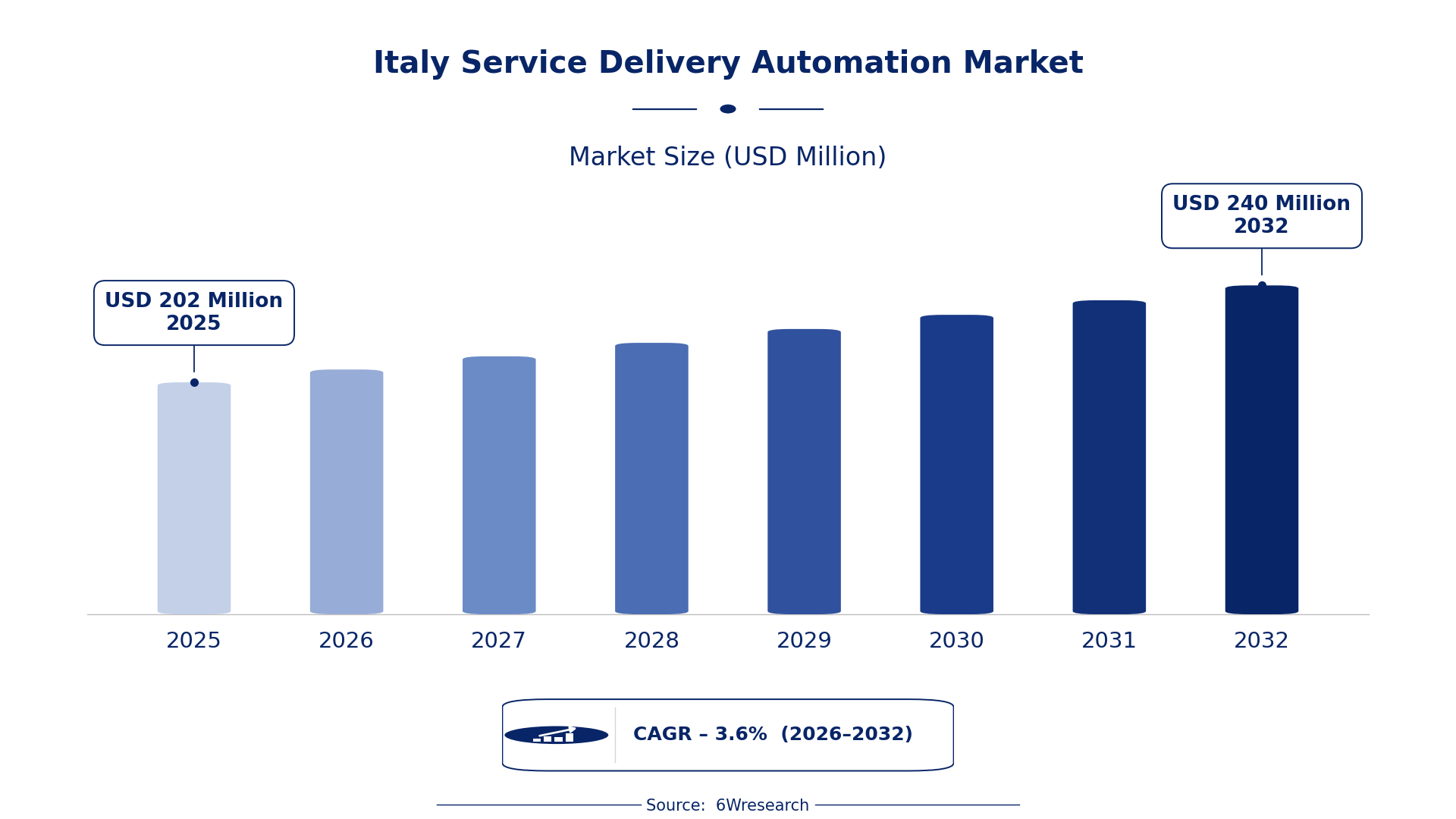
The Italy Service Delivery Automation Market was estimated at USD 202 Million in 2025 and is projected to reach USD 240 Million by 2032, growing at a CAGR of 3.6% from 2026 to 2032.
Italy Service Delivery Automation Market Synopsis
In Italy, businesses are increasingly turning to service delivery automation to enhance efficiency and meet rising customer expectations. The push for digital transformation across sectors like IT, telecom, and healthcare is a primary driver, with automation technologies becoming integral to strategic planning.
The demand for solutions such as Robotic Process Automation (RPA) and Artificial Intelligence (AI) is rising as organizations seek to streamline operations and reduce costs. This trend reflects a broader commitment to innovation, with companies recognizing the value of automation in maintaining competitiveness in a fast-paced market.
Italy Service Delivery Automation Market Year-wise Growth Rate and Key Drivers
This graph illustrates the annual growth rates of the Italy Service Delivery Automation Market from 2021 to 2032, highlighting a steady upward trajectory and projected expansion over the forecast period.
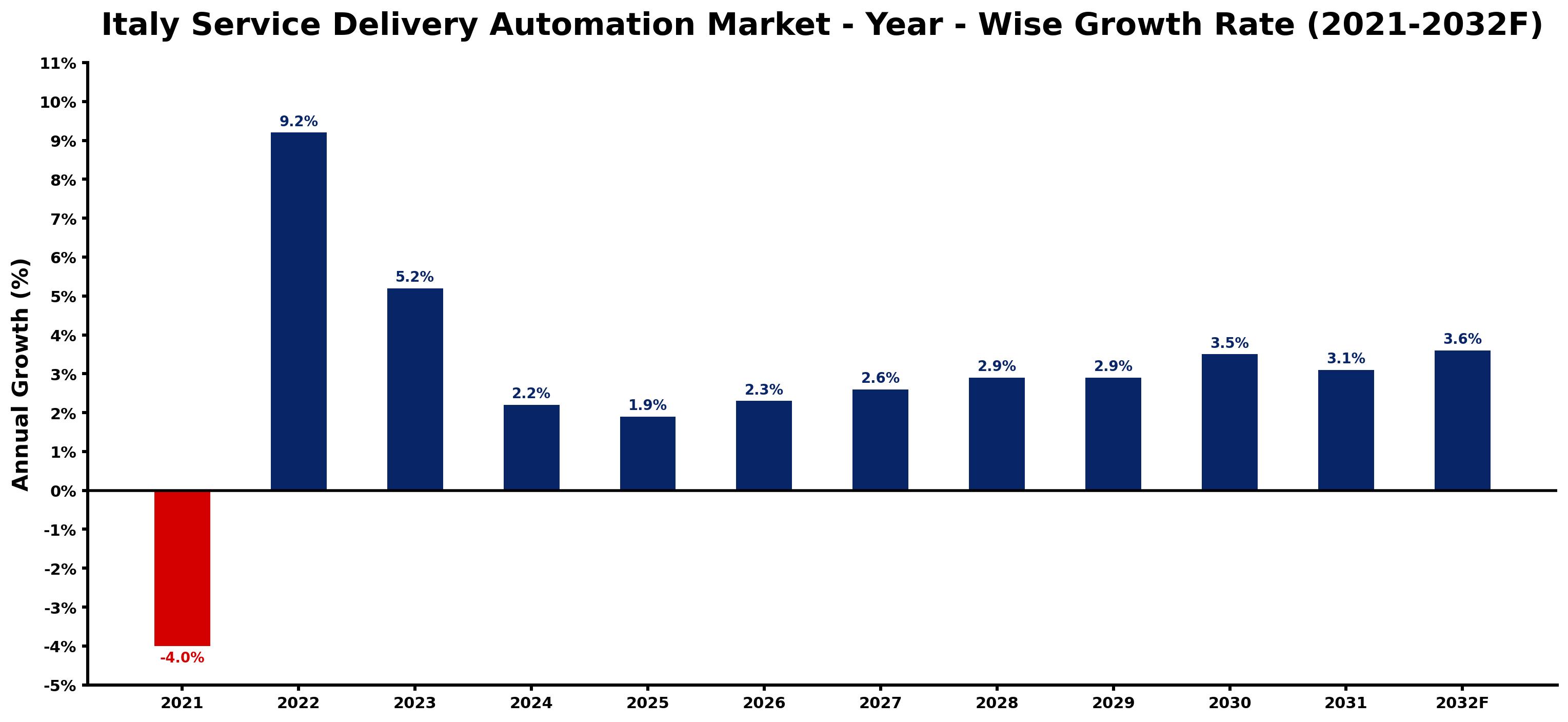
The table below presents the year‑wise growth rates along with the key drivers influencing the market
| Year | Growth Rate | Major Drivers |
| 2021 | -4.0% | Delayed adoption due to stringent EU GDPR compliance requirements. |
| 2022 | 9.2% | Growing interest in robotic process automation among SMEs |
| 2023 | 5.2% | Implementation of GDPR fostering automation in compliance services |
| 2024 | 2.2% | Rise in e-commerce boosting automated fulfillment systems |
| 2025 | 1.9% | Interest in chatbots for improving customer engagement strategies |
| 2026 | 2.3% | Surge in telehealth services driving automation in healthcare |
| 2027 | 2.6% | Adoption of cloud solutions enhancing service delivery efficiency |
| 2028 | 2.9% | Increased focus on operational cost reduction via automation |
| 2029 | 2.9% | Collaborations with local tech startups on automation innovations |
| 2030 | 3.5% | Government incentives for automating small business operations |
| 2031 | 3.1% | Demand for contactless services due to health concerns |
| 2032 | 3.6% | Growing emphasis on data analytics for service optimization |
Note: Market size estimations and growth projections presented in this report are based on 6Wresearch's proprietary forecasting methodology, utilizing the latest available industry data, government publications, and primary research inputs.
Italy Service Delivery Automation Market Key Takeaways
Below are some of the specific key takeaways from the market, including:
- The market is driven by a strong demand for digital transformation across various sectors.
- Companies are increasingly adopting advanced technologies such as RPA, AI, and Machine Learning.
- There is a notable focus on improving customer experience and operational efficiency.
- Investment in training programs is crucial to overcome workforce skill gaps in automation technologies.
- Government initiatives are fostering a supportive environment for automation adoption.
Evaluation of Restraints in Italy Service Delivery Automation Market
Resistance to change remains a major barrier in the Italy Service Delivery Automation Market. Traditional businesses often hesitate to embrace new technologies, primarily due to fears of job displacement and a lack of understanding regarding automation's benefits. This reluctance can stall progress and innovation, limiting the market's potential for growth.
on top of that, the shortage of a skilled workforce capable of implementing and managing these solutions effectively poses another challenge. Without targeted educational initiatives and training programs, companies may struggle to capitalize on automation opportunities.
Italy Service Delivery Automation Market Trends
A significant trend in the Italy Service Delivery Automation Market is the emphasis on automating repetitive tasks within customer service and IT operations. Businesses are increasingly prioritizing solutions that enhance productivity and agility, especially in a post-pandemic environment where remote work has become more prevalent.
Customization and scalability of automation tools are also gaining traction, as Italian companies seek solutions tailored to their unique needs. This trend is fostering a competitive atmosphere among technology providers, pushing them to innovate continuously and meet diverse business requirements.
Italy Service Delivery Automation Market Opportunities
The Italy Service Delivery Automation Market presents numerous investment opportunities across various sectors. Key areas include IT services, healthcare, and finance, where the demand for process streamlining and cost reduction is particularly high.
Companies focusing on RPA, AI, and machine learning technologies are well-positioned to thrive. As the Italian government emphasizes digital transformation, there is an encouraging environment for innovation, making this an attractive market for investors looking for growth potential.
Government Initiatives in the Italy Service Delivery Automation Market
The Italian government is actively promoting service delivery automation as part of its broader digital agenda. Policies aimed at fostering innovation and efficiency are critical for supporting businesses in adopting these technologies. The focus on digital transformation not only enhances productivity but also contributes to economic growth.
- A recent initiative launched in 2025 focuses on providing tax incentives for companies investing in automation technologies.
- Current efforts include the rollout of the National Industry 4.0 Plan, which aims to enhance automation across various sectors.
- Upcoming programs are expected to support the development of digital skills among the workforce to better adapt to automation technologies.
- Continuous funding programs are being introduced to encourage research and development in automation solutions.
- Ongoing public-private partnerships are designed to enhance digital infrastructure, facilitating the integration of automation across industries.
Future Insights of the Italy Service Delivery Automation Market
Looking ahead to 2026-2032, the Italy Service Delivery Automation Market is set for substantial growth. The increasing emphasis on digital transformation will drive demand for automation technologies, as companies prioritize efficiency and cost-effectiveness.
Advancements in AI, machine learning, and RPA are likely to revolutionize operational practices, leading to innovations that further enhance service delivery. As businesses continue to adapt to changing market dynamics, the need for tailored automation solutions will become even more pronounced.
Italy Service Delivery Automation Market Latest Developments
In the past year, the Italy Service Delivery Automation Market has seen a flurry of activity as businesses respond to the accelerating demand for automation solutions. Companies are exploring new technologies and partnerships to enhance their service delivery capabilities.
- A major technology vendor announced a partnership in early 2025 to develop AI-driven automation tools tailored for the healthcare sector.
- Ongoing initiatives include the implementation of RPA solutions in financial services, aimed at optimizing back-office processes and improving customer service.
- A product launch expected in mid-2026 will introduce advanced machine learning capabilities to existing automation platforms, enhancing their functionality.
- Several Italian companies are currently upgrading their digital infrastructure to support automation initiatives, an effort that began in late 2025 and is still in progress.
- Upcoming investments are planned for 2027 to expand automation solutions into the retail sector, focusing on improving supply chain efficiency.
Italy Service Delivery Automation Market - Key Attractiveness of the Report
- 10 Years of Market Numbers
- Historical Data Starting from 2022 to 2025
- Base Year: 2025
- Forecast Data until 2032
- Key Performance Indicators Impacting the Market
- Major Upcoming Developments and Projects
Key Highlights of the Report:
- Italy Service Delivery Automation Market Outlook
- Market Size of Italy Service Delivery Automation Market, 2025
- Forecast of Italy Service Delivery Automation Market, 2032
- Historical Data and Forecast of Italy Service Delivery Automation Revenues & Volume for the Period 2022-2032F
- Italy Service Delivery Automation Market Trend Evolution
- Italy Service Delivery Automation Market Drivers and Challenges
- Italy Service Delivery Automation Price Trends
- Italy Service Delivery Automation Porter's Five Forces
- Italy Service Delivery Automation Industry Life Cycle
- Historical Data and Forecast of Italy Service Delivery Automation Market Revenues & Volume By Type for the Period 2022-2032F
- Historical Data and Forecast of Italy Service Delivery Automation Market Revenues & Volume By IT Process Automation for the Period 2022-2032F
- Historical Data and Forecast of Italy Service Delivery Automation Market Revenues & Volume By Business Process Automation for the Period 2022-2032F
- Historical Data and Forecast of Italy Service Delivery Automation Market Revenues & Volume By Vertical for the Period 2022-2032F
- Historical Data and Forecast of Italy Service Delivery Automation Market Revenues & Volume By BFSI for the Period 2022-2032F
- Historical Data and Forecast of Italy Service Delivery Automation Market Revenues & Volume By IT, Telecommunication & Media for the Period 2022-2032F
- Historical Data and Forecast of Italy Service Delivery Automation Market Revenues & Volume By Travel, Hospitality & Transportation for the Period 2022-2032F
- Historical Data and Forecast of Italy Service Delivery Automation Market Revenues & Volume By Retail & Consumer Goods for the Period 2022-2032F
- Historical Data and Forecast of Italy Service Delivery Automation Market Revenues & Volume By Healthcare & Pharmaceuticals for the Period 2022-2032F
- Historical Data and Forecast of Italy Service Delivery Automation Market Revenues & Volume By Manufacturing & Logistics for the Period 2022-2032F
- Historical Data and Forecast of Italy Service Delivery Automation Market Revenues & Volume By Others for the Period 2022-2032F
- Historical Data and Forecast of Italy Service Delivery Automation Market Revenues & Volume By Organization Size for the Period 2022-2032F
- Historical Data and Forecast of Italy Service Delivery Automation Market Revenues & Volume By Large Enterprises for the Period 2022-2032F
- Historical Data and Forecast of Italy Service Delivery Automation Market Revenues & Volume By SME??s for the Period 2022-2032F
- Italy Service Delivery Automation Import Export Trade Statistics
- Market Opportunity Assessment By Type
- Market Opportunity Assessment By Vertical
- Market Opportunity Assessment By Organization Size
- Italy Service Delivery Automation Top Companies Market Share
- Italy Service Delivery Automation Competitive Benchmarking By Technical and Operational Parameters
- Italy Service Delivery Automation Company Profiles
- Italy Service Delivery Automation Key Strategic Recommendations






































