Italy Smart Weapons Market Size, Share & Growth Rate
The Italy Smart Weapons Market was estimated at USD 236 Million in 2025 and is projected to reach USD 288 Million by 2032, growing at a CAGR of 2.9% from 2026 to 2032. This steady growth is primarily attributed to the Italian government's commitment to modernizing its defense capabilities and increasing investments in advanced military technologies. Furthermore, the rising emphasis on precision warfare and enhanced military effectiveness continues to drive demand for innovative smart weapon systems.
Italy Smart Weapons Market Year-wise Growth Rate and Key Drivers
This graph highlights how the Italy Smart Weapons Market has steadily grown over the years, supported by major growth factors.
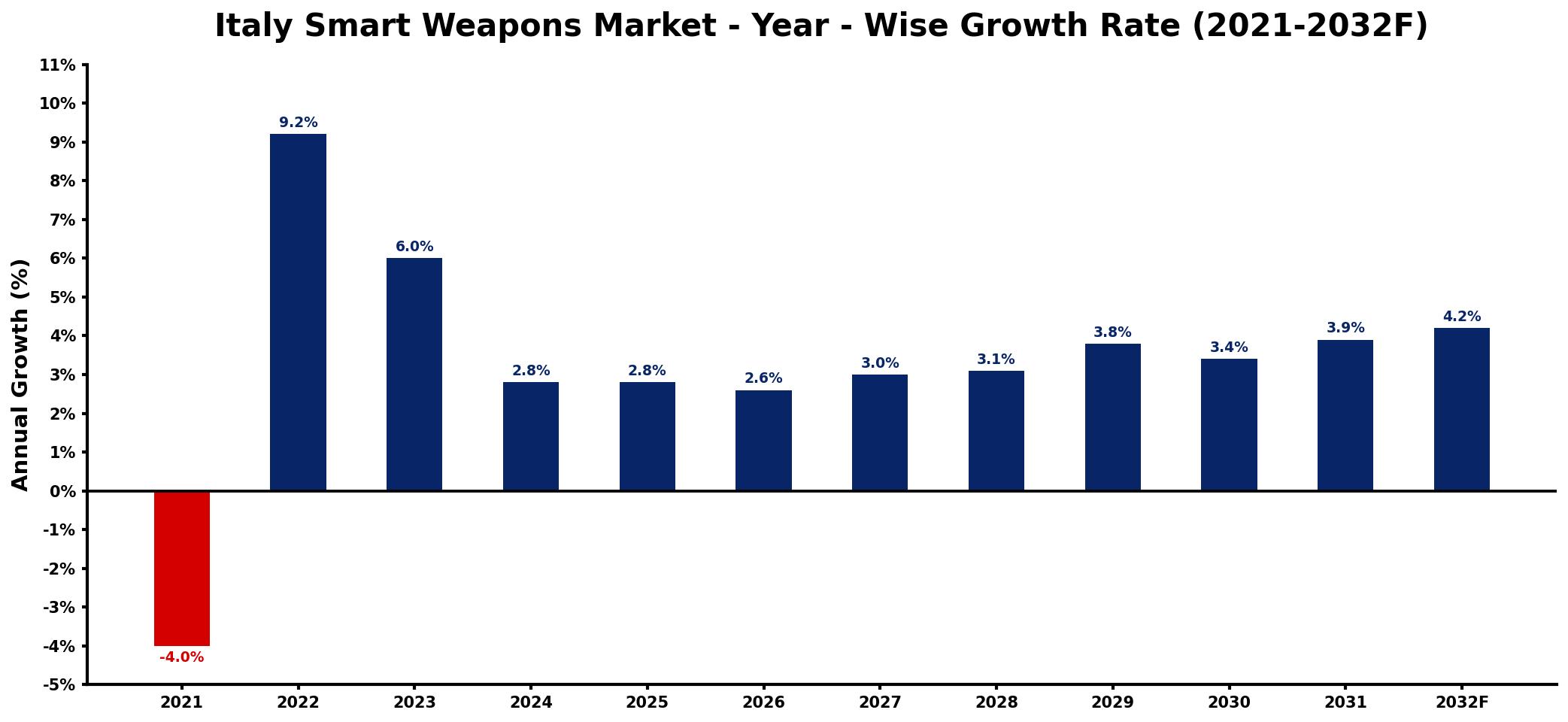
The table below presents the year‑wise growth rates along with the key drivers influencing the market
| Year | Growth Rate | Major Drivers |
| 2021 | -4.0% | Global defense spending reductions observed |
| 2022 | 9.2% | Government contracts for modernization increase |
| 2023 | 6.0% | Rising demand for advanced technology |
| 2024 | 2.8% | Increased investments in defense sectors |
| 2025 | 2.8% | Emerging markets boost technology adoption |
| 2026 | 2.6% | Collaborations between defense contractors expand |
| 2027 | 3.0% | Growing focus on cybersecurity measures |
| 2028 | 3.1% | Military exercises drive procurement needs |
| 2029 | 3.8% | Technological innovation enhances operational efficiency |
| 2030 | 3.4% | Increased focus on international partnerships |
| 2031 | 3.9% | Enhanced training programs for personnel |
| 2032 | 4.2% | Sustainability initiatives influence procurement strategies |
Note: Market size estimations and growth projections presented in this report are based on 6Wresearch's proprietary forecasting methodology, utilizing the latest available industry data, government publications, and primary research inputs.
Italy Smart Weapons Market Synopsis
The demand for precision-guided munitions in Italy is surging, owing to their effectiveness in reducing collateral damage while maximizing operational efficiency. As military engagements evolve, the focus on smart weapons that integrate advanced technologies like artificial intelligence and machine learning is becoming paramount for the Italian armed forces.
As Italy navigates its position within the global defense landscape, domestic defense manufacturers are collaborating with international partners to enhance product offerings. This synergy is expected to bolster the development of cutting-edge smart weapons that align with modern warfare requirements, creating a dynamic market environment.
Italy Smart Weapons Market Key Takeaways
- The market is fueled by government initiatives aimed at enhancing Italy's military capabilities through advanced weaponry.
- Technological advancements in artificial intelligence and machine learning are shaping the future of smart weapons.
- There is a pronounced shift towards integrating smart weapons with network-centric warfare systems for improved interoperability.
- Investment opportunities abound in R&D for next-generation smart weapon technologies.
- Regulatory challenges pose hurdles, necessitating strategic navigation to ensure compliance with international standards.
Evaluation of Restraints in Italy Smart Weapons Market
The growth of the Italy Smart Weapons Market is significantly affected by the stringent regulatory environment governing the use and export of military technologies. Italy's membership in the European Union subjects its defense sector to strict arms control regulations aimed at ensuring responsible development and use of advanced weaponry. This regulatory landscape can sometimes stifle innovation and slow down the time-to-market for new technologies. Additionally, ethical concerns surrounding the deployment of smart weapon systems continue to generate public discourse, which further complicates the landscape for defense contractors.
Italy Smart Weapons Market Trends
Current trends within the Italy Smart Weapons Market reflect a shift toward the incorporation of next-generation technologies to enhance the performance of weapon systems. The adoption of sophisticated sensors and AI-driven target acquisition systems is enabling greater precision in engagement strategies. Moreover, the integration of smart weapons into broader network-centric frameworks is enhancing real-time operational awareness, contributing to more effective military responses.
Italy Smart Weapons Market Opportunities
The market presents substantial investment opportunities in R&D focused on developing cutting-edge smart weapons. Companies specializing in precision-guided munitions, unmanned aerial vehicles, and next-gen missile systems are well-positioned to benefit from Italy's defense modernization initiatives. Collaborating with government entities and other defense contractors can provide significant avenues for growth, as the country prioritizes innovation in military applications to bolster its national security.
Government Initiatives in the Italy Smart Weapons Market
The Italian government emphasizes the responsible development and procurement of smart weapon technologies through stringent policies and regulations. Aligning with international arms control agreements, Italy is committed to maintaining transparency in its defense contracts while promoting domestic industry growth. Public spending on defense R&D is prioritized to foster innovation, and strategic collaborations with international allies aim to enhance the interoperability of Italian military systems.
Future Insights of the Italy Smart Weapons Market
Looking ahead to 2026-2032, the Italy Smart Weapons Market is poised for continuous growth driven by ongoing advancements in military technology and heightened defense spending. As security threats evolve, the demand for advanced smart weapons systems will increase, necessitating investments in precision-guided munitions and missile defense systems. With a commitment to modernization and improved military effectiveness, Italy is likely to remain a competitive player within the global defense industry.
Italy Smart Weapons Market Latest Developments (2025 - 2026)
Recent developments within the Italy Smart Weapons Market indicate a continued focus on technological innovation and strategic partnerships. Defense contractors are increasingly collaborating with international firms to enhance their capabilities, particularly in the realms of AI and smart technology integration. Moreover, discussions around regulatory reforms aim to streamline the export process for advanced weaponry, potentially fostering a more conducive environment for market growth.
Italy Smart Weapons Market - Key Attractiveness of the Report
- 10 Years of Market Numbers
- Historical Data Starting from 2022 to 2025
- Base Year: 2025
- Forecast Data until 2032
- Key Performance Indicators Impacting the Market
- Major Upcoming Developments and Projects
Key Highlights of the Report:
- Italy Smart Weapons Market Outlook
- Market Size of Italy Smart Weapons Market, 2025
- Forecast of Italy Smart Weapons Market, 2032
- Historical Data and Forecast of Italy Smart Weapons Revenues & Volume for the Period 2022-2032F
- Italy Smart Weapons Market Trend Evolution
- Italy Smart Weapons Market Drivers and Challenges
- Italy Smart Weapons Price Trends
- Italy Smart Weapons Porter's Five Forces
- Italy Smart Weapons Industry Life Cycle
- Historical Data and Forecast of Italy Smart Weapons Market Revenues & Volume By Product for the Period 2022-2032F
- Historical Data and Forecast of Italy Smart Weapons Market Revenues & Volume By Missiles for the Period 2022-2032F
- Historical Data and Forecast of Italy Smart Weapons Market Revenues & Volume By Munitions for the Period 2022-2032F
- Historical Data and Forecast of Italy Smart Weapons Market Revenues & Volume By Guided Projectiles for the Period 2022-2032F
- Historical Data and Forecast of Italy Smart Weapons Market Revenues & Volume By Guided Rockets for the Period 2022-2032F
- Historical Data and Forecast of Italy Smart Weapons Market Revenues & Volume By Guided Firearms for the Period 2022-2032F
- Historical Data and Forecast of Italy Smart Weapons Market Revenues & Volume By Directed Energy Weapons for the Period 2022-2032F
- Historical Data and Forecast of Italy Smart Weapons Market Revenues & Volume By Technology for the Period 2022-2032F
- Historical Data and Forecast of Italy Smart Weapons Market Revenues & Volume By Laser for the Period 2022-2032F
- Historical Data and Forecast of Italy Smart Weapons Market Revenues & Volume By Infrared for the Period 2022-2032F
- Historical Data and Forecast of Italy Smart Weapons Market Revenues & Volume By Radar for the Period 2022-2032F
- Historical Data and Forecast of Italy Smart Weapons Market Revenues & Volume By GPS for the Period 2022-2032F
- Historical Data and Forecast of Italy Smart Weapons Market Revenues & Volume By Others for the Period 2022-2032F
- Historical Data and Forecast of Italy Smart Weapons Market Revenues & Volume By Platform for the Period 2022-2032F
- Historical Data and Forecast of Italy Smart Weapons Market Revenues & Volume By Air for the Period 2022-2032F
- Historical Data and Forecast of Italy Smart Weapons Market Revenues & Volume By Land for the Period 2022-2032F
- Historical Data and Forecast of Italy Smart Weapons Market Revenues & Volume By Naval for the Period 2022-2032F
- Italy Smart Weapons Import Export Trade Statistics
- Market Opportunity Assessment By Product
- Market Opportunity Assessment By Technology
- Market Opportunity Assessment By Platform
- Italy Smart Weapons Top Companies Market Share
- Italy Smart Weapons Competitive Benchmarking By Technical and Operational Parameters
- Italy Smart Weapons Company Profiles
- Italy Smart Weapons Key Strategic Recommendations






































