Italy Stainless Steel Tableware And Kitchenware Market Size (2020-2030)
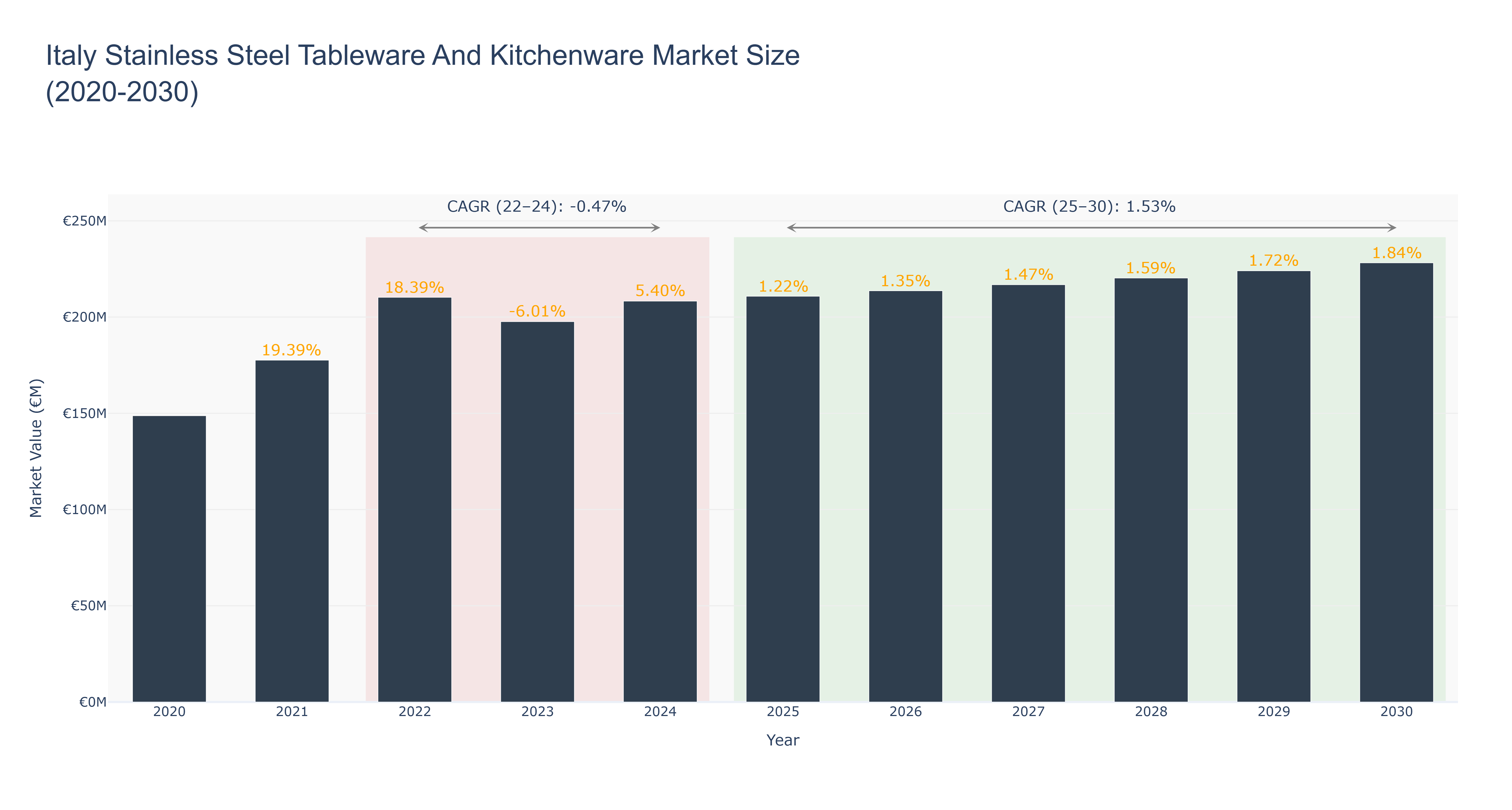
Italy's Stainless Steel Tableware And Kitchenware Market experienced a peak market size of €228.18 million in 2030. The actual market size saw steady growth from €148.75 million in 2020 to €208.28 million in 2024. Forecasted growth projects a continued upward trajectory, reaching €228.18 million by 2030. The CAGR for the period 2022-2024 was -0.47%, reflecting a slight decline, while the CAGR for 2025-2030 is expected to be 1.53%, indicating a positive trend. The decline in CAGR from 2022-2024 could be attributed to economic challenges, while the subsequent rise could be driven by increasing consumer demand for durable and stylish kitchenware products. Looking ahead, Italy's market is set to witness advancements in sustainable manufacturing processes and innovative product designs to meet evolving consumer preferences.
Italy Stainless Steel Tableware And Kitchenware Market: Production & Trade Performance (2019-2025)
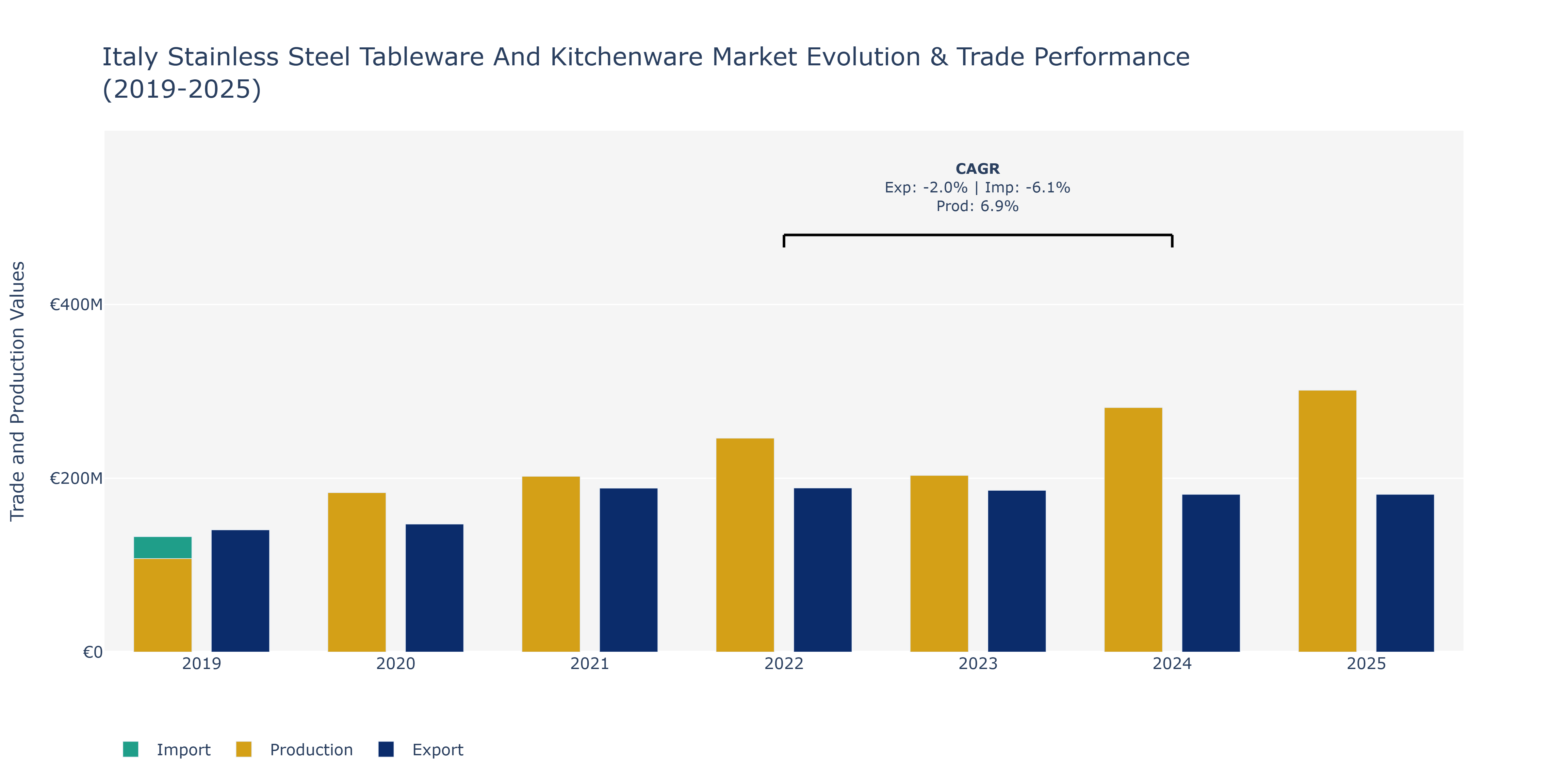
Between 2019 and 2025, the Italy Stainless Steel Tableware And Kitchenware Market showcased varied performance in exports, imports, and production. Exports saw a slight fluctuation, starting at €140.55 million in 2019, increasing to €188.60 million in 2021, and then stabilizing around €181.50 million by 2025. Imports experienced a more erratic trend, starting at €132.76 million in 2019, dropping to €112.51 million in 2020, before rising to €149.37 million in 2022, and finally settling at €127.27 million in 2025. In contrast, production consistently grew from €107.51 million in 2019 to €301.28 million in 2025, with a notable peak in 2024 at €281.37 million. The fluctuations in exports and imports could be attributed to global economic conditions, trade agreements, and currency exchange rates. The steady growth in production reflects increasing demand for stainless steel tableware and kitchenware, possibly due to evolving consumer preferences, technological advancements in manufacturing processes, and heightened focus on quality and sustainability in kitchen products.
Key Highlights of the Report:
- Italy Stainless Steel Tableware and Kitchenware Market Outlook
- Market Size of Italy Stainless Steel Tableware and Kitchenware Market, 2025
- Forecast of Italy Stainless Steel Tableware and Kitchenware Market, 2032
- Historical Data and Forecast of Italy Stainless Steel Tableware and Kitchenware Revenues & Volume for the Period 2022-2032F
- Italy Stainless Steel Tableware and Kitchenware Market Trend Evolution
- Italy Stainless Steel Tableware and Kitchenware Market Drivers and Challenges
- Italy Stainless Steel Tableware and Kitchenware Price Trends
- Italy Stainless Steel Tableware and Kitchenware Porter's Five Forces
- Italy Stainless Steel Tableware and Kitchenware Industry Life Cycle
- Historical Data and Forecast of Italy Stainless Steel Tableware and Kitchenware Market Revenues & Volume By Product for the Period 2022-2032F
- Historical Data and Forecast of Italy Stainless Steel Tableware and Kitchenware Market Revenues & Volume By Tableware for the Period 2022-2032F
- Historical Data and Forecast of Italy Stainless Steel Tableware and Kitchenware Market Revenues & Volume By Kitchenwares for the Period 2022-2032F
- Historical Data and Forecast of Italy Stainless Steel Tableware and Kitchenware Market Revenues & Volume By Application for the Period 2022-2032F
- Historical Data and Forecast of Italy Stainless Steel Tableware and Kitchenware Market Revenues & Volume By Domestic Use for the Period 2022-2032F
- Historical Data and Forecast of Italy Stainless Steel Tableware and Kitchenware Market Revenues & Volume By Commercial Use for the Period 2022-2032F
- Italy Stainless Steel Tableware and Kitchenware Import Export Trade Statistics
- Market Opportunity Assessment By Product
- Market Opportunity Assessment By Application
- Italy Stainless Steel Tableware and Kitchenware Top Companies Market Share
- Italy Stainless Steel Tableware and Kitchenware Competitive Benchmarking By Technical and Operational Parameters
- Italy Stainless Steel Tableware and Kitchenware Company Profiles
- Italy Stainless Steel Tableware and Kitchenware Key Strategic Recommendations






































