Italy Thermal Insulation Material Market: Import Trend Analysis
In 2024, Italy thermal insulation material Market: Import Trend Analysis experienced a notable increase in imports. The trend reflected a growing demand for foreign thermal insulation products within the Italian Market: Import Trend Analysis.
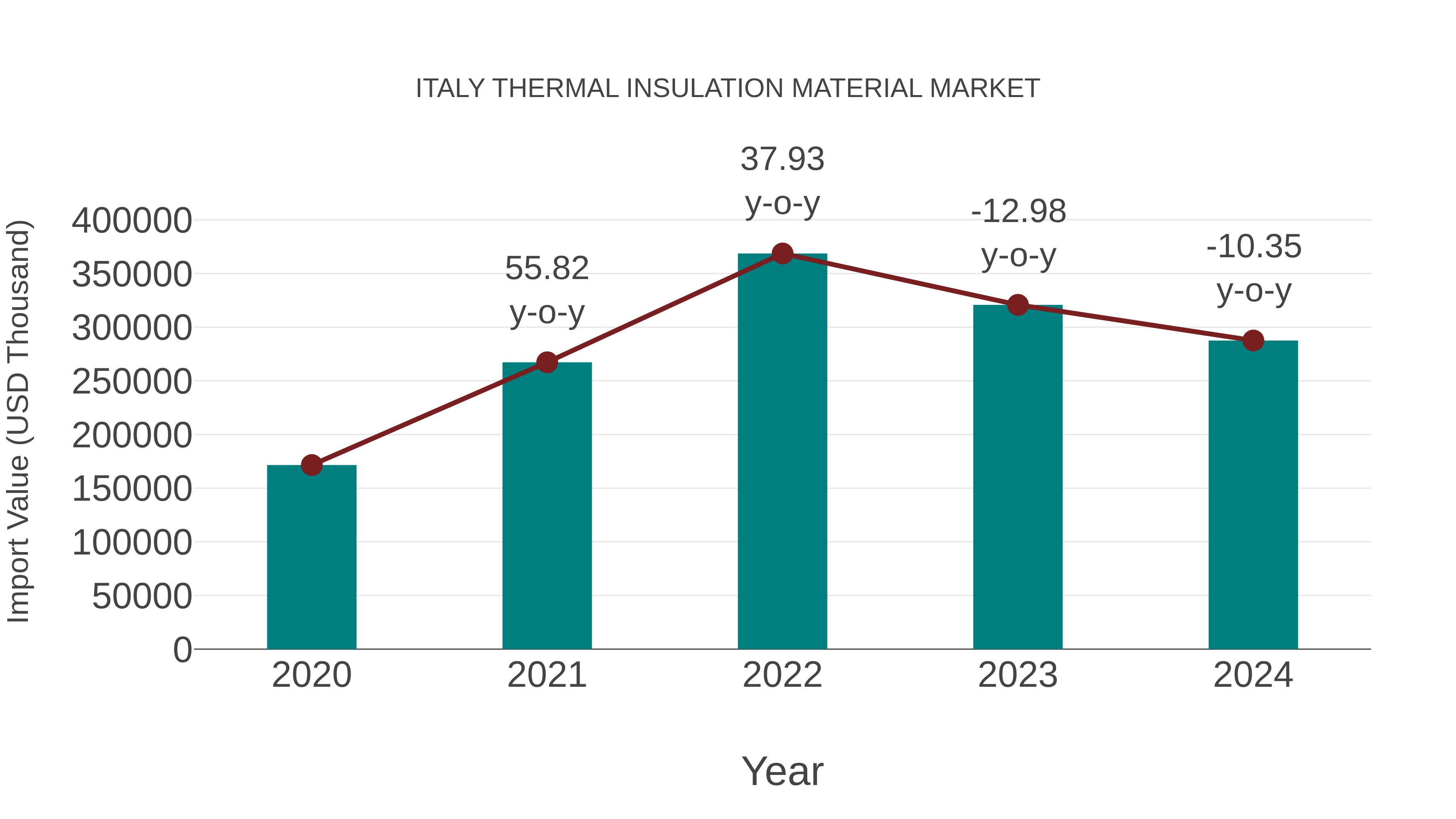
Italy Thermal Insulation Material Market Synopsis
The thermal insulation materials market in Italy is expected to witness steady growth during the forecast period of 20202026. The market is likely to be driven by the increasing demand for thermal insulation products from various end-use industries such as automotive, construction, and consumer goods. Additionally, government initiatives aimed at encouraging green building practices are estimated to positively influence the products adoption rate in the near future.
In Italy, mineral wool and polystyrene are majorly used as thermal insulation material types due to their excellent properties such as low coefficient of heat transfer and enhanced sound absorption capacity. Moreover, rising investments toward research & development activities for developing innovative products are estimated to further boost the overall industry growth over the coming years. In terms of applications, residential segment holds a significant share owing to increasing urbanization along with growing awareness regarding energy conservation techniques among homeowners across different cities in Italy. Furthermore, manufacturers have also started focusing on designing technologically advanced insulating systems that can reduce energy consumption while offering better comfort levels inside buildings or dwellings; this factor is further projected to favor industry expansion over the analysis timeframe.
Key Highlights of the Report:
- Italy Thermal Insulation Material Market Outlook
- Market Size of Italy Thermal Insulation Material Market, 2019
- Forecast of Italy Thermal Insulation Material Market, 2026
- Historical Data and Forecast of Italy Thermal Insulation Material Revenues & Volume for the Period 2016 - 2026
- Italy Thermal Insulation Material Market Trend Evolution
- Italy Thermal Insulation Material Market Drivers and Challenges
- Italy Thermal Insulation Material Price Trends
- Italy Thermal Insulation Material Porter's Five Forces
- Italy Thermal Insulation Material Industry Life Cycle
- Historical Data and Forecast of Italy Thermal Insulation Material Market Revenues & Volume By Material Type for the Period 2016 - 2026
- Historical Data and Forecast of Italy Thermal Insulation Material Market Revenues & Volume By Plastic Foam for the Period 2016 - 2026
- Historical Data and Forecast of Italy Thermal Insulation Material Market Revenues & Volume By Stone Wool for the Period 2016 - 2026
- Historical Data and Forecast of Italy Thermal Insulation Material Market Revenues & Volume By Fiberglass for the Period 2016 - 2026
- Historical Data and Forecast of Italy Thermal Insulation Material Market Revenues & Volume By Others for the Period 2016 - 2026
- Historical Data and Forecast of Italy Thermal Insulation Material Market Revenues & Volume By Temperature Range for the Period 2016 - 2026
- Historical Data and Forecast of Italy Thermal Insulation Material Market Revenues & Volume By 160 C to 50 C for the Period 2016 - 2026
- Historical Data and Forecast of Italy Thermal Insulation Material Market Revenues & Volume By 49 C to 0 C for the Period 2016 - 2026
- Historical Data and Forecast of Italy Thermal Insulation Material Market Revenues & Volume By 1 C to 100 C for the Period 2016 - 2026
- Historical Data and Forecast of Italy Thermal Insulation Material Market Revenues & Volume By 1 C to 650 C for the Period 2016 - 2026
- Italy Thermal Insulation Material Import Export Trade Statistics
- Market Opportunity Assessment By Material Type
- Market Opportunity Assessment By Temperature Range
- Italy Thermal Insulation Material Top Companies Market Share
- Italy Thermal Insulation Material Competitive Benchmarking By Technical and Operational Parameters
- Italy Thermal Insulation Material Company Profiles
- Italy Thermal Insulation Material Key Strategic Recommendations






































