Italy Transaction Monitoring Market Size & Growth Rate (2026-2032)
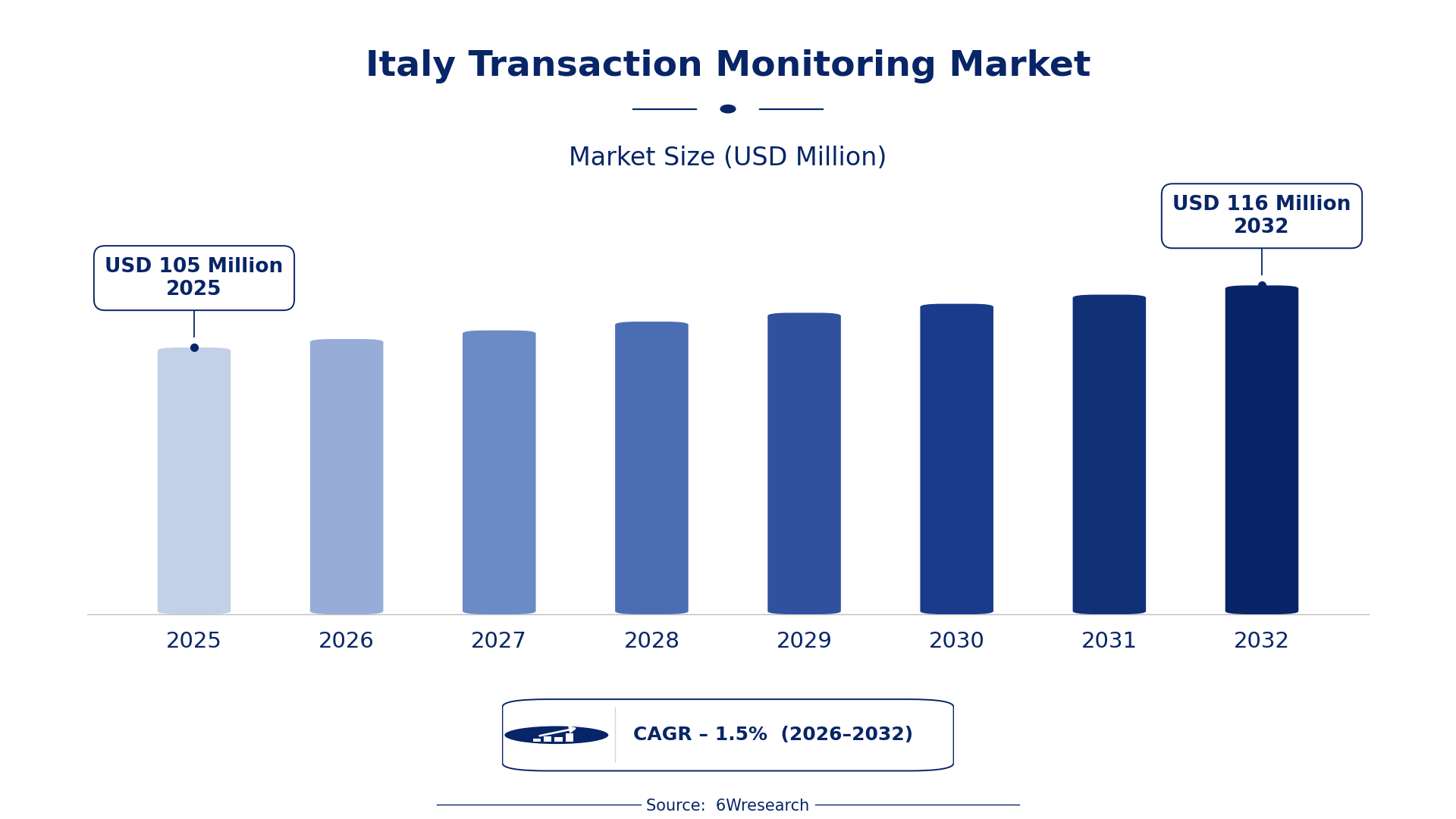
The Italy Transaction Monitoring Market was estimated at USD 105 Million in 2025 and is projected to reach USD 116 Million by 2032, growing at a CAGR of 1.5% from 2026 to 2032.
Italy Transaction Monitoring Market Synopsis
The Italy Transaction Monitoring Market is experiencing heightened scrutiny as financial institutions face mounting pressure to implement effective anti-money laundering (AML) measures. Given the country’s reputation as a significant financial hub, the urgency for advanced transaction monitoring systems has never been more pronounced, particularly amid increasing regulations aimed at curtailing fraud and illicit financial activities.
In this landscape, real-time transaction analysis has emerged as a critical component for banks and other financial entities. With regulators tightening their grip on compliance protocols, organizations are investing in sophisticated technology solutions to identify suspicious behavior proactively, thereby safeguarding both their operations and the broader financial system.
Italy Transaction Monitoring Market Year-wise Growth Rate and Key Drivers
This graph illustrates the annual growth rates of the Italy Transaction Monitoring Market from 2021 to 2032, highlighting a steady upward trajectory and projected expansion over the forecast period.
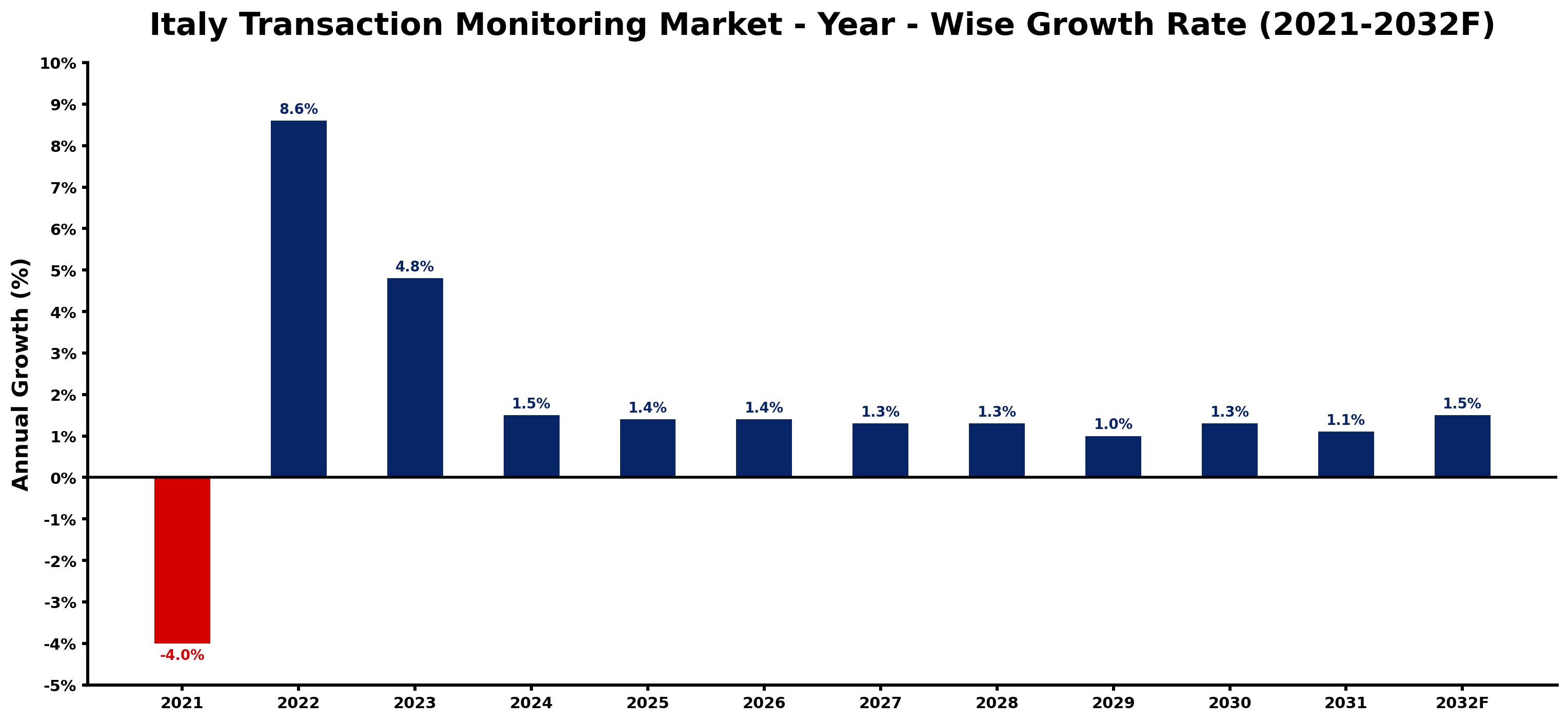
The table below presents the year‑wise growth rates along with the key drivers influencing the market
| Year | Growth Rate | Major Drivers |
| 2021 | -4.0% | Implementation delays in EU AML directives hampered growth. |
| 2022 | 8.6% | European Union AML regulations boosting compliance technology adoption. |
| 2023 | 4.8% | Increased online transactions prompting demand for fraud detection. |
| 2024 | 1.5% | Rise in fintech startups enhancing transaction oversight capabilities. |
| 2025 | 1.4% | Consumer awareness of digital security driving monitoring investments. |
| 2026 | 1.4% | Italian government promoting cybersecurity initiatives for financial sector. |
| 2027 | 1.3% | Heightened scrutiny on money laundering enforcement by regulators. |
| 2028 | 1.3% | Digital identity initiatives fostering advanced transaction monitoring solutions. |
| 2029 | 1.0% | AI innovations tailored for Italian market improving monitoring efficacy. |
| 2030 | 1.3% | Growing concerns over privacy leading to stricter compliance requirements. |
| 2031 | 1.1% | Collaboration between banks and tech firms enhancing monitoring tools. |
| 2032 | 1.5% | Rising incidents of cybercrime driving demand for vigilance. |
Note: Market size estimations and growth projections presented in this report are based on 6Wresearch's proprietary forecasting methodology, utilizing the latest available industry data, government publications, and primary research inputs.
Italy Transaction Monitoring Market Key Takeaways
Below are some of the specific key takeaways from the market, including:
- The demand for transaction monitoring systems is primarily driven by the need to comply with stringent AML regulations.
- Technological advancements in data analytics are enabling more efficient fraud detection and prevention strategies.
- Financial institutions are facing challenges related to data privacy and system scalability in their transaction monitoring efforts.
- Government initiatives are increasingly focused on enhancing regulatory frameworks for transaction monitoring processes.
- The integration of artificial intelligence is shaping the future of transaction monitoring, allowing for improved accuracy in identifying risks.
Evaluation of Restraints in Italy Transaction Monitoring Market
Despite the growing need for effective transaction monitoring solutions, several factors constrain market growth. One notable challenge is the complexity of regulatory compliance. Financial institutions must navigate an intricate web of local and international regulations, which can slow down the implementation of new systems. on top of that, issues related to data privacy create a cautious atmosphere, as organizations must ensure that customer data is handled securely. Lastly, the persistent challenge of false positives in fraud detection systems can undermine confidence in these technologies, leading to operational inefficiencies and increased costs for financial institutions.
Italy Transaction Monitoring Market Trends
Current trends indicate a shift toward the use of artificial intelligence and machine learning in transaction monitoring systems. These technologies enhance the ability to analyze large data sets swiftly, allowing institutions to detect anomalies more effectively. Additionally, an increased emphasis on cross-border collaboration among regulatory agencies is fostering a more unified approach to combatting financial crime, which is particularly relevant for Italy as a participant in the broader European financial framework. on top of that, the integration of behavioral analytics is emerging, offering deeper insights into customer transaction patterns and helping institutions better understand legitimate versus suspicious activities.
Italy Transaction Monitoring Market Opportunities
The potential for growth in the Italy Transaction Monitoring Market is significant. Financial institutions that prioritize investments in cutting-edge technology can gain a competitive advantage. The rise of fintech companies presents additional avenues for collaboration, as these agile entities often seek to innovate in compliance and monitoring areas. on top of that, as regulatory pressures intensify, there is an opportunity for providers of transaction monitoring solutions to offer tailored services that meet specific compliance requirements, enhancing their market position. Organizations willing to invest in employee training to improve the overall effectiveness of their transaction monitoring programs can also capitalize on this trend.
Government Initiatives in the Italy Transaction Monitoring Market
Government policy has a profound impact on the transaction monitoring market in Italy, primarily through enhanced regulations aimed at curbing financial crime. In recent years, authorities have emphasized the need for comprehensive monitoring systems that meet strict compliance standards. This focus is shaping how financial institutions strategize their anti-money laundering frameworks and aligns their operations with national and international guidelines.
- A regulatory framework introduced in 2025 mandates comprehensive transaction monitoring protocols for all financial institutions to enhance transparency and accountability.
- Current initiatives involve ongoing collaborations between the Bank of Italy and law enforcement agencies to streamline suspicious transaction reporting processes.
- A planned public-private partnership aims to improve infrastructure for data sharing among financial institutions and regulatory bodies, expected to launch in late 2026.
- Recent updates to AML legislation in 2024 have imposed stricter penalties on financial institutions failing to adhere to monitoring requirements, signaling increased regulatory scrutiny.
- An educational outreach program initiated by the government in early 2025 focuses on improving compliance capabilities among smaller financial entities.
Future Insights of the Italy Transaction Monitoring Market
Looking ahead to 2026-2032, the Italy Transaction Monitoring Market is expected to evolve significantly. With technology leading the charge, advancements in real-time data processing and AI will become more commonplace. As financial institutions continue to enhance their monitoring capabilities, an increased focus on customer-centric compliance measures will likely emerge, balancing regulatory demands with user experience. Enhanced collaboration among financial entities and regulatory bodies will also play a crucial role in shaping the future of transaction monitoring, fostering a more transparent financial environment.
Italy Transaction Monitoring Market Latest Developments
In the past year, the Italy Transaction Monitoring Market has seen a surge of activity as financial institutions adapt to stricter regulations and evolving technology. Many organizations are now prioritizing compliance technology investments, responding to the pressing need for effective fraud detection mechanisms. As these changes unfold, market players are rapidly adjusting their strategies to keep pace with regulatory demands and technological advancements.
- A major technology vendor launched a new transaction monitoring solution in early 2025 that leverages AI for improved fraud detection capabilities.
- An initiative that began in mid-2025 focuses on updating legacy systems within banks to ensure compliance with the latest regulatory standards.
- A significant collaboration was announced in late 2025 between a regional bank and a fintech company to develop a joint transaction monitoring platform.
- Research and development efforts are currently underway to integrate blockchain technology into transaction monitoring systems, anticipated to yield results by early 2026.
- Plans for an industry-wide compliance summit aimed at sharing best practices and emerging technologies are in motion for Q3 2026.
Italy Transaction Monitoring Market - Key Attractiveness of the Report
- 10 Years of Market Numbers
- Historical Data Starting from 2022 to 2025
- Base Year: 2025
- Forecast Data until 2032
- Key Performance Indicators Impacting the Market
- Major Upcoming Developments and Projects
Key Highlights of the Report:
- Italy Transaction Monitoring Market Outlook
- Market Size of Italy Transaction Monitoring Market, 2025
- Forecast of Italy Transaction Monitoring Market, 2032
- Historical Data and Forecast of Italy Transaction Monitoring Revenues & Volume for the Period 2022-2032F
- Italy Transaction Monitoring Market Trend Evolution
- Italy Transaction Monitoring Market Drivers and Challenges
- Italy Transaction Monitoring Price Trends
- Italy Transaction Monitoring Porter's Five Forces
- Italy Transaction Monitoring Industry Life Cycle
- Historical Data and Forecast of Italy Transaction Monitoring Market Revenues & Volume By Application Area for the Period 2022-2032F
- Historical Data and Forecast of Italy Transaction Monitoring Market Revenues & Volume By AML for the Period 2022-2032F
- Historical Data and Forecast of Italy Transaction Monitoring Market Revenues & Volume By FDP for the Period 2022-2032F
- Historical Data and Forecast of Italy Transaction Monitoring Market Revenues & Volume By Compliance Management for the Period 2022-2032F
- Historical Data and Forecast of Italy Transaction Monitoring Market Revenues & Volume By Customer Identity Management for the Period 2022-2032F
- Historical Data and Forecast of Italy Transaction Monitoring Market Revenues & Volume By Component for the Period 2022-2032F
- Historical Data and Forecast of Italy Transaction Monitoring Market Revenues & Volume By Solution for the Period 2022-2032F
- Historical Data and Forecast of Italy Transaction Monitoring Market Revenues & Volume By Services for the Period 2022-2032F
- Historical Data and Forecast of Italy Transaction Monitoring Market Revenues & Volume By Function for the Period 2022-2032F
- Historical Data and Forecast of Italy Transaction Monitoring Market Revenues & Volume By Case Management for the Period 2022-2032F
- Historical Data and Forecast of Italy Transaction Monitoring Market Revenues & Volume By KYC/Customer Onboarding for the Period 2022-2032F
- Historical Data and Forecast of Italy Transaction Monitoring Market Revenues & Volume By Dashboard and Reporting for the Period 2022-2032F
- Historical Data and Forecast of Italy Transaction Monitoring Market Revenues & Volume By Watch List Screening for the Period 2022-2032F
- Historical Data and Forecast of Italy Transaction Monitoring Market Revenues & Volume By Deployment Mode for the Period 2022-2032F
- Historical Data and Forecast of Italy Transaction Monitoring Market Revenues & Volume By On-Premises for the Period 2022-2032F
- Historical Data and Forecast of Italy Transaction Monitoring Market Revenues & Volume By Cloud for the Period 2022-2032F
- Historical Data and Forecast of Italy Transaction Monitoring Market Revenues & Volume By Organization Size for the Period 2022-2032F
- Historical Data and Forecast of Italy Transaction Monitoring Market Revenues & Volume By SMEs for the Period 2022-2032F
- Historical Data and Forecast of Italy Transaction Monitoring Market Revenues & Volume By Large Enterprises for the Period 2022-2032F
- Historical Data and Forecast of Italy Transaction Monitoring Market Revenues & Volume By Vertical for the Period 2022-2032F
- Historical Data and Forecast of Italy Transaction Monitoring Market Revenues & Volume By Banking, Financial Services, and Insurance for the Period 2022-2032F
- Historical Data and Forecast of Italy Transaction Monitoring Market Revenues & Volume By Government and Defense for the Period 2022-2032F
- Historical Data and Forecast of Italy Transaction Monitoring Market Revenues & Volume By IT and Telecom for the Period 2022-2032F
- Historical Data and Forecast of Italy Transaction Monitoring Market Revenues & Volume By Retail for the Period 2022-2032F
- Historical Data and Forecast of Italy Transaction Monitoring Market Revenues & Volume By Healthcare for the Period 2022-2032F
- Historical Data and Forecast of Italy Transaction Monitoring Market Revenues & Volume By Energy and Utilities for the Period 2022-2032F
- Historical Data and Forecast of Italy Transaction Monitoring Market Revenues & Volume By Manufacturing for the Period 2022-2032F
- Historical Data and Forecast of Italy Transaction Monitoring Market Revenues & Volume By Others for the Period 2022-2032F
- Italy Transaction Monitoring Import Export Trade Statistics
- Market Opportunity Assessment By Application Area
- Market Opportunity Assessment By Component
- Market Opportunity Assessment By Function
- Market Opportunity Assessment By Deployment Mode
- Market Opportunity Assessment By Organization Size
- Market Opportunity Assessment By Vertical
- Italy Transaction Monitoring Top Companies Market Share
- Italy Transaction Monitoring Competitive Benchmarking By Technical and Operational Parameters
- Italy Transaction Monitoring Company Profiles
- Italy Transaction Monitoring Key Strategic Recommendations






































