Italy White Chocolate Market Size (2020-2030)
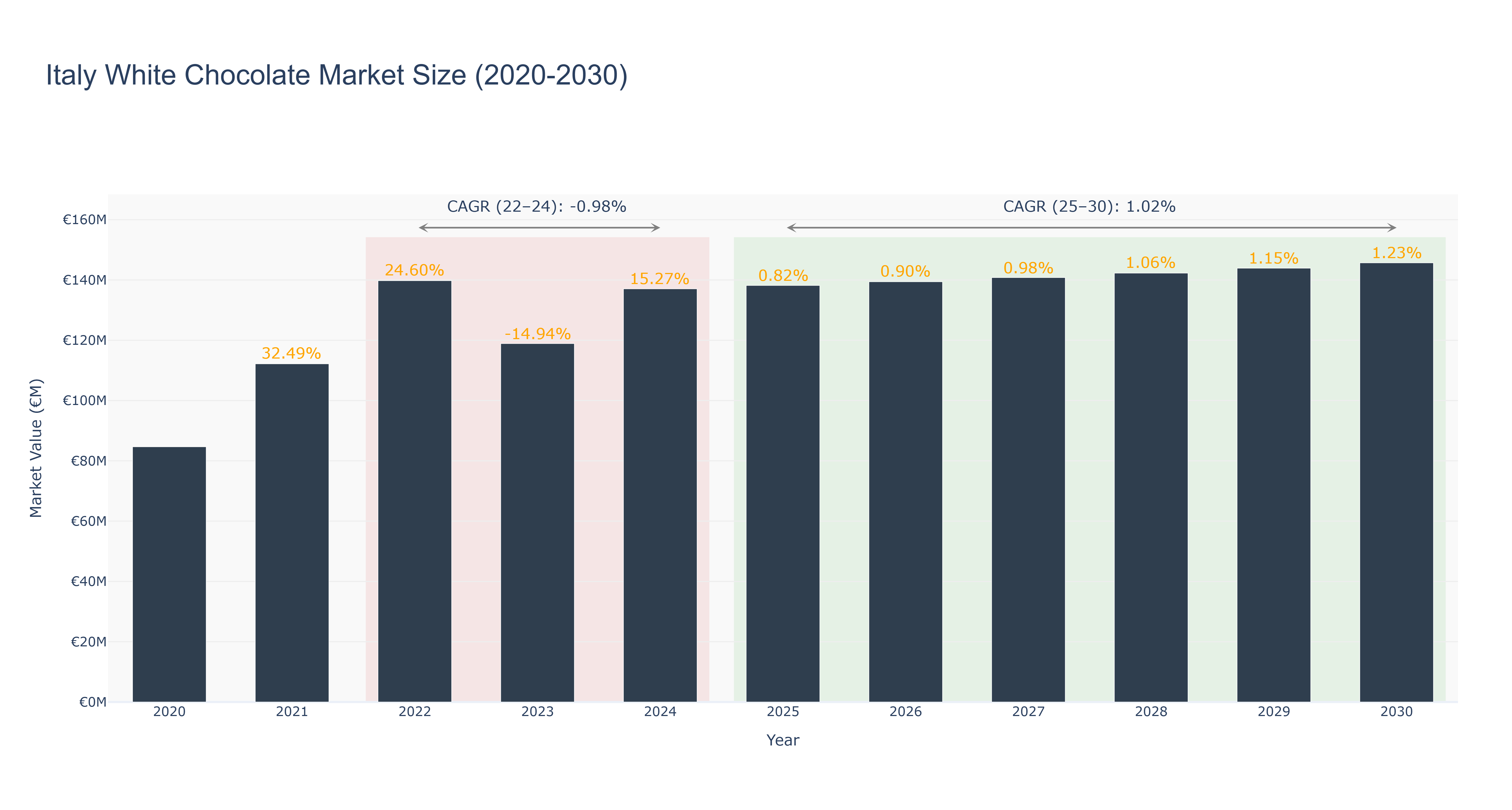
Italy White Chocolate Market has shown a fluctuating trend in recent years. The peak market size was €139.78 million in 2022. Actual market size decreased to €137.06 million in 2024, experiencing a negative growth rate of -14.94%. However, from 2025 to 2030, the market is forecasted to grow steadily, with a CAGR of 1.02%. The recent downturn can be attributed to changing consumer preferences towards healthier options, while the expected growth is driven by innovative product offerings and expanding distribution channels. In the near future, Italy is planning to introduce sustainable packaging initiatives in the white chocolate market, aligning with global sustainability trends. This initiative is expected to attract environmentally conscious consumers and drive further market growth.
Italy White Chocolate Market: Production & Trade Performance (2019-2025)
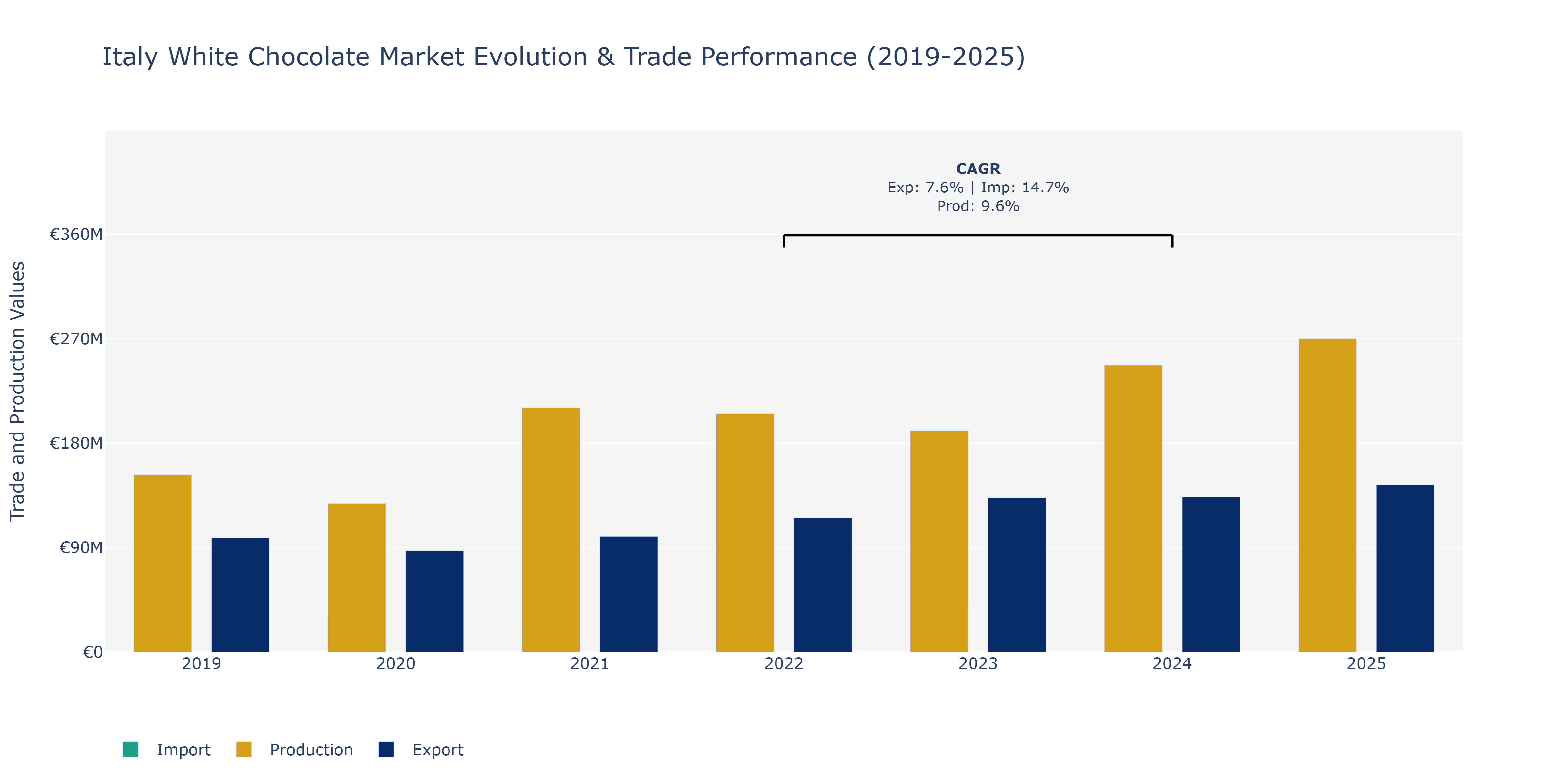
Between 2019 and 2025, the Italy White Chocolate Market displayed notable fluctuations in exports, imports, and production. Exports started at €98.42 million in 2019, declining to €87.26 million in 2020, before increasing steadily each year, reaching a peak of €143.99 million in 2025. Imports followed a similar pattern, beginning at €32.4 million, dropping to €29.16 million in 2020, and then consistently rising to €50.77 million in 2025. Production experienced a more erratic trend, starting at €153.02 million in 2019, decreasing to €128.13 million in 2020, and then displaying peaks and declines before ending at €270.16 million in 2025. These fluctuations can be attributed to various factors, including changing consumer preferences, fluctuations in raw material prices, and advancements in production technologies within the Italian white chocolate market. The increase in exports and imports could be linked to expanding global demand for premium white chocolate products, driving manufacturers to ramp up production to meet growing international orders. Furthermore, the shift in production levels may reflect efforts by industry players to innovate and introduce new product lines to capitalize on emerging market trends, such as organic and sustainable white chocolate options.
Key Highlights of the Report:
- Italy White Chocolate Market Outlook
- Market Size of Italy White Chocolate Market, 2025
- Forecast of Italy White Chocolate Market, 2032
- Historical Data and Forecast of Italy White Chocolate Revenues & Volume for the Period 2022-2032F
- Italy White Chocolate Market Trend Evolution
- Italy White Chocolate Market Drivers and Challenges
- Italy White Chocolate Price Trends
- Italy White Chocolate Porter's Five Forces
- Italy White Chocolate Industry Life Cycle
- Historical Data and Forecast of Italy White Chocolate Market Revenues & Volume By Type for the Period 2022-2032F
- Historical Data and Forecast of Italy White Chocolate Market Revenues & Volume By Conventional White Chocolate for the Period 2022-2032F
- Historical Data and Forecast of Italy White Chocolate Market Revenues & Volume By Organic White Chocolate for the Period 2022-2032F
- Historical Data and Forecast of Italy White Chocolate Market Revenues & Volume By Application for the Period 2022-2032F
- Historical Data and Forecast of Italy White Chocolate Market Revenues & Volume By Food & Beverages for the Period 2022-2032F
- Historical Data and Forecast of Italy White Chocolate Market Revenues & Volume By Pharmaceuticals for the Period 2022-2032F
- Historical Data and Forecast of Italy White Chocolate Market Revenues & Volume By Cosmetics for the Period 2022-2032F
- Historical Data and Forecast of Italy White Chocolate Market Revenues & Volume By Other for the Period 2022-2032F
- Italy White Chocolate Import Export Trade Statistics
- Market Opportunity Assessment By Type
- Market Opportunity Assessment By Application
- Italy White Chocolate Top Companies Market Share
- Italy White Chocolate Competitive Benchmarking By Technical and Operational Parameters
- Italy White Chocolate Company Profiles
- Italy White Chocolate Key Strategic Recommendations






































