Italy Zinc Market Size (2020-2030)
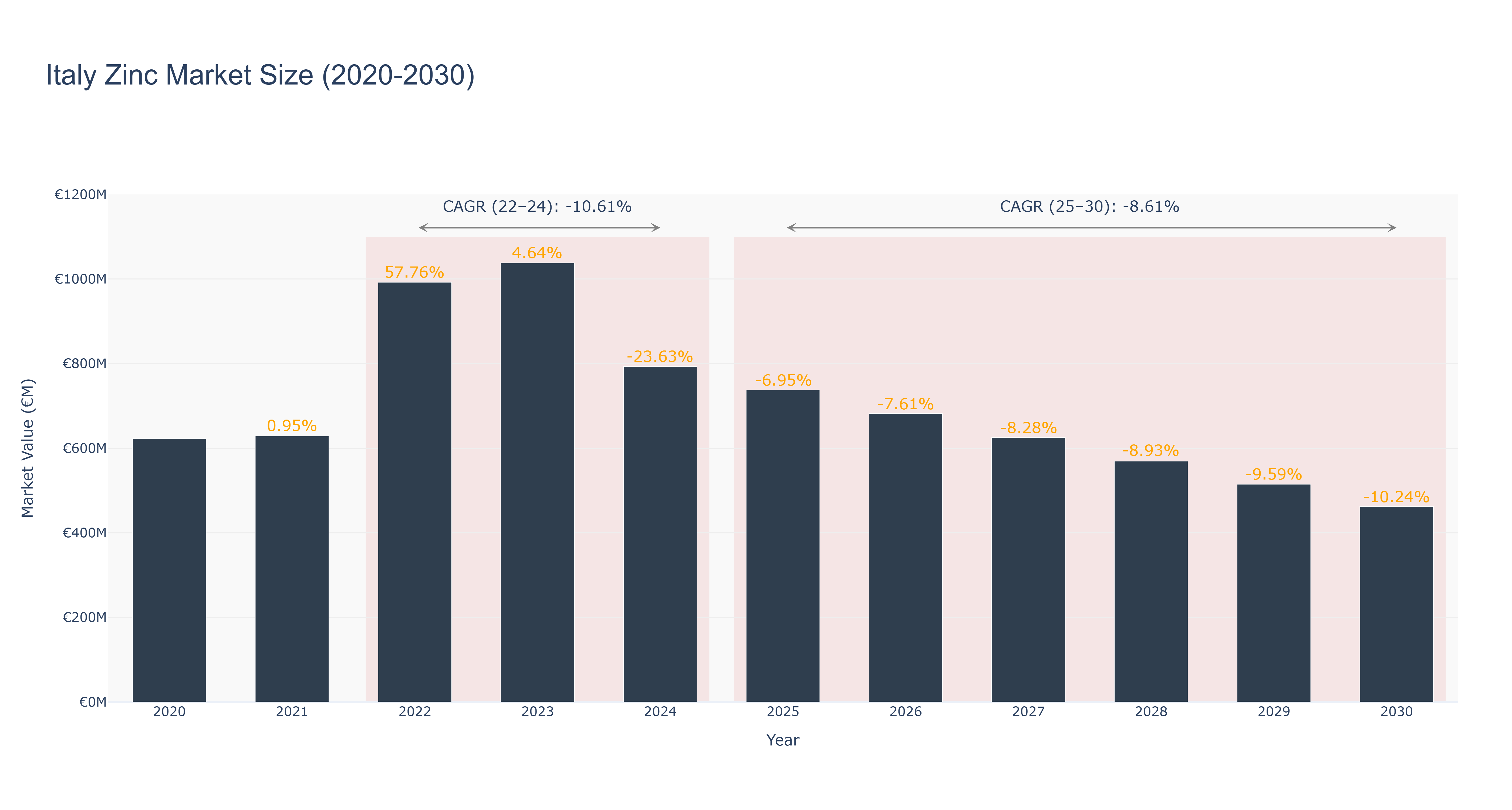
Italy Zinc Market has experienced a fluctuating trend in recent years. The peak market size was recorded in 2022 at €992.17 million, followed by a decline to €737.80 million in 2025. The market is forecasted to further decrease to €462.08 million by 2030, with a CAGR of -8.61% from 2025 to 2030. The decline in market size can be attributed to various factors such as economic slowdown, changes in consumer preferences, and global market conditions. Despite the challenges, Italy is focusing on enhancing its zinc production capabilities through technological advancements and sustainable practices to maintain its competitiveness in the global market. In the near future, Italy is planning to launch new initiatives to promote the use of zinc in various industries, which could potentially drive market growth.
Italy Zinc Market: Production & Trade Performance (2019-2025)
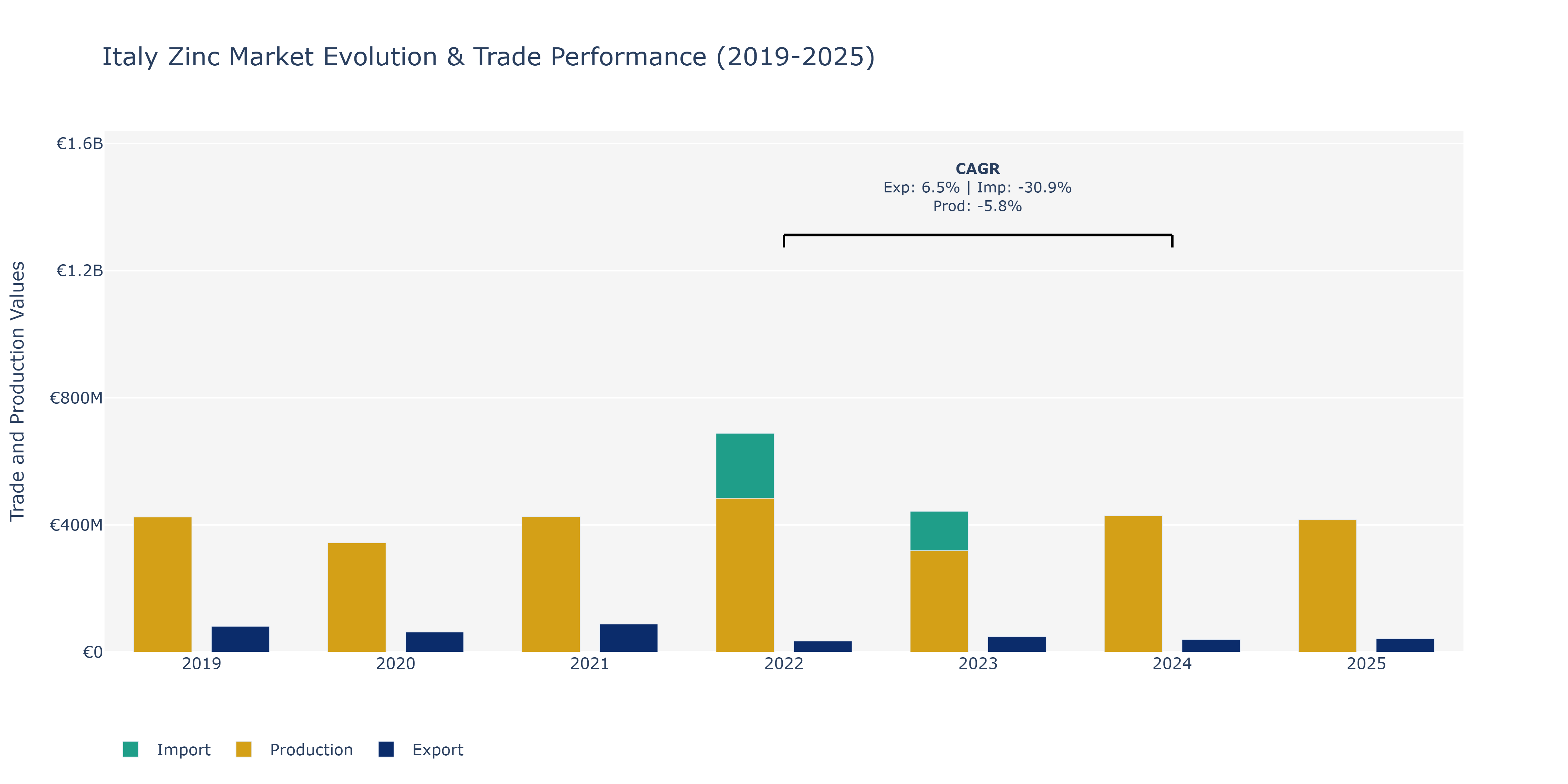
In the Italy Zinc Market, exports experienced fluctuations over the period. Starting at €80.87 million in 2019, Export value declined to €63.05 million in 2020 before rebounding to €88.16 million in 2021. A subsequent drop to €34.6 million in 2022 was followed by a slight recovery to €49.13 million in 2023 and then to €39.28 million in 2024. By 2025, exports rose to €41.95 million. Imports peaked at €688.26 million in 2022, representing a significant increase from previous years, followed by a notable decrease to €442.97 million in 2023. Production, on the other hand, displayed a decline from €425.05 million in 2019 to €318.92 million in 2023 before increasing to €415.99 million in 2025. The fluctuations in exports could be attributed to global demand shifts for zinc products and changes in trade policies affecting the Italian market. The volatility in imports might have been influenced by international zinc prices and local industrial demand variations. The decrease in production till 2023 may be linked to factors like operational challenges or market saturation, with the subsequent uptrend potentially indicative of industry restructuring or technological advancements aimed at enhancing efficiency and product quality.
italy zinc market Synopsis
The Italy zinc market is expected to register a CAGR of around 2.3% during the forecast period 2020-2026. Factors such as increasing demand from end-use industries, growing investments in infrastructure development projects and government initiatives towards developing the metallic material industry are driving growth in the country`s zinc market over the forecast period.
Demand for galvanized steel due to its anti-corrosive properties has increased significantly across various industrial applications including construction & engineering, automotive, and others. The automotive sector is one of the major consumers of galvanized steel products owing to their high strength & durability which helps them withstand corrosion and other environmental factors. Furthermore, rising urbanization coupled with increasing spending on residential apartments have boosted demand for Zinc coated sheets used in roofing structures, resulting in higher purchases from downstream players involved in manufacturing these products. Moreover, initiatives taken by Italy?s Ministry of Economic Development (MISE) towards promoting local consumption of raw materials such as zinc offer ample opportunities for manufacturers operating within this space over the coming years.
However, stringent regulations concerning air pollution related emissions and availability of substitutes like aluminum might hinder growth prospects of this market over the coming years.
Key Highlights of the Report:
- Italy Zinc Market Outlook
- Market Size of Italy Zinc Market, 2019
- Forecast of Italy Zinc Market, 2026
- Historical Data and Forecast of Italy Zinc Revenues & Volume for the Period 2016 - 2026
- Italy Zinc Market Trend Evolution
- Italy Zinc Market Drivers and Challenges
- Italy Zinc Price Trends
- Italy Zinc Porter's Five Forces
- Italy Zinc Industry Life Cycle
- Historical Data and Forecast of Italy Zinc Market Revenues & Volume By Applications for the Period 2016 - 2026
- Historical Data and Forecast of Italy Zinc Market Revenues & Volume By Galvanizing for the Period 2016 - 2026
- Historical Data and Forecast of Italy Zinc Market Revenues & Volume By Die casting for the Period 2016 - 2026
- Historical Data and Forecast of Italy Zinc Market Revenues & Volume By Brass and bronze for the Period 2016 - 2026
- Historical Data and Forecast of Italy Zinc Market Revenues & Volume By Others for the Period 2016 - 2026
- Historical Data and Forecast of Italy Zinc Market Revenues & Volume By End-users for the Period 2016 - 2026
- Historical Data and Forecast of Italy Zinc Market Revenues & Volume By Construction for the Period 2016 - 2026
- Historical Data and Forecast of Italy Zinc Market Revenues & Volume By Transportation for the Period 2016 - 2026
- Historical Data and Forecast of Italy Zinc Market Revenues & Volume By Consumer goods for the Period 2016 - 2026
- Historical Data and Forecast of Italy Zinc Market Revenues & Volume By Others for the Period 2016 - 2026
- Italy Zinc Import Export Trade Statistics
- Market Opportunity Assessment By Applications
- Market Opportunity Assessment By End-users
- Italy Zinc Top Companies Market Share
- Italy Zinc Competitive Benchmarking By Technical and Operational Parameters
- Italy Zinc Company Profiles
- Italy Zinc Key Strategic Recommendations






































