Ivory Coast Bioethanol Market: Top 5 Importing Countries and Market Competition (HHI) Analysis
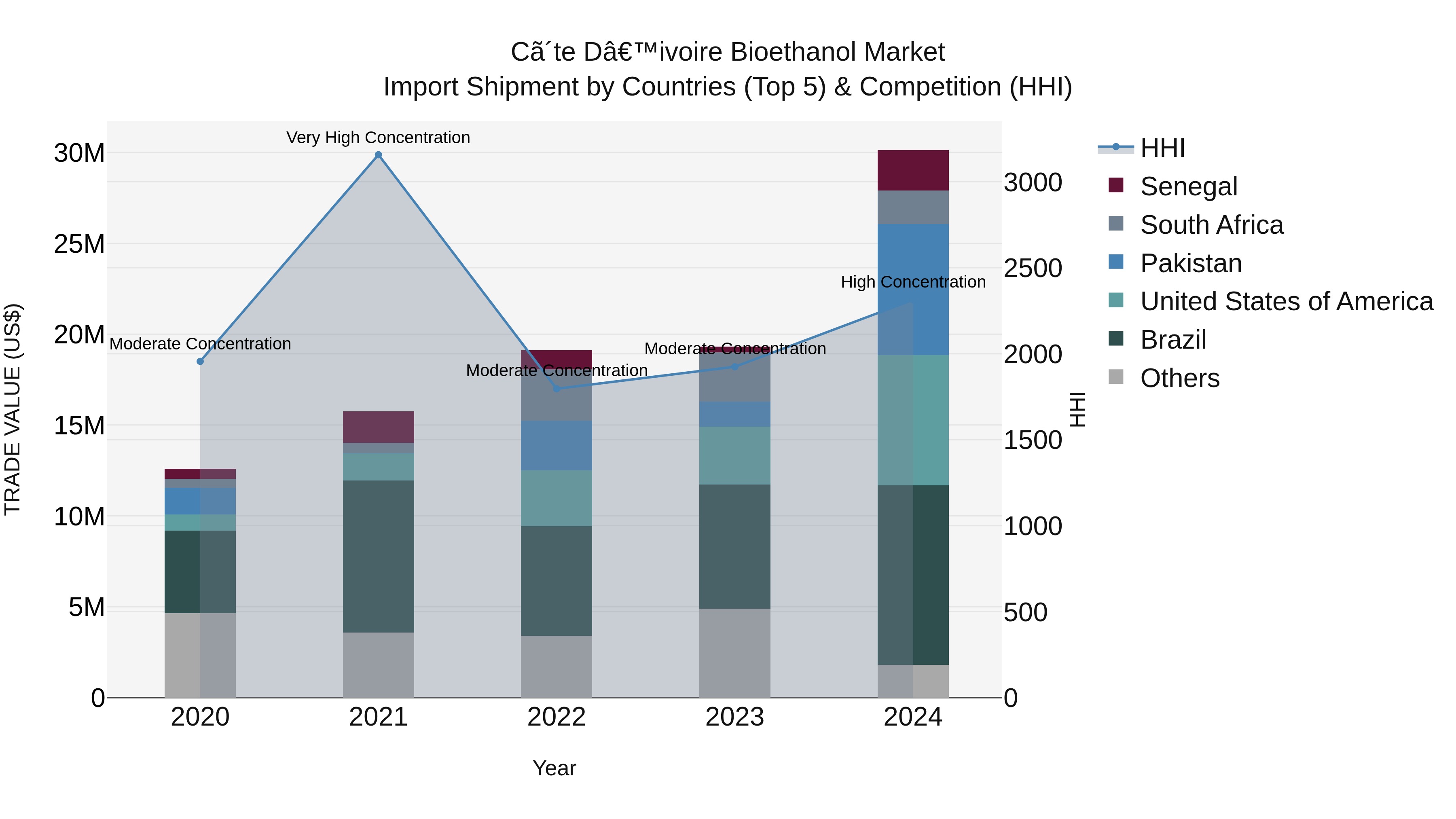
The bioethanol import market in Ivory Coast experienced significant growth in 2024, with Brazil, Pakistan, USA, Senegal, and South Africa emerging as the top exporting countries. The market concentration, as measured by the Herfindahl-Hirschman Index (HHI), increased from moderate to high in 2024. The impressive Compound Annual Growth Rate (CAGR) of 24.38% from 2020 to 2024 highlights the rising demand for bioethanol in the region. Moreover, the remarkable growth rate of 55.94% from 2023 to 2024 indicates a rapid expansion of the market, offering lucrative opportunities for stakeholders.
Ivory Coast Bioethanol Market Growth Rate
According to 6Wresearch internal database and industry insights, the Ivory Coast Bioethanol Market is projected to grow at a compound annual growth rate (CAGR) of 7.4% during the forecast period (2026-2032).
Topics Covered in the Ivory Coast Bioethanol Market Report
The Ivory Coast Bioethanol Market report thoroughly covers the market by feedstock, end-use industry, and fuel blend. The report provides a detailed analysis of ongoing market trends, opportunities/high-growth areas, and market drivers that will help stakeholders align strategies based on current and future market dynamics.
Ivory Coast Bioethanol Market Highlights
| Report Name | Ivory Coast Bioethanol Market |
| Forecast period | 2026-2032 |
| CAGR | 7.4% |
| Growing Sector | Transportation |
Ivory Coast Bioethanol Market Synopsis
Ivory Coast Bioethanol Market is projected to obtain immense growth on account of surging demand for renewable energy sources. With a commitment to plummeting carbon emissions, the country’s bioethanol market is benefiting from a robust government policy push which aimed at promoting biofuels for the transportation industry. Also, the rise in domestic bioethanol production, backed by local feedstock cultivation, is strengthening the supply chain and reducing reliance on imports.
Evaluation of Growth Drivers in the Ivory Coast Bioethanol Market
Below are some major drivers and their influence on the market dynamics:
| Drivers | Primary Segments Affected | Why it matters (evidence) |
| Energy Security Mandates | Transportation | The government’s push for an E5 to E10 blending mandate by 2027 aims to lower the $1.2 billion annual fuel import bill. |
| Agricultural Surplus Utilization | Starch-based Feedstock | Ivory Coast’s position as a leading cassava producer provides an annual surplus of 2.5 million tons suitable for ethanol conversion. |
| Strategic Oil & Gas Partnerships | Fuel Blends | Partnerships with firms like Eni and TotalEnergies are accelerating the construction of industrial-scale biorefineries. |
| Industrial Decarbonization | Industrial/Cosmetics | Large-scale manufacturers are switching to bio-based solvents to meet international ESG export standards for European markets. |
| Rural Job Creation Programs | Raw Material Supply | Decentralized "micro-distillery" initiatives are incentivizing smallholder farmers to supply feedstock, ensuring raw material stability. |
Ivory Coast Bioethanol Market is expected to gain traction, exhibiting a CAGR of nearly 7.4% during the forecast period (2026-2032). due to the growing interest in renewable energy sources and government efforts to cut down on carbon emissions. Besides, the expansion of agriculture, particularly in the cultivation of maize and sugarcane, incredibly helps in obtaining local feedstock at a much lesser cost. In addition to this, there have been rise in demand from transportation and industrial fuel blending applications which positions bioethanol as a strategic renewable alternative.
Evaluation of Restraints in the Ivory Coast Bioethanol Market
Below are some primary restraints and their influence on the market dynamics:
| Restraints | Primary Segments Affected | What this means (evidence) |
| Food vs. Fuel Controversy | Starch-based (Cassava) | Surging demand for bioethanol can result in local food price inflation, instigating regulatory limits on edible crop diversion. |
| Technical Fleet Incompatibility | High Fuel Blends (E85) | Major portion of the Ivorian vehicle fleet consists of older models unable to handle ethanol blends exceeding 15% without modification. |
| Inconsistent Feedstock Yields | Sugar-based Feedstock | Seasonal fluctuations and climate sensitivity of sugarcane crops lead to unstable supply and pricing for distillers. |
| High Initial Capex | Production Infrastructure | The absence of localized specialized enzyme and catalyst production makes the setup of 2nd-generation plants capital-intensive. |
| Informal Market Competition | Industrial/Beverages | Small-scale, unregulated traditional "Koutoukou" production strives with industrial ethanol in the lower-tier beverage and solvent sectors. |
Ivory Coast Bioethanol Market Challenges
Ivory Coast bioethanol market growth is expected to face hurdles regarding the logistical infrastructure required for transporting bulky biomass from rural northern regions to coastal processing hubs in San Pédro and Abidjan. Furthermore, the lack of a standardized certification framework for carbon intensity (CI) scores makes it difficult for local producers to tap into premium international export markets like the EU. In addition to this, another factor that is hindering price uniformity with conventional fossil fuels is the high cost of imported processing chemicals and fermentation agents.
Ivory Coast Bioethanol Market Trends
Here are some of the trends impacting the growth patterns of Ivory Coast Bioethanol Market:
- Shift Toward Second-Generation (2G) Ethanol: The use of agricultural residues such as cocoa husk and palm oil mill effluent for ethanol production is gaining ground.
- Rise of Flex-Fuel Public Transport: Government is currently studying "Green Bus" projects in Abidjan, which use engines adjusted to run on a high percentage of bioethanol.
- Pharmaceutical Grade Upgrading: Local companies are installing multi-column vacuum distillation systems to make 99.9% anhydrous ethanol for the rapidly growing West African medical sector.
- Decentralized Production Hubs: To bypass logistics issues, smaller, modular ethanol plants are being established closer to sugarcane and cassava plantation clusters.
Investment Opportunities in the Ivory Coast Bioethanol Market
In Ivory Coast Bioethanol Market, there are several potential investment prospects which includes:
- Integrated Biorefineries: There is an opportunity for setting up integrated biorefineries for bioethanol production, DDGS for animal feed, and biofertilizers from sugarcane molasses.
- E-Commerce for Industrial Ethanol: Developing digital B2B platforms to supply certified bio-based solvents to the cosmetics and pharmaceutical industries in Abidjan.
- Advanced Enzyme Distribution: Investing in the local supply chain for high-efficiency cellulase and amylase enzymes to lower production costs for local manufacturers.
Top 5 Leading Players in the Ivory Coast Bioethanol Market
Prominent industry leaders operating in Ivory Coast Bioethanol Market are mentioned below:
1. SUCRIVIRE (Group SIFCA)
| Company Name | SUCRIVIRE (Group SIFCA) |
| Headquarters | Abidjan, Ivory Coast |
| Established | 1997 |
| Website | Click Here |
A leader in the agro-industrial sector, SUCRIVIRE operates extensive sugarcane plantations and integrated sugar-ethanol complexes, focusing on molasses-based fuel ethanol.
2. Eni
| Company Name | Eni |
| Headquarters | Abidjan (Branch of Rome, Italy) |
| Established | 2021 (Renewed Bio-Agri Focus) |
| Website | Click Here |
Through its "Sustainable Mobility" arm, Eni is developing a network of agri-hubs in Ivory Coast to collect non-food feedstock for large-scale biofuel production.
3. TotalEnergies Marketing
| Company Name | TotalEnergies Marketing |
| Headquarters | Abidjan, Ivory Coast |
| Established | 1947 |
| Website | Click Here |
TotalEnergies is a primary driver of ethanol blending infrastructure and has spearheaded pilot programs for bioethanol-powered public transit in the capital.
4. UBIPHARM CI (Industrial Alcohol Division)
| Company Name | UBIPHARM CI (Industrial Alcohol Division) |
| Headquarters | Abidjan, Ivory Coast |
| Established | 1950 |
| Website | Click Here |
While primarily a distributor, UBIPHARM manages a massive volume of bio-based ethanol for use in medical sterilization and pharmaceutical manufacturing across the country.
5. Olam Group
| Company Name | Olam Group |
| Headquarters | Singapore |
| Established | 1994 |
| Website | - |
Olam Group is a major agricultural commodities processor working with local farmers for feedstock supply and expanding into bioethanol production and export.
Ivory Coast Bioethanol Market: Government Initiatives
According to Ministry of Petroleum, Energy and Renewable Energy data, the National Health and Environment Plan (2022-2026) provide a 15% tax rebate on all imported machinery used to produce biofuels from non-food biomass. Additionally, under the Investment Code (Code des Investissements), the government has designated the San Pédro region as a "Special Bio-Energy Zone," offering a 10-year corporate tax exemption for companies that establish bioethanol plants with a capacity exceeding 50,000 liters per day. A notable example is the National Biofuel Roadmap, which successfully launched the 2024 biodiesel-ethanol pilot in Abidjan in collaboration with the private sector.
Future Insights of the Ivory Coast Bioethanol Market
In the upcoming years, the Ivory Coast bioethanol industry is anticipated to diversify into more advanced biofuels like cellulosic ethanol while consolidating linkages with neighboring ECOWAS markets for export opportunities. With expanding fuel blend mandates and industrial uptake, bioethanol is poised to become a key part of the country’s renewable energy landscape. Apart from this, the adoption of Internet of Things (IoT) in precision farming for feedstock management will likely stabilize crop yields, ensuring a more consistent and cost-effective supply of bioethanol through 2032.
Market Segmentation Analysis
The report offers a comprehensive study of the following market segments and their leading categories:
By End Use Industry – Transportation to Lead the Market
According to Yash, Senior Research Analyst, 6Wresearch, Transportation segment is expected to remain dominant as the government implements nationwide mandatory fuel blending standards. The surge in urban population and the subsequent expansion of public transportation networks in Abidjan and Yamoussoukro is driving massive volumes of bioethanol demand. This dominance is reinforced by the shift toward "Green Logistics," where corporate fleets are adopting ethanol-gasoline blends to comply with carbon-reduction targets.
By Fuel Blend – E10 to Lead the Market
E10 blend (10% ethanol, 90% gasoline) is anticipated to dominate the Ivory Coast bioethanol market share during the forecast period as it is the "sweet spot" for the current vehicle infrastructure in Ivory Coast; it can be used in almost all modern passenger cars and motorcycles without requiring engine modifications.
Key Attractiveness of the Report
- 10 Years of Market Numbers.
- Historical Data Starting from 2022 to 2025.
- Base Year: 2025.
- Forecast Data until 2032.
- Key Performance Indicators Impacting the Market.
- Major Upcoming Developments and Projects.
Key Highlights of the Report:
- Ivory Coast Bioethanol Market Outlook
- Market Size of Ivory Coast Bioethanol Market, 2025
- Forecast of Ivory Coast Bioethanol Market, 2032
- Historical Data and Forecast of Ivory Coast Bioethanol Revenues & Volume for the Period 2022 - 2032F
- Ivory Coast Bioethanol Market Trend Evolution
- Ivory Coast Bioethanol Market Drivers and Challenges
- Ivory Coast Bioethanol Price Trends
- Ivory Coast Bioethanol Porter`s Five Forces
- Ivory Coast Bioethanol Industry Life Cycle
- Historical Data and Forecast of Ivory Coast Bioethanol Market Revenues & Volume By Feedstock for the Period 2022 - 2032F
- Historical Data and Forecast of Ivory Coast Bioethanol Market Revenues & Volume By Starch based for the Period 2022 - 2032F
- Historical Data and Forecast of Ivory Coast Bioethanol Market Revenues & Volume By sugar based for the Period 2022 - 2032F
- Historical Data and Forecast of Ivory Coast Bioethanol Market Revenues & Volume By cellulose based for the Period 2022 - 2032F
- Historical Data and Forecast of Ivory Coast Bioethanol Market Revenues & Volume By End Use Industry for the Period 2022 - 2032F
- Historical Data and Forecast of Ivory Coast Bioethanol Market Revenues & Volume By transportation for the Period 2022 - 2032F
- Historical Data and Forecast of Ivory Coast Bioethanol Market Revenues & Volume By pharmaceuticals for the Period 2022 - 2032F
- Historical Data and Forecast of Ivory Coast Bioethanol Market Revenues & Volume By cosmetics for the Period 2022 - 2032F
- Historical Data and Forecast of Ivory Coast Bioethanol Market Revenues & Volume By alcoholic beverages for the Period 2022 - 2032F
- Historical Data and Forecast of Ivory Coast Bioethanol Market Revenues & Volume By Fuel blend for the Period 2022 - 2032F
- Historical Data and Forecast of Ivory Coast Bioethanol Market Revenues & Volume By E5 for the Period 2022 - 2032F
- Historical Data and Forecast of Ivory Coast Bioethanol Market Revenues & Volume By E10 for the Period 2022 - 2032F
- Historical Data and Forecast of Ivory Coast Bioethanol Market Revenues & Volume By E15 to E70 for the Period 2022 - 2032F
- Historical Data and Forecast of Ivory Coast Bioethanol Market Revenues & Volume By E75 & E85 for the Period 2022 - 2032F
- Ivory Coast Bioethanol Import Export Trade Statistics
- Market Opportunity Assessment By Feedstock
- Market Opportunity Assessment By End Use Industry
- Market Opportunity Assessment By Fuel blend
- Ivory Coast Bioethanol Top Companies Market Share
- Ivory Coast Bioethanol Competitive Benchmarking By Technical and Operational Parameters
- Ivory Coast Bioethanol Company Profiles
- Ivory Coast Bioethanol Key Strategic Recommendations
Market Covered
The report offers a comprehensive study of the following market segments:
By Feedstock
- Starch based
- Sugar based
- Cellulose based
By End Use Industry
- Transportation
- Pharmaceuticals
- Cosmetics
- Alcoholic Beverages
By Fuel Blend
- E5
- E10
- E15 to E70
- E75 & E85






































