Japan 3D and 4D Technology Market Growth Rate
According to 6Wresearch internal database and industry insights, the Japan 3D and 4D Technology Market is growing at a compound annual growth rate (CAGR) of 2.1% during the forecast period (2026-2032).
Japan 3D and 4D Technology Market Year-wise Growth Rate and Key Drivers
This graph illustrates the annual growth rates of the Japan 3D and 4D Technology Market from 2021 to 2032, highlighting a steady upward trajectory and projected market expansion over the forecast period.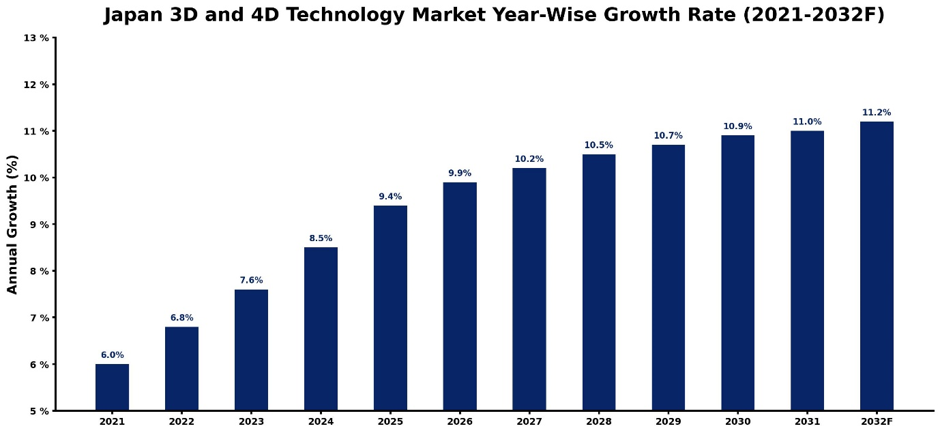
The following table summarizes the historical and forecasted growth rates of the Japan 3D and 4D Technology Market, along with the rationale behind each year’s performance.
| Year | Growth Rate (%) | Key Reasons |
| 2021 | 6% | Recovery of industrial digitalization and increased use of 3D visualization tools. |
| 2022 | 6.8% | Applications growth in gaming, animation and automotive design. |
| 2023 | 7.6% | The evolution of 3D scanning usage in manufacturing and engineering workflows. |
| 2024 | 8.5% | Major improvements in sensors, imaging systems and real-time interpretation technologies. |
| 2025 | 9.4% | Rising demand for immersive imitation and AI-driven modeling solutions. |
| 2026 | 9.9% | Robust adoption of industrial automation and digital twin ecosystems. |
| 2027 | 10.2% | Progress of AI embedded modeling and live simulation platforms. |
| 2028 | 10.5% | Growth in smart robotics, manufacturing and automotive testing applications. |
| 2029 | 10.7% | Increase in the acceptance of entertainment, healthcare imaging, and defense systems. |
| 2030 | 10.9% | Rise of addition with IoT, spatial computing, and liberal analytics. |
| 2031 | 11% | Strong enterprise by investing in training, simulation and digital surroundings. |
| 2032 | 11.2% | Market maturity with widespread adoption across industrial and consumer sectors. |
Topics Covered in the Japan 3D and 4D Technology Market Report
Japan 3D and 4D Technology Market report thoroughly covers the market by product, application, end-use application, and vertical. The market report provides an unbiased and detailed analysis of ongoing market trends, opportunities/high growth areas, and market drivers, which would help stakeholders devise and align their market strategies according to the current and future market dynamics.
Japan 3D and 4D Technology Market Highlights
| Report Name | Japan 3D and 4D Technology Market |
| Forecast period | 2026–2032 |
| CAGR | 2.1% |
| Growing Sector | Healthcare & Medical Imaging |
Japan 3D and 4D Technology Market Synopsis
The Japan 3D and 4D Technology Market is witnessing steady growth owing to rising demand for progressive visualization, simulation, and three-dimensional computing solutions across multiple industries. So, as the growth of adoption in automotive design, healthcare imaging, gaming, and industrial manufacturing is driving market expansion. Also, technological progressions like AI-powered modeling, real-time rendering, and motion capture systems are further improving market abilities. Furthermore, integration of 3D/4D technologies into smart factories and digital twin ecosystems is significantly accelerating industry growth in Japan.
Evaluation of Growth Drivers in the Japan 3D and 4D Technology Market (2026-2032)
Below are some of the mentioned growth drivers and their impact on market dynamics:
| Drivers | Primary Segments Affected | Why It Matters |
| Growth of Digital Manufacturing | Industrial, Automotive | Improves design efficiency, accuracy, and faster production cycles. |
| Expansion of Gaming & Entertainment | Gaming, Cinema | Advances immersive experience and increases the user engagement. |
| AI-Based Modeling Systems | Healthcare, Rendering | Recovers exactness, automation, and workflow efficiency. |
| Rising Adoption of Digital Twins | Construction, Industrial | Maintains real-time simulation and better operational planning. |
| Advancements in Motion Capture | Entertainment, Defense | Boosts realism and improves training and simulation accuracy. |
The Japan 3D and 4D Technology Market is projected to grow significantly, with a CAGR of 2.1% during the forecast period of 2026-2032. Due to increasing integration of spatial computing across industrial and consumer applications with a rise in demand for real-time simulation, immersive gaming, and progressive healthcare imaging solutions is firming market’s expansion. Also, continuous innovation in sensors, scanning devices, and rendering engines is further driving adoption. Moreover, the growth of investment in digital infrastructure and smart manufacturing ecosystems is likely to accelerate market growth during the forecast period.
Evaluation of Restraints in the Japan 3D and 4D Technology Market
Below mentioned are some major restraints and their influence on market dynamics:
| Restraints | Primary Segments Affected | What This Means |
| High Implementation Cost | Industrial, Healthcare | Limits large-scale adoption due to high upfront investment and infrastructure expenses. |
| Complex Integration Systems | Automotive, Defense | Increases deployment difficulty and slows system integration with existing workflows. |
| Data Processing Limitations | Rendering, Scanning | Delays real-time performance and lessens effectiveness in high-volume applications. |
| Shortage of Skilled Workforce | Industrial, Animation | Limits operational efficiency and bounds effective utilization of progressive systems. |
| Hardware Compatibility Issues | Consumer Electronics | Decreases system flexibility and creates addition challenges across devices. |
Japan 3D and 4D Technology Market Challenges
The Japan 3D and 4D Technology Market faces challenges like high deployment costs, which limit adoption among small and medium enterprises. Additionally, system incorporation complexity across legacy framework delays application in industrial and automotive sectors. Also, limited availability of skilled professionals in 3D modeling and motion capture also influences efficiency. Furthermore, large data processing requires real-time rendering and simulation create technological bottlenecks affecting scalability.
Japan 3D and 4D Technology Market Trends
Some major trends contributing to the Japan 3D and 4D Technology Market Growth are:
- AI-Driven Spatial Computing: Increase in use of AI improves 3D modeling accuracy, accelerates real-time simulation, and improves cross-industry decision-making efficiency.
- Growth of Digital Twin Ecosystems: Rise in the adoption of digital twins advances analytical maintenance, operational efficiency, and real-time monitoring across manufacturing and construction sectors.
- Expansion of Immersive Media: Expanding demand for VR/AR content improves 3D and 4D visualization applications, enhances engagement in gaming, entertainment, and interactive digital experiences.
Investment Opportunities in the Japan 3D and 4D Technology Market
Here are some investment opportunities in the Japan 3D and 4D Technology Industry:
- Advanced Simulation Platforms: Developing high-performance simulation tools creates strong opportunities in industrial and defense applications, refining accuracy, training efficiency, and real-time decision support systems.
- Healthcare Imaging Solutions: Increase in the demand for 3D medical imaging and diagnostics supports long-term healthcare investments, improving early detection, treatment planning, and clinical precision outcomes.
- Smart Manufacturing Systems: Mixing of 3D/4D technologies in Industry 4.0 environments fuels industrial automation opportunities, increasing productivity, operational efficiency, and intelligent production workflows.
Top Leading Players in the Japan 3D and 4D Technology Market
Here are some top companies contributing to Japan 3D and 4D Technology Market Share:
1. Sony Group Corporation
| Company Name | Sony Group Corporation |
|---|---|
| Established Year | 1946 |
| Headquarters | Tokyo, Japan |
| Official Website | Click Here |
Sony provides advanced imaging sensors, motion capture systems, and immersive technology solutions widely used in entertainment, gaming, and industrial applications.
2. Canon Inc.
| Company Name | Canon Inc. |
|---|---|
| Established Year | 1937 |
| Headquarters | Tokyo, Japan |
| Official Website | Click Here |
Canon develops high-precision imaging, scanning, and 3D visualization systems supporting healthcare, industrial inspection, and media production industries.
3. Fujitsu Limited
| Company Name | Fujitsu Limited |
|---|---|
| Established Year | 1935 |
| Headquarters | Tokyo, Japan |
| Official Website | Click Here |
Fujitsu specializes in digital twin solutions, AI-powered simulation platforms, and enterprise 3D modeling systems for industrial and smart city applications.
4. Panasonic Holdings Corporation
| Company Name | Panasonic Holdings Corporation |
|---|---|
| Established Year | 1918 |
| Headquarters | Osaka, Japan |
| Official Website | Click Here |
Panasonic offers advanced sensing technologies and 3D imaging solutions supporting automotive, healthcare, and consumer electronics sectors.
5. Nikon Corporation
| Company Name | Nikon Corporation |
|---|---|
| Established Year | 1917 |
| Headquarters | Tokyo, Japan |
| Official Website | Click Here |
Nikon provides precision optical systems and 3D measurement technologies widely used in industrial metrology, healthcare imaging, and research applications.
Government Regulations Introduced in the Japan 3D and 4D Technology Market
According to Japanese government data, the development of the Japan 3D and 4D Technology Market is strongly reinforced by innovation-driven policies. As The Society 5.0 initiative promotes addition of cyber-physical systems across industries. Additionally, Japan’s Digital Agency programs encourage implementation of progressive digital framework and smart manufacturing technologies. Overall, government investments in robotics, AI development, and industrial automation are further bolstering adoption of 3D and 4D technologies across key sectors such as automotive, healthcare, and defense.
Future Insights of the Japan 3D and 4D Technology Market
The upcoming years for the Japan 3D and 4D Technology Market remains to be highly positive due to increase in demand for immersive simulation, digital twins, and innovative visualization systems. As the expanding applications in healthcare diagnostics, gaming, automotive design, and industrial automation are expected to drive long-term growth. Besides, continuous innovation in AI-based version engines, motion capture, and spatial computing will further improve market abilities. Furthermore, the rising enterprise investments in smart manufacturing and virtual simulation ecosystems will meaningly support future expansion.
Market Segmentation Analysis
The report offers a comprehensive study of the subsequent market segments and their leading categories.
By Product - Market Dominated by 3D and 4D Cameras, Set for Rapid Expansion
According to Kanak Phartiyal, Senior Research Analyst at 6Wresearch, 3D and 4D Cameras dominated the Japan 3D and 4D Technology Market with 41.28% share in 2025, driven by immersive imaging demand, and are projected to grow at 10.42% CAGR during 2026–2032 forecast period, due to rising adoption in entertainment, gaming, and industrial vision systems.
By Application - Market Dominated by 3D and 4D Rendering, Set for Rapid Expansion
By application, 3D and 4D Rendering led with 38.67% share in 2025, supported by high demand for realistic visualization, and is expected to expand at 10.18% CAGR through 2026-2032 owing to growth in digital design, simulation, and AI-based rendering technologies.
By End-Use Application - Market Dominated by 3D Machine Vision, Set for Rapid Expansion
By end-use application, 3D Machine Vision accounted for 36.54% share in 2025, driven by industrial automation and quality inspection needs, and is projected to grow at 10.56% CAGR during 2026–2032 forecast period, due to smart factory expansion and robotics integration.
By Vertical - Market Dominated by Industrial segment, Set for Rapid Expansion
By vertical, Industrial segment dominated with 34.92% share in 2025, supported by strong adoption of digital manufacturing and smart factory systems, and is expected to grow at 10.33% CAGR through the forecast period 2026-2032 driven by Industry 4.0 transformation and automation investments.
Note: Market size estimations and growth projections presented in this report are based on 6Wresearch’s advanced forecasting approach, validated with industry datasets as of June 2026.
Key Attractiveness of the Report
- 10 Years Market Numbers.
- Historical Data Starting from 2022 to 2025.
- Base Year: 2025
- Forecast Data until 2032.
- Key Performance Indicators Impacting the Market.
- Major Upcoming Developments and Projects.
Key Highlights of the Report:
- Japan 3D and 4D Technology Market Outlook
- Market Size of Japan 3D and 4D Technology Market, 2025
- Forecast of Japan 3D and 4D Technology Market, 2032
- Historical Data and Forecast of Japan 3D and 4D Technology Revenues & Volume for the Period 2022-2032
- Japan 3D and 4D Technology Market Trend Evolution
- Japan 3D and 4D Technology Market Drivers and Challenges
- Japan 3D and 4D Technology Price Trends
- Japan 3D and 4D Technology Porter's Five Forces
- Japan 3D and 4D Technology Industry Life Cycle
- Historical Data and Forecast of Japan 3D and 4D Technology Market Revenues & Volume By Product for the Period 2022-2032
- Historical Data and Forecast of Japan 3D and 4D Technology Market Revenues & Volume By 3D and 4D Scanners for the Period 2022-2032
- Historical Data and Forecast of Japan 3D and 4D Technology Market Revenues & Volume By 3D and 4D Cameras for the Period 2022-2032
- Historical Data and Forecast of Japan 3D and 4D Technology Market Revenues & Volume By 3D and 4D Sensors for the Period 2022-2032
- Historical Data and Forecast of Japan 3D and 4D Technology Market Revenues & Volume By Application for the Period 2022-2032
- Historical Data and Forecast of Japan 3D and 4D Technology Market Revenues & Volume By 3D and 4D Modeling for the Period 2022-2032
- Historical Data and Forecast of Japan 3D and 4D Technology Market Revenues & Volume By 3D and 4D Scanning for the Period 2022-2032
- Historical Data and Forecast of Japan 3D and 4D Technology Market Revenues & Volume By 3D and 4D Rendering for the Period 2022-2032
- Historical Data and Forecast of Japan 3D and 4D Technology Market Revenues & Volume By 3D and 4D Image Reconstruction for the Period 2022-2032
- Historical Data and Forecast of Japan 3D and 4D Technology Market Revenues & Volume By End-Use Application for the Period 2022-2032
- Historical Data and Forecast of Japan 3D and 4D Technology Market Revenues & Volume By 3D and 4D Gaming for the Period 2022-2032
- Historical Data and Forecast of Japan 3D and 4D Technology Market Revenues & Volume By 3D and 4D Cinema for the Period 2022-2032
- Historical Data and Forecast of Japan 3D and 4D Technology Market Revenues & Volume By 3D Navigation for the Period 2022-2032
- Historical Data and Forecast of Japan 3D and 4D Technology Market Revenues & Volume By 3D Layout and Animation for the Period 2022-2032
- Historical Data and Forecast of Japan 3D and 4D Technology Market Revenues & Volume By 3D and 4D Motion Capture for the Period 2022-2032
- Historical Data and Forecast of Japan 3D and 4D Technology Market Revenues & Volume By 3D Machine Vision for the Period 2022-2032
- Historical Data and Forecast of Japan 3D and 4D Technology Market Revenues & Volume By 3D and 4D Metrology for the Period 2022-2032
- Historical Data and Forecast of Japan 3D and 4D Technology Market Revenues & Volume By 3D and 4D Gesture Recognition for the Period 2022-2032
- Historical Data and Forecast of Japan 3D and 4D Technology Market Revenues & Volume By Vertical for the Period 2022-2032
- Historical Data and Forecast of Japan 3D and 4D Technology Market Revenues & Volume By Military and Defense for the Period 2022-2032
- Historical Data and Forecast of Japan 3D and 4D Technology Market Revenues & Volume By Automotive for the Period 2022-2032
- Historical Data and Forecast of Japan 3D and 4D Technology Market Revenues & Volume By Construction for the Period 2022-2032
- Historical Data and Forecast of Japan 3D and 4D Technology Market Revenues & Volume By Consumer Electronics for the Period 2022-2032
- Historical Data and Forecast of Japan 3D and 4D Technology Market Revenues & Volume By Industrial for the Period 2022-2032
- Historical Data and Forecast of Japan 3D and 4D Technology Market Revenues & Volume By Entertainment for the Period 2022-2032
- Historical Data and Forecast of Japan 3D and 4D Technology Market Revenues & Volume By Healthcare for the Period 2022-2032
- Historical Data and Forecast of Japan 3D and 4D Technology Market Revenues & Volume By Others for the Period 2022-2032
- Japan 3D and 4D Technology Import Export Trade Statistics
- Market Opportunity Assessment By Product
- Market Opportunity Assessment By Application
- Market Opportunity Assessment By End-Use Application
- Market Opportunity Assessment By Vertical
- Japan 3D and 4D Technology Top Companies Market Share
- Japan 3D and 4D Technology Competitive Benchmarking By Technical and Operational Parameters
- Japan 3D and 4D Technology Company Profiles
- Japan 3D and 4D Technology Key Strategic Recommendations
Market Covered
The report subsequently covers the market by following segments and subsegments.
By Product
- 3D and 4D Scanners
- 3D and 4D Cameras
- 3D and 4D Sensors
By Application
- 3D and 4D Modeling
- 3D and 4D Scanning
- 3D and 4D Rendering
- 3D and 4D Image Reconstruction
By End-Use Application
- 3D and 4D Gaming
- 3D and 4D Cinema
- 3D Navigation
- 3D Layout and Animation
- 3D and 4D Motion Capture
- 3D Machine Vision
- 3D and 4D Metrology
- 3D and 4D Gesture Recognition
By Vertical
- Military and Defense
- Automotive
- Construction
- Consumer Electronics
- Industrial
- Entertainment
- Healthcare
- Others






































