Japan 3D Rendering Software Market Growth Rate
According to 6Wresearch internal database and industry insights, the Japan 3D Rendering Software Market is growing at a compound annual growth rate (CAGR) of 7.59% during the forecast period (2026-2032).
Japan 3D Rendering Software Market Year-wise Growth Rate and Key Drivers (2022-2032)
This graph illustrates the annual growth rates of the Japan 3D Rendering Software Market from 2022 to 2032, highlighting a steady upward trajectory and projected market expansion over the forecast period.
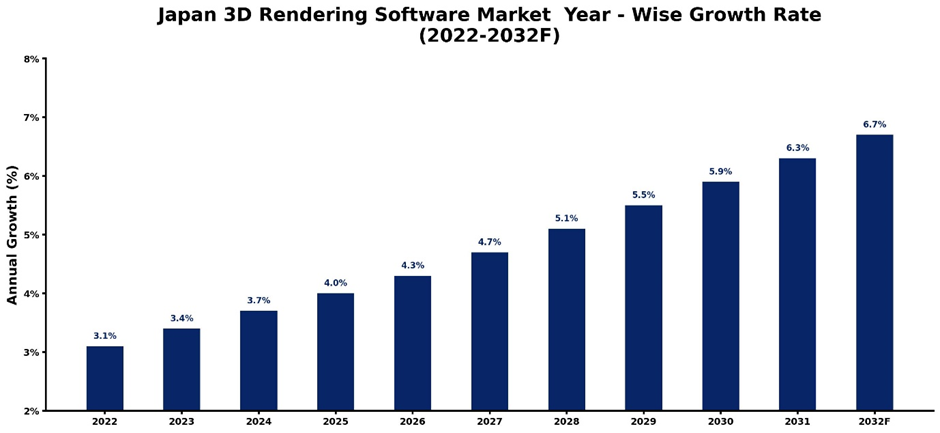 The table below represents the historical and projected growth rates for Japan 3D Rendering Software Market and the rationale behind each year’s performance.
| Year | Estimated Annual Growth (%) | Market Rationale |
| 2022 | 3.1% | Early adoption of rendering tools in architecture, rising digital design workflows |
| 2023 | 3.4% | Increased BIM usage and growing real estate visualization demand |
| 2024 | 3.7% | Expansion of gaming and media rendering applications across studios |
| 2025 | 4% | Strong AI-based rendering adoption and cloud rendering platform growth |
| 2026 | 4.3% | Government-led smart city projects and infrastructure visualization expansion |
| 2027 | 4.7% | Rising demand for real-time rendering in architecture and product design |
| 2028 | 5.1% | Healthcare visualization and simulation demand increases with digital imaging integration |
| 2029 | 5.5% | Advanced GPU adoption improves rendering efficiency and workflow automation |
| 2030 | 5.9% | Growth in immersive VR and interactive visualization across industries |
| 2031 | 6.3% | Strong enterprise adoption of cloud-based rendering and AI optimization tools |
| 2032 | 6.7% | Mature market with widespread adoption across architecture, gaming, and media sectors |
Topics Covered in the Japan 3D Rendering Software Market Report
Japan 3D Rendering Software Market report thoroughly covers the market by type, deployment, application, and end user. The market report provides an unbiased and detailed analysis of ongoing market trends, opportunities/high growth areas, and market drivers, which would help stakeholders devise and align their market strategies according to the current and future market dynamics.
Japan 3D Rendering Software Market Highlights
| Report Name | Japan 3D Rendering Software Market |
| Forecast period | 2026-2032 |
| CAGR | 7.59% |
| Growing Sector | IT & Creative Technology |
Japan 3D Rendering Software Market Synopsis
The Japan 3D Rendering Software Market is expected to witness significant growth due to the increasing adoption of real-time rendering engines, AI-based visualization tools, and the growing digital content creation in the architecture, gaming, and media industries. Japan’s sophisticated design ecosystem, rising demand for immersive visualization, and growth in smart infrastructure and virtual production technologies are driving the market. Government initiatives includes Digital Agency Japan DX programs and MLIT digital construction policies, are pushing uptake across architectural and industrial sectors.
Evaluation of Growth Drivers in the Japan 3D Rendering Software Market (2026-2032)
Below are some of the mentioned growth drivers and their impact on market dynamics:
| Drivers | Primary Segments Affected | Why It Matters |
| AI-Powered Rendering Engines Adoption | Architecture, Media & Design Firms | Improves rendering speed, realism, automation, reduces production cycles, and enhances real-time visualization accuracy significantly |
| Growing Real Estate Digitalization | Real Estate, Commercial Projects | Enhances property visualization quality, improves investor engagement, and accelerates pre-construction marketing and decision-making processes |
| BIM Integration Expansion | Architects, Engineering Firms | Improves cross-team coordination, reduces design conflicts, enhances project accuracy, and supports efficient construction planning workflows |
| Cloud-Based Rendering Platforms | SMEs, Design Studios | Enables scalable rendering infrastructure, reduces hardware dependency, supports remote collaboration, and lowers operational costs significantly |
| Gaming & Animation Industry Growth | Media & Entertainment | Drives demand for high-performance rendering engines, immersive environments, and real-time visual content creation at scale |
Japan 3D Rendering Software Market is projected to grow significantly at a CAGR of 7.59% during 2026-2032. Powered by AI rendering engines, with cloud-based visualization platforms and real-time 3D content creation tools. The growth of the market is fuelled by the increasing demand for immersive experiences in architecture, gaming and virtual production. Also, the combination of GPU-accelerated computing and hybrid rendering workflows is increasing efficiency and reducing rendering time. Japan’s emphasis on smart cities, digital construction and creative digital economy is also accelerating software adoption in enterprise and design ecosystems.
Evaluation of Restraints in the Japan 3D Rendering Software Market
Below mentioned are some major restraints and their influence on market dynamics:
| Restraints | Primary Segments Affected | What This Means |
| High Software Licensing Costs | SMEs, Design Studios | Limits adoption among small firms due to expensive subscription and licensing structures, reducing scalability |
| High GPU and Hardware Dependency | Rendering Studios, IT Infrastructure | Increases operational expenditure due to requirement of advanced computing systems, raising overall project costs significantly |
| Skilled Workforce Shortage | Architecture, Design Firms | Slows project delivery due to lack of trained 3D visualization professionals, impacting productivity and timelines |
| Long Rendering Times for Complex Projects | Large Enterprises | Reduces workflow efficiency in high-detail architectural and simulation projects, delaying project completion and delivery schedules |
| Data Security Concerns | Cloud Platforms, Enterprises | Raises risks related to confidential project data and digital asset protection, affecting trust and adoption rates. |
Japan 3D Rendering Software Market Challenges
The Japan 3D Rendering Software Market faces challenges such as high computational requirements, dependency on advanced GPU infrastructure, and complex integration with BIM and CAD ecosystems. Also, the shortage of skilled 3D artists and technical specialists hinders large scale adoption. In addition, the rise in cybersecurity threats associated with cloud-based rendering platforms and the exorbitant costs of software restrict the adoption among SMEs and mid-sized design firms, impeding the overall market penetration across the fledgling digital design ecosystems.
Japan 3D Rendering Software Market Trends
Some major trends contributing to the Japan 3D Rendering Software Market Growth are:
- Real Time Rendering Adoption: With the traction real time engines are gaining, interactive visualization is becoming better, delays in rendering are minimized, and workflows for design decision-making are greatly enhanced across industries.
- Cloud-Based Collaboration: Scalable cloud rendering allows for scalable processing, remote collaboration and cost-effective high-quality visualization at a global scale.
- AI-powered rendering optimization: Improves lighting accuracy and realism, automates complex rendering tasks to speed up production cycles and increases consistency by intelligently optimizing computational rendering workloads efficiently.
Investment Opportunities in Japan 3D Rendering Software Market
Below mentioned are some investment opportunities in the Japan 3D Rendering Software Industry:
- Smart City Visualization Projects: Urban development initiatives have been growing which makes demand for large-scale 3D rendering solutions supporting infrastructure planning and use modeling, public service design and better data-driven urban governance across municipalities nationwide implementation.
- Solutions for Digital Marketing in Real Estate: Property development growth generates demand for premium architectural rendering that captivates buyers and investors in property visualization quality, immersive walkthroughs, faster sales cycles and better investment decision-making for developers and buyers globally.
- Gaming & Virtual Production Platforms: Expansion of gaming industry boosts adoption of real-time rendering engines and immersive content creation tools enabling cinematic storytelling, virtual production workflows, and advanced interactive media experiences across platforms globally adopted.
Top 5 Leading Players in the Japan 3D Rendering Software Market
Here are some top companies contributing to Japan 3D Rendering Software Market Share:
1. Autodesk Inc.
| Company Name | Autodesk Inc. |
|---|---|
| Established Year | 1982 |
| Headquarters | San Rafael, California, USA |
| Official Website | Click Here |
Autodesk provides advanced 3D design and rendering software widely used in architecture, engineering, and construction industries.
2. Chaos
| Company Name | Chaos |
|---|---|
| Established Year | 1997 |
| Headquarters | Karlsruhe, Germany |
| Official Website | Click Here |
Chaos offers high-performance rendering and visualization software solutions for architecture, design, and media industries.
3. Epic Games, Inc.
| Company Name | Epic Games, Inc. |
|---|---|
| Established Year | 1991 |
| Headquarters | Cary, North Carolina, USA |
| Official Website | Click Here |
Epic Games develops Unreal Engine for real-time 3D rendering and immersive visualization across industries.
4. Adobe Inc.
| Company Name | Adobe Inc. |
|---|---|
| Established Year | 1982 |
| Headquarters | San Jose, California, USA |
| Official Website | Click Here |
Adobe provides creative and visualization software solutions used in media, design, and digital content creation.
5. NVIDIA Corporation
| Company Name | NVIDIA Corporation |
|---|---|
| Established Year | 1993 |
| Headquarters | Santa Clara, California, USA |
| Official Website | Click Here |
NVIDIA delivers GPU and AI-powered rendering technologies enabling high-performance visualization and simulation workflows.
Government Regulations Introduced in the Japan 3D Rendering Software Market
According to Japanese government data, shows that regulatory support from the Ministry of Economy, Trade and Industry (METI), Ministry of Land, Infrastructure, Transport and Tourism (MLIT) and Digital Agency Japan is helping to drive adoption of digital construction, AI-based visualization and smart city initiatives. Programs such as Society 5.0, Construction Policy and Japan Digital Architecture Strategy promote the adoption of 3D rendering technologies in infrastructure planning, architectural design and urban development ecosystems. These programs are driving digital transformation across the country’s construction and design industries.
Future Insights of the Japan 3D Rendering Software Market
The Japan 3D Rendering Software Market is expected to witness strong expansion driven by AI-based visualization, real-time rendering adoption, and cloud-native design platforms. Future growth is being shaped by the growing demand for immersive digital experiences in the architecture, gaming and media industries. In addition, the incorporation of metaverse applications, digital twins, and GPU-accelerated rendering engines will further improve performance and scalability. Japan’s focus on smart cities, digital construction, and creative economy development will continue to strengthen long-term market expansion.
Market Segmentation Analysis
The report offers a comprehensive study of the following market segments and their leading categories:
By Type – Software Led the Market, Services Set for Strong Growth
According to Sachin, Senior Research Analyst at 6Wresearch, Software dominated the Japan 3D Rendering Software Market in 2025 with an estimated 62% share, driven BIM-integrated workflows across design industries. However, Services is expected to grow fastest during 2026–2032 with a CAGR of 16.8%, supported by rising complexity of large-scale visualization projects.
By Deployment – Cloud-Based Led the Market, Offline Rendering to Grow Rapidly
Cloud-Based deployment dominated the market in 2025 with 40% share due to scalable rendering capacity, remote collaboration, and subscription-based SaaS adoption across SMEs and studios. However, Offline Rendering is expected to register the highest CAGR of 15.9% during 2026-2032, due to the need for full local control for studio-grade environments.
By End User – Architects & Designers Led the Market, Media & Entertainment Rapid Growth
Architects & Designers dominated in 2025 with 39% share, driven by strong CAD-BIM integration and infrastructure development projects. However, Media & Entertainment is expected to grow rapidly during 2026–2032 with a CAGR of 17.9%, supported by high-quality digital content creation in Japan’s creative industry ecosystem.
Note: Market size estimations and growth projections presented in this report are based on 6Wresearch's proprietary forecasting methodology, utilizing the latest available industry data, government publications, and primary research inputs.
Key Attractiveness of the Report
- 10 Years Market Numbers
- Historical Data Starting from 2022 to 2025
- Base Year: 2025
- Forecast Data until 2032
- Key Performance Indicators Impacting the Market
- Major Upcoming Developments and Projects
Key Highlights of the Report:
- Japan 3D Rendering Software Market Outlook
- Market Size of Japan 3D Rendering Software Market,2025
- Forecast of Japan 3D Rendering Software Market, 2032
- Historical Data and Forecast of Japan 3D Rendering Software Revenues & Volume for the Period 2022-2032
- Japan 3D Rendering Software Market Trend Evolution
- Japan 3D Rendering Software Market Drivers and Challenges
- Japan 3D Rendering Software Price Trends
- Japan 3D Rendering Software Porter's Five Forces
- Japan 3D Rendering Software Industry Life Cycle
- Historical Data and Forecast of Japan 3D Rendering Software Market Revenues & Volume By Type for the Period 2022-2032
- Historical Data and Forecast of Japan 3D Rendering Software Market Revenues & Volume By Software for the Period 2022-2032
- Historical Data and Forecast of Japan 3D Rendering Software Market Revenues & Volume By Services for the Period 2022-2032
- Historical Data and Forecast of Japan 3D Rendering Software Market Revenues & Volume By Deployment for the Period 2022-2032
- Historical Data and Forecast of Japan 3D Rendering Software Market Revenues & Volume By Cloud-Based for the Period 2022-2032
- Historical Data and Forecast of Japan 3D Rendering Software Market Revenues & Volume By On-Premise for the Period 2022-2032
- Historical Data and Forecast of Japan 3D Rendering Software Market Revenues & Volume By Standalone for the Period 2022-2032
- Historical Data and Forecast of Japan 3D Rendering Software Market Revenues & Volume By Offline Rendering for the Period 2022-2032
- Historical Data and Forecast of Japan 3D Rendering Software Market Revenues & Volume By Application for the Period 2022-2032
- Historical Data and Forecast of Japan 3D Rendering Software Market Revenues & Volume By Architectural Visualization for the Period 2022-2032
- Historical Data and Forecast of Japan 3D Rendering Software Market Revenues & Volume By Gaming & Animation for the Period 2022-2032
- Historical Data and Forecast of Japan 3D Rendering Software Market Revenues & Volume By Product Design for the Period 2022-2032
- Historical Data and Forecast of Japan 3D Rendering Software Market Revenues & Volume By Virtual Reality for the Period 2022-2032
- Historical Data and Forecast of Japan 3D Rendering Software Market Revenues & Volume By End User for the Period 2022-2032
- Historical Data and Forecast of Japan 3D Rendering Software Market Revenues & Volume By Architects & Designers for the Period 2022-2032
- Historical Data and Forecast of Japan 3D Rendering Software Market Revenues & Volume By Media & Entertainment for the Period 2022-2032
- Historical Data and Forecast of Japan 3D Rendering Software Market Revenues & Volume By Manufacturers for the Period 2022-2032
- Historical Data and Forecast of Japan 3D Rendering Software Market Revenues & Volume By Healthcare for the Period 2022-2032
- Japan 3D Rendering Software Import Export Trade Statistics
- Market Opportunity Assessment By Type
- Market Opportunity Assessment By Deployment
- Market Opportunity Assessment By Application
- Market Opportunity Assessment By End User
- Japan 3D Rendering Software Top Companies Market Share
- Japan 3D Rendering Software Competitive Benchmarking By Technical and Operational Parameters
- Japan 3D Rendering Software Company Profiles
- Japan 3D Rendering Software Key Strategic Recommendations
Market Covered
The report subsequently covers the market by following segments and subsegments.
By Type
- Software
- Services
By Deployment
- Cloud-Based
- On-Premise
- Standalone
- Offline Rendering
By Application
- Architectural Visualization
- Gaming & Animation
- Product Design
- Virtual Reality
By End User
- Architects & Designers
- Media & Entertainment
- Manufacturers
- Healthcare






































