Japan 5G Substrate Materials Market Growth Rate
According to 6Wresearch internal database and industry insights, the Japan 5G Substrate Materials Market is growing at a compound annual growth rate (CAGR) of 3.7% during the forecast period (2026-2032).
Japan 5G Substrate Materials Market Year-wise Growth Rate and Key Drivers (2022-2032)
This graph illustrates the annual growth rates of the Japan 5G Substrate Materials Market from 2022 to 2032, highlighting a steady upward trajectory and projected market expansion over the forecast period.
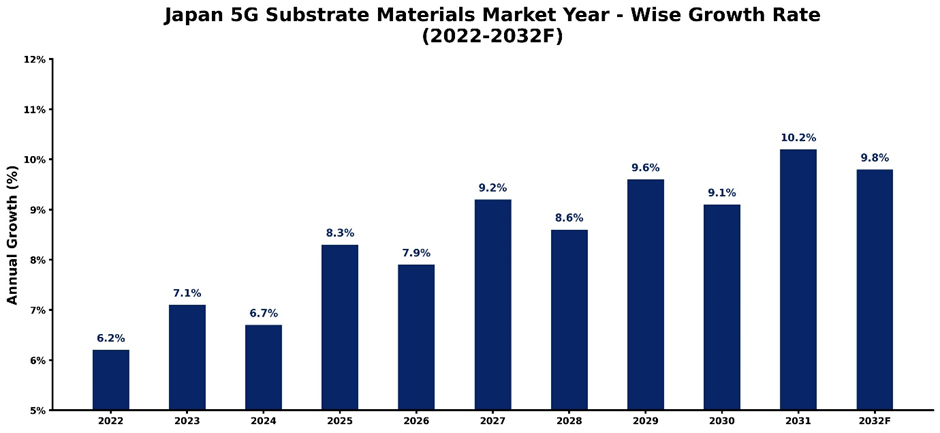
The table below represents the historical and projected growth rates for the Japan 5G Substrate Materials Market and the rationale behind each year’s performance.
| Year | Estimated Annual Growth (%) | Market Rationale |
| 2022 | 6.2% | Expansion of initial 5G networks increased demand for advanced RF substrate materials. |
| 2023 | 7.1% | Growing smartphone connectivity and telecom equipment upgrades supported market adoption. |
| 2024 | 6.7% | Increasing production of 5G devices and base station components enhanced material demand, with phased manufacturing cycles. |
| 2025 | 8.3% | Advanced antenna development and high-frequency applications strengthened market growth. |
| 2026 | 7.9% | 5G network expansion and demand for low-loss materials accelerated adoption. |
| 2027 | 9.2% | Growth of smart devices and industrial connectivity increased substrate requirements. |
| 2028 | 8.6% | Rising mmWave applications and advanced communication systems boosted demand. |
| 2029 | 9.6% | 5G Advanced deployment increased requirements for high-performance materials. |
| 2030 | 9.1% | Smart factories and connected infrastructure supported market expansion. |
| 2031 | 10.2% | Innovation in flexible and lightweight substrate materials improved adoption. |
| 2032 | 9.8% | Beyond 5G technologies sustained demand for advanced substrate solutions. |
Topics Covered in the Japan 5G Substrate Materials Market Report
Japan 5G Substrate Materials Market report thoroughly covers the market by type and application. The market report provides an unbiased and detailed analysis of ongoing market trends, opportunities/high growth areas, and market drivers, which would help stakeholders devise and align their market strategies according to the current and future market dynamics.
Japan 5G Substrate Materials Market Highlights
| Report Name | Japan 5G Substrate Materials Market |
| Forecast period | 2026-2032 |
| CAGR | 3.7% |
| Growing Sector | Telecommunications |
Japan 5G Substrate Materials Market Synopsis
Japan 5G Substrate Materials Market is expected to grow at a significant pace owing to increasing deployment of 5G communication infrastructure, rising demand for high-frequency electronic components, and growing adoption of advanced antenna technologies. The market growth is further supported by increasing investments in smart factories and advanced wireless communication solutions. The government initiatives focused on digital transformation and semiconductor ecosystem development are supporting innovation in high-performance material technologies. The rise of demand for lightweight and low-loss substrates is estimated to create significant opportunities for manufacturers during the forecast period.
Evaluation of Growth Drivers in the Japan 5G Substrate Materials Market (2026-2032)
Below mentioned are some major growth drivers and their influence on market dynamics:
| Drivers | Primary Segments Affected | Why It Matters |
| Expansion of 5G Network Infrastructure | Base Station Antennas, RF Components | Increases demand for reliable substrate materials supporting efficient and high-performance communication networks. |
| Rising Smartphone Antenna Adoption | Smartphone Antennas, LCP, PI | Supports demand for flexible and compact materials used in advanced mobile antenna designs. |
| Growth of High-Frequency Applications | PTFE, Ceramics, mmWave Systems | Requires materials with enhanced signal performance for a stable high-speed wireless communication application. |
| Increasing Smart Factory Deployment | Industrial Communication Systems | Creates demand for durable electronic materials permitting reliable industrial connectivity solutions. |
| Semiconductor Industry Expansion | Advanced Substrate Manufacturing | Strengthens domestic material development and enhances local advanced manufacturing capabilities. |
The Japan 5G Substrate Materials Market is projected to grow at a CAGR of 3.7% during 2026–2032. The growth is attributed to augmenting 5G infrastructure investments, rising adoption of innovative wireless devices, and growing requirements for efficient RF communication components. Japan’s Society 5.0 initiative and the Beyond 5G Promotion Strategy by the Ministry of Internal Affairs and Communications (MIC) are supporting research in advanced communication technologies. Japan had over 100 million 5G subscriptions by 2024, growing demand for high-performance substrate materials. Additionally, NTT’s research on next-generation networks emphasis the need for low-loss, thermally stable materials for future wireless systems.
Evaluation of Restraints in the Japan 5G Substrate Materials Market
Below mentioned are some major restraints and their influence on market dynamics:
| Restraints | Primary Segments Affected | What This Means |
| High Material Manufacturing Costs | Advanced Substrates | Increases overall production expenses and affects affordability for manufacturers and end-users. |
| Complex Processing Requirements | Specialty Materials | Requires advanced manufacturing expertise and specialized equipment for efficient production processes. |
| Raw Material Supply Dependency | Substrate Producers | Can impact production continuity owing to variation in availability of specialized materials. |
| Limited Skilled Workforce | Material Development | Slows innovation activities and creates challenges in advanced substrate research and manufacturing. |
| Increasing Performance Requirements | High-Frequency Applications | Raises research and development costs to meet evolving communication technology standards. |
Japan 5G Substrate Materials Market Challenges
In the Japan 5G Substrate Materials Market, achieving cost-effective production while maintaining advanced material performance remains a major challenge. Japan’s MIC reported that 5G coverage reached over 95% of the population by 2024, that has increased the demand for high-performance RF materials. Additionally, METI’s semiconductor strategy highlights Japan’s dependence on innovative material supply chains, supporting domestic production capabilities. Also, the companies such as NTT and Fujitsu are investing in Beyond 5G research, requiring substrates with low dielectric loss and enhanced thermal resistance.
Japan 5G Substrate Materials Market Trends
Below are some major trends contributing to the Japan 5G Substrate Materials Market Growth:
- Flexible Substrate Adoption: Growing demand for compact smartphones and advanced electronic devices is increasing the use of flexible materials such as LCP and PI for antenna applications.
- Miniaturization of Communication Components: The requirement for smaller and efficient devices is driving development of lightweight substrate materials that maintain high performance in limited spaces.
- Advanced Manufacturing Technologies: The material producers are investing in enhanced manufacturing processes to improve substrate quality, reliability, and compatibility with next-generation communication systems.
Investment Opportunities in Japan 5G Substrate Materials Market
Here are some investment opportunities in the Japan 5G Substrate Materials Industry:
- Advanced LCP and PI Material Development: Investing in flexible and lightweight substrate technologies can encourage the increasing demand from smartphone antenna and consumer electronics manufacturers.
- High-Performance Ceramic Substrate Production: Developing ceramic materials with enhanced thermal conductivity can create opportunities in base station and high-frequency communication applications.
- Domestic Supply Chain Development: The growth of investment in local substrate manufacturing capabilities can lower the dependence on imported specialty materials and reinforce Japan’s electronic material ecosystem.
Top Leading Players in the Japan 5G Substrate Materials Market
Here are some top companies contributing to Japan 5G Substrate Materials Market Share:
1. AGC Inc. (Asahi Glass Company)
| Company Name | AGC Inc. (Asahi Glass Company) |
|---|---|
| Established Year | 1907 |
| Headquarters | Tokyo, Japan |
| Official Website | Click Here |
AGC Inc. develops advanced specialty materials, electronic components, and glass technologies supporting communication, semiconductor, automotive, and industrial applications.
2. Panasonic Corporation
| Company Name | Panasonic Corporation |
|---|---|
| Established Year | 1918 |
| Headquarters | Osaka, Japan |
| Official Website | Click Here |
Panasonic Corporation provides advanced materials, electronic components, and communication technologies supporting consumer electronics, automotive systems, and industrial applications.
3. Resonac Corporation
| Company Name | Resonac Corporation |
|---|---|
| Established Year | 1939 |
| Headquarters | Tokyo, Japan |
| Official Website | Click Here |
Resonac Corporation develops semiconductor materials, functional chemicals, and advanced materials for high-performance electronics, communication systems, and industrial applications.
4. Ibiden Co., Ltd.
| Company Name | Ibiden Co., Ltd. |
|---|---|
| Established Year | 1912 |
| Headquarters | Ogaki, Gifu, Japan |
| Official Website | Click Here |
Ibiden Co., Ltd. manufactures advanced electronic materials, printed circuit boards, semiconductor packaging substrates, and related components for high-performance computing and communication applications.
Government Regulations Introduced in the Japan 5G Substrate Materials Market
According to Japanese government data, the Ministry of Internal Affairs and Communications (MIC) is reinforcing the next-generation communication development through programs like Beyond 5G Promotion Strategy and Society 5.0 framework. In addition, the Ministry of Economy, Trade and Industry (METI) is enhancing semiconductor and innovative material ecosystems through supply chain support programs. Furthermore, these initiatives support domestic development of high-performance materials required for advanced wireless networks and electronic manufacturing, while supporting research collaboration, technology commercialization, and reinforcing Japan’s progressive electronics manufacturing capabilities for future connectivity solutions.
Future Insights of the Japan 5G Substrate Materials Market
The Japan 5G Substrate Materials Market is set to experience a steady growth owing to rising demand for innovative communication framework, high-frequency components, and next-generation antenna technologies. Besides, the increase of investments in smart factories, connected devices, and digital transformation will create opportunities for substrate manufacturers. Furthermore, the future developments in PTFE, LCP, ceramics, glass, and PI materials will focus on improving signal efficiency, thermal management, and reliability for more of the latest wireless communication applications.
Market Segmentation Analysis
This report presents a detailed analysis of the market segments along with their leading categories.
By Type – PTFE Led the Market, LCP Set for Strong Growth
According to Bhawna Singh, Senior Research Analyst at 6Wresearch, PTFE dominated the Japan 5G Substrate Materials Market till 2025 with an estimated 38% market share, driven by extensive adoption in high-frequency RF applications. However, during 2026–2032, LCP is expected to emerge as the fastest-growing segment with a CAGR of around 11.5%, supported by compact substrate materials for advanced smartphone antennas and next-generation communication devices.
By Applications – Base Station Antennas Led the Market, Smartphone Antennas to Grow Rapidly
Base Station Antennas dominated the Japan 5G Substrate Materials Market till 2025 with an estimated 56% market share, driven by increasing deployment of advanced wireless communication systems. However, during 2026–2032, Smartphone Antennas are expected to witness strong growth with a CAGR of around 10.8%, supported by growing demand for high-performance flexible substrate materials.
Note: Market size estimations and growth projections presented in this report are based on 6Wresearch's proprietary forecasting methodology, utilizing the latest available industry data, government publications, and primary research inputs.
Key Attractiveness of the Report
- 10 Years Market Numbers.
- Historical Data Starting from 2022 to 2025.
- Base Year: 2025.
- Forecast Data until 2032.
- Key Performance Indicators Impacting the Market.
- Major Upcoming Developments and Projects.
Key Highlights of the Report:
- Japan 5G Substrate Materials Market Outlook
- Market Size of Japan 5G Substrate Materials Market, 2025
- Forecast of Japan 5G Substrate Materials Market, 2032
- Historical Data and Forecast of Japan 5G Substrate Materials Revenues & Volume for the Period 2022-2032
- Japan 5G Substrate Materials Market Trend Evolution
- Japan 5G Substrate Materials Market Drivers and Challenges
- Japan 5G Substrate Materials Price Trends
- Japan 5G Substrate Materials Porter's Five Forces
- Japan 5G Substrate Materials Industry Life Cycle
- Historical Data and Forecast of Japan 5G Substrate Materials Market Revenues & Volume By Type for the Period 2022-2032
- Historical Data and Forecast of Japan 5G Substrate Materials Market Revenues & Volume By PTFE for the Period 2022-2032
- Historical Data and Forecast of Japan 5G Substrate Materials Market Revenues & Volume By Ceramics for the Period 2022-2032
- Historical Data and Forecast of Japan 5G Substrate Materials Market Revenues & Volume By Glass for the Period 2022-2032
- Historical Data and Forecast of Japan 5G Substrate Materials Market Revenues & Volume By LCP for the Period 2022-2032
- Historical Data and Forecast of Japan 5G Substrate Materials Market Revenues & Volume By PI for the Period 2022-2032
- Historical Data and Forecast of Japan 5G Substrate Materials Market Revenues & Volume By Applications for the Period 2022-2032
- Historical Data and Forecast of Japan 5G Substrate Materials Market Revenues & Volume By Smartphone Antennas for the Period 2022-2032
- Historical Data and Forecast of Japan 5G Substrate Materials Market Revenues & Volume By Base Station Antennas for the Period 2022-2032
- Japan 5G Substrate Materials Import Export Trade Statistics
- Market Opportunity Assessment By Type
- Market Opportunity Assessment By Applications
- Japan 5G Substrate Materials Top Companies Market Share
- Japan 5G Substrate Materials Competitive Benchmarking By Technical and Operational Parameters
- Japan 5G Substrate Materials Company Profiles
- Japan 5G Substrate Materials Key Strategic Recommendations
Market Covered
The report subsequently covers the market by following segments and subsegments.
By Type
- PTFE
- Ceramics
- Glass
- LCP
- PI
By Applications
- Smartphone Antennas
- Base Station Antennas






































