Japan Abalone Extract Market Growth Rate
According to 6Wresearch internal database and industry insights, the Japan Abalone Extract Market is growing at a compound annual growth rate (CAGR) of 3.8% during the forecast period (2026-2032).
Japan Abalone Extract Market Year-wise Growth Rate and Key Drivers (2022-2032)
This graph illustrates the annual growth rates of the Japan Abalone Extract Market from 2022 to 2032, highlighting a gradual upward trajectory and projected market expansion over the forecast period.
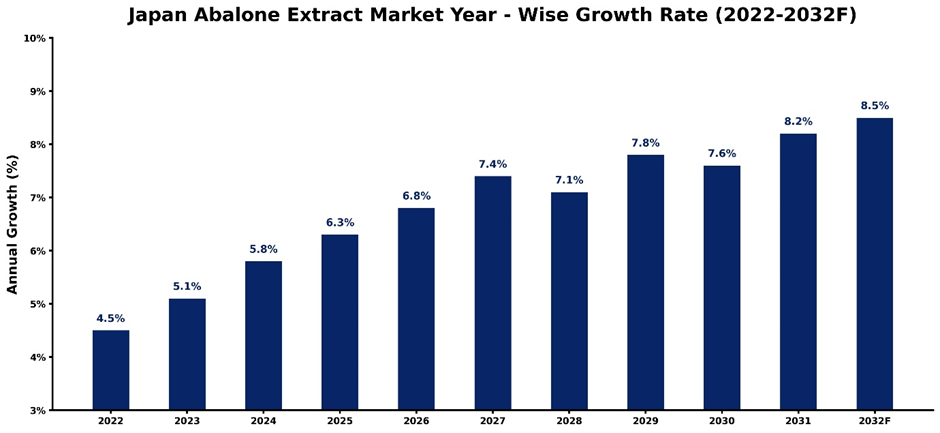
The table below represents the historical and projected growth rates for the Japan Abalone Extract Market and the rationale behind each year’s performance.
| Year | Estimated Annual Growth (%) | Market Rationale |
| 2022 | 4.5% | Growing interest in marine-based nutritional ingredients supported early adoption. |
| 2023 | 5.1% | Rising demand for premium seafood products improved extract applications. |
| 2024 | 5.8% | Functional food development increased demand for marine bioactive ingredients. |
| 2025 | 6.3% | Expansion of health-focused products strengthened abalone extract utilization. |
| 2026 | 6.8% | Increasing demand from dietary supplements and cosmetic formulations supported growth. |
| 2027 | 7.4% | Food innovation and premium ingredient adoption accelerated market development. |
| 2028 | 7.1% | Supply challenges slightly moderated growth momentum across applications. |
| 2029 | 7.8% | Growth in nutraceutical and wellness products increased extract demand. |
| 2030 | 7.6% | Advanced processing technologies supported wider commercial applications. |
| 2031 | 8.2% | Increasing marine biotechnology research encouraged product innovation. |
| 2032 | 8.5% | Sustainable seafood ingredient adoption strengthened long-term market opportunities. |
Topics Covered in the Japan Abalone Extract Market Report
Japan Abalone Extract Market report thoroughly covers the market by product type, form, end use, and distribution channel. The market report provides an unbiased and detailed analysis of ongoing market trends, opportunities/high growth areas, and market drivers, which would help stakeholders devise and align their market strategies according to the current and future market dynamics.
Japan Abalone Extract Market Highlights
| Report Name | Japan Abalone Extract Market |
| Forecast period | 2026-2032 |
| CAGR | 3.8% |
| Growing Sector | Marine-Based Nutraceuticals |
Japan Abalone Extract Market Synopsis
Japan Abalone Extract Market is expected to grow steadily owing to increasing consumer preference for premium seafood-derived ingredients, functional nutrition products, and marine-based wellness solutions. Japan’s strong seafood consumption culture, advanced food processing industry, and growing interest in natural ingredients are supporting market development. Also, raising applications of abalone extracts in dietary supplements and specialty food products are creating new opportunities for manufacturers. Moreover, government initiatives promoting sustainable fisheries and marine resource management are also supporting the innovation in value-added seafood products.
Evaluation of Growth Drivers in the Japan Abalone Extract Market (2026-2032)
Below mentioned are some major growth drivers and their influence on market dynamics:
| Drivers | Primary Segments Affected | Why It Matters |
| Rising Demand for Functional Food Ingredients | Food, Dietary Supplements | Encourages adoption of marine-based ingredients with nutritional benefits and promotes variation in health-focused product formulations. |
| Growth of Premium Seafood Products | Food, Sauces & Seasoning | Supports the development of higher value-added, refined quality and more consumer appealing abalone-based products. |
| Increasing Cosmetic Ingredient Applications | Cosmetics | This expands the usage of marine extracts in skin care formulations with natural and premium ingredient positioning. |
| Growth of Marine Biotechnology Research | Pharmaceuticals, Supplements | Accelerates the search for bioactive compounds from marine resources for specific health and wellness applications. |
| Sustainable Seafood Processing Initiatives | Manufacturers, B2B Distribution | Promotes the efficient use of marine resources and minimizes waste by enhancing processing practices. |
The Japan Abalone Extract Market is projected to grow at a CAGR of 3.8% during 2026–2032. Japan’s marine biotechnology sector supports innovation in seafood-derived ingredients through research institutions and food technology companies. The MAFF promotes sustainable fisheries management through resource control measures. Furthermore, the growth in functional food innovation is supported by Japan’s Foods with Function Claims (FFC) system, which has recorded over 5,000 registered notifications since its introduction, encouraging development of marine-based health ingredients.
Evaluation of Restraints in the Japan Abalone Extract Market
Below mentioned are some major restraints and their influence on market dynamics:
| Restraints | Primary Segments Affected | What This Means |
| Limited Abalone Resource Availability | Raw Material Supply, Manufacturers | Creates supply challenges due to dependence on controlled marine resources and harvesting conditions, affecting production continuity. |
| High Production and Processing Costs | Extract Manufacturers, Food Companies | Raises product pricing owing to specialized extraction and purification processes, restricting affordability for some manufacturers. |
| Strict Seafood Safety Regulations | Food, Pharmaceutical Applications | Must adhere to quality standards due to rigorous testing processes, which has stringent operational requirements and more of a complex regulatory environment. |
| Seasonal Variation in Raw Material Supply | Suppliers, Processors | Impacts availability during production planning and needs an effective inventory with sourcing approaches. |
| Competition from Alternative Marine Extracts | Supplements, Cosmetics | Limits adoption due to availability of other marine-based ingredients offering similar functional benefits. |
Japan Abalone Extract Market Challenges
The Japan Abalone Extract Market faces challenges related to resource availability, processing complexity, and regulatory compliance requirements. Besides, Japan has established fisheries management frameworks covering multiple marine species and coastal regions to support long-term resource conservation. Also, the seafood processing industry requires advanced extraction technologies, quality testing systems, and traceability measures. Moreover, maintaining stable sourcing, ensuring product consistency, and controlling production costs remain important challenges for market participants while adapting to evolving consumer preferences and sustainability expectations.
Japan Abalone Extract Market Trends
Below are some major trends contributing to the Japan Abalone Extract Market Growth:
- Growth of Clean Label Products: The preference for natural ingredients with minimal processing is encouraging the adoption of marine-based extracts in food and beverage applications.
- Expansion of Marine Biotechnology Applications: The research on marine bioactive compounds is creating opportunities for utilizing abalone extracts in pharmaceutical and cosmetic formulations.
- Sustainable Seafood Utilization: Companies are focusing on efficient utilization of seafood resources by converting marine by-products into high-value ingredients.
Investment Opportunities in Japan Abalone Extract Market
Below mentioned are some investment opportunities in the Japan Abalone Extract Industry:
- Advanced Extraction Technology Development: The investment in refined extraction and purification technologies enhances product quality and raises applications over nutraceutical and cosmetic industries.
- Functional Food Product Expansion: Companies investing in abalone-based supplements, health beverages, and premium food ingredients can benefit from growing consumer interest in marine nutrition.
- Marine Biotechnology Research: Development of bioactive marine compounds provides opportunities for collaboration between research institutions, seafood companies, and ingredient manufacturers.
Top Leading Players in the Japan Abalone Extract Market
Here are some top companies contributing to Japan Abalone Extract Market:
1. Nikken Foods Co., Ltd.
| Company Name | Nikken Foods Co., Ltd. |
|---|---|
| Established Year | 1964 |
| Headquarters | Fukuyama, Hiroshima, Japan |
| Official Website | Click Here |
Nikken Foods develops seafood-based ingredients, including abalone extracts and functional food materials, for food manufacturing and premium consumer applications.
2. ICHIMARU PHARCOS Co., Ltd.
| Company Name | ICHIMARU PHARCOS Co., Ltd. |
|---|---|
| Established Year | 1959 |
| Headquarters | Motosu, Japan |
| Official Website | Click Here |
ICHIMARU PHARCOS develops natural ingredients for cosmetics, health foods, and nutraceutical applications.
3. Shingy Corporation
| Company Name | Shingy Corporation |
|---|---|
| Established Year | 1989 |
| Headquarters | Tokyo, Japan |
| Official Website | Click Here |
Shingy Corporation supplies marine-derived ingredients, including abalone extracts, for nutraceutical and wellness products.
Government Regulations Introduced in the Japan Abalone Extract Market
According to Japanese government data, policies like the Ministry of Agriculture, Forestry and Fisheries (MAFF) leads to sustainable fisheries management and the effective application of marine resources. Also, these initiatives encourage responsible seafood production, resource conservation, and development of value-added marine products. Additionally, Japan’s Food Safety Basic Act establishes food safety management principles, which supports the quality control and consumer protection across processed food industries. Overall, these regulatory frameworks encourage manufacturers to improve traceability, processing standards, and sustainable sourcing practices for marine-based ingredients.
Future Insights of the Japan Abalone Extract Market
Japan Abalone Extract Market is expected to witness continued development due to increasing adoption of marine-derived ingredients in food and nutraceutical applications. According to Japan’s Fisheries Agency, the country has established resource management measures covering multiple marine species and coastal fisheries, supporting sustainable seafood utilization. Japan’s functional food sector continues to expand, with more than 1,000 Foods with Function Claims (FFC) notifications submitted annually in recent years. Moreover, research institutions are also exploring marine bioactive compounds, strengthening opportunities for abalone extract applications across wellness and specialty product segments.
Market Segmentation Analysis
This report presents a detailed analysis of the market segments along with their leading categories.
By Product Type – Red Abalone Led the Market, Pink Abalone to Witness Growth
According to Ravi Bhandari, Senior Research Analyst at 6Wresearch, Red Abalone dominated the Japan Abalone Extract Market till 2025 with an estimated 44% market share, driven by its widespread use in seafood-based products. However, during 2026–2032, Pink Abalone is expected to experience steady growth with a CAGR of around 7.6%, supported by expansion of premium food applications.
By Form – Liquid Extract Led the Market, Powder Extract to Grow Rapidly
Liquid extract dominated the market till 2025 with an estimated 56% market share, driven by its industrial ingredient formulations. During 2026–2032, Powder extract is expected to grow strongly with a CAGR of around 8.1%, supported by increasing adoption in dietary supplements and functional food products.
By End Use – Food Led the Market, Dietary Supplements to Grow at the Fastest Pace
Food applications dominated the Japan Abalone Extract Market till 2025 with an estimated 48% Japan Abalone Extract Market Share, driven by Japan’s strong seafood consumption culture and specialty food products. However, during 2026–2032, Dietary Supplements are expected to emerge as the fastest-growing segment with a CAGR of around 9.2%, supported by natural marine-derived ingredients.
By Distribution Channel – B2B Led the Market, B2C Segment to Expand Gradually
B2B distribution dominated the Japan Abalone Extract Market till 2025 with an estimated 62% market share, driven by cosmetic companies and supplement producers. During 2026–2032, B2C distribution is expected to witness growth with a CAGR of around 8.5%, supported by direct consumer access to specialty health products.
Note: Market size estimations and growth projections presented in this report are based on 6Wresearch's proprietary forecasting methodology, utilizing the latest available industry data, government publications, and primary research inputs.
Key attractiveness of the report
- 10 Years Market Numbers.
- Historical Data Starting from 2022 to 2025.
- Base Year: 2025.
- Forecast Data until 2032.
- Key Performance Indicators Impacting the Market.
- Major Upcoming Developments and Projects.
Key Highlights of the Report:
- Japan Abalone Extract Market Outlook
- Market Size of Japan Abalone Extract Market, 2025
- Forecast of Japan Abalone Extract Market, 2032
- Historical Data and Forecast of Japan Abalone Extract Revenues & Volume for the Period 2022-2032
- Japan Abalone Extract Market Trend Evolution
- Japan Abalone Extract Market Drivers and Challenges
- Japan Abalone Extract Price Trends
- Japan Abalone Extract Porter's Five Forces
- Japan Abalone Extract Industry Life Cycle
- Historical Data and Forecast of Japan Abalone Extract Market Revenues & Volume By Product Type for the Period 2022-2032
- Historical Data and Forecast of Japan Abalone Extract Market Revenues & Volume By Pink Abalone for the Period 2022-2032
- Historical Data and Forecast of Japan Abalone Extract Market Revenues & Volume By Red Abalone for the Period 2022-2032
- Historical Data and Forecast of Japan Abalone Extract Market Revenues & Volume By Others for the Period 2022-2032
- Historical Data and Forecast of Japan Abalone Extract Market Revenues & Volume By Form for the Period 2022-2032
- Historical Data and Forecast of Japan Abalone Extract Market Revenues & Volume By Liquid for the Period 2022-2032
- Historical Data and Forecast of Japan Abalone Extract Market Revenues & Volume By Powder for the Period 2022-2032
- Historical Data and Forecast of Japan Abalone Extract Market Revenues & Volume By End Use for the Period 2022-2032
- Historical Data and Forecast of Japan Abalone Extract Market Revenues & Volume By Food for the Period 2022-2032
- Historical Data and Forecast of Japan Abalone Extract Market Revenues & Volume By Sauces & Salads for the Period 2022-2032
- Historical Data and Forecast of Japan Abalone Extract Market Revenues & Volume By Extruded Snacks for the Period 2022-2032
- Historical Data and Forecast of Japan Abalone Extract Market Revenues & Volume By Preservatives for the Period 2022-2032
- Historical Data and Forecast of Japan Abalone Extract Market Revenues & Volume By Seasoning for the Period 2022-2032
- Historical Data and Forecast of Japan Abalone Extract Market Revenues & Volume By Cosmetics for the Period 2022-2032
- Historical Data and Forecast of Japan Abalone Extract Market Revenues & Volume By Dietary Supplements for the Period 2022-2032
- Historical Data and Forecast of Japan Abalone Extract Market Revenues & Volume By Pharmaceuticals for the Period 2022-2032
- Historical Data and Forecast of Japan Abalone Extract Market Revenues & Volume By Distribution Channel for the Period 2022-2032
- Historical Data and Forecast of Japan Abalone Extract Market Revenues & Volume By B2B for the Period 2022-2032
- Historical Data and Forecast of Japan Abalone Extract Market Revenues & Volume By B2C for the Period 2022-2032
- Historical Data and Forecast of Japan Abalone Extract Market Revenues & Volume By Store-Based Retailing for the Period 2022-2032
- Historical Data and Forecast of Japan Abalone Extract Market Revenues & Volume By Pharmaceutical Retailers for the Period 2022-2032
- Historical Data and Forecast of Japan Abalone Extract Market Revenues & Volume By Grocery Retailers for the Period 2022-2032
- Historical Data and Forecast of Japan Abalone Extract Market Revenues & Volume By Non-grocery Retailers for the Period 2022-2032
- Historical Data and Forecast of Japan Abalone Extract Market Revenues & Volume By Mixed Retailers for the Period 2022-2032
- Historical Data and Forecast of Japan Abalone Extract Market Revenues & Volume By Other Non-grocery Retailers for the Period 2022-2032
- Japan Abalone Extract Import Export Trade Statistics
- Market Opportunity Assessment By Product Type
- Market Opportunity Assessment By Form
- Market Opportunity Assessment By End Use
- Market Opportunity Assessment By Distribution Channel
- Japan Abalone Extract Top Companies Market Share
- Japan Abalone Extract Competitive Benchmarking By Technical and Operational Parameters
- Japan Abalone Extract Company Profiles
- Japan Abalone Extract Key Strategic Recommendations
Market covered
The report subsequently covers the market by following segments and subsegments.
By Product Type
- Pink Abalone
- Red Abalone
- Others
By Form
- Liquid
- Powder
By End Use
- Food
- Sauces & Salads
- Extruded Snacks
- Preservatives
- Seasoning
- Cosmetics
- Dietary Supplements
- Pharmaceuticals
By Distribution Channel
- B2B
- B2C
- Store-Based Retailing
- Pharmaceutical Retailers
- Grocery Retailers
- Non-grocery Retailers
- Mixed Retailers
- Other Non-grocery Retailer






































