Japan Abrasives Market Growth Rate
According to 6Wresearch internal database and industry insights, the Japan Abrasives Market is growing at a compound annual growth rate (CAGR) of 4.3% during the forecast period (2026–2032).
Japan Abrasives Market Year-wise Growth Rate and Key Drivers (2022–2032)
This graph illustrates the annual growth rates of the Japan Abrasives Market from 2022 to 2032, showing fluctuating growth reflecting industrial modernization and increasing construction activities.
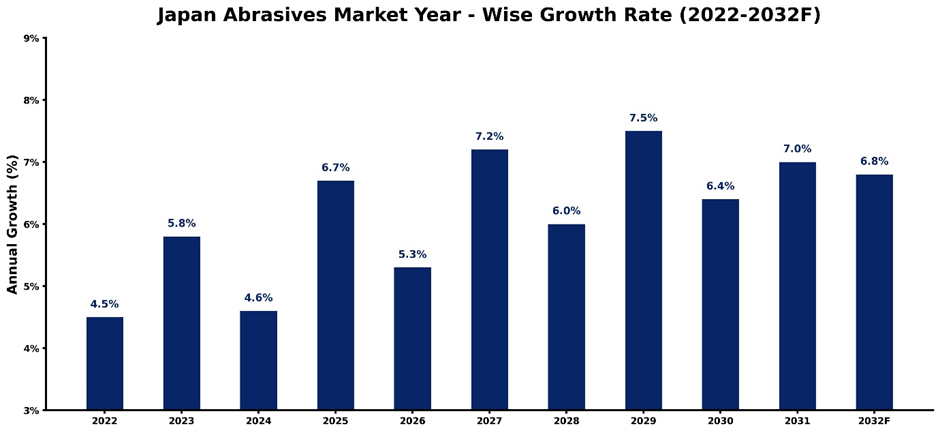 The table below represents the historical and projected growth rates for the Japan Abrasives Market and the rationale behind each year’s performance.
| Year | Estimated Annual Growth (%) | Market Rationale |
| 2022 | 4.5% | Growing residential renovation projects and industrial grinding activities supported abrasives demand. |
| 2023 | 5.8% | Expansion in automotive and furniture manufacturing increased demand for coated and bonded abrasive products. |
| 2024 | 4.6% | Precision finishing requirements in civil engineering projects increased adoption of super abrasives. |
| 2025 | 6.7% | Industrial modernization and new construction projects strengthened market consumption of abrasive sheets and discs. |
| 2026 | 5.3% | High-performance abrasives for cutting, polishing, and finishing applications accelerate adoption across end-use industries. |
| 2027 | 7.2% | Increased civil engineering renovation activities drove demand for durable bonded and coated abrasives. |
| 2028 | 6% | Raw material price volatility moderated market expansion in specialty abrasive applications. |
| 2029 | 7.5% | Rising automation in surface finishing and grinding operations supported growth of standardized abrasive solutions. |
| 2030 | 6.4% | Sustainable and eco-friendly abrasive product adoption maintained steady market development. |
| 2031 | 7% | Precision finishing applications in industrial and residential sectors increased demand for advanced abrasive technologies. |
| 2032 | 6.8% | Advanced manufacturing, high-rise construction, and civil engineering modernization sustained long-term market growth. |
Topics Covered in the Japan Abrasives Market Report
The Japan Abrasives Market report thoroughly covers the market by raw material, type, product, form, application, and end-use industry. The report provides an unbiased and detailed analysis of ongoing market trends, opportunities/high growth areas, and market drivers, which would help stakeholders devise and align their market strategies according to the current and future market dynamics.
Japan Abrasives Market Highlights
| Report Name | Japan Abrasives Market |
| Forecast period | 2026-2032 |
| CAGR | 4.3% |
| Growing Sector | Industrial & Construction Materials |
Japan Abrasives Market Synopsis
Japan Abrasives Market is expected to grow at a steady pace owing to increasing industrial activities, civil engineering projects, and residential & non-residential construction. Japan’s established automotive, aerospace, and furniture manufacturing sectors, along with government-supported construction initiatives, are driving adoption of coated, bonded, and super abrasives. In addition, sustainability initiatives for eco-friendly abrasives and rising use of automated finishing technologies further support long-term market growth which improves effectivity and reduces operational costs across industrial users.
Evaluation of Growth Drivers in the Japan Abrasives Market (2026–2032)
Below mentioned are some major growth drivers and their influence on market dynamics:
| Drivers | Primary Segments Affected | Why It Matters |
| Growth of Automotive Manufacturing | Automotive, Bonded Abrasives, Coated Abrasives | Increasing vehicle production raises demand for grinding, polishing, and surface finishing solutions across automotive manufacturing processes. |
| Rising Civil Engineering Activities | Civil Engineering Renovation, Super Abrasives | Infrastructure development increases usage of durable abrasives for concrete cutting, drilling, and finishing applications. |
| Expansion of Furniture Manufacturing | Furniture, Fine Grit Coated Abrasives | The growth in furniture production is supporting solutions in sanding, polishing and smooth surface preparation. |
| Residential & Non-Residential Construction Growth | New Residential & Non-Residential Construction, Disc & Sheet Abrasives | Construction expansion increases consumption of abrasive discs, sheets, and cups for material processing and finishing activities. |
| Adoption of Automated Finishing Systems | Industrial Users, Powdered & Block Abrasives | Automation adoption drives demand for consistent abrasives that improve precision, productivity, and manufacturing efficiency. |
Japan Abrasives Market is expected to witness steady industrial growth at a CAGR of 4.3% during 2026–2032. The construction industry is growing and contributing about 3.2% of GDP, while the manufacturing output is rising at an annual rate of about 2.8%. Besides, civil engineering renovation projects are expected to increase by 5% annually and automotive production increased by 4.1% in 2025 which will boost demand for bonded and coated abrasives. In addition, energy-efficient and sustainable industrial processes are driving the use of environmentally friendly abrasives, where nearly 18% of manufacturers are now adding recyclable abrasive sheets and powders to their production lines.
Evaluation of Restraints in the Japan Abrasives Market
Below mentioned are some major restrains and their influence on market dynamics:
| Restraints | Primary Segments Affected | What This Means |
| Rising Raw Material Costs | All Abrasive Paper Types | Increased material expenses raise production costs, affecting pricing strategies, and overall competitiveness among manufacturers. |
| Environmental Compliance Requirements | Specialty Abrasives, Industrial Applications | The strict regulations require a sustainable production method, increasing investment needs for cleaner technologies and waste management solutions. |
| Competition from Alternative Finishing Methods | Precision Finishing, Metalworking | Alternative technologies challenge abrasive adoption by providing improved efficiency, precision, and reduced processing requirements. |
| Limited Abrasive Product Recycling Infrastructure | Industrial Users | Poor recycling systems raises the cost of waste disposal and restrict the sustainable recovery of abrasive materials. |
| Skilled Labor Shortages | Manufacturing, Precision Applications | The limited technical knowledge influences the efficiency of abrasive utilization, operational performance and quality of precision finishing in industries. |
Japan Abrasives Market Challenges
The continuity of abrasive supply in Japan faces challenges from fluctuating prices of raw materials, dependence on imported super abrasives and the growing energy requirements of high-speed finishing processes. The use of industrial automation is restricted by high operational costs arising from a lack of skilled workforce and strict environmental regulations for abrasive disposal. For example, local construction authorities require 60% recycling of construction abrasives waste, which forces manufacturers to invest in compliant production systems, affecting short-term profitability but helping to achieve long-term sustainability goals.
Japan Abrasives Market Trends
Below are some major trends contributing to the Japan Abrasives Market Growth:
- Automation-Based Surface Processing: Growth in adoption of robotics and automated manufacturing systems is raising demand for consistent abrasive products capable of supporting the high-speed grinding, polishing, and finishing operations.
- Advanced Manufacturing Applications: Rising demand from automotive, aerospace, and electronics industries is encouraging the development of high-performance abrasives with improved durability, accuracy, and heat resistance.
- Growth of Super Abrasive Technologies: The increase in utilization of diamond and cubic boron nitride abrasives is supporting precision machining requirements in semiconductor, aerospace, and advanced engineering industries.
Investment Opportunities in Japan Abrasives Market
Here are some investment opportunities in the Japan Abrasives Industry:
- Eco-Friendly Abrasive Solutions: Creating recyclable abrasive products and sustainable manufacturing processes can enable companies to comply with environmental regulations and attract green manufacturing initiatives.
- Automation-Compatible Abrasive Products: The proliferation of smart factories in Japanese industries will favours the company’s manufacturing durable abrasives for robotic grinding & polishing systems.
- Specialty Abrasive Development: Concentration on customized abrasive grades can address increasing needs of automotive, electronics and precision engineering industries for application-specific products.
Top Leading Players in the Japan Abrasives Market
Here are some top companies contributing to Japan Abrasives Market Share:
1. 3M Company
| Company Name | 3M Company |
|---|---|
| Established Year | 1902 |
| Headquarters | Saint Paul, Minnesota, United States |
| Official Website | Click Here |
3M Company provides advanced abrasive solutions including coated abrasives, grinding products, and surface finishing technologies used across automotive, aerospace, construction, and industrial processing applications.
2. Compagnie de Saint-Gobain S.A.
| Company Name | Compagnie de Saint-Gobain S.A. |
|---|---|
| Established Year | 1665 |
| Headquarters | Courbevoie, France |
| Official Website | Click Here |
Compagnie de Saint-Gobain S.A. develops bonded, coated, and super abrasive solutions for precision grinding, cutting, and finishing applications across industrial and construction sectors.
3. Noritake Co., Limited
| Company Name | Noritake Co., Limited |
|---|---|
| Established Year | 1904 |
| Headquarters | Nagoya, Japan |
| Official Website | Click Here |
Noritake Co., Limited manufactures grinding wheels, abrasive products, and precision processing solutions supporting automotive, semiconductor, and industrial manufacturing applications.
4. Asahi Diamond Industrial Co., Ltd.
| Company Name | Asahi Diamond Industrial Co., Ltd. |
|---|---|
| Established Year | 1937 |
| Headquarters | Tokyo, Japan |
| Official Website | Click Here |
Asahi Diamond Industrial develops diamond tools and super abrasive products used for precision cutting, grinding, and polishing applications in advanced manufacturing industries.
5. Fujimi Incorporated
| Company Name | Fujimi Incorporated |
|---|---|
| Established Year | 1950 |
| Headquarters | Kiyosu, Japan |
| Official Website | Click Here |
Fujimi Incorporated specializes in abrasive powders and precision polishing materials used in semiconductor manufacturing, optical components, and high-technology applications.
Government Regulations Introduced in the Japan Abrasives Market
According to Japanese government data, the Ministry of Economy, Trade and Industry (METI) promotes sustainable manufacturing through initiatives like the Green Transformation (GX) policy and the Circular Economy Action Plan. These programs support industries to lower industrial waste, improves resource efficiency, and to adopt eco-friendly production methods. Additionally, Japan’s Construction Recycling Promotion Plan supports recycling practices in construction activities, while increasing demand for recyclable abrasive materials used in renovation and civil engineering applications. Moreover, the government’s Society 5.0 program also supports smart manufacturing adoption, encouraging industries to implement automation, and innovative processing technologies, indirectly associating demand for high-performance abrasive products.
Future Insights of the Japan Abrasives Market
Japan Abrasives Market is expected to experience consistent growth, supported by industrial automation, construction modernization, and innovative manufacturing applications. Japan’s manufacturing sector contributes approximately 20% of GDP, maintaining a strong demand for accuracy abrasive solutions. Besides, the semiconductor and electronics production growth are likely to increase demand for super abrasives, while more than 70% of large manufacturers are adopting automation technologies to improve production efficiency. Moreover, rising sustainability requirements are projected to encourage greater adoption of recyclable abrasives and energy-efficient processing solutions across industries.
Market Segmentation Analysis
This report presents a detailed analysis of the market segments along with their leading categories.
By Raw Material – Synthetic Abrasives Led the Market, Advanced Natural Abrasives to Support Specialty Applications
According to Sumit, Senior Research Analyst at 6Wresearch, Synthetic abrasives dominated the Japan Abrasives Market till 2025 with an estimated 68% market share, driven by superior durability and suitability for industrial precision finishing applications. However, during 2026–2032, advanced natural abrasive solutions are expected to witness steady adoption with a CAGR of around 5.8%, supported by environmentally responsible abrasive materials.
By Type – Bonded Abrasives Led the Market, Super Abrasives to Grow Rapidly
Bonded abrasives dominated the Japan Abrasives Market till 2025 with an estimated 39% market share, driven by extensive usage in industrial machining operations. During 2026–2032, super abrasives are expected to emerge as the fastest-growing segment with a CAGR of around 8.2%, supported by increasing semiconductor manufacturing and precision engineering requirements.
By Product – Disc Abrasives Led the Market, Sheet & Non-Woven Fabric to Expand Strongly
Disc abrasives had the dominant share in the Japan Abrasives Market until 2025, accounting for an estimated 34% of the market, due to extensive use in construction applications. However, sheet and non-woven fabric abrasives are projected to experience strong growth during the forecast period of 2026-2032, with a CAGR of about 7.1%, owing to increasing demand for surface preparation and automated finishing applications.
By Form – Powdered Abrasives Led the Market, Block Abrasives to Gain Adoption
Powdered abrasives dominated the Japan Abrasives Market till 2025 with an estimated 56% market share, driven by semiconductor polishing. During 2026–2032, block abrasives are expected to grow at a CAGR of around 6.9%, supported by demand from heavy-duty industrial operations.
By Application – Grinding Led the Market, Finishing Applications to Grow Rapidly
Grinding applications dominated the Japan Abrasives Market till 2025 with an estimated 37% market share, supported by metal processing activities. During 2026–2032, finishing applications are expected to record the fastest growth with a CAGR of around 7.6%, driven by increasing precision requirements in automotive component manufacturing.
By End-Use – New Non-Residential Construction Led the Market, Civil Engineering Renovation to Expand Rapidly
New non-residential construction dominated the Japan Abrasives Market till 2025 with an estimated 31% market share, driven by commercial infrastructure development. During 2026–2032, civil engineering renovation is expected to grow at a CAGR of around 7.4%, supported by Japan’s modernization of aging public structures.
Note: Market size estimations and growth projections presented in this report are based on 6Wresearch's proprietary forecasting methodology, utilizing the latest available industry data, government publications, and primary research inputs.
Key attractiveness of the report
- 10 Years Market Numbers.
- Historical Data Starting from 2022 to 2025.
- Base Year: 2025.
- Forecast Data until 2032.
- Key Performance Indicators Impacting the Market.
- Major Upcoming Developments and Projects.
Key Highlights of the Report:
- Japan Abrasives Market Outlook
- Market Size of Japan Abrasives Market, 2025
- Forecast of Japan Abrasives Market, 2032
- Historical Data and Forecast of Japan Abrasives Revenues & Volume for the Period 2022-2032
- Japan Abrasives Market Trend Evolution
- Japan Abrasives Market Drivers and Challenges
- Japan Abrasives Price Trends
- Japan Abrasives Porter's Five Forces
- Japan Abrasives Industry Life Cycle
- Historical Data and Forecast of Japan Abrasives Market Revenues & Volume By Raw Material for the Period 2022-2032
- Historical Data and Forecast of Japan Abrasives Market Revenues & Volume By Natural for the Period 2022-2032
- Historical Data and Forecast of Japan Abrasives Market Revenues & Volume By Synthetic for the Period 2022-2032
- Historical Data and Forecast of Japan Abrasives Market Revenues & Volume By Type for the Period 2022-2032
- Historical Data and Forecast of Japan Abrasives Market Revenues & Volume By Coated Abrasive for the Period 2022-2032
- Historical Data and Forecast of Japan Abrasives Market Revenues & Volume By Bonded Abrasive for the Period 2022-2032
- Historical Data and Forecast of Japan Abrasives Market Revenues & Volume By Super Abrasive for the Period 2022-2032
- Historical Data and Forecast of Japan Abrasives Market Revenues & Volume By Others for the Period 2022-2032
- Historical Data and Forecast of Japan Abrasives Market Revenues & Volume By Product for the Period 2022-2032
- Historical Data and Forecast of Japan Abrasives Market Revenues & Volume By Disc for the Period 2022-2032
- Historical Data and Forecast of Japan Abrasives Market Revenues & Volume By Cups for the Period 2022-2032
- Historical Data and Forecast of Japan Abrasives Market Revenues & Volume By Cylinder for the Period 2022-2032
- Historical Data and Forecast of Japan Abrasives Market Revenues & Volume By Sheet & Non- Woven Fabric for the Period 2022-2032
- Historical Data and Forecast of Japan Abrasives Market Revenues & Volume By Others for the Period 2022-2032
- Historical Data and Forecast of Japan Abrasives Market Revenues & Volume By Form for the Period 2022-2032
- Historical Data and Forecast of Japan Abrasives Market Revenues & Volume By Block for the Period 2022-2032
- Historical Data and Forecast of Japan Abrasives Market Revenues & Volume By Powdered for the Period 2022-2032
- Historical Data and Forecast of Japan Abrasives Market Revenues & Volume By Application for the Period 2022-2032
- Historical Data and Forecast of Japan Abrasives Market Revenues & Volume By Grinding for the Period 2022-2032
- Historical Data and Forecast of Japan Abrasives Market Revenues & Volume By Cutting for the Period 2022-2032
- Historical Data and Forecast of Japan Abrasives Market Revenues & Volume By Polishing for the Period 2022-2032
- Historical Data and Forecast of Japan Abrasives Market Revenues & Volume By Drilling for the Period 2022-2032
- Historical Data and Forecast of Japan Abrasives Market Revenues & Volume By Finishing for the Period 2022-2032
- Historical Data and Forecast of Japan Abrasives Market Revenues & Volume By Others for the Period 2022-2032
- Historical Data and Forecast of Japan Abrasives Market Revenues & Volume By End-Use for the Period 2022-2032
- Historical Data and Forecast of Japan Abrasives Market Revenues & Volume By New Residential Construction for the Period 2022-2032
- Historical Data and Forecast of Japan Abrasives Market Revenues & Volume By Residential Renovation for the Period 2022-2032
- Historical Data and Forecast of Japan Abrasives Market Revenues & Volume By New Non-Residential Construction for the Period 2022-2032
- Historical Data and Forecast of Japan Abrasives Market Revenues & Volume By Non-Residential Renovation for the Period 2022-2032
- Historical Data and Forecast of Japan Abrasives Market Revenues & Volume By New Civil Engineering for the Period 2022-2032
- Historical Data and Forecast of Japan Abrasives Market Revenues & Volume By Civil Engineering Renovation for the Period 2022-2032
- Japan Abrasives Import Export Trade Statistics
- Market Opportunity Assessment By Raw Material
- Market Opportunity Assessment By Type
- Market Opportunity Assessment By Product
- Market Opportunity Assessment By Form
- Market Opportunity Assessment By Application
- Market Opportunity Assessment By End-Use
- Japan Abrasives Top Companies Market Share
- Japan Abrasives Competitive Benchmarking By Technical and Operational Parameters
- Japan Abrasives Company Profiles
- Japan Abrasives Key Strategic Recommendations
Market covered
The report subsequently covers the market by following segments and subsegments.
By Raw Material
- Natural
- Synthetic
By Type
- Coated Abrasive
- Bonded Abrasive
- Super Abrasive
- Others
By Product
- Disc
- Cups
- Cylinder
- Sheet & Non-Woven Fabric
- Others
By Form
- Block
- Powdered
By Application
- Grinding
- Cutting
- Polishing
- Drilling
- Finishing
- Others
By End-Use
- New Residential Construction
- Residential Renovation
- New Non-Residential Construction
- Non-Residential Renovation
- New Civil Engineering
- Civil Engineering Renovation






































