Japan Abscess Market Growth Rate
According to 6Wresearch internal database and industry insights, the Japan Abscess Market is growing at a compound annual growth rate (CAGR) of 5.9% during the forecast period (2026-2032).
Japan Abscess Market Year-wise Growth Rate and Key Drivers (2022-2032)
This graph illustrates the annual growth rates of the Japan Abscess Market from 2022 to 2032, highlighting a gradual upward trajectory and projected market expansion over the forecast period.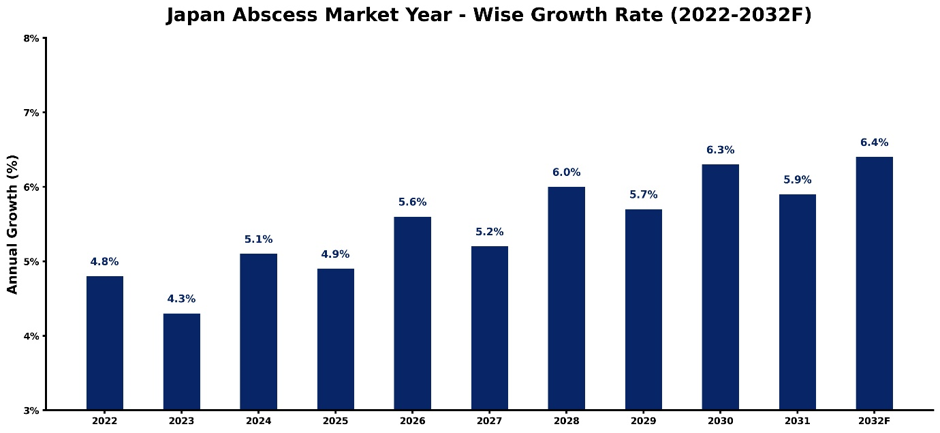 The table below represents the historical and projected growth rates for the Japan Abscess Market and the rationale behind each year’s performance.
| Year | Estimated Annual Growth (%) | Market Rationale |
| 2022 | 4.8% | Increased diagnosis of bacterial infections and growing hospital consultations for abscess-related conditions supported market demand. |
| 2023 | 4.3% | Variations in healthcare service utilization and treatment preferences resulted in comparatively moderate market growth. |
| 2024 | 5.1% | Improved availability of diagnostic imaging and increased adoption of outpatient infection management supported market expansion. |
| 2025 | 4.9% | Rising use of drainage procedures and improved clinical treatment protocols contributed to steady market development. |
| 2026 | 5.6% | Growing focus on infection prevention initiatives and healthcare modernization increased adoption of abscess treatment solutions. |
| 2027 | 5.2% | Expansion of minimally invasive treatment options and advanced wound care approaches supported continued market progression. |
| 2028 | 6% | Increasing elderly healthcare requirements and rising demand for effective infection management solutions accelerated market growth. |
| 2029 | 5.7% | Improved antimicrobial management practices and wider adoption of advanced diagnostic technologies maintained positive market momentum. |
| 2030 | 6.3% | Greater integration of digital healthcare systems and enhanced patient monitoring approaches created new growth opportunities. |
| 2031 | 5.9% | Increased healthcare technology adoption and evolving treatment strategies supported market advancement at a stable pace. |
| 2032 | 6.4% | Continuous innovation in infection treatment methods and improved healthcare accessibility sustained long-term market growth. |
Topics Covered in the Japan Abscess Market Report
Japan Abscess Market report thoroughly covers the market by infection type, treatment modality, patient demographic, and end-user. The market report provides an unbiased and detailed analysis of ongoing market trends, opportunities/high growth areas, and market drivers, which would help stakeholders devise and align their market strategies according to the current and future market dynamics.
Japan Abscess Market Highlights
| Report Name | Japan Abscess Market |
| Forecast period | 2026-2032 |
| CAGR | 5.9% |
| Growing Sector | Healthcare |
Japan Abscess Market Synopsis
Japan Abscess Market is expected to grow steadily owing to increasing prevalence of bacterial infections, rising demand for effective infection management, and continuous improvements in healthcare facilities. Japan’s advanced medical infrastructure, growing elderly population, and strong focus on early diagnosis are supporting the adoption of abscess treatment solutions. Besides, increasing utilization of minimally invasive drainage procedures, advanced imaging technologies, and antimicrobial therapies is further contributing to market development. Moreover, the government healthcare initiatives focusing on enhancing medical accessibility, infection control practices, and quality patient care are also supporting market expansion.
Evaluation of Growth Drivers in the Japan Abscess Market (2026-2032)
Below mentioned are some major growth drivers and their influence on market dynamics:
| Drivers | Primary Segments Affected | Why It Matters |
| Rising Incidence of Bacterial Skin Infections | Skin Abscess, Antibiotic Therapy | Increasing infection cases drive demand for diagnosis and treatment solutions while supporting growth of advanced infection management approaches. |
| Growing Geriatric Population | Elderly Patients, Internal Abscess | Older adults require improved infection management due to higher healthcare needs and increased vulnerability to complex bacterial infections. |
| Increasing Adoption of Minimally Invasive Procedures | Surgical Drainage, Minimally Invasive Treatment | Less invasive techniques improve patient outcomes and recovery, reduce procedural complications, and make the healthcare delivery more effective. |
| Advancements in Diagnostic Technologies | All Infection Types | A better-quality imaging and testing encourage faster abscess to identification while enabling precise treatment decisions and refined clinical management. |
| Expansion of Healthcare Infrastructure | Hospitals, Clinics, Treatment Centers | Improved medical access increases treatment availability and strengthens infection diagnosis, management, and specialized healthcare services. |
Japan Abscess Market is estimated to grow at a CAGR of 5.9% during 2026-2032. Japan has one of the highest proportions of elderly citizens globally, increasing the requirement for infection management and specialized healthcare services. According to Japan’s Ministry of Internal Affairs and Communications, people aged 65 years and above accounted for more than one-quarter of the country’s population in recent years, creating higher demand for medical services related to age-associated infections. Clinical studies published in Japan have highlighted that skin and soft tissue infections remain common conditions requiring drainage and antimicrobial management. Furthermore, the hospitals increasingly utilize ultrasound-based diagnosis to enhance detection accuracy and treatment planning.
Evaluation of Restraints in the Japan Abscess Market
Below mentioned are some major restraints and their influence on market dynamics:
| Restraints | Primary Segments Affected | What This Means |
| Antibiotic Resistance Concerns | Antibiotic Therapy | Reduced antibiotic effectiveness creates treatment challenges and requires alternative infection management strategies for better clinical outcomes. |
| High Treatment Costs for Complex Cases | Internal Abscess, Hospitals | The latest procedures raise healthcare expenditure and may limit accessibility to specialized abscess treatment services. |
| Limited Awareness of Early Symptoms | Skin Abscess, Dental Abscess | The delayed diagnosis may raise the treatment complexity and lead to prolonged recovery periods between affected patients. |
| Shortage of Specialized Healthcare Professionals | Surgical Drainage, Hospitals | Limited expertise can impact the latest treatment availability and reduce access to specialized infection management procedures. |
| Risk of Recurrence | All Infection Types | Repeated infections require continuous monitoring and effective treatment strategies to minimize recurrence risks and improve patient outcomes. |
Japan Abscess Market Challenges
In Japan, the treatment of abscesses is becoming more difficult because of antimicrobial resistance and the disparity of access to healthcare. Japan’s National Action Plan on Antimicrobial Resistance includes surveillance activities to monitor resistant organisms across healthcare facilities, and has expanded antibiotic stewardship programs throughout the country. Government demographic data shows around 29% of Japan’s population is aged 65 or older, resulting in a higher demand for infection management services. But the specialized resources for treating infectious diseases are still concentrated in larger urban centers, while Japan has more than 8,000 hospitals and 100,000-plus medical facilities.
Japan Abscess Market Trends
Below are some major trends contributing to the Japan Abscess Market Growth:
- Advanced Wound Care Technologies: The increasing adoption of advanced wound care products is delivering improved recovery outcomes for abscess treatment patients through advanced healing, infection control, and post-procedure care.
- Ultrasound-Guided Abscess Diagnosis: Point-of-care ultrasound technologies are being increasingly used by healthcare providers to improve identification of fluid collections and guide drainage procedures with greater precision, accuracy, and faster clinical decision-making.
- Growth of Minimally Invasive Treatment Approaches: The preference for less invasive procedures is increasing as hospitals focus on reducing recovery time, minimizing complications, and improving patient comfort through advanced surgical techniques.
Investment Opportunities in Japan Abscess Market
Here are some investment opportunities in the Japan Abscess Industry:
- Advanced Diagnostic Device Development: Investment in portable ultrasound systems and enhanced diagnostic technologies may help in faster detection and treatment planning of abscess conditions.
- Innovative Wound Care Solutions: Innovative dressings, infection monitoring tools and recovery-focused products developed by some companies can contribute to the ever-increasing demand for better patient outcomes.
- Minimally Invasive Treatment Technologies: The development of enhanced drainage devices and surgical tools offers opportunities as healthcare providers mostly prefer efficient treatment methods.
Government Regulations Introduced in the Japan Abscess Market
According to Japanese government data, the Ministry of Health, Labour and Welfare (MHLW) is strengthening infection prevention, antimicrobial stewardship, and healthcare quality improvement programs. Programs like Japan’s National Action Plan on Antimicrobial Resistance (AMR) promote appropriate antibiotic use, surveillance of resistant organisms, and improved infection management practices. In addition, Japan’s healthcare digitalization initiatives under the Digital Agency’s healthcare transformation programs support improved medical data management and coordination among healthcare providers. Moreover, these regulations encourage safer infection treatment approaches and strengthen the overall healthcare ecosystem for abscess management.
Future Insights of the Japan Abscess Market
The Japan Abscess Market is expected to witness constant growth supported by advancements in infection diagnosis, minimally invasive treatment methods, and improved healthcare accessibility. Japan recorded more than 36 million people aged 65 years and above according to government demographic statistics, increasing the need for effective management of age-related infections and wound complications. Also, hospitals are mostly adopting ultrasound-based procedures and innovative wound care approaches to improve clinical outcomes. Additionally, rise of investment in healthcare technology, antimicrobial research, and digital patient monitoring systems is expected to further strengthen future market opportunities.
Market Segmentation Analysis
This report presents a detailed analysis of the market segments along with their leading categories.
By Infection Type – Skin Abscess Led the Market, Internal Abscess to Witness Growth
According to Sachin, Senior Research Analyst at 6Wresearch, Skin Abscess dominated the Japan Abscess Market in 2025, accounting for approximately 62% of the market share, driven by its high prevalence and frequent requirement for drainage procedures and antibiotic treatment. However, during 2026–2032, Internal Abscess is projected to register a higher CAGR of around 7.2%, supported by increasing diagnosis of complex infections.
By Treatment Modality – Surgical Drainage Led the Market, Combination Therapy to Grow Rapidly
By treatment modality, Surgical Drainage dominated the Japan Abscess Market in 2025 with an estimated market share of around 68%, as drainage remains the primary clinical approach for removing accumulated pus. However, during 2026–2032, Combination Therapy is expected to witness significant growth with a CAGR of approximately 7.8%, driven by increasing adoption of integrated treatment approaches combining surgical drainage with antimicrobial therapies.
Note: Market size estimations and growth projections presented in this report are based on 6Wresearch's proprietary forecasting methodology, utilizing the latest available industry data, government publications, and primary research inputs.
Key attractiveness of the report
- 10 Years Market Numbers.
- Historical Data Starting from 2022 to 2025.
- Base Year: 2025.
- Forecast Data until 2032.
- Key Performance Indicators Impacting the Market.
- Major Upcoming Developments and Healthcare Initiatives.
Key Highlights of the Report:
- Japan Abscess Market Outlook
- Market Size of Japan Abscess Market, 2025
- Forecast of Japan Abscess Market, 2032
- Historical Data and Forecast of Japan Abscess Revenues & Volume for the Period 2022-2032
- Japan Abscess Market Trend Evolution
- Japan Abscess Market Drivers and Challenges
- Japan Abscess Price Trends
- Japan Abscess Porter's Five Forces
- Japan Abscess Industry Life Cycle
- Historical Data and Forecast of Japan Abscess Market Revenues & Volume By Infection Type for the Period 2022-2032
- Historical Data and Forecast of Japan Abscess Market Revenues & Volume By Skin Abscess for the Period 2022-2032
- Historical Data and Forecast of Japan Abscess Market Revenues & Volume By Internal Abscess for the Period 2022-2032
- Historical Data and Forecast of Japan Abscess Market Revenues & Volume By Post-Surgical Abscess for the Period 2022-2032
- Historical Data and Forecast of Japan Abscess Market Revenues & Volume By Dental Abscess for the Period 2022-2032
- Historical Data and Forecast of Japan Abscess Market Revenues & Volume By Treatment Modality for the Period 2022-2032
- Historical Data and Forecast of Japan Abscess Market Revenues & Volume By Antibiotic Therapy for the Period 2022-2032
- Historical Data and Forecast of Japan Abscess Market Revenues & Volume By Surgical Drainage for the Period 2022-2032
- Historical Data and Forecast of Japan Abscess Market Revenues & Volume By Minimally Invasive for the Period 2022-2032
- Historical Data and Forecast of Japan Abscess Market Revenues & Volume By Combination Therapy for the Period 2022-2032
- Historical Data and Forecast of Japan Abscess Market Revenues & Volume By Patient Demographic for the Period 2022-2032
- Historical Data and Forecast of Japan Abscess Market Revenues & Volume By Pediatric/Adult for the Period 2022-2032
- Historical Data and Forecast of Japan Abscess Market Revenues & Volume By Adult for the Period 2022-2032
- Historical Data and Forecast of Japan Abscess Market Revenues & Volume By Elderly for the Period 2022-2032
- Historical Data and Forecast of Japan Abscess Market Revenues & Volume By All Ages for the Period 2022-2032
- Japan Abscess Import Export Trade Statistics
- Market Opportunity Assessment By Infection Type
- Market Opportunity Assessment By Treatment Modality
- Market Opportunity Assessment By Patient Demographic
- Japan Abscess Top Companies Market Share
- Japan Abscess Competitive Benchmarking By Technical and Operational Parameters
- Japan Abscess Company Profiles
- Japan Abscess Key Strategic Recommendations
Market covered
The report subsequently covers the market by following segments and subsegments.
By Infection Type
- Skin Abscess
- Internal Abscess
- Post-Surgical Abscess
- Dental Abscess
By Treatment Modality
- Antibiotic Therapy
- Surgical Drainage
- Minimally Invasive
- Combination Therapy
By Patient Demographic
- Pediatric/Adult
- Adult
- Elderly
- All Ages






































