Japan Accelerometer Market Growth Rate
According to 6Wresearch internal database and industry insights, the Japan Accelerometer Market is growing at a compound annual growth rate (CAGR) of 11.2% during the forecast period (2026-2032).
Japan Accelerometer Market Year-wise Growth Rate and Key Drivers (2022-2032)
This graph illustrates the annual growth rates of the Japan Accelerometer Market from 2022 to 2032, highlighting a steady upward trajectory and projected market expansion over the forecast period.
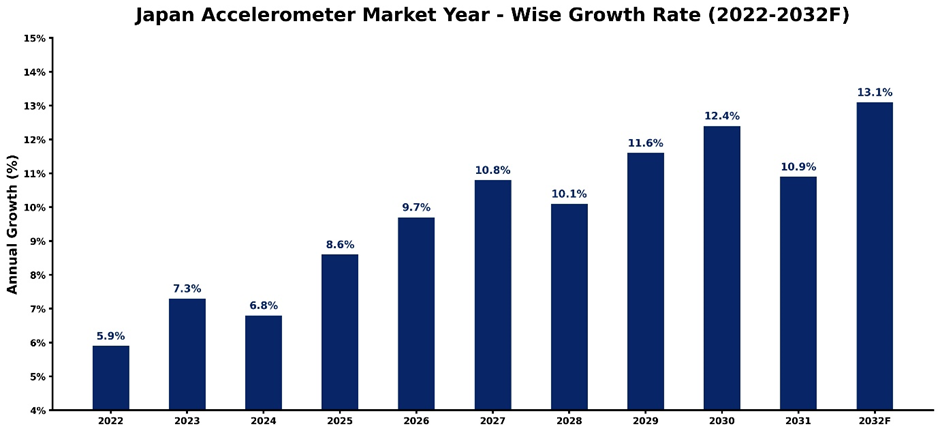
The table below represents the historical and projected growth rates for the Japan Accelerometer Market and the rationale behind each year’s performance.
| Year | Estimated Annual Growth (%) | Market Rationale |
| 2022 | 5.9% | Increasing demand for motion sensing components supported consumer electronics adoption. |
| 2023 | 7.3% | Growth in automotive safety systems increased accelerometer integration in vehicles. |
| 2024 | 6.8% | Expansion of wearable devices encouraged adoption of compact sensing solutions. |
| 2025 | 8.6% | Rising industrial automation applications strengthened demand for precision measurement technologies. |
| 2026 | 9.7% | Growing electric vehicle adoption accelerated the requirement for advanced motion sensors. |
| 2027 | 10.8% | Expansion of autonomous systems increased demand for multi-axis accelerometer solutions. |
| 2028 | 10.1% | Healthcare monitoring applications supported wider deployment of sensor-based technologies. |
| 2029 | 11.6% | Smart manufacturing initiatives increased adoption of industrial accelerometer applications. |
| 2030 | 12.4% | Aerospace technology advancements improved demand for high-accuracy sensing systems. |
| 2031 | 10.9% | Connected device expansion supported integration of advanced accelerometer technologies. |
| 2032 | 13.1% | Continued innovation in intelligent systems sustained long-term market development. |
Topics Covered in the Japan Accelerometer Market Report
Japan Accelerometer Market report thoroughly covers the market by type, axis, and end-use industry. The market report provides an unbiased and detailed analysis of ongoing market trends, opportunities/high growth areas, and market drivers, which would help stakeholders devise and align their market strategies according to the current and future market dynamics.
Japan Accelerometer MarketHighlights
| Report Name | Japan Accelerometer Market |
| Forecast period | 2026-2032 |
| CAGR | 11.2% |
| Growing Sector | Automotive Electronics |
Japan Accelerometer Market Synopsis
Japan Accelerometer Market is expected to grow steadily due to increasing adoption of motion sensing technologies across automotive safety systems, consumer electronics, industrial automation, and aerospace applications. With the strong manufacturing ecosystem and focus on smart mobility solutions are driving the deployment of high-precision accelerometers. Besides, the growth in demand for electric vehicles, autonomous driving technologies, and wearable healthcare devices is raising the requirement for compact and reliable sensing components. Moreover, the advancements in MEMS-based accelerometers are improving accuracy and enabling integration into next-generation electronic systems.
Evaluation of Growth Drivers in the Japan Accelerometer Market (2026-2032)
Below mentioned are some major growth drivers and their influence on market dynamics:
| Drivers | Primary Segments Affected | Why It Matters |
| Increasing Automotive Safety Systems | Automotive, ADAS, Vehicle Electronics | Improves vehicle stability control, enhances passenger safety, and enables reliable accident prevention technologies. |
| Growth of Electric Vehicles | Automotive, EV Platforms | Allows the accurate motion monitoring which improves vehicle control efficiency and supports advanced electric mobility systems. |
| Expansion of Industrial Automation | Industrial Equipment, Robotics | Drives a precise movement tracking, enhances operational accuracy, and refines the automated manufacturing processes. |
| Rising Wearable Healthcare Adoption | Healthcare, Consumer Electronics | Allows a continuous health monitoring, improves device functionality, and drives personalised healthcare applications. |
| Government Smart Manufacturing Initiatives | Industrial, Manufacturing Sector | Encourages advanced sensor adoption, promotes automation growth, and strengthens intelligent production capabilities. |
The Japan Accelerometer Market is projected to grow at a CAGR of 11.2% during 2026–2032. Japan’s sensor ecosystem continues to benefit from strong industrial automation and electronics manufacturing capabilities. Japan’s manufacturing sector contributes about 20% of national economic output which supports the demand for advanced sensing technologies. It has deployed more than 400,000 industrial robots, expanding requirements for accurate motion measurement. Moreover, the increasing adoption of MEMS technology, with sensor dimensions is lowered by more than 50% compared with traditional systems, is driving the compact and efficient applications.
Evaluation of Restraints in the Japan Accelerometer Market
Below mentioned are some major restraints and their influence on market dynamics:
| Restraints | Primary Segments Affected | What This Means |
| High Sensor Manufacturing Costs | MEMS Accelerometers, Industrial Applications | Advanced fabrication processes increase production expenses and require specialised manufacturing capabilities. |
| Calibration and Accuracy Requirements | Aerospace, Automotive Systems | Maintaining the precise measurements requires an extensive testing, validation, and performance optimisation procedures. |
| Component Supply Chain Dependency | Sensor Manufacturing, Electronics Industry | The dependence on specialised semiconductor materials impacts the production continuity and flexibility. |
| Integration Complexity | Automotive, Industrial Automation | Combination of sensors with advanced platforms requires a technical expertise and system compatibility. |
| Competition from Alternative Sensing Technologies | Sensor Manufacturers, Electronics Applications | Emerging technologies may create pricing pressure and influence future sensor adoption. |
Japan Accelerometer Market Challenges
Japan Accelerometer Market faces challenges associated with increasing sensor complexity, rising manufacturing requirements, and technological integration difficulties. The advanced accelerometer development requires precise MEMS fabrication and extensive reliability testing. Japan’s ageing workforce generates additional pressure on the availability of skilled engineering professionals with the increasing demand for automation-driven solutions. Also, the semiconductor manufacturing requires high precision, with fabrication processes involving advanced accuracy and specialised technologies. Furthermore, the increasing demand for low-power sensors requires continuous innovation to achieve an enhanced efficiency and reliability across automotive and healthcare applications.
Japan Accelerometer Market Trends
Below are some major trends contributing to the Japan Accelerometer Market Growth:
- Growth of MEMS-Based Accelerometers: With the increasing adoption of MEMS technology is improving sensor miniaturisation, reducing power requirements, and allowing incorporation into compact electronic devices.
- Autonomous Vehicle Sensor Integration: This growth of innovative driver assistance systems is raising the demand for precise accelerometers used in vehicle stability and navigation usages.
- Smart Manufacturing Adoption: The industrial facilities are applying connected sensing solutions to expand equipment monitoring, predictive maintenance, and operational effectivity.
Investment Opportunities in Japan Accelerometer Market
Here are some investment opportunities in the Japan Accelerometer Industry:
- Advanced MEMS Sensor Development: The investment in next-generation MEMS accelerometers supports the demand for smaller, and energy-efficient sensing solutions across automotive, healthcare, and consumer electronics applications.
- Automotive Motion Sensing Solutions: Development of accelerometer technologies for electric vehicles and autonomous systems can create opportunities in innovative mobility applications requiring better-quality stability and security performance.
- Industrial IoT Sensor Platforms: Investing in connected accelerometer solutions can support the smart factories and predictive maintenance systems by enhancing equipment monitoring and real-time performance analysis.
Top Leading Players in the Japan Accelerometer Market
Here are some top companies contributing to Japan Accelerometer Market Share:
1. Murata Manufacturing Co., Ltd.
| Company Name | Murata Manufacturing Co., Ltd. |
|---|---|
| Established Year | 1944 |
| Headquarters | Kyoto, Japan |
| Official Website | Click Here |
Murata Manufacturing Co., Ltd. develops advanced sensor technologies including MEMS-based accelerometers, offering compact motion sensing solutions for automotive electronics, industrial systems, and consumer devices.
2. TDK Corporation
| Company Name | TDK Corporation |
|---|---|
| Established Year | 1935 |
| Headquarters | Tokyo, Japan |
| Official Website | Click Here |
TDK Corporation provides advanced sensor solutions including accelerometers, motion sensors, and electronic components used across automotive, industrial, and consumer electronics applications.
3. Nidec Corporation
| Company Name | Nidec Corporation |
|---|---|
| Established Year | 1973 |
| Headquarters | Kyoto, Japan |
| Official Website | Click Here |
Nidec Corporation develops precision technologies and motion-related components supporting industrial automation, automotive systems, and electronic applications.
4. Omron Corporation
| Company Name | Omron Corporation |
|---|---|
| Established Year | 1933 |
| Headquarters | Kyoto, Japan |
| Official Website | Click Here |
Omron Corporation provides sensing and automation technologies including industrial sensors and control systems and support manufacturing automation and intelligent systems requiring accurate motion detection.
Government Regulations Introduced in the Japan Accelerometer Market
According to Japanese government data, the Ministry of Economy, Trade and Industry (METI) supports the advanced manufacturing, semiconductor development, and industrial digitalisation through programmes like the Society 5.0 framework and the Connected Industries initiative. Also, these programmes encourage adoption of smart factories and advanced sensor technologies. In addition, Japan’s Green Growth Strategy promotes electric mobility and energy-efficient technologies, increasing demand for automotive sensing solutions. Government support for semiconductor supply chain strengthening and research collaboration between industries and universities is further improving domestic capabilities in MEMS and sensor innovation.
Future Insights of the Japan Accelerometer Market
Japan Accelerometer Market is expected to experience sustained growth due to increasing adoption of smart mobility, industrial automation, and intelligent electronic systems. Japan’s automotive industry continues to remain a major technology contributor, with electric and hybrid vehicles accounting for approximately 50% of new passenger vehicle sales in recent years. The country maintains one of the world’s highest robot densities, with more than 300 robots per 10,000 manufacturing employees, supporting demand for industrial motion sensors. Increasing investment in autonomous driving research, healthcare technology, and MEMS innovation is expected to create new opportunities for accelerometer manufacturers through 2032.
Market Segmentation Analysis
This report presents a detailed analysis of the Japan Accelerometer Market segments along with their leading categories.
By Type – DC Response Led the Market, AC Response to Witness Strong Growth
According to Sumit Sagar, Senior Research Analyst at 6Wresearch, DC Response accelerometers dominated the Japan Accelerometer Market till 2025 with an estimated 58% market share, driven by their consumer devices requiring continuous low-frequency motion measurement. However, during 2026–2032, AC Response accelerometers are expected to witness significant growth with a CAGR of around 8.9%, supported by high-frequency industrial applications requiring precise dynamic measurements.
By Axis – 3-Axis Led the Market, 2-Axis Accelerometers to Maintain Growth Momentum
3-Axis accelerometers dominated the Japan Accelerometer Market till 2025 with an estimated 52% market share, supported by cutting-edge motion tracking applications which requires the multi-directional sensing capabilities. However, during 2026–2032, 2-Axis accelerometers are expected to grow steadily with a CAGR of around 8.2%, supported by specialised motion-control applications where dual-axis measurement is sufficient.
By End-use Industry – Consumer Electronics Led the Market, Automotive Segment to Grow Rapidly
Consumer Electronics dominated the Japan Accelerometer Market till 2025 with an estimated 34% market share, driven by smart consumer products requiring compact motion sensing technologies. However, during 2026–2032, Automotive is expected to emerge as the fastest-growing segment with a CAGR of around 10.1%, supported by autonomous mobility solutions requiring accurate acceleration measurement.
Note: Market size estimations and growth projections presented in this report are based on 6Wresearch's proprietary forecasting methodology, utilizing the latest available industry data, government publications, and primary research inputs.
Key attractiveness of the report
- 10 Years Market Numbers.
- Historical Data Starting from 2022 to 2025.
- Base Year: 2025.
- Forecast Data until 2032.
- Key Performance Indicators Impacting the Market.
- Major Upcoming Developments and Projects.
Key Highlights of the Report:
- Japan Accelerometer Market Outlook
- Market Size of Japan Accelerometer Market, 2025
- Forecast of Japan Accelerometer Market, 2032
- Historical Data and Forecast of Japan Accelerometer Revenues & Volume for the Period 2022-2032
- Japan Accelerometer Market Trend Evolution
- Japan Accelerometer Market Drivers and Challenges
- Japan Accelerometer Price Trends
- Japan Accelerometer Porter's Five Forces
- Japan Accelerometer Industry Life Cycle
- Historical Data and Forecast of Japan Accelerometer Market Revenues & Volume By Type for the Period 2022-2032
- Historical Data and Forecast of Japan Accelerometer Market Revenues & Volume By AC Response for the Period 2022-2032
- Historical Data and Forecast of Japan Accelerometer Market Revenues & Volume By DC Response for the Period 2022-2032
- Historical Data and Forecast of Japan Accelerometer Market Revenues & Volume By Axis for the Period 2022-2032
- Historical Data and Forecast of Japan Accelerometer Market Revenues & Volume By 1-Axis for the Period 2022-2032
- Historical Data and Forecast of Japan Accelerometer Market Revenues & Volume By 2-Axis for the Period 2022-2032
- Historical Data and Forecast of Japan Accelerometer Market Revenues & Volume By 3-Axis for the Period 2022-2032
- Historical Data and Forecast of Japan Accelerometer Market Revenues & Volume By End-use Industry for the Period 2022-2032
- Historical Data and Forecast of Japan Accelerometer Market Revenues & Volume By Consumer Electronics for the Period 2022-2032
- Historical Data and Forecast of Japan Accelerometer Market Revenues & Volume By Automotive for the Period 2022-2032
- Historical Data and Forecast of Japan Accelerometer Market Revenues & Volume By Healthcare for the Period 2022-2032
- Historical Data and Forecast of Japan Accelerometer Market Revenues & Volume By Aerospace & Defense for the Period 2022-2032
- Historical Data and Forecast of Japan Accelerometer Market Revenues & Volume By Industrial for the Period 2022-2032
- Historical Data and Forecast of Japan Accelerometer Market Revenues & Volume By Others for the Period 2022-2032
- Japan Accelerometer Import Export Trade Statistics
- Market Opportunity Assessment By Type
- Market Opportunity Assessment By Axis
- Market Opportunity Assessment By End-use Industry
- Japan Accelerometer Top Companies Market Share
- Japan Accelerometer Competitive Benchmarking By Technical and Operational Parameters
- Japan Accelerometer Company Profiles
- Japan Accelerometer Key Strategic Recommendations
Market covered
The report subsequently covers the market by following segments and subsegments.
By Type
- AC Response
- DC Response
By Axis
- 1-Axis
- 2-Axis
- 3-Axis
By End-use Industry
- Consumer Electronics
- Automotive
- Healthcare
- Aerospace & Defense
- Industrial
- Others






































