Japan Acetic Acid Market Growth Rate
According to 6Wresearch internal database and industry insights, the Japan Acetic Acid Market is growing at a compound annual growth rate (CAGR) of 4.8% during the forecast period (2026-2032).
Japan Acetic Acid Market Year-wise Growth Rate and Key Drivers (2022-2032)
This graph illustrates the annual growth rates of the Japan Acetic Acid Market from 2022 to 2032, highlighting a steady upward trajectory and projected market expansion over the forecast period.
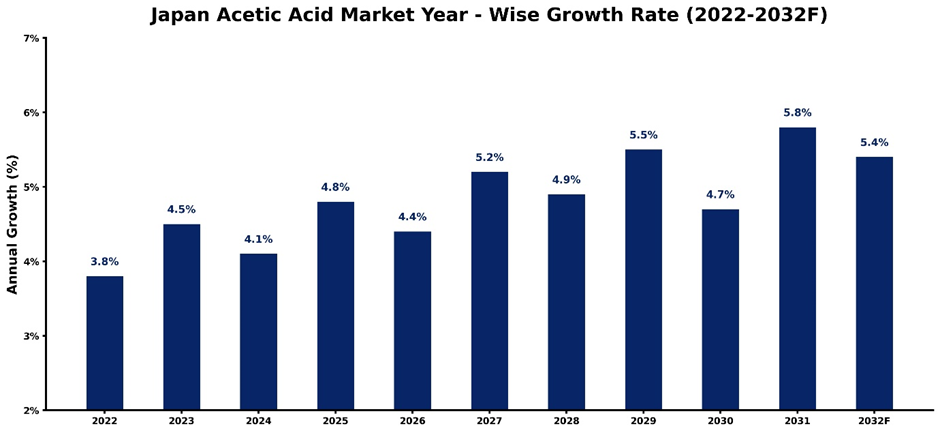
The table below represents the historical and projected growth rates for the Japan Acetic Acid Market and the rationale behind each year's performance.
| Year | Estimated Annual Growth (%) | Market Rationale |
| 2022 | 3.8% | Recovery in chemical manufacturing supported acetic acid consumption. |
| 2023 | 4.5% | Higher demand from coatings and adhesive industries strengthened market activity. |
| 2024 | 4.1% | Growth in food processing and pharmaceutical applications sustained consumption. |
| 2025 | 4.8% | Expansion of specialty chemicals increased industrial utilization. |
| 2026 | 4.4% | Rising downstream chemical production supported market demand. |
| 2027 | 5.2% | Vinyl acetate monomer manufacturing accelerated acetic acid consumption. |
| 2028 | 4.9% | Strong demand from acetate esters and solvents expanded applications. |
| 2029 | 5.5% | Industrial modernization increased specialty chemical production. |
| 2030 | 4.7% | Sustainable chemical manufacturing encouraged efficient production technologies. |
| 2031 | 5.8% | High-value chemical applications strengthened domestic demand. |
| 2032 | 5.4% | Continued industrial innovation supported long-term market expansion. |
Topics Covered in the Japan Acetic Acid Market Report
Japan Acetic Acid Market report thoroughly covers the market by application. The market report provides an unbiased and detailed analysis of ongoing market trends, opportunities/high-growth areas, and market drivers, which would help stakeholders devise and align their market strategies according to the current and future market dynamics.
Japan Acetic Acid Market Highlights
| Report Name | Japan Acetic Acid Market |
| Forecast period | 2026-2032 |
| CAGR | 4.8% |
| Growing Sector | Chemicals |
Japan Acetic Acid Market Synopsis
The Japan Acetic Acid Market is expected to witness steady growth, backed by rising demand from downstream chemical industries and increasing consumption in food processing, pharmaceuticals, textiles and industrial manufacturing applications. Acetic Acid is a versatile organic acid used as a food preservative, acidity regulator, and chemical intermediate across food, industrial, and specialty chemical applications. Furthermore, the country's innovative chemical manufacturing framework, focus on high-value specialty chemicals, and investments in the sustainable industrial processes are expected to support market growth throughout the forecast period.
Evaluation of Growth Drivers in the Japan Acetic Acid Market (2026-2032)
Below mentioned are some major growth drivers and their influence on market dynamics:
| Drivers | Primary Segments Affected | Why It Matters |
| Increasing Vinyl Acetate Monomer Production | Vinyl Acetate Monomer | Expands demand for acetic acid feedstock and supports growth across adhesive, coating, and polymer manufacturing industries. |
| Growth of Specialty Chemical Manufacturing | Acetate Esters, Acetic Anhydride | Enables production of high-value chemicals and improves applications in industrial, pharmaceutical, and manufacturing sectors. |
| Rising Pharmaceutical Manufacturing | Acetic Anhydride, Other Applications | Increases total industrial demand and the demand for chemical intermediates used in the manufacture of pharmaceuticals. |
| Expanding Food Processing Industry | Other Applications | It increases the consumption of food-grade acetic acid, and helps applications in preservation, flavoring and acidity control. |
| Sustainable Chemical Production Initiatives | All Applications | Promotes efficient and cleaner manufacturing practices while improving environmental performance and resource appliction. |
The Japan Acetic Acid Market is projected to grow at a CAGR of 4.8% during 2026–2032. Japan remains one of Asia's leading producers of high-value chemicals which is supported by an innovative petrochemical manufacturing ecosystem. The country's chemical industry plays an important role in supplying raw materials for automotive, electronics, and packaging sectors. Moreover, the acetic acid continues to serve as a critical intermediate for vinyl acetate monomer, acetate esters, and sanitized terephthalic acid production that is reinforced by diversified downstream manufacturing activities.
Evaluation of Restraints in the Japan Acetic Acid Market
Below mentioned are some major restraints and their influence on market dynam
| Restraints | Primary Segments Affected | What This Means |
| Feedstock Price Volatility | All Applications | Raises production costs, affects pricing stability, and creates uncertainty across the acetic acid supply chain. |
| Stringent Environmental Regulations | Chemical Manufacturing | Requires additional compliance investments, advanced technologies, and operational adjustments to meet regulatory standards. |
| Competition from Alternative Chemicals | Industrial Applications | Limits growth in selected applications and creates pressure for improvement of product performance and competitiveness. |
| High Energy Consumption | Chemical Plants | Increases manufacturing cost, reduces efficiency in operations, and encourages use of energy saving production methods. |
| Supply Chain Dependency | Industrial Production | May disrupt raw material availability, impact production continuity, and create procurement challenges for manufacturers. |
Japan Acetic Acid Market Challenges
The Japan Acetic Acid Market faces many challenges which are related to feedstock price volatility, energy-intensive production, and regulatory compliance requirements. Japan’s chemical industry has undergone input cost pressures, with industrial producer prices recording annual fluctuations of approximately 3–5% in recent years. Also, the country imports nearly 90% of its energy resources, increasing exposure to global energy price movements. Additionally, Japan’s 46% greenhouse gas reduction target by 2030 compared with 2013 levels requires chemical producers to invest in low-carbon manufacturing technologies which raises operational complexity and costs.
Japan Acetic Acid Market Trends
Below are some major trends contributing to the Japan Acetic Acid Market Growth:
- Expansion of Specialty Chemicals: Growing production of specialty chemicals is increasing the demand for high-purity acetic acid across multiple industrial applications.
- Sustainable Manufacturing Practices: Chemical manufacturers are adopting cleaner production technologies to improve resource efficiency and reduce environmental impact.
- Growth in Food and Pharmaceutical Applications: Increasing use of acetic acid in food preservation, pharmaceutical intermediates, and healthcare products continues to support the market expansion.
Investment Opportunities in Japan Acetic Acid Market
Here are some investment opportunities in the Japan Acetic Acid Industry:
- High-Purity Acetic Acid Production: The investments in innovative purification technologies can address increasing demand from pharmaceutical and electronics industries.
- Specialty Chemical Manufacturing: The construction of downstream chemical production facilities provides more value-added applications for acetic acid.
- Sustainable Chemical Processing: The competitiveness is enhanced by investment in energy-efficient manufacturing systems and environment-friendly production technologies.
Leading Players in the Japan Acetic Acid Market
Here are some top companies contributing to Japan Acetic Acid Market Share:
1. Daicel Corporation
| Company Name | Daicel Corporation |
|---|---|
| Established Year | 1919 |
| Headquarters | Osaka, Japan |
| Official Website | Click Here |
Daicel Corporation is one of Japan's leading chemical manufacturers, producing high-value chemical products for industrial, pharmaceutical, automotive, and specialty applications.
2. Mitsubishi Chemical Group Corporation
| Company Name | Mitsubishi Chemical Group Corporation |
|---|---|
| Established Year | 1933 |
| Headquarters | Tokyo, Japan |
| Official Website | Click Here |
Mitsubishi Chemical Group Corporation supplies advanced chemical intermediates for coatings, electronics, and industrial manufacturing while continuously investing in environmentally responsible production processes.
3. Kuraray Co., Ltd.
| Company Name | Kuraray Co., Ltd. |
|---|---|
| Established Year | 1926 |
| Headquarters | Tokyo, Japan |
| Official Website | Click Here |
Kuraray Co., Ltd. chemical business extensively utilizes acetic acid derivatives for producing high-performance polymers and industrial materials used across diverse manufacturing industries.
4.Resonac Corporation
| Company Name | Resonac Corporation |
|---|---|
| Established Year | 1962 |
| Headquarters | Tokyo, Japan |
| Official Website | Click Here |
Resonac Corporation provides advanced chemical materials and industrial solutions supporting electronics, automotive, infrastructure, and chemical processing industries.
Government Regulations Introduced in the Japan Acetic Acid Market
According to the Japanese government data, the Ministry of Economy, Trade and Industry (METI) promotes a sustainable industrial development over the Green Growth Strategy through Achieving Carbon Neutrality by 2050, supporting the chemical manufacturers to adopt energy-efficient production technologies with low-carbon manufacturing processes. In addition, Japan’s Chemical Substances Control Law (CSCL) controls the manufacture and use of industrial chemicals to protect human health and the environment. Moreover, the government also promotes resource-efficient manufacturing under the GX (Green Transformation) Promotion Strategy by encouraging investment in cleaner production technologies and advanced chemical processing facilities.
Future Insights of the Japan Acetic Acid Market
The Japan Acetic Acid Market is expected to maintain stable growth as demand for high-purity chemical intermediates increases across specialty chemicals, pharmaceuticals and advanced materials manufacturing. Japan's well-established chemical industry continues to invest in sustainable production technologies and process optimization to improve operational efficiency. Growing applications of acetic acid in value-added downstream products, combined with increasing research into environmentally responsible manufacturing methods and circular chemical production, are expected to strengthen long-term market opportunities throughout the forecast period.
Market Segmentation Analysis
This report presents a detailed analysis of the market segments along with their leading categories.
By Application – Vinyl Acetate Monomer Led the Market, Acetate Esters to Witness Strong Growth
According to Sumit Sagar, Senior Research Analyst at 6Wresearch, Vinyl Acetate Monomer dominated the Japan Acetic Acid Market till 2025 with an estimated 42% market share, driven by extensive utilization of acetic acid as a key feedstock in the production of adhesives and polymer-based materials. However, during 2026–2032, Acetate Esters are anticipated to emerge as the fastest-growing application segment with a CAGR of around 4.8%, supported by increasing demand from solvents and specialty chemical manufacturing industries.
Note: Market size estimations and growth projections presented in this report are based on 6Wresearch's proprietary forecasting methodology, utilizing the latest available industry data, government publications, primary research inputs, and industry developments.
Key Attractiveness of the Report
- 10 Years Market Numbers.
- Historical Data Starting from 2022 to 2025.
- Base Year: 2025.
- Forecast Data until 2032.
- Key Performance Indicators Impacting the Market.
- Major Upcoming Developments and Projects.
Key Highlights of the Report:
- Japan Acetic Acid Market Outlook
- Market Size of Japan Acetic Acid Market, 2025
- Forecast of Japan Acetic Acid Market, 2032
- Historical Data and Forecast of Japan Acetic Acid Revenues & Volume for the Period 2022-2032
- Japan Acetic Acid Market Trend Evolution
- Japan Acetic Acid Market Drivers and Challenges
- Japan Acetic Acid Price Trends
- Japan Acetic Acid Porter's Five Forces
- Japan Acetic Acid Industry Life Cycle
- Historical Data and Forecast of Japan Acetic Acid Market Revenues & Volume By Application for the Period 2022-2032
- Historical Data and Forecast of Japan Acetic Acid Market Revenues & Volume By Vinyl Acetate Monomer for the Period 2022-2032
- Historical Data and Forecast of Japan Acetic Acid Market Revenues & Volume By Acetic Anhydride for the Period 2022-2032
- Historical Data and Forecast of Japan Acetic Acid Market Revenues & Volume By Acetate Esters for the Period 2022-2032
- Historical Data and Forecast of Japan Acetic Acid Market Revenues & Volume By Purified Terephthalic Acid for the Period 2022-2032
- Historical Data and Forecast of Japan Acetic Acid Market Revenues & Volume By Ethanol for the Period 2022-2032
- Historical Data and Forecast of Japan Acetic Acid Market Revenues & Volume By Other Application for the Period 2022-2032
- Japan Acetic Acid Import Export Trade Statistics
- Market Opportunity Assessment By Application
- Japan Acetic Acid Top Companies Market Share
- Japan Acetic Acid Competitive Benchmarking By Technical and Operational Parameters
- Japan Acetic Acid Company Profiles
- Japan Acetic Acid Key Strategic Recommendations
Market Covered
The report subsequently covers the market by the following segments and subsegments.
By Application
- Vinyl Acetate Monomer
- Acetic Anhydride
- Acetate Esters
- Purified Terephthalic Acid
- Ethanol
- Other Application






































