Japan Acoustic Guitar Market Growth Rate
According to 6Wresearch internal database and industry insights, the Japan Acoustic Guitar Market is growing at a compound annual growth rate (CAGR) of 5.8% during the forecast period (2026-2032).
Japan Acoustic Guitar Market Year-wise Growth Rate and Key Drivers (2022-2032)
This graph illustrates the annual growth rates of the Japan Acoustic Guitar Market from 2022 to 2032, highlighting a steady upward trajectory and projected market expansion over the forecast period.
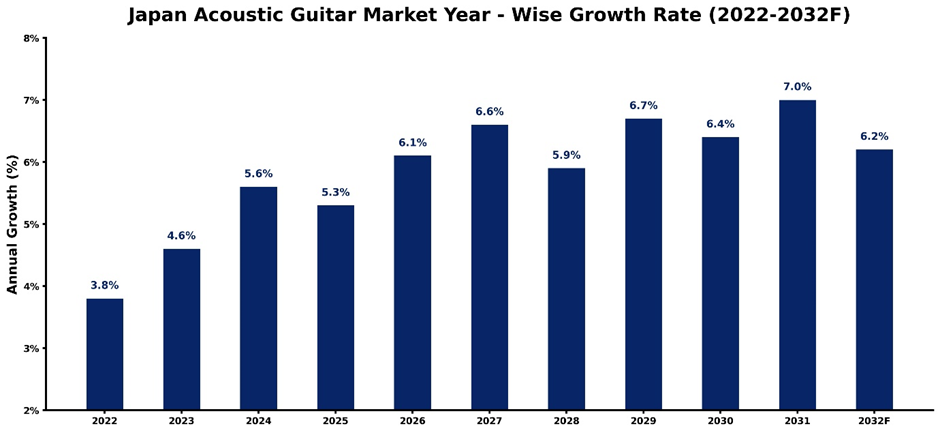
The table below represents the historical and projected growth rates for the Japan Acoustic Guitar Market and the rationale behind each year’s performance.
| Year | Estimated Annual Growth (%) | Market Rationale |
| 2022 | 3.8% | Growing music learning interest increased demand for acoustic guitars. |
| 2023 | 4.6% | Online music education supported wider guitar adoption among beginners. |
| 2024 | 5.6% | Rising live performances encouraged demand for quality acoustic instruments. |
| 2025 | 5.3% | Premium guitar preferences strengthened sales of advanced acoustic models. |
| 2026 | 6.1% | Music schools and digital learning platforms supported market expansion. |
| 2027 | 6.6% | Expanding hobby-based music participation accelerated acoustic guitar purchases. |
| 2028 | 5.9% | Increasing professional usage boosted demand for performance-oriented guitars. |
| 2029 | 6.7% | Sustainable material adoption influenced acoustic guitar product development. |
| 2030 | 6.4% | Changing consumer spending patterns slightly moderated instrument market growth. |
| 2031 | 7% | Product innovation and smart acoustic technologies-maintained market growth. |
| 2032 | 6.2% | Expanding music culture and premium instrument demand sustained growth. |
Topics Covered in the Japan Acoustic Guitar Market Report
Japan Acoustic Guitar Market report thoroughly covers the market by product type and application. The market report provides an unbiased and detailed analysis of ongoing market trends, opportunities/high growth areas, and market drivers, which would help stakeholders devise and align their market strategies according to the current and future market dynamics.
Japan Acoustic Guitar Market Highlights
| Report Name | Japan Acoustic Guitar Market |
| Forecast period | 2026-2032 |
| CAGR | 5.8% |
| Growing Sector | Musical Instruments |
Japan Acoustic Guitar Market Synopsis
Japan Acoustic Guitar Market is expected to grow steadily owing to the country’s strong musical heritage, increasing participation in music education, and rising demand for acoustic instruments among professional performers and hobby musicians. Acoustic Guitar is a type of musical instrument that produces sound acoustically through the vibration of its strings and the resonance of its hollow body, without requiring electronic amplification. The growing popularity of online guitar lessons and independent artists is further supporting acoustic guitar adoption. In addition, demand for handcrafted instruments and customized guitar designs is creating new opportunities for manufacturers and retailers.
Evaluation of Growth Drivers in the Japan Acoustic Guitar Market (2026-2032)
Below mentioned are some major growth drivers and their influence on market dynamics:
| Drivers | Primary Segments Affected | Why It Matters |
| Growth of Music Education Programs | Teaching, Nylon String Guitars | Supports the beginner instrument adoption over structured learning programs and raising interest in musical skills development. |
| Rising Live Performance Culture | Perform, Steel String Guitars | Drives demand for professional guitars by growing requirements for reliable stage-ready performance instruments. |
| Expansion of Online Music Learning | Teaching, Entry-Level Guitars | Flexibility for learners with digital lessons with more virtual music learning options. |
| Demand for Premium Handcrafted Instruments | Steel String Guitars, Professional Users | High demand for top quality products with a superior craftsmanship and durability and growth of customized acoustic performance qualities. |
| Sustainable Guitar Manufacturing | Other Product Categories | Encourages eco-friendly product development through responsible materials and eco-friendly conscious manufacturing practices. |
The Japan Acoustic Guitar Market is projected to grow at a CAGR of 5.8% during 2026–2032. Japan’s acoustic guitar industry benefits from a mature musical culture supported by manufacturers, retailers, and educational institutions. The guitar business includes acoustic guitars, electric guitars, and related equipment, reflecting its long-term presence in the global guitar industry. Japanese music schools and the independent learning platforms continue to support guitar adoption among students and hobbyists. Furthermore, the manufacturers are also focusing on improved craftsmanship, lightweight designs, and acoustic-electric technologies to meet changing consumer preferences.
Evaluation of Restraints in the Japan Acoustic Guitar Market
Below mentioned are some major restraints and their influence on market dynamics:
| Restraints | Primary Segments Affected | What This Means |
| High Premium Guitar Prices | Steel String Guitars | Limits adoption among price-sensitive buyers due to increased instrument costs and premium manufacturing expenses. |
| Competition from Digital Instruments | All Product Categories | Declining demand from some consumers who prefer electronic alternatives and virtual music solutions. |
| Limited Availability of Skilled Craftsmen | Handmade Guitars | The skill and ability to make the hand-built instruments which limit the scale of production. |
| Changing Entertainment Preferences | Perform Applications | Impacts the demand for traditional instruments as audiences move towards digital and the alternative forms of entertainment. |
| Dependence on Quality Wood Materials | Premium Acoustic Guitars | Creates sourcing challenges due to material availability, sustainability concerns, and production requirements. |
Japan Acoustic Guitar Market Challenges
Japan Acoustic Guitar Market faces challenges that are related to finest pricing and competition from digital music alternatives. Japan’s guitar sales volume reached about 191.32 thousand units in 2023, replicating continued consumer interest but also emphasizing the need for manufacturers to maintain an innovation and product differentiation. The Japanese musical instrument industry recorded around 69.6% import dependency in 2024, creating a competitive pressure for domestic producers and growing focus on effective manufacturing. Additionally, Japan’s music industry continues to adapt towards digital transformation and new engagement models.
Japan Acoustic Guitar Market Trends
Below are some major trends contributing to the Japan Acoustic Guitar Market Growth:
- Growth of Online Music Education: The digital learning platforms are growing access to guitar lessons and supporting new users to purchase acoustic instruments over convenient virtual training options.
- Premium Handmade Guitar Demand: Professional musicians and collectors are showing improved interest in customized guitars with superior craftsmanship, unique designs, and top acoustic performance.
- Acoustic-Electric Guitar Adoption: Hybrid models with built-in amplification features are obtaining popularity between performers requiring live sound flexibility, improved stage performance, and recording versatility.
Investment Opportunities in Japan Acoustic Guitar Market
Here are some investment opportunities in the Japan Acoustic Guitar Industry:
- Digital Music Learning Integration: Investment in guitar learning platforms and connected educational tools can support a beginner to adopt through personalized practice and accessible music training experiences.
- Premium Custom Guitar Manufacturing: The growth of handcrafted, personalized instruments that offer unique designs, high-quality craftsmanship and altered acoustic properties may attract professional musicians and collectors.
- Music Experience Retail Models: The co-operative stores and guitar testing experiences can enhance a customer’s engagement and buying decision by providing a full product demo and customized purchase aids.
Leading Players in the Japan Acoustic Guitar Market
Here are some top companies contributing to Japan Acoustic Guitar Market Share:
1. Yamaha Corporation
| Company Name | Yamaha Corporation |
|---|---|
| Established Year | 1887 |
| Headquarters | Hamamatsu, Japan |
| Official Website | Click Here |
Yamaha Corporation is one of Japan’s leading musical instrument manufacturers, offering a broad portfolio of acoustic guitars, classical guitars, electric guitars, and related musical equipment.
2. Takamine Musical Instruments Manufacturing Co., Ltd.
| Company Name | Takamine Musical Instruments Manufacturing Co., Ltd. |
|---|---|
| Established Year | 1959 |
| Headquarters | Nakatsugawa, Gifu, Japan |
| Official Website | Click Here |
Takamine Musical Instruments Manufacturing Co., Ltd. is a Japanese acoustic guitar manufacturer specializing in steel-string acoustic guitars, classical guitars, and acoustic-electric instruments.
3. Ibanez (Hoshino Gakki Co., Ltd.)
| Company Name | Ibanez (Hoshino Gakki Co., Ltd.) |
|---|---|
| Established Year | 1908 |
| Headquarters | Nagoya, Japan |
| Official Website | Click Here |
Ibanez, operated by Hoshino Gakki, is a Japanese musical instrument brand known for guitars, basses, and professional performance instruments.
4. K.Yairi (K. Yairi & Co., Ltd.)
| Company Name | K.Yairi (K. Yairi & Co., Ltd.) |
|---|---|
| Established Year | 1935 |
| Headquarters | Kani, Gifu, Japan |
| Official Website | Click Here |
K.Yairi (K. Yairi & Co., Ltd.) emphasizes traditional craftsmanship and customized instrument production, attracting professional musicians and collectors seeking high-quality acoustic instruments.
5. Fender Musical Instruments Corporation
| Company Name | Fender Musical Instruments Corporation |
|---|---|
| Established Year | 1946 |
| Headquarters | Los Angeles, United States |
| Official Website | Click Here |
Fender Musical Instruments Corporation provides acoustic guitar models and musical equipment serving beginner, professional, and performance-oriented users.
Government Regulations Introduced in the Japan Acoustic Guitar Market
According to Japanese government initiatives, the Agency for Cultural Affairs promotes cultural activities and creative industries over programs supporting music and cultural development. Schemes like the Cultural Promotion Framework support the participation in artistic activities, including music learning and performance. Additionally, Japan’s Ministry of Education, Culture, Sports, Science and Technology (MEXT) continues to support the music education programs in schools, reinforcing interest in musical instruments among students. Furthermore, government efforts toward preserving traditional craftsmanship and supporting the local manufacturing ecosystems also benefit Japanese instrument makers producing handcrafted acoustic guitars.
Future Insights of the Japan Acoustic Guitar Market
Japan Acoustic Guitar Market is expected to benefit from increasing music education participation, premium instrument demand, and digital learning integration. Manufacturers are likely to focus on sustainable materials and acoustic-electric innovations to attract modern musicians. The combination of online platforms and interactive learning tools is estimated to improve accessibility for beginners while supporting experienced players. Furthermore, the Japanese brands with strong craftsmanship capabilities are positioned to benefit from evolving consumer preferences toward quality, durability, and personalized musical experiences.
Market Segmentation Analysis
This report presents a detailed analysis of the market segments along with their leading categories.
By Product – Steel Stringed Guitars Led the Market, Nylon/Gut Stringed Guitars to Witness Steady Growth
According to Ravi Bhandari, Senior Research Analyst at 6Wresearch, Steel Stringed Guitars dominated the Japan Acoustic Guitar Market till 2025 with an estimated 56% market share, driven by strong demand among professional performers and hobby players due to their suitability across multiple music genres. However, during 2026–2032, Nylon/Gut Stringed Guitars are expected to witness steady growth with a CAGR of around 5.9%, supported by increasing demand from beginner musicians seeking comfortable playing experiences.
By Application – Perform Led the Market, Teaching Set for Strong Growth
Perform applications dominated the Japan Acoustic Guitar Market till 2025 with an estimated 61% market share, driven by demand from professional musicians and independent creators using acoustic guitars for concerts and music events. However, during 2026–2032, Teaching Set applications are expected to emerge as the fastest-growing segment with a CAGR of around 6.4%, supported by increasing interest among students and beginners in acquiring acoustic instruments.
Note: Market size estimations and growth projections presented in this report are based on 6Wresearch's proprietary forecasting methodology, utilizing the latest available industry data, government publications, and primary research inputs.
Key attractiveness of the report
- 10 Years Market Numbers.
- istorical Data Starting from 2022 to 2025.
- Base Year: 2025.
- Forecast Data until 2032.
- Key Performance Indicators Impacting the Market.
- Major Upcoming Developments and Projects.
Key Highlights of the Report:
- Japan Acoustic Guitar Market Outlook
- Market Size of Japan Acoustic Guitar Market, 2025
- Forecast of Japan Acoustic Guitar Market, 2032
- Historical Data and Forecast of Japan Acoustic Guitar Revenues & Volume for the Period 2022-2032
- Japan Acoustic Guitar Market Trend Evolution
- Japan Acoustic Guitar Market Drivers and Challenges
- Japan Acoustic Guitar Price Trends
- Japan Acoustic Guitar Porter's Five Forces
- Japan Acoustic Guitar Industry Life Cycle
- Historical Data and Forecast of Japan Acoustic Guitar Market Revenues & Volume By Product for the Period 2022-2032
- Historical Data and Forecast of Japan Acoustic Guitar Market Revenues & Volume By Nylon/gut Stringed Guitars for the Period 2022-2032
- Historical Data and Forecast of Japan Acoustic Guitar Market Revenues & Volume By Steel Stringed Guitars for the Period 2022-2032
- Historical Data and Forecast of Japan Acoustic Guitar Market Revenues & Volume By Other for the Period 2022-2032
- Historical Data and Forecast of Japan Acoustic Guitar Market Revenues & Volume By Application for the Period 2022-2032
- Historical Data and Forecast of Japan Acoustic Guitar Market Revenues & Volume By Perform for the Period 2022-2032
- Historical Data and Forecast of Japan Acoustic Guitar Market Revenues & Volume By Teaching for the Period 2022-2032
- Historical Data and Forecast of Japan Acoustic Guitar Market Revenues & Volume By Other for the Period 2022-2032
- Japan Acoustic Guitar Import Export Trade Statistics
- Market Opportunity Assessment By Product
- Market Opportunity Assessment By Application
- Japan Acoustic Guitar Top Companies Market Share
- Japan Acoustic Guitar Competitive Benchmarking By Technical and Operational Parameters
- Japan Acoustic Guitar Company Profiles
- Japan Acoustic Guitar Key Strategic Recommendations
Market covered
The report subsequently covers the market by following segments and subsegments.
By Product
- Nylon/gut Stringed Guitars
- Steel Stringed Guitars
- Other
By Application
- Perform
- Teaching
- Other






































