Japan Acrylate Monomers Market Growth Rate
According to 6Wresearch internal database and industry insights, the Japan Acrylate Monomers Market is projected to grow at a compound annual growth rate (CAGR) of 7.6% during the forecast period (2026-2032).
Japan Acrylate Monomers Market Year-wise Growth Rate and Key Drivers (2022-2032)
This graph illustrates the annual growth rates of the Japan Acrylate Monomers Market from 2022 to 2032, highlighting a steady upward trajectory and projected market expansion over the forecast period.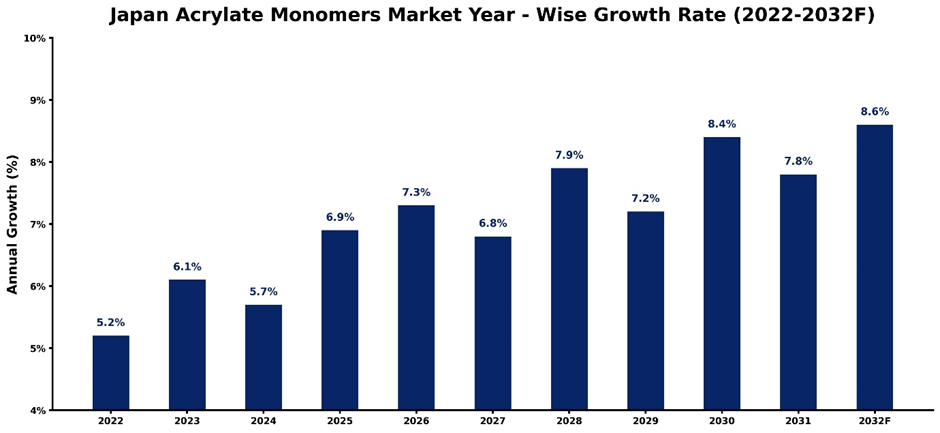 The following table presents the estimated annual growth rates of the market for each year, along with the key factors influencing market performance during the respective period. The values are intended to highlight year-wise drivers rather than provide a direct comparison between individual years.
| Year | Estimated Annual Growth (%) | Market Rationale |
| 2022 | 5.2% | Recovery in industrial coatings, adhesives, and plastics applications supported acrylate monomer consumption. |
| 2023 | 6.1% | Rising demand for acrylic-based formulations and specialty polymers strengthened downstream utilization. |
| 2024 | 5.7% | Growth in paints, pressure-sensitive adhesives, and resin applications supported acrylate consumption. |
| 2025 | 6.9% | Higher demand for performance coatings and specialty adhesive formulations strengthened market activity. |
| 2026 | 7.3% | Greater adoption of acrylic materials across coatings, plastics, and packaging applications is supporting expansion. |
| 2027 | 6.8% | Specialty adhesives and durable coating applications are expected to increase demand for higher-performance monomers. |
| 2028 | 7.9% | Growing interest in lower-emission formulations and advanced polymer technologies is expected to support adoption. |
| 2029 | 7.2% | Expansion of electronics, automotive, and industrial coating applications is likely to sustain acrylate demand. |
| 2030 | 8.4% | Increasing use of functional acrylic polymers is expected to strengthen consumption across adhesives and coatings. |
| 2031 | 7.8% | Bio-attributed feedstocks and higher-value specialty monomers are expected to support market development. |
| 2032 | 8.6% | Advanced coatings, adhesives, plastics, and sustainable polymer solutions are expected to sustain long-term growth. |
Topics Covered in the Japan Acrylate Monomers Market Report
Japan Acrylate Monomers Market report thoroughly covers the market by type and application. The market report provides an unbiased and detailed analysis of ongoing market trends, opportunities/high growth areas, and market drivers, which would help stakeholders devise and align their market strategies according to the current and future market dynamics.
Japan Acrylate Monomers Market Highlights
| Report Name | Japan Acrylate Monomers Market |
| Forecast period | 2026-2032 |
| CAGR | 7.6% |
| Growing Sector | Adhesive Materials |
Japan Acrylate Monomers Market Synopsis
The Japan Acrylate Monomers Market is supported by steady demand from paints, coatings, adhesives, plastics, printing inks, and specialty polymer applications. The Acrylate Monomers are reactive chemical building blocks used to produce acrylic polymers for coatings, plastics, inks, and specialty materials. Also, growing preference for water-based coatings and adhesives is supporting the advanced acrylic formulations, while demand for functional materials is driving specialty monomer development. Moreover, the sustainability initiatives and established domestic expertise are further supporting innovation in acrylic materials.
Evaluation of Growth Drivers in the Japan Acrylate Monomers Market (2026-2032)
Below mentioned are some major growth drivers and their influence on market dynamics:
| Drivers | Primary Segments Affected | Why It Matters |
| Expansion of Paints and Coatings Applications | Butyl Acrylate, Ethyl Acrylate | Supports demand for durable acrylic formulations with improved weather resistance, surface protection, adhesion, and application performance. |
| Growth of Adhesive and Pressure-Sensitive Materials | Butyl Acrylate, 2-Ethylhexyl Acrylate | Enhances the adhesion and flexibility among packaging, construction, and industrial bonding applications, driving wider formulation requirements. |
| Increasing Specialty Polymer Development | Ethylhexyl Acrylate, Methyl Acrylate | Allows for customized polymer performance in terms of enhanced flexibility, compatibility and application-specific functional characteristics. |
| Demand for Advanced Plastic Materials | Methyl Acrylate, Butyl Acrylate | It leads to functional resin production with improved processing properties, transparency, impact resistance and versatility of materials. |
| Growth of Printing and Functional Inks | Ethyl Acrylate, Specialty Acrylates | Improves film formation and print performance while supporting enhanced adhesion, surface quality, and compatibility amid specialized ink formulations. |
The Japan Acrylate Monomers Market is projected to grow at a CAGR of 7.6% during 2026–2032. The growing adoption of water-based and low-emission formulations is supporting the manufacturers to develop more sustainable acrylic systems. Innovative requirements from automotive, construction, electronics, and packaging applications are driving demand for performance-based monomers. Furthermore, the Japanese producers are also expanding functional and bio-based offerings, while established expertise in acrylic chemistry continues to encourage product innovation and higher-value applications.
Evaluation of Restraints in the Japan Acrylate Monomers Market
Below mentioned are some major restraints and their influence on market dynamics:
| Restraints | Primary Segments Affected | What This Means |
| Volatility in Feedstock and Energy Costs | All Acrylate Monomers | Can pressure producer margins by increasing manufacturing expenses and making pricing strategies more difficult to maintain. |
| Stringent Chemical Management Requirements | Ethyl Acrylate, Methyl Acrylate, Butyl Acrylate | Increases the compliance responsibilities by demanding additional monitoring, documentation, and adherence to the chemical-management standards. |
| Hazardous-Material Handling Requirements | Production and Distribution | Increased safety and logistics complexity due to special storage, transportation controls and handling measures. |
| Dependence on Petrochemical Feedstocks | Butyl Acrylate, Ethylhexyl Acrylate | Exposes to input-cost volatility, which can impact production economics, inventory management and downstream pricing stability. |
| Production Process Complexity | Specialty Acrylates | Requires tighter process control to maintain consistent product quality, manage reaction conditions, reduce impurities, and meet demanding application-specific performance requirements. |
Japan Acrylate Monomers Market Challenges
The Japan Acrylate Monomers Market undergoes various challenges that are from strict chemical-management requirements, raw-material handling, and environmental reporting obligations. Japan’s PRTR infrastructure which covers methyl acrylate and n-butyl acrylate as Class I designated substances, increasing compliance requirements among production and downstream applications. Also, in 2024, PRTR-covered businesses stated 137 thousand tonnes of releases and 271 thousand tonnes of transfers among designated chemicals, highlighting the scale of environmental-management responsibilities. Moreover, the volatility in feedstock availability and pressure to develop lower-emission formulations further complicate production planning.
Japan Acrylate Monomers Market Trends
Below are some major trends contributing to the Japan Acrylate Monomers Market Growth:
- Advanced Functional Acrylics: The high demand is shifting toward monomers that offer specific adhesion, flexibility, weatherability, curing, and resin-modification properties for higher-value applications.
- Performance Coating Development: Acrylic monomers are gradually used in coatings that requires durability, appearance, chemical resistance, and enhanced formulation flexibility.
- Specialty Adhesive Applications: Pressure-sensitive adhesives, tapes, and industrial bonding applications continue to support demand for monomers offering controlled tack, flexibility, and adhesion.
Investment Opportunities in Japan Acrylate Monomers Market
Here are some investment opportunities in the Japan Acrylate Monomers Industry:
- Bio-Attributed Acrylate Production: The investment in specialized sustainable monomer production can support with the customers seeking for lower-carbon acrylic materials.
- Specialty Monomer Development: Increasing investment in functional acrylates can capture the demand from innovative coatings, adhesives, electronics, and resin-modification applications.
- Low-Emission Coating Technologies: Development of acrylic monomers compatible with waterborne and other lower-emission coating systems can create opportunities as formulation requirements evolve.
Leading Players in the Japan Acrylate Monomers Market
Here are some top companies contributing to Japan Acrylate Monomers Market Share:
1. Mitsubishi Chemical Corporation
| Company Name | Mitsubishi Chemical Corporation |
|---|---|
| Established Year | 1933 |
| Headquarters | Tokyo, Japan |
| Official Website | Click Here |
Mitsubishi Chemical Corporation is a major Japanese chemical producer with an extensive petrochemical and functional-materials portfolio.
2. TOAGOSEI CO., LTD.
| Company Name | TOAGOSEI CO., LTD. |
|---|---|
| Established Year | 1944 |
| Headquarters | Tokyo, Japan |
| Official Website | Click Here |
TOAGOSEI is a significant acrylic-material producer offering methyl acrylate, ethyl acrylate, butyl acrylate, and 2-ethylhexyl acrylate.
3. NIPPON SHOKUBAI CO., LTD.
| Company Name | NIPPON SHOKUBAI CO., LTD. |
|---|---|
| Established Year | 1941 |
| Headquarters | Osaka, Japan |
| Official Website | Click Here |
Nippon Shokubai supplies acrylic acid and acrylic esters, including methyl acrylate, ethyl acrylate, butyl acrylate, and 2-ethylhexyl acrylate.
Government Regulations Introduced in the Japan Acrylate Monomers Market
According to Japanese government data, acrylate monomers are governed by chemical-management and environmental frameworks covering manufacture, import, handling, reporting, and environmental risk assessment. Japan’s Chemical Substances Control Law (CSCL) is designed to prevent environmental pollution from chemical substances that may affect human health or ecosystems and provides procedures for notification and evaluation of chemical substances. In addition, the PRTR-SDS framework identifies ethyl acrylate, butyl acrylate, and methyl acrylate as designated substances, reinforcing reporting and safety-management requirements.
Future Insights of the Japan Acrylate Monomers Market
The Japan Acrylate Monomers Market is expected to benefit from sustained demand for high-performance coatings, adhesives, plastics, and specialty polymers. Growing preference for water-based and lower-emission formulations will support the development of innovative acrylic systems. Such as, electronics, automotive, construction, and packaging applications are expected to support specialized monomer consumption. Manufacturers are also expected to focus on sustainable feedstocks, improved formulation efficiency, and application-specific grades. Japan’s established chemical manufacturing capabilities and emphasis on precision materials should further support innovation and premium acrylate applications.
Market Segmentation Analysis
This report presents a detailed analysis of the market segments along with their leading categories.
By Type – Butyl Acrylate Led the Market, Ethylhexyl Acrylate Set for Strong Growth
According to Sumit Sagar, Senior Research Analyst at 6Wresearch, Butyl Acrylate dominated the Japan Acrylate Monomers Market till 2025 with a projected 39% market share, driven by its broad use in paints, pressure-sensitive adhesives and acrylic rubber. However, during 2026–2032, Ethylhexyl Acrylate is expected to emerge as the fastest-growing segment with a CAGR of around 8.4%, supported by demand for weather-resistant and high-performance adhesive formulations.
By Application – Paints and Coatings Led the Market, Adhesives to Grow Rapidly
Paints and Coatings dominated till 2025 with an estimated 42% market share, supported by the established use of acrylic esters as coating and paint raw materials. However, during 2026–2032, Adhesives are expected to experience the fastest growth with a CAGR of around 8.1%, driven by pressure-sensitive adhesives and formulations requiring improved tack and durability.
Note: Market size estimations and growth projections presented in this report are based on 6Wresearch's proprietary forecasting methodology, utilizing the latest available industry data, government publications, and primary research inputs.
Key attractiveness of the report
- 10 Years Market Numbers.
- Historical Data Starting from 2022 to 2025.
- Base Year: 2025.
- Forecast Data until 2032.
- Key Performance Indicators Impacting the Market.
- Major Upcoming Developments and Projects.
Key Highlights of the Report:
- Japan Acrylate Monomers Market Outlook
- Market Size of Japan Acrylate Monomers Market, 2025
- Forecast of Japan Acrylate Monomers Market, 2032
- Historical Data and Forecast of Japan Acrylate Monomers Revenues & Volume for the Period 2022-2032
- Japan Acrylate Monomers Market Trend Evolution
- Japan Acrylate Monomers Market Drivers and Challenges
- Japan Acrylate Monomers Price Trends
- Japan Acrylate Monomers Porter's Five Forces
- Japan Acrylate Monomers Industry Life Cycle
- Historical Data and Forecast of Japan Acrylate Monomers Market Revenues & Volume By Type for the Period 2022-2032
- Historical Data and Forecast of Japan Acrylate Monomers Market Revenues & Volume By Butyl Acrylate for the Period 2022-2032
- Historical Data and Forecast of Japan Acrylate Monomers Market Revenues & Volume By Ethyl Acrylate for the Period 2022-2032
- Historical Data and Forecast of Japan Acrylate Monomers Market Revenues & Volume By Ethylhexyl Acrylate for the Period 2022-2032
- Historical Data and Forecast of Japan Acrylate Monomers Market Revenues & Volume By Methyl Acrylate for the Period 2022-2032
- Historical Data and Forecast of Japan Acrylate Monomers Market Revenues & Volume By Application for the Period 2022-2032
- Historical Data and Forecast of Japan Acrylate Monomers Market Revenues & Volume By Paints and Coatings for the Period 2022-2032
- Historical Data and Forecast of Japan Acrylate Monomers Market Revenues & Volume By Plastics for the Period 2022-2032
- Historical Data and Forecast of Japan Acrylate Monomers Market Revenues & Volume By Adhesives for the Period 2022-2032
- Historical Data and Forecast of Japan Acrylate Monomers Market Revenues & Volume By Printing Inks for the Period 2022-2032
- Japan Acrylate Monomers Import Export Trade Statistics
- Market Opportunity Assessment By Type
- Market Opportunity Assessment By Application
- Japan Acrylate Monomers Top Companies Market Share
- Japan Acrylate Monomers Competitive Benchmarking By Technical and Operational Parameters
- Japan Acrylate Monomers Company Profiles
- Japan Acrylate Monomers Key Strategic Recommendations
Market covered
The report subsequently covers the market by following segments and subsegments.
By Type
- Butyl Acrylate
- Ethyl Acrylate
- Ethylhexyl Acrylate
- Methyl Acrylate
By Application
- Paints and Coatings
- Plastics
- Adhesives
- Printing Inks






































