Japan Acrylic Elastomers Market Growth Rate
According to 6Wresearch internal database and industry insights, the Japan Acrylic Elastomers Market is growing at a compound annual growth rate (CAGR) of 6.3% during the forecast period (2026-2032).
Japan Acrylic Elastomers Market Year-wise Growth Rate and Key Drivers (2022-2032)
This graph illustrates the annual growth rates of the Japan Acrylic Elastomers Market from 2022 to 2032, highlighting a stable upward trajectory and projected market expansion over the forecast period.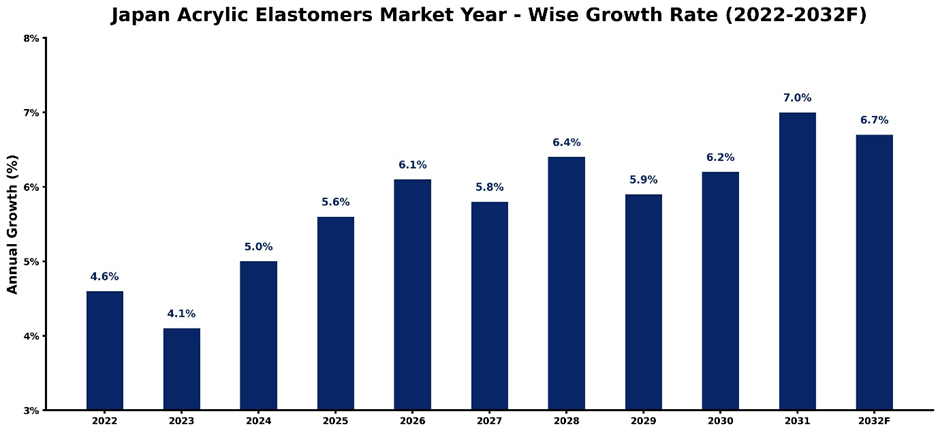
The following table presents the estimated annual growth rates of the market for each year, along with the key factors influencing market performance during the respective period. The values are intended to highlight year-wise drivers rather than provide a direct comparison between individual years.
| Year | Estimated Annual Growth (%) | Market Rationale |
| 2022 | 4.6% | Recovery in automotive manufacturing activities and increasing demand for heat-resistant rubber materials supported acrylic elastomer consumption. |
| 2023 | 4.1% | Rising automotive component production and demand for durable sealing solutions increased adoption across industrial applications. |
| 2024 | 5% | Growth in hybrid and electric vehicle components encouraged the use of advanced elastomer materials with improved temperature resistance. |
| 2025 | 5.6% | Expansion of automotive applications and industrial equipment modernization strengthened demand for acrylic elastomer products. |
| 2026 | 6.1% | Increasing requirements for high-performance sealing materials in automotive and machinery applications supported market growth. |
| 2027 | 5.8% | Growth in electric mobility and lightweight vehicle components enhanced demand for specialty elastomer solutions. |
| 2028 | 6.4% | Industrial automation and advanced manufacturing applications increased the adoption of durable rubber materials. |
| 2029 | 5.9% | Rising demand for chemical-resistant and heat-resistant elastomers supported wider industrial usage. |
| 2030 | 6.2% | Advanced automotive technologies and sustainable material development encouraged acrylic elastomer adoption. |
| 2031 | 7% | Innovation in elastomer formulations improved performance characteristics for demanding applications. |
| 2032 | 6.7% | Long-term demand from automotive, construction, and industrial sectors sustained market expansion. |
Topics Covered in the Japan Acrylic Elastomers Market Report
Japan Acrylic Elastomers Market report thoroughly covers the market by type and application. The market report provides an unbiased and detailed analysis of ongoing market trends, opportunities/high growth areas, and market drivers, which would help stakeholders devise and align their market strategies according to the current and future market dynamics.
Japan Acrylic Elastomers Market Highlights
| Report Name | Japan Acrylic Elastomers Market |
| Forecast period | 2026-2032 |
| CAGR | 6.3% |
| Growing Sector | Automotive |
Japan Acrylic Elastomers Market Synopsis
Japan Acrylic Elastomers Market is expected to witness steady growth owing to increasing demand for high-performance rubber materials in automotive and construction applications. The country’s advanced automotive manufacturing ecosystem and requirement for durable sealing materials are driving acrylic elastomer consumption. Acrylic Elastomers are the high-performance synthetic rubbers known for excellent heat and weather resistance as broadly used in industrial sealing applications. Furthermore, Japan’s focus on innovative manufacturing technologies and material origination is driving the development of enhanced elastomer formulations for next-generation applications.
Evaluation of Growth Drivers in the Japan Acrylic Elastomers Market (2026-2032)
Below mentioned are some major growth drivers and their influence on market dynamics:
| Drivers | Primary Segments Affected | Why It Matters |
| Growing Automotive Component Demand | Automotive, Engine Sealing Systems, Rubber Components | Rising vehicle production increases demand for durable elastomer materials, supporting long-term component reliability and performance. |
| Expansion of Electric and Hybrid Vehicles | Automotive, Specialty Elastomers | EV systems require advanced materials with improved heat resistance, durability, and compatibility with modern vehicle technologies. |
| Industrial Equipment Modernization | Industrial Machinery, Manufacturing | High-performance seals enhance the equipment reliability, minimize the maintenance requirements, and also improve operational effectivity. |
| Increasing Demand for Heat and Oil Resistant Materials | Automotive, Industrial Applications | Acrylic elastomers perform well in harsh operating conditions which ensures that it has improved durability and resistance in demanding environments. |
| Growth of Advanced Manufacturing Technologies | Industrial, Engineering Applications | Supports development of customized elastomer solutions, enabling precision performance and innovation across industrial sectors. |
The Japan Acrylic Elastomers Market is projected to grow at a CAGR of 6.3% during 2026–2032. The growth is supported by the country’s strong automotive manufacturing base, where the advanced sealing materials are widely used in engines, transmissions, and mechanical systems. Moreover, growing automation in manufacturing facilities and increasing replacement demand for high-performance industrial components are expected to create additional opportunities for acrylic elastomer suppliers during the forecast period.
Evaluation of Restraints in the Japan Acrylic Elastomers Market
Below mentioned are some major restraints and their influence on market dynamics:
| Restraints | Primary Segments Affected | What This Means |
| High Raw Material Costs | Acrylic Elastomer Manufacturing | Production costs can affect pricing competitiveness by increasing manufacturing expenses and limiting profit margins. |
| Complex Manufacturing Process | Specialty Elastomer Production | Innovative formulations require a technical expertise, specific equipment, and controlled processes for consistent product performance. |
| Competition from Alternative Elastomers | Industrial, Automotive Applications | Other rubber materials may replace acrylic elastomers owing to the cost advantages and application-driven performance requirements. |
| Dependence on Petrochemical Feedstock | Elastomer Production | The raw material volatility affects supply planning, production stability, and overall manufacturing cost management. |
| Environmental Regulations on Synthetic Materials | Chemical Industry, Manufacturing | Companies need improved sustainable formulations to meet compliance requirements and reduce environmental impact during production. |
Japan Acrylic Elastomers Market Challenges
The Japan acrylic elastomers market undergoes challenges that are related to raw material availability, technological complexity, and increasing environmental requirements. Acrylic elastomer production requires specialized chemical processing capabilities, which can rise manufacturing complexity compared with conventional rubber materials. Also, the automotive sector’s transition toward electric mobility creates both opportunities and challenges, as elastomer suppliers must develop materials compatible with new vehicle architectures. Additionally, the competition from silicone rubber and other specialty elastomers requires a continuous innovation to maintain application preference.
Japan Acrylic Elastomers Market Trends
Below are some major trends contributing to the Japan Acrylic Elastomers Market Growth:
- Rising Adoption in Electric Vehicles: The increasing development of electric and hybrid vehicles is creating demand for elastomer materials capable of operating at higher temperature, mainly for sealing systems and vibration control applications.
- Industrial Automation Expansion: Reliable sealing components are essential to automated manufacturing systems, so the demand for high-performance elastomer products used in robotics, machinery and precision equipment remains steady.
- Sustainable Elastomer Development: Due to the industry development, companies are investigating how to improve their production processes and use more eco-friendly materials.
Investment Opportunities in Japan Acrylic Elastomers Market
Here are some investment opportunities in the Japan Acrylic Elastomers Industry:
- High-Performance Industrial Applications: Developing elastomers for machinery, manufacturing equipment, and industrial seals offers opportunities in specific markets by refining durability, temperature resistance, and operational reliability.
- Eco-Friendly Material Innovation: By researching sustainable elastomer formulations can assist the manufacturers in meeting the high environmental standards, including lower emissions, increased recyclability, and eco-friendly manufacturing methods.
- Advanced Manufacturing Technologies: The investment in automated production and material processing technologies can increase the efficiency and product quality by allowing accuracy manufacturing, consistency, and reduced production waste.
Leading Players in the Japan Acrylic Elastomers Market
Here are some top companies contributing to Japan Acrylic Elastomers Market Share:
1. NOK Corporation
| Company Name | NOK Corporation |
|---|---|
| Established Year | 1939 |
| Headquarters | Tokyo, Japan |
| Official Website | Click Here |
NOK Corporation is a leading manufacturer of sealing products and functional materials, supplying advanced rubber and elastomer solutions for automotive, industrial machinery, and precision equipment applications.
2. Zeon Corporation
| Company Name | Zeon Corporation |
|---|---|
| Established Year | 1950 |
| Headquarters | Tokyo, Japan |
| Official Website | Click Here |
Zeon Corporation develops specialty elastomers, synthetic rubber, and advanced polymer materials for automotive, industrial, and electronics applications.
3. Denka Company Limited
| Company Name | Denka Company Limited |
|---|---|
| Established Year | 1915 |
| Headquarters | Tokyo, Japan |
| Official Website | Click Here |
Denka develops specialty polymers and functional materials used in automotive, electronics, and industrial sectors. The company focuses on innovative material solutions that enhance product performance, reliability, and application efficiency.
Government Initiatives Introduced in the Japan Acrylic Elastomers Market
Japan is promoting innovative material development across programs focused on carbon neutrality, manufacturing innovation, and sustainable industrial growth. Initiatives such as the Green Growth Strategy through Achieving Carbon Neutrality by 2050 supports industries to adopt environmentally effective materials and production technologies. In addition, the Society 5.0 framework promoted by the Japanese government encourage the smart manufacturing, innovative mobility solutions, and innovation in industrial materials. Moreover, these initiatives encourage elastomer manufacturers to develop enhanced formulations with improved durability, efficiency, and reduced environmental impact.
Future Insights of the Japan Acrylic Elastomers Market
The future of Japan Acrylic Elastomers Market is estimated to witness a steady expansion, driven by rising demand for the high-performance sealing materials in automotive and industrial applications. Japan produced approximately 8.2 million motor vehicles in 2024, upholding its position as a main global automotive manufacturing hub and supporting demand for durable elastomer components used in hoses, gaskets, and seals. Additionally, the hybrid vehicles held for more than 50% of new passenger vehicle sales in Japan in 2024, rising requirements for heat-resistant and long-life elastomer materials in innovative powertrain systems.
Market Segmentation Analysis
This report presents a detailed analysis of the Japan Acrylic Elastomers Market segments along with their leading categories.
By Type – Acrylic Co-Monomer Elastomer Led the Market, Ethylene Acrylic Elastomers to Witness Steady Growth
According to Sumit Sagar, Senior Market Research Analyst, 6Wresearch, Acrylic Co-Monomer Elastomer dominated the Japan Acrylic Elastomers Market in 2025 with an estimated 68% market share, driven by its widespread adoption in automotive sealing systems due to its excellent heat resistance and compatibility with demanding operating conditions. However, during 2026–2032, Ethylene Acrylic Elastomers are set to register a robust growth with a CAGR of around 5.1%, driven by increasing demand for high-performance elastomer solutions in next-generation automotive applications.
By Application – Automotive Led the Market, Industrial Applications to Record Strong Growth
Automotive dominated till 2025 with an expected 62% market share, supported by increasing adoption of acrylic elastomers in electric and hybrid vehicle systems. However, during 2026–2032, Industrial applications are projected to be the fastest-growing segment with a CAGR of around 5.4%, fueled by expanding demand for high-performance elastomers in machinery and chemical-resistant industrial components.
Note: Market size estimations and growth projections presented in this report are based on 6Wresearch's proprietary forecasting methodology, utilizing the latest available industry data, government publications, and primary research inputs.
Key attractiveness of the report
- 10 Years Market Numbers.
- Historical Data Starting from 2022 to 2025.
- Base Year: 2025.
- Forecast Data until 2032.
- Key Performance Indicators Impacting the Market.
- Major Upcoming Developments and Projects.
Key Highlights of the Report:
- Japan Acrylic Elastomers Market Outlook
- Market Size of Japan Acrylic Elastomers Market, 2025
- Forecast of Japan Acrylic Elastomers Market, 2032
- Historical Data and Forecast of Japan Acrylic Elastomers Revenues & Volume for the Period 2022-2032
- Japan Acrylic Elastomers Market Trend Evolution
- Japan Acrylic Elastomers Market Drivers and Challenges
- Japan Acrylic Elastomers Price Trends
- Japan Acrylic Elastomers Porter's Five Forces
- Japan Acrylic Elastomers Industry Life Cycle
- Historical Data and Forecast of Japan Acrylic Elastomers Market Revenues & Volume By Type for the Period 2022-2032
- Historical Data and Forecast of Japan Acrylic Elastomers Market Revenues & Volume By Acrylic Co-Monomer Elastomer for the Period 2022-2032
- Historical Data and Forecast of Japan Acrylic Elastomers Market Revenues & Volume By Ethylene Acrylic Elastomers for the Period 2022-2032
- Historical Data and Forecast of Japan Acrylic Elastomers Market Revenues & Volume By Application for the Period 2022-2032
- Historical Data and Forecast of Japan Acrylic Elastomers Market Revenues & Volume By Automotive for the Period 2022-2032
- Historical Data and Forecast of Japan Acrylic Elastomers Market Revenues & Volume By Construction for the Period 2022-2032
- Historical Data and Forecast of Japan Acrylic Elastomers Market Revenues & Volume By Industrial for the Period 2022-2032
- Japan Acrylic Elastomers Import Export Trade Statistics
- Market Opportunity Assessment By Type
- Market Opportunity Assessment By Application
- Japan Acrylic Elastomers Top Companies Market Share
- Japan Acrylic Elastomers Competitive Benchmarking By Technical and Operational Parameters
- Japan Acrylic Elastomers Company Profiles
- Japan Acrylic Elastomers Key Strategic Recommendations
Market covered
The report subsequently covers the market by following segments and subsegments.
By Type
- Acrylic Co-Monomer Elastomer
- Ethylene Acrylic Elastomers
By Application
- Automotive
- Construction
- Industrial






































