Japan Acrylic Sheet Market Growth Rate
According to 6Wresearch internal database and industry insights, the Japan Acrylic Sheet Market is growing at a compound annual growth rate (CAGR) of 7.6% during the forecast period (2026-2032).
Japan Acrylic Sheet Market Year-wise Growth Rate and Key Drivers (2022-2032)
This graph illustrates the annual growth rates of the Japan Acrylic Sheet Market from 2022 to 2032, highlighting an overall upward trajectory and projected market expansion over the forecast period.
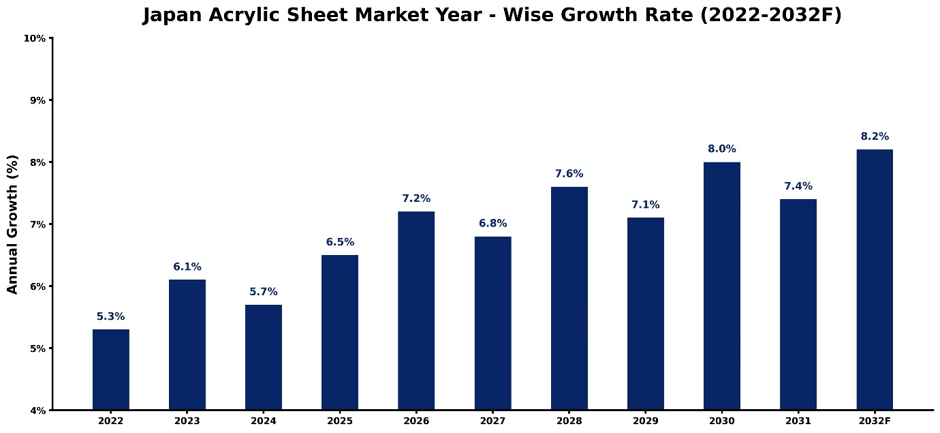
The following table presents the estimated annual growth rates of the market for each year, along with the key factors influencing market performance during the respective period. The values are intended to highlight year-wise drivers rather than provide a direct comparison between individual years.
| Year | Estimated Annual Growth (%) | Market Rationale |
| 2022 | 5.3% | Renovation activity and demand for transparent architectural materials supported acrylic sheet consumption. |
| 2023 | 6.1% | Growth in retail displays, signage, and interior applications strengthened demand for fabricated acrylic sheets. |
| 2024 | 5.7% | Automotive, furniture, and industrial applications supported steady market development. |
| 2025 | 6.5% | Expanding construction activity and specialized PMMA applications improved market momentum. |
| 2026 | 7.2% | Demand for lightweight, durable, and design-oriented materials is expected to increase across downstream industries. |
| 2027 | 6.8% | Advanced fabrication and growing architectural applications are expected to sustain market expansion. |
| 2028 | 7.6% | Specialty optical, automotive, and electronics applications are projected to accelerate acrylic sheet adoption. |
| 2029 | 7.1% | Recycled acrylic solutions and higher-value applications are expected to strengthen industry growth. |
| 2030 | 8% | Greater use of lightweight transparent materials in mobility and smart building applications will support demand. |
| 2031 | 7.4% | Advanced surface treatments and functional acrylic grades are expected to broaden application opportunities. |
| 2032 | 8.2% | Circular-material adoption and premium acrylic applications are projected to sustain long-term market growth. |
Topics Covered in the Japan Acrylic Sheet Market Report
Japan Acrylic Sheet Market report thoroughly covers the market by technology and application. The market report provides an unbiased and detailed analysis of ongoing market trends, opportunities/high growth areas, and market drivers, which would help stakeholders devise and align their market strategies according to the current and future market dynamics.
Japan Acrylic Sheet Market Highlights
| Report Name | Japan Acrylic Sheet Market |
| Forecast period | 2026-2032 |
| CAGR | 7.6% |
| Growing Sector | Advanced Materials |
Japan Acrylic Sheet Market Synopsis
The Japan acrylic sheet market is supported by a strong demand from construction and electronics. Acrylic Sheet is a lightweight, durable, transparent plastic sheet widely used in signage, displays, and interior applications. The framework modernization and demand for visually appealing architectural materials further support adoption. Moreover, the growth in automotive lighting, display components, protective covers, and customized signage is making more additional opportunities, while the technological innovations and growing interest in sustainable materials are supporting product innovation.
Evaluation of Growth Drivers in the Japan Acrylic Sheet Market (2026-2032)
Below mentioned are some major growth drivers and their influence on market dynamics:
| Drivers | Primary Segments Affected | Why It Matters |
| Growth in Construction and Renovation | Architecture & Construction, Cell Cast | Supports demand for durable, lightweight, transparent materials across modern buildings, façades, partitions, and interiors. |
| Expansion of Retail and Visual Merchandising | Furniture & Design, Visual Comm. & Retail | Supports demand for versatile acrylic displays that improve product visibility, customization, visuals and customer engagement. |
| Increasing Automotive Material Optimization | Automotive & Transportation, Extruded | Allows lightweight, durable, design-flexible components that enhances the vehicle efficiency, aesthetics, functionality, and manufacturing flexibility. |
| Rising Electronics and Optical Applications | Electronics & Energy, Continuous Cast | Enables precision components requiring optical clarity, dimensional stability, lightweight performance, and controlled material properties across applications. |
| Development of Circular Acrylic Solutions | All Technologies, Industrial Applications | Enhances resource efficiency, reduces material waste, supports sustainability goals, and strengthens demand for recycled acrylic products. |
The Japan Acrylic Sheet Market is projected to grow at a CAGR of 7.6% during 2026–2032. Japan’s acrylic sheet market is driven by a measurable activity among construction, electronics, and materials recycling. The MLIT reported that private construction orders handled by the largest 50 contractors increased 13.7% in FY2025, while total orders rose up to 12%. The JEITA’s METI-centric statistics recorded about ¥3.42 trillion in industrial electronic equipment production in 2025. Moreover, these downstream activities support demand for transparent, durable PMMA sheets in buildings, equipment covers, and design applications, strengthening opportunities for specialized acrylic sheet suppliers.
Evaluation of Restraints in the Japan Acrylic Sheet Market
Below mentioned are some major restraints and their influence on market dynamics:
| Restraints | Primary Segments Affected | What This Means |
| Fluctuating MMA and Resin Costs | Cell Cast, Extruded | Input-cost volatility can pressure producer margins and create challenges in maintaining competitive pricing and profitability. |
| Competition from Alternative Materials | Architecture, Automotive, Furniture | Glass and polycarbonate can substitute acrylic in selected applications, limiting market penetration and growth opportunities. |
| Recycling Collection Complexity | All Technologies | The mixed plastic streams can complicate recovery and sorting, rising recycling costs and limiting material recovery competence. |
| Energy-Intensive Processing | Extruded, Continuous Cast | Processing the requirements can raise the manufacturing costs, potentially limiting profitability and competitiveness among energy-intensive production operations. |
| Surface Scratching and Maintenance | Architecture, Retail, Furniture | Surface durability requirements can restrict use in demanding environments, increasing maintenance needs and limiting long-term application suitability. |
Japan Acrylic Sheet Market Challenges
Japan Acrylic Sheet Market has various challenges from fluctuating raw material costs, competition from glass and polycarbonate, and energy-intensive processing. Recycling can also be difficult owing to collection and sorting complexities, mainly across mixed plastic streams. The acrylic’s susceptibility to surface scratching may restrict its usage in demanding environments where durability is essential. Additionally, the manufacturers must balance product quality sustainability expectations, and cost efficiency. Furthermore, these factors can influence the purchasing decisions and create pressure among construction, retail, and furniture applications.
Japan Acrylic Sheet Market Trends
Below are some major trends contributing to the Japan Acrylic Sheet Market Growth:
- Circular Acrylic Recycling: Chemical recycling of PMMA is gaining importance as manufacturers and local authorities explore closed-loop recovery and reprocessing systems.
- Specialized Functional Sheets: Demand is moving toward sanitary, optical, weather-resistant, scratch-resistant, and application-specific acrylic grades rather than standard transparent sheets.
- Lightweight Automotive Materials: Automotive manufacturers are increasingly evaluating lightweight transparent and design-oriented materials for displays, lighting, trim, and interior applications.
Investment Opportunities in Japan Acrylic Sheet Market
Here are some investment opportunities in the Japan Acrylic Sheet Industry:
- High-Performance Acrylic Sheets: The development of optical, sanitary and specialty sheets can address premium applications with higher technical requirements, allowing more performance and value through demanding end-use sectors.
- Automotive Acrylic Solutions: With the help of suppliers, it develops lightweight sheets and fabricated components for vehicle displays and mobility applications, driving design flexibility and improved functionality.
- Architectural Acrylic Applications: Opportunities exist in transparent partitions, decorative panels, façades, and tailored building solutions, driving the modern aesthetics and innovative architectural designs.
Leading Players in the Japan Acrylic Sheet Market
Here are some top companies contributing to Japan Acrylic Sheet Market Share:
1. Kuraray Co., Ltd.
| Company Name | Kuraray Co., Ltd. |
| Established Year | 1926 |
| Headquarters | Tokyo, Japan |
| Official Website | Click Here |
Kuraray is a major Japanese materials manufacturer offering PARAGLAS™ cast acrylic sheets and COMOGLAS™ extruded sheets.
2. Sumitomo Chemical Company, Limited
| Company Name | Sumitomo Chemical Company, Limited |
| Established Year | 1913 |
| Headquarters | Tokyo, Japan |
| Official Website | Click Here |
Sumitomo Chemical is also advancing PMMA chemical recycling through collaboration with Japan Steel Works and Niihama City, creating opportunities for circular acrylic materials.
3. Mitsubishi Chemical Corporation
| Company Name | Mitsubishi Chemical Corporation |
| Established Year | 1933 |
| Headquarters | Tokyo, Japan |
| Official Website | Click Here |
Mitsubishi Chemical is a major Japanese materials company with businesses spanning performance products and industrial materials.
Government Initiatives Introduced in the Japan Acrylic Sheet Market
The Japan’s government is supporting a circular resource use and eco-friendly manufacturing which creates a supportive environment for sustainable acrylic applications. The Plastic Resource Circulation Act promotes recycling and environmentally conscious product design among the plastic value chains. Meanwhile, the GX policy framework also supports investment in decarbonization, cleaner production, and resource efficiency. Moreover, the recent circular-economy measures further support recycled-material use and environmentally friendly designs while benefiting with acrylic producers pursuing sustainable products.
Future Insights of the Japan Acrylic Sheet Market
The Japan Acrylic Sheet Market is projected to benefit from a steady demand among displays, electronics, and signage applications. The lightweight and optically clear materials will remain attractive as the producers seek enhanced design flexibility and performance. The framework modernization and innovative vehicle components can support a wider adoption. Growth of interest in recycled and sustainable acrylic products may further shape product development. Meanwhile, innovations in scratch resistance, optical performance, and customized sheet solutions are set to create new opportunities for premium applications.
Market Segmentation Analysis
This report presents a detailed analysis of the market segments along with their leading categories.
By Technology – Cell Cast Led the Market, Continuous Cast Set for Strong Growth
According to Sumit Sagar, Senior Research Analyst at 6Wresearch, Cell Cast dominated the Japan Acrylic Sheet Market till 2025 with a projected 46% market share, supported by its ability to deliver high optical clarity and specialized sheet grades. Meanwhile, during 2026–2032, Continuous Cast is expected to emerge as the fastest-growing technology with a CAGR of around 8.6%, supported by continuous production efficiency and increasing demand for standardized industrial and architectural applications.
By Application – Architecture & Construction Led the Market, Electronics & Energy to Grow at the Fastest Pace
Architecture & Construction dominated till 2025 with an estimated 31% market share, supported by acrylic’s transparency and fabrication flexibility across partitions and decorative structures. However, during 2026–2032, Electronics & Energy is expected to be the fastest-growing application segment with a CAGR of around 9.1%, driven by demand for optical components and advanced transparent materials.
Note: Market size estimations and growth projections presented in this report are based on 6Wresearch's proprietary forecasting methodology, utilizing the latest available industry data, government publications, and primary research inputs.
Key attractiveness of the report
- 10 Years Market Numbers.
- Historical Data Starting from 2022 to 2025.
- Base Year: 2025.
- Forecast Data until 2032.
- Key Performance Indicators Impacting the Market.
- Major Upcoming Developments and Projects.
Key Highlights of the Report:
- Japan Acrylic Sheet Market Outlook
- Market Size of Japan Acrylic Sheet Market, 2025
- Forecast of Japan Acrylic Sheet Market, 2032
- Historical Data and Forecast of Japan Acrylic Sheet Revenues & Volume for the Period 2022- 2032
- Japan Acrylic Sheet Market Trend Evolution
- Japan Acrylic Sheet Market Drivers and Challenges
- Japan Acrylic Sheet Price Trends
- Japan Acrylic Sheet Porter's Five Forces
- Japan Acrylic Sheet Industry Life Cycle
- Historical Data and Forecast of Japan Acrylic Sheet Market Revenues & Volume By Technology for the Period 2022- 2032
- Historical Data and Forecast of Japan Acrylic Sheet Market Revenues & Volume By Cell Cast for the Period 2022- 2032
- Historical Data and Forecast of Japan Acrylic Sheet Market Revenues & Volume By Extruded for the Period 2022- 2032
- Historical Data and Forecast of Japan Acrylic Sheet Market Revenues & Volume By Continuous Cast for the Period 2022- 2032
- Historical Data and Forecast of Japan Acrylic Sheet Market Revenues & Volume By Application for the Period 2022- 2032
- Historical Data and Forecast of Japan Acrylic Sheet Market Revenues & Volume By Architecture & Construction for the Period 2022- 2032
- Historical Data and Forecast of Japan Acrylic Sheet Market Revenues & Volume By Furniture & Design for the Period 2022- 2032
- Historical Data and Forecast of Japan Acrylic Sheet Market Revenues & Volume By Automotive & Transportation for the Period 2022- 2032
- Historical Data and Forecast of Japan Acrylic Sheet Market Revenues & Volume By Visual Comm. & Retail for the Period 2022- 2032
- Historical Data and Forecast of Japan Acrylic Sheet Market Revenues & Volume By Electronics & Energy for the Period 2022- 2032
- Historical Data and Forecast of Japan Acrylic Sheet Market Revenues & Volume By Medical for the Period 2022- 2032
- Historical Data and Forecast of Japan Acrylic Sheet Market Revenues & Volume By Sanitary for the Period 2022- 2032
- Japan Acrylic Sheet Import Export Trade Statistics
- Market Opportunity Assessment By Technology
- Market Opportunity Assessment By Application
- Japan Acrylic Sheet Top Companies Market Share
- Japan Acrylic Sheet Competitive Benchmarking By Technical and Operational Parameters
- Japan Acrylic Sheet Company Profiles
- Japan Acrylic Sheet Key Strategic Recommendations
Market covered
The report subsequently covers the market by following segments and subsegments.
By Technology
- Cell Cast
- Extruded
- Continuous Cast
By Application
- Architecture & Construction
- Furniture & Design
- Automotive & Transportation
- Visual Comm. & Retail
- Electronics & Energy
- Medical
- Sanitary






































