Japan Active Geofencing Market Growth Rate
According to 6Wresearch internal database and industry insights, the Japan Active Geofencing Market is growing at a compound annual growth rate (CAGR) of 13.8% during the forecast period (2026-2032).
Japan Active Geofencing Market Year-wise Growth Rate and Key Drivers (2022-2032)
This graph illustrates the annual growth rates of the Japan Active Geofencing Market from 2022 to 2032, highlighting a steady upward trajectory and projected market expansion over the forecast period.
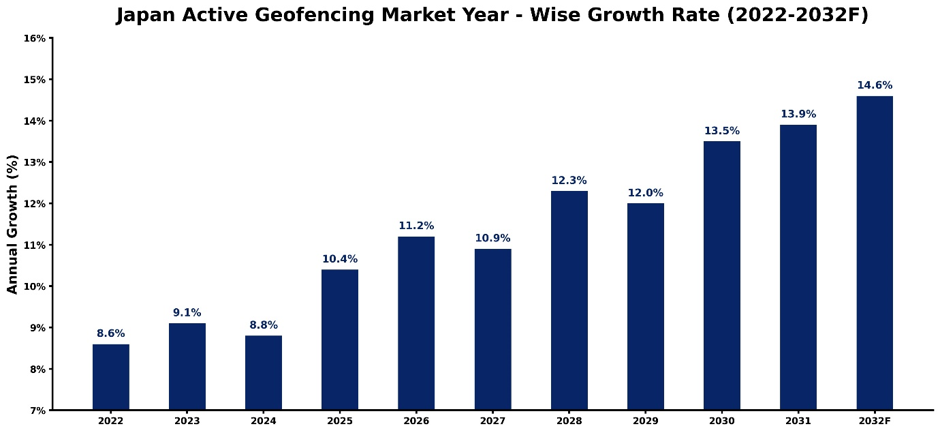
The following table presents the estimated annual growth rates of the market for each year, along with the key factors influencing market performance during the respective period. The values are intended to highlight year-wise drivers rather than provide a direct comparison between individual years.
| Year | Estimated Annual Growth (%) | Market Rationale |
| 2022 | 8.6% | Increasing smartphone location services and connected-device adoption supported geofencing applications. |
| 2023 | 9.1% | Growth in location-based services and digital retail strengthened demand for virtual geographic boundaries. |
| 2024 | 8.8% | Expansion of connected mobility and logistics tracking increased enterprise use of location intelligence. |
| 2025 | 10.4% | Rising adoption of real-time fleet, asset, and customer-location monitoring supported market growth. |
| 2026 | 11.2% | Smart mobility initiatives and connected infrastructure are accelerating deployment of geofencing platforms. |
| 2027 | 10.9% | Increasing logistics automation and location-aware services are broadening enterprise applications. |
| 2028 | 12.3% | Expansion of IoT-connected assets is expected to increase demand for real-time location controls. |
| 2029 | 12% | Smart-city development and intelligent transportation applications will support wider geofencing adoption. |
| 2030 | 13.5% | Advanced analytics and automated location-based decision-making are expected to strengthen demand. |
| 2031 | 13.9% | Integration of AI, IoT, and location intelligence will support more sophisticated geofencing applications. |
| 2032 | 14.6% | Connected mobility, logistics, and public-sector applications are expected to sustain market expansion. |
Topics Covered in the Japan Active Geofencing Market Report
Japan Active Geofencing Market report thoroughly covers the market by type, organization size, and end use industry. The market report provides an unbiased and detailed analysis of ongoing market trends, opportunities/high growth areas, and market drivers, which would help stakeholders devise and align their market strategies according to the current and future market dynamics.
Japan Active Geofencing Market Highlights
| Report Name | Japan Active Geofencing Market |
| Forecast period | 2026-2032 |
| CAGR | 13.8% |
| Growing Sector | Communication Technology |
Japan Active Geofencing Market Synopsis
Japan Active Geofencing Market is expected to grow rapidly owing to increasing adoption of location-based services, connected mobility, logistics automation, and IoT-enabled infrastructure. Active Geofencing is a location-based technology that continuously monitors a device’s position and triggers alerts or actions when it enters or leaves a defined area. The country's MaaS and smart-city initiatives are also supporting integration of mobility data and location intelligence. In addition, Japan's growing importance on automated logistics, fleet visibility, and modified customer engagement is producing wider opportunities for active geofencing solutions.
Evaluation of Growth Drivers in the Japan Active Geofencing Market (2026-2032)
Below mentioned are some major growth drivers and their influence on market dynamics:
| Drivers | Primary Segments Affected | Why It Matters |
| Expansion of Smart Mobility | Transportation and Logistics, Mobile | Allows seamless location-aware transportation solutions, refining connectivity, efficiency, and modified mobility experiences among urban environments. |
| Growth of E-commerce and Retail | Retail, Large-scale Businesses | Drives aimed customer engagement, improved deliveries, and enhanced shopping experiences across real-time location-derived interactions. |
| Increasing Logistics Automation | Transportation and Logistics, Industrial Manufacturing | Enhances fleet tracking, route optimization, asset management, and operational efficiency among complex supply chains. |
| Smart-City Development | Government and Military, Large-scale Businesses | Allows intelligent framework management, public safety improvements, and effective urban resource allocation within location intelligence. |
| Rising IoT Adoption | Industrial Manufacturing, Healthcare | Links devices and assets with real-time location insights, allowing a smarter automation and predictive operations. |
The Japan Active Geofencing Market is projected to grow at a CAGR of 13.8% during 2026–2032, supported by growing adoption of location-based technologies among mobility, retail, logistics, and smart framework applications. The growing demand for a real-time tracking, improved customer engagement, and operational efficiency is supporting businesses to integrate geofencing solutions. Moreover, the market is further supported by innovations in IoT connectivity and digital transformation initiatives, allowing more intelligent and responsive location-aware services across various industries.
Evaluation of Restraints in the Japan Active Geofencing Market
Below mentioned are some major restraints and their influence on market dynamics:
| Restraints | Primary Segments Affected | What This Means |
| Privacy and Data Protection Requirements | Retail, Healthcare, BFSI | Upsurges compliance needs, requiring a secure handling and responsible management of location-driven user data. |
| Location Accuracy Limitations | Mobile, Transportation and Logistics | It can affect service reliability by impacting accurate geofence triggers in challenging environments. |
| Integration Complexity | Industrial Manufacturing, Large-scale Businesses | Involves a seamless system compatibility, growing deployment efforts and technical resource requirements. |
| Cybersecurity Risks | Government and Military, BFSI | Demands robust security measures to protect the sensitive location information from unauthorized access. |
| Infrastructure Dependency | Small-scale and Medium-scale Businesses | Needs dependable connectivity and positioning framework for operative geofencing performance. |
Japan Active Geofencing Market Challenges
Japan Active Geofencing Market undergoes various challenges from stringent data privacy needs, combination barriers, and framework limitations. With internet penetration reaching around 88% and mobile connections exceeding up to 190 million, demand for location-driven services continues to increase, but secure data management remains critical. Also, Japan’s low unemployment rate of nearly 2.5% focusses on a skilled but restricted workforce environment, growing the need for automation. Additionally, the businesses must address cybersecurity concerns and make sure of accurate positioning across complex urban areas.
Japan Active Geofencing Market Trends
Below are some major trends contributing to the Japan Active Geofencing Market Growth:
- AI-Enabled Location Intelligence: AI is gradually being joined with location data to identify movement patterns, predict operational events, and automate location-driven decisions.
- Automated Logistics Monitoring: Geofencing is increasingly being combined with fleet and delivery platforms to trigger alerts when the vehicles or assets enter or leave predefined areas.
- Smart-City Applications: Linked urban framework is increasing the use of geofencing for traffic management, public services, limited areas, and location-aware municipal operations.
Investment Opportunities in Japan Active Geofencing Market
Below here are some investment opportunities in the Japan Active Geofencing Industry:
- Logistics and Fleet Solutions: The geofencing technologies combined with fleet-management platforms can increase delivery visibility and operational coordination by allowing real-time tracking, automated alerts, and effective resource utilization.
- Retail Location Intelligence: Retail-based geofencing solutions can aid businesses produce proximity-led customer engagement and directed promotional campaigns across modified offers and location-driven marketing strategies.
- Industrial Asset Monitoring: By linking geofencing with IoT sensors offers opportunities for tracking high-value equipment and personnel among industrial environments and asset management efficiency.
Leading Players in the Japan Active Geofencing Market
Here are some top companies contributing to Japan Active Geofencing Market Share:
1. KDDI Corporation
| Company Name | KDDI Corporation |
| Established Year | 1984 |
| Headquarters | Tokyo, Japan |
| Official Website | Click Here |
KDDI Corporation provides telecommunications, IoT connectivity, and digital transformation services that enable location-based solutions and smart mobility applications across various industries.
2. SoftBank Corp.
| Company Name | SoftBank Corp. |
| Established Year | 1986 |
| Headquarters | Tokyo, Japan |
| Official Website | Click Here |
SoftBank Corp. offers mobile communication, IoT platforms, and digital services supporting location intelligence and enterprise solutions for businesses and public-sector applications.
3. Toyota Motor Corporation
| Company Name | Toyota Motor Corporation |
| Established Year | 1937 |
| Headquarters | Toyota City, Japan |
| Official Website | Click Here |
Toyota Motor Corporation develops connected mobility solutions and smart transportation technologies that support geofencing applications in fleet management and intelligent mobility ecosystems.
Government Initiatives Introduced in the Japan Active Geofencing Market
As per the Japanese government data, driving the adoption of location-based technologies across initiatives focused on smart mobility, digital transformation, and geospatial data utilization. The programs such as the Mobility DX Strategy, Smart City initiatives, and Geospatial Information utilization plans support data-led transportation, automated mobility, and connected framework development. Furthermore, these efforts make a favorable environment for geofencing claims among logistics, public services, and urban management by promoting digital integration and location intelligence.
Future Insights of the Japan Active Geofencing Market
The Japan Active Geofencing Market is projected to move toward more intelligent, automated, and industry-based location applications. Integrating with AI, IoT, connected vehicles, and cloud platforms will allow the organizations to respond to geographic events with more accuracy. The transportation and logistics are expected to remain significant application areas as fleet operators pursue enhanced visibility and operational efficiency. The retailers and smart-city developers are also likely to expand location-aware services. Moreover, privacy-conscious architectures, stronger cybersecurity, and improved indoor positioning will further shape the evolution of geofencing solutions.
Market Segmentation Analysis
This report presents a detailed analysis of the market segments along with their leading categories.
By Type – Fixed Led the Market, Mobile Set for Strong Growth
According to Sumit Sagar, Senior Research Analyst at 6Wresearch, Fixed geofencing dominated the Japan Active Geofencing Market till 2025 with a projected 61.3% market share, supported by extensive use in defined locations such as industrial facilities and smart infrastructure. During 2026–2032, Mobile geofencing is expected to emerge as the fastest-growing segment with a CAGR of around 15.1%, driven by increasing smartphone penetration, mobile workforce applications, and location-based consumer services.
By Organization Size – Large-scale Businesses Led the Market, Small-scale and Medium-scale Businesses to Gain Momentum
Large-scale Businesses dominated till 2025 with an expected 66.8% market share, driven by their more ability to deploy enterprise location platforms across logistics, transportation, and public infrastructure operations. However, during 2026–2032, Small-scale and Medium-scale Businesses are expected to register comparatively rapid growth with a CAGR of around 14.6%, supported by the increasing availability of cloud-based geofencing platforms and affordable IoT connectivity that lowers the demand for extensive in-house infrastructure.
By End Use Industry – Transportation and Logistics Led the Market, Transportation and Logistics to Maintain Strong Growth
Transportation and Logistics dominated till 2025 with an estimated 22.7% market share, supported by the country's extensive freight networks, delivery operations, and increasing focus on logistics efficiency. However, during 2026–2032, Transportation and Logistics is expected to remain one of the fastest-growing end-use industries with a CAGR of around 15.4%, driven by connected fleet management, smart mobility initiatives, and increasing use of real-time location intelligence for operational decision-making.
Note: Market size estimations and growth projections presented in this report are based on 6Wresearch's proprietary forecasting methodology, utilizing the latest available industry data, government publications, and primary research inputs.
Key attractiveness of the report
- 10 Years Market Numbers.
- Historical Data Starting from 2022 to 2025.
- Base Year: 2025.
- Forecast Data until 2032.
- Key Performance Indicators Impacting the Market.
- Major Upcoming Developments and Projects.
Key Highlights of the Report:
- Japan Active Geofencing Market Outlook
- Market Size of Japan Active Geofencing Market, 2025
- Forecast of Japan Active Geofencing Market, 2032
- Historical Data and Forecast of Japan Active Geofencing Revenues & Volume for the Period 2022-2032
- Japan Active Geofencing Market Trend Evolution
- Japan Active Geofencing Market Drivers and Challenges
- Japan Active Geofencing Price Trends
- Japan Active Geofencing Porter's Five Forces
- Japan Active Geofencing Industry Life Cycle
- Historical Data and Forecast of Japan Active Geofencing Market Revenues & Volume By Type for the Period 2022-2032
- Historical Data and Forecast of Japan Active Geofencing Market Revenues & Volume By Fixed for the Period 2022-2032
- Historical Data and Forecast of Japan Active Geofencing Market Revenues & Volume By Mobile for the Period 2022-2032
- Historical Data and Forecast of Japan Active Geofencing Market Revenues & Volume By Organization Size for the Period 2022-2032
- Historical Data and Forecast of Japan Active Geofencing Market Revenues & Volume By Small-scale and Medium-scale Businesses for the Period 2022-2032
- Historical Data and Forecast of Japan Active Geofencing Market Revenues & Volume By Large-scale Businesses for the Period 2022-2032
- Historical Data and Forecast of Japan Active Geofencing Market Revenues & Volume By End Use Industry for the Period 2022-2032
- Historical Data and Forecast of Japan Active Geofencing Market Revenues & Volume By BFSI for the Period 2022-2032
- Historical Data and Forecast of Japan Active Geofencing Market Revenues & Volume By Retail for the Period 2022-2032
- Historical Data and Forecast of Japan Active Geofencing Market Revenues & Volume By Defense, Government and Military for the Period 2022-2032
- Historical Data and Forecast of Japan Active Geofencing Market Revenues & Volume By Healthcare for the Period 2022-2032
- Historical Data and Forecast of Japan Active Geofencing Market Revenues & Volume By Industrial Manufacturing for the Period 2022-2032
- Historical Data and Forecast of Japan Active Geofencing Market Revenues & Volume By Transportation and Logistics for the Period 2022-2032
- Japan Active Geofencing Import Export Trade Statistics
- Market Opportunity Assessment By Type
- Market Opportunity Assessment By Organization Size
- Market Opportunity Assessment By End Use Industry
- Japan Active Geofencing Top Companies Market Share
- Japan Active Geofencing Competitive Benchmarking By Technical and Operational Parameters
- Japan Active Geofencing Company Profiles
- Japan Active Geofencing Key Strategic Recommendations
Market covered
The report subsequently covers the market by following segments and subsegments.
By Type
- Fixed
- Mobile
By Organization Size
- Small-scale and Medium-scale Businesses
- Large-scale Businesses
By End Use Industry
- BFSI
- Retail
- Defense
- Government and Military
- Healthcare
- Industrial Manufacturing
- Transportation and Logistics






































