Japan Active Space Debris Removal Market Growth Rate
According to 6Wresearch internal databases and industry insights, the Japan Active Space Debris Removal Market is projected to grow at a CAGR of 11.10% during the forecast period 2026–2032.
Japan Active Space Debris Removal Market Year-wise Growth Rate and Key Drivers (2022–2032)
The graph illustrates the annual growth rates of the Japan Active Space Debris Removal Market from 2022 to 2032, highlighting a steady upward trajectory and projected market expansion over the forecast period.
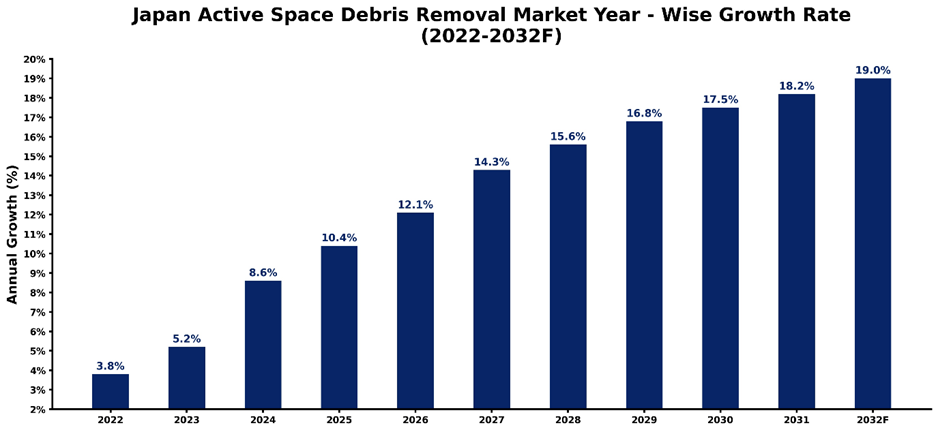
The following table presents the estimated annual growth rates of the market for each year, along with the key factors influencing market performance during the respective period. The values are intended to highlight year-wise drivers rather than provide a direct comparison between individual years.
| Year | Estimated Growth (%) | Market Rationale |
| 2022 | 3.8% | Early-stage commercial activity and government and private-sector R&D support . |
| 2023 | 5.2% | CRD2 development progressed and private-sector participation. |
| 2024 | 8.6% | Strong acceleration following ADRAS-J launch. |
| 2025 | 10.4% | Completion of CRD2 Phase I validated rendezvous and proximity operations. |
| 2026 | 12.1% | Transition toward actual debris-removal capability and greater commercial interest. |
| 2027 | 14.3% | Projected acceleration of ADRAS-J2 is targeted for launch in Japan. |
| 2028 | 15.6% | Successful demonstration could stimulate demand for commercial debris-removal. |
| 2029 | 16.8% | Expansion from demonstration missions towards commercial debris-removal services. |
| 2030 | 17.5% | Increasing need to protect satellites and orbital infrastructure. |
| 2031 | 18.2% | Greater technology maturity and improved manufacturing capabilities. |
| 2032 | 19% | Market moves toward a more established commercial ecosystem. |
Topics Covered in the Japan Active Space Debris Removal Market Report
The Japan Active Space Debris Removal Market report provides a comprehensive analysis based on debris size and end-users. It offers detailed insights into key industry trends, growth drivers, emerging opportunities, competitive developments, and high-growth segments. The report presents an objective assessment of current dynamics and future prospects, enabling stakeholders to make informed business decisions and develop effective strategies aligned with the evolving industry landscape.
Japan Active Space Debris Removal Market Highlights
| Report Name | Japan Active Space Debris Removal Market |
| Forecast period | 2026-2032 |
| CAGR | 11.10% |
| Growing Sector | Active Debris Removal (ADR) |
Japan Active Space Debris Removal Market Synopsis
The Japan Active Space Debris Removal Market is emerging around technologies and services designed to safely identify, approach, capture, deorbit, and remove non-functional satellites, spent rocket stages, and other large orbital debris. Japan is developing this market through strong government-industry collaboration, particularly JAXA’s Commercial Removal of Debris Demonstration (CRD2) program. Further, Phase I has demonstrated rendezvous and proximity operations (RPO) with a large, non-cooperative Japanese rocket upper stage through Astroscale’s ADRAS-J, while Phase II is advancing towards actual capture and orbital removal using robotic-arm technology.
Evaluation of Growth Drivers in Japan Active Space Debris Removal Market (2026–2032)
Below are the major growth drivers influencing the Japan Active Space Debris Removal Market:
| Drivers | Primary Segment Affected | Why It Matters |
| Rising volume of orbital debris and collision risks | Active Debris Removal Services | Increasing debris threatens operational satellites, creating demand for dedicated removal and de-orbiting services. |
| Government-backed CRD2 technology demonstrations | Debris Removal Spacecraft | JAXA’s CRD2 program is advancing rendezvous, proximity operations, capture, and removal technologies. |
| Growing public–private collaboration | Commercial Debris Removal | JAXA’s partnership model with private companies encourages Japanese firms to develop commercially viable capabilities. |
| Advancement of rendezvous and proximity operations (RPO) | RPO & Navigation Systems | Successful ADRAS-J operations demonstrate progress in safely approaching and observing non-cooperative debris. |
| Development of capture and de-orbiting technologies | Capture & De-orbit Systems | CRD2 Phase II is moving beyond observation towards actual debris capture and orbital removal. |
The Japan Active Space Debris Removal Market is projected to grow at a CAGR of 11.10% during the forecast period (2026–2032). The Japan Active Space Debris Removal Market is being driven by the growing need to maintain safe and sustainable orbital operations as space debris accumulates in low Earth orbit, increasing collision risks for satellites and other space infrastructure. Japan’s JAXA Commercial Removal of Debris Demonstration (CRD2) program is a major catalyst, combining government support with private-sector technology development and commercialization; Phase II targets the capture, towing, and deorbiting of a large Japanese rocket upper stage operation.
Evaluation of Restraints in Japan Active Space Debris Removal Market
Below are some major restraints and their influence on the market dynamics:
| Restraints | Primary SegmentAffected | What This Means (Evidence) |
| High Mission Development and Operating Costs | Commercial ADR Services | ADR missions require specialized spacecraft, propulsion, and extensive testing. |
| Complex Non-Cooperative Rendezvous and Capture | Capture & Rendezvous Systems | Debris lacks navigation, attitude control and capture interfaces. |
| Limited Commercial Business Models | Commercial Debris Removal Services | The market is still developing, with uncertainty around recurring customers. |
| Regulatory and International Framework Gaps | Cross-Border ADR Operations | International rules for active debris removal remain under development. |
| Limited Knowledge of Debris Condition and Motion | Space Situational Awareness & Target Selection | Long-resident debris can have uncertain surface condition. |
Japan Active Space Debris Removal Market Challenges
The Japan Active Space Debris Removal Market faces several major restraints, primarily the high technical complexity and mission risk involved in approaching, capturing, and de-orbiting non-cooperative debris, where any malfunction or collision could generate additional debris rather than remove it. Further, high development and mission costs also constrain commercialization because ADR requires sophisticated rendezvous, proximity-operation, sensing, navigation, and capture technologies, while a mature recurring revenue model is still developing.
In addition, regulatory and international coordination challenges remain significant because debris-removal activities can involve ownership, authorization, liability, and security concerns, while internationally agreed frameworks for ADR are still evolving.
Japan Active Space Debris Removal Market Trends
Key trends influencing Japan Active Space Debris Removal Market are presented below:
- Government-Backed Commercialization: Japan is increasingly using JAXA-led programs such as the Commercial Removal of Debris Demonstration (CRD2) to move active debris removal (ADR) from research toward commercially deployable orbital services.
- Shift from Inspection to Actual Removal: The market is progressing from debris observation and rendezvous technologies toward physical capture and deorbiting of debris.
- Growing Use of Rendezvous and Proximity Operations: RPO technologies are becoming a core capability for safely approaching uncooperative debris, whose condition, rotation, and trajectory may be difficult to predict.
- Robotic Capture Technologies: Robotic arms and related capture mechanisms are gaining importance as Japan advances toward removal of large, non-cooperative objects. ADRAS-J2 is planned to combine RPO with robotic-arm technology for capture and deorbiting.
- Expansion of Public–Private Partnerships: Collaboration between JAXA and private companies is becoming a major market-development mechanism, with CRD2 explicitly designed to support Japanese companies engaged in establishing commercial capabilities.
Investment Opportunities in the Japan Active Space Debris Removal Market
Growth-oriented investment opportunities in the Japan Active Space Debris Removal industry include the following:
- Commercial Debris Removal Services: Japan’s efforts to develop debris removal as a commercial space business through JAXA’s CRD2 programme could help attract investment for dedicated orbital debris-removal services.
- Rendezvous & Proximity Operations: Companies that develop autonomous navigation, proximity control, sensing and rendezvous technologies can meet the technical requirements to approach non-cooperative debris.
- Debris Capture Technologies: Japan is moving from debris observation to actual removal, and capture mechanisms for unprepared rocket bodies and other non-cooperative objects are an important area of investment.
- On-Orbit Servicing Platforms: Spacecraft that are capable of inspection, servicing, capture and de-orbiting can generate multiple revenue opportunities beyond single debris-removal missions.
Top 5 Leading Players in Japan Active Space Debris Removal Market
A list of leading companies operating in the Japan Active Space Debris Removal Market is presented below:
1. Astroscale Holdings Inc. / Astroscale Japan Inc.
| Company Name | Astroscale Holdings Inc. / Astroscale Japan Inc. |
|---|---|
| Established Year | 2013 |
| Headquarters | Tokyo, Japan |
| Official Website | Click Here |
Astroscale is a Japan-headquartered space company focused on on-orbit servicing, end-of-life services and active debris removal.
2. Orbital Lasers Co., Ltd.
| Company Name | Orbital Lasers Co., Ltd. |
|---|---|
| Established Year | 2024 |
| Headquarters | Tokyo, Japan |
| Official Website | Click Here |
A SKY Perfect JSAT-origin startup developing laser-based space-debris removal technologies. Its business covers detumbling of rotating debris and active debris removal, with the company targeting commercial ADR services using laser technology.
3. Kawasaki Heavy Industries, Ltd. (KHI)
| Company Name | Kawasaki Heavy Industries, Ltd. (KHI) |
|---|---|
| Established Year | 1896 |
| Headquarters | Tokyo, Japan |
| Official Website | Click Here |
Kawasaki Heavy Industries, Ltd. is a major Japanese aerospace and industrial manufacturer with capabilities in spacecraft and robotics.
4. SKY Perfect JSAT Corporation
| Company Name | SKY Perfect JSAT Corporation |
|---|---|
| Established Year | 1994 |
| Headquarters | Tokyo, Japan |
| Official Website | Click Here |
SKY Perfect JSAT Corporation is a major Japanese satellite operator that has expanded into orbital sustainability and debris-removal technologies.
Government Initiatives Being Implemented in the Japan Active Space Debris Removal Market
Japan’s government is strengthening the Active Space Debris Removal ecosystem through JAXA-led initiatives focused on technology demonstration, commercialization, and sustainable space operations. A key initiative is JAXA’s Commercial Removal of Debris Demonstration (CRD2), launched to acquire active debris-removal technologies while creating commercial opportunities for Japanese companies; its Phase I successfully demonstrated rendezvous, proximity operations, observation, and safe mission termination using Astroscale Japan’s ADRAS-J, while Phase II is intended to demonstrate capture, towing, and removal of a large Japanese rocket-body debris, with launch targeted for FY2027.
Future Insights of the Japan Active Space Debris Removal Market
The Japan Active Space Debris Removal Market is expected to progress from technology demonstration toward commercial orbital servicing, supported by JAXA’s CRD2 program and growing participation from private space companies. The planned CRD2 Phase II mission, including Astroscale’s ADRAS-J2, is expected to demonstrate the approach, capture, and de-orbiting of a large Japanese rocket upper stage, strengthening Japan’s capabilities in non-cooperative target removal services.
Over the longer term, demand is likely to expand for debris inspection, rendezvous and proximity operations, capture systems, autonomous navigation, and end-of-life orbital services as satellite deployments increase and orbital congestion becomes more important.
Market Segmentation Analysis
This report presents a detailed analysis of the market segments along with their leading categories:
By Debris Size – More Than 10 Cm Debris-Size Led the Market, 10–100 mm Debris Category Shows Growth Potential
According to Ravi Bhandari, Research Head, 6Wresearch, the More than 10 cm debris-size segment is the leading segment, accounting for an estimated 43.75% market share in 2025. The growth is supported by the higher strategic value of removing large debris.
The 10–100 mm debris segment is expected to be the leading segment, with a CAGR of 7.68% during 2026–2032. The demand is supported by the increasing recognition that centimeter-scale debris can cause severe spacecraft damage.
By End-Users– Government & Space Agencies Dominated the Market, Commercial End-Users Segment is Expected to Gain Attention
The government & space agencies segment remained the leading end-user segment, accounting for 63.20% market share in 2025. Its leadership is supported by Japan’s strong institutional focus on space sustainability. Additionally, the commercial end-users are likely to growth at a CAGR of 12.56% during 2026-2032, driven by ongoing commercialization efforts.
Note: Market size estimations and growth projections presented in this report are based on 6Wresearch's proprietary forecasting methodology, utilizing the latest available industry data, government publications, and primary research inputs.
Key Attractiveness of the Report
- 10 Years of Market Numbers
- Historical Data Starting from 2022 to 2025
- Base Year: 2025
- Forecast Data until 2032
- Key Performance Indicators Impacting the Market
- Major Upcoming Developments and Projects
Key Highlights of the Report:
- Japan Active Space Debris Removal Market Outlook
- Market Size of Japan Active Space Debris Removal Market, 2025
- Forecast of Japan Active Space Debris Removal Market, 2032
- Historical Data and Forecast of Japan Active Space Debris Removal Revenues & Volume for the Period 2022-2032
- Japan Active Space Debris Removal Market Trend Evolution
- Japan Active Space Debris Removal Market Drivers and Challenges
- Japan Active Space Debris Removal Price Trends
- Japan Active Space Debris Removal Porter's Five Forces
- Japan Active Space Debris Removal Industry Life Cycle
- Historical Data and Forecast of Japan Active Space Debris Removal Market Revenues & Volume By Debris Size for the Period 2022-2032
- Historical Data and Forecast of Japan Active Space Debris Removal Market Revenues & Volume By Between 1 mm and 1 cm for the Period 2022-2032
- Historical Data and Forecast of Japan Active Space Debris Removal Market Revenues & Volume By Between 1 cm to 10 cm for the Period 2022-2032
- Historical Data and Forecast of Japan Active Space Debris Removal Market Revenues & Volume By More than 10 cm for the Period 2022-2032
- Historical Data and Forecast of Japan Active Space Debris Removal Market Revenues & Volume By End-users for the Period 2022-2032
- Historical Data and Forecast of Japan Active Space Debris Removal Market Revenues & Volume By Commercial for the Period 2022-2032
- Historical Data and Forecast of Japan Active Space Debris Removal Market Revenues & Volume By Defense for the Period 2022-2032
- Japan Active Space Debris Removal Import Export Trade Statistics
- Market Opportunity Assessment By Debris Size
- Market Opportunity Assessment By End-users
- Japan Active Space Debris Removal Top Companies Market Share
- Japan Active Space Debris Removal Competitive Benchmarking By Technical and Operational Parameters
- Japan Active Space Debris Removal Company Profiles
- Japan Active Space Debris Removal Key Strategic Recommendations
Market Covered
The report offers an extensive study of the following market segments:
By Debris Size
- Between 1 mm and 1 cm
- Between 1 cm to 10 cm
- More than 10 cm
By End-Users
- Commercial
- Defense































