Japan Adjuvants Market Growth Rate
According to 6Wresearch internal database and industry insights, the Japan Adjuvants Market is projected to expand at a CAGR of approximately 10.4% during 2026–2032.
Japan Adjuvants Market Year-wise Growth Rate and Key Drivers (2022–2032)
This graph illustrates the annual growth rates of the Japan Adjuvants Market from 2022 to 2032, highlighting a steady upward trajectory and projected market expansion over the forecast period.
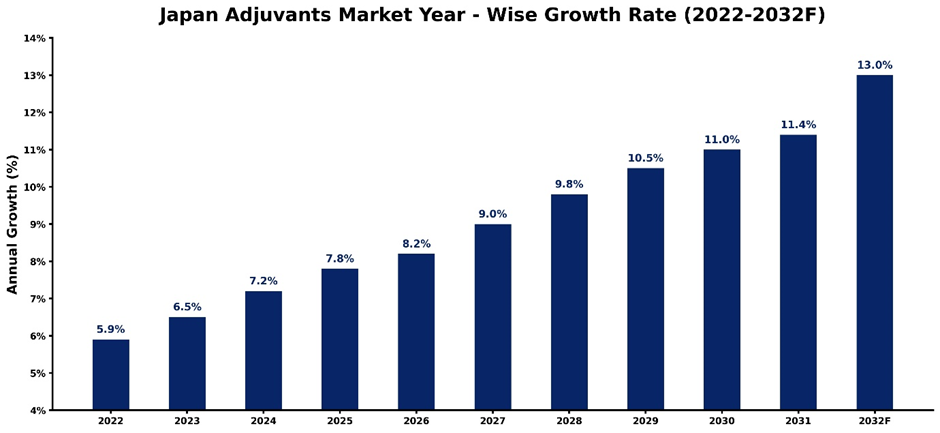
The following table presents the estimated annual growth rates of the market for each year, along with the key factors influencing market performance during the respective period. The values are intended to highlight year-wise drivers rather than provide a direct comparison between individual years.
| Year | Estimated Annual Growth (%) | Market Rationale |
| 2022 | 5.9% | Increasing crop-protection applications and development of advanced vaccine adjuvant systems. |
| 2023 | 6.5% | Rising demand for formulation efficiency and expanded biological research activities. |
| 2024 | 7.2% | Growth in precision agriculture, biological products, and next-generation vaccine development. |
| 2025 | 7.8% | Increasing adoption of advanced crop-protection formulations and vaccine adjuvants. |
| 2026 | 8.2% | Rising demand for high-efficiency agricultural formulations and improved vaccine responses. |
| 2027 | 9% | Expansion of biological crop inputs and advanced human and veterinary vaccine development. |
| 2028 | 9.8% | Increasing adoption of precision spraying, formulation technologies, and next-generation adjuvants. |
| 2029 | 10.5% | Growing demand for targeted crop protection and enhanced immune-response technologies. |
| 2030 | 11% | Expansion of biological products, advanced vaccine platforms, and premium formulation systems. |
| 2031 | 11.4% | Increasing commercialization of innovative adjuvant technologies across agriculture and healthcare. |
| 2032 | 13% | Strong adoption of advanced vaccine and agricultural adjuvants supported by technology development. |
Topics Covered in the Japan Adjuvants Market Report
The Japan Adjuvants Market report provides detailed analysis across Type and Application segments. The report provides a detailed analysis of ongoing market trends, opportunities/high-growth areas, and market drivers that will help stakeholders align strategies based on current and future market dynamics.
Japan Adjuvants Market Highlights
| Report Name | Japan Adjuvants Market |
| Forecast period | 2026-2032 |
| CAGR | 10.4% |
| Growing Sector | Pharmaceuticals & Biotechnology |
Japan Adjuvants Market Synopsis
The Japan Adjuvants Market is expected to grow due to rising demand for efficient crop-protection formulations, expanding vaccine development, adoption of biological and precision agriculture, and increasing demand for advanced immune-response enhancement systems. Adjuvants are additives that improve the performance, stability, dispersion, penetration, delivery, or immune response of active ingredients and antigens. Agricultural applications include herbicides, insecticides, and fungicides, while healthcare and veterinary uses focus on improving vaccine immunogenicity.
Evaluation of Drivers in Japan Adjuvants Market (2026–2032)
Below mentioned are some major drivers and their influence on the market dynamics:
| Drivers | Primary Segment Affected | Why It Matters (Evidence) |
| Increasing demand for efficient crop protection | Oil Emulsions, Mineral Salts, Others | Adjuvants improve spray performance, coverage, penetration, and effectiveness of crop-protection products. |
| Expansion of precision agriculture | Oil Emulsions, Microbial Products, Others | Precision application increases the importance of formulation efficiency and targeted delivery. |
| Rising vaccine development activities | Mineral Salts, Oil Emulsions, Saponins | Vaccine manufacturers require adjuvant systems that improve antigen response and formulation performance. |
| Growing demand for next-generation vaccines | Saponins, Microbial Products, Cytokines | Advanced adjuvant technologies can enable stronger and more targeted immune responses. |
| Increasing focus on biological agriculture | Microbial Products, Saponins, Others | Biological crop inputs and sustainable farming practices are creating opportunities for bio-based formulation technologies. |
The Japan Adjuvants Market growth is projected to reach a CAGR of 10.4% strongly during 2026–2032, driven by rising demand for advanced crop-protection formulations, next-generation vaccine development, growth in precision agriculture, increasing adoption of biological inputs, and higher requirements for improved vaccine immunogenicity. The agriculture and pharmaceutical industries are increasingly evaluating advanced adjuvant technologies for improving application efficiency, biological performance, product stability, active ingredient delivery, and immune response for enabling higher uptake in agriculture, healthcare and veterinary applications.
Evaluation of Restraints in Japan Adjuvants Market
Below mentioned are some major restraints and their influence on market dynamics:
| Market Restraint | Primary Segment Affected | Why It Matters (Evidence) |
| High development and formulation costs | Cytokines, Saponins, Microbial Products | Advanced adjuvant systems require specialized research, formulation, quality control, and validation. |
| Regulatory requirements | Human Vaccines, Veterinary Vaccines | Vaccine-related adjuvants require stringent safety, quality, efficacy, and regulatory evaluation. |
| Limited availability of specialized raw materials | Saponins, Cytokines, Microbial Products | Complex biological and specialty materials can increase procurement costs and supply-chain risks. |
| Formulation compatibility challenges | Oil Emulsions, Mineral Salts, Others | Adjuvants must remain compatible with active ingredients or antigens without compromising stability. |
| Environmental and sustainability requirements | Agricultural Applications | Increasing sustainability requirements may affect the selection and formulation of agricultural adjuvants. |
Japan Adjuvants Market Challenges
The Japan Adjuvants Industry encounters various challenges that could affect its overall expansion. High research and formulation costs, stringent regulatory requirements for pharmaceutical applications, specialty raw-material availability, compatibility issues, and the need for extensive product validation remain key concerns. Agricultural manufacturers are also challenged to find the right balance of formulation performance versus environmental and sustainability needs. Furthermore, the market is composed of technically demanding pharmaceutical and agricultural applications that require companies to have specialized R&D capabilities, quality control systems and regulatory know-how.
Trends in the Japan Adjuvants Market
Below mentioned are some of the trends shaping the Japan Adjuvants Market Growth:
- Trend toward Next-generation Vaccine Adjuvants: Japanese pharmaceutical and biotechnology research is increasingly focusing on adjuvant systems capable of generating stronger and more targeted immune responses.
- Growing Adoption of Biological and Sustainable Agricultural Inputs: Agricultural producers and formulation companies are increasingly exploring biological products and improved application technologies.
- Increasing Use of Precision Application Technologies: The policies of Japan on smart agriculture are encouraging the adoption of technologies to improve agricultural productivity and input efficiency.
Investment Opportunities in the Japan Adjuvants Market
Some of the investments opportunities in the Japan Adjuvants Market are:
- Biological Agricultural Adjuvants: Development of microbial and bio-based adjuvants can provide growth opportunities as Japanese agriculture increasingly focuses on efficient and sustainable input management.
- Precision Agriculture and Spray Technologies: Investments in precision spraying, drone-based application, formulation optimization, and digital crop-management systems can drive additional demand for high-performance adjuvants in agriculture.
- Veterinary Vaccine Adjuvants: The burgeoning field of preventive veterinary health care represents an exciting opportunity for the development of specialized adjuvants for livestock, poultry, companion animals and aquaculture.
Leading Players in Japan Adjuvants Market
Stated below are some of the leading companies contributing significantly to the Japan Adjuvants Market Share:
1. BASF SE
| Company Name | BASF SE |
| Established Year | 1865 |
| Headquarters | Ludwigshafen, Germany |
| Official Website | Click Here |
BASF provides agricultural solutions and specialty chemical technologies that support the agricultural adjuvant ecosystem.
2. Croda International Plc
| Company Name | Croda International Plc |
| Established Year | 1925 |
| Headquarters | Snaith, East Yorkshire, United Kingdom |
| Official Website | Click Here |
Croda develops specialty ingredients and formulation technologies for agricultural, pharmaceutical, and life-science applications.
3. GSK plc
| Company Name | GSK plc |
| Established Year | 2000 |
| Headquarters | London, United Kingdom |
| Official Website | Click Here |
GSK is a major pharmaceutical and vaccine company with proprietary vaccine adjuvant systems, including advanced adjuvant technologies used in vaccine development.
4. Seppic
| Company Name | Seppic |
| Established Year | 1946 |
| Headquarters | Paris, France |
| Official Website | Click Here |
Seppic develops specialty ingredients and formulation technologies for pharmaceutical and vaccine applications.
Government Initiatives in the Japan Adjuvants Market
Japan government is driving the modernization of agriculture through smart agriculture to grow productivity, develop technology and data-driven farming policies. The Smart Agriculture Technology Utilization Promotion Act, which went into effect in 2024, provides financial and tax support to certified plans. MAFF initiatives promote demonstrations of smart-technology, precision farming, technology development and workforce training. These measures promote the efficient use of inputs, accurate application, reduction of labor, and better crop management, thereby indirectly increasing the demand for advanced agricultural adjuvants and contributing to the growth of the adjuvants market in Japan.
Future Insight of the Japan Adjuvants Market
Japan Adjuvants Market is expected to grow with the adoption of precision farming, biological inputs, vaccine innovation and specialty formulations. Japan had hectares of farmland in 2025 and hectares of farmland were covered by drone-based pesticide spraying in FY2024, indicating technology adoption. The average age of core farmers is 69.2 years, increasing the need for automation. Demand for preventive healthcare remains high, with 29.6% of the population being 65+ The companies should focus on precision-compatible, biological, emulsion and next-generation adjuvant technologies.
Market Segmentation Analysis
The report offers a comprehensive study of the following market segments and their leading categories in the market:
By Type – Market Dominated by Oil Emulsions, Microbial Products Expected to Witness Strong Growth
According to Sumit Sagar, Senior Research Analyst at 6Wresearch, till 2025, Oil Emulsions dominated the Japan Adjuvants Market by type, accounting for an estimated 31% market share, supported by their established use in crop-protection formulations and effectiveness in improving spreading and application efficiency. From 2026 to 2032, Microbial Products are expected to witness strong growth at a CAGR of 10.6%, driven by increasing adoption of biological agriculture and demand for environmentally compatible formulations.
By Application – Human Vaccines Dominated the Market, Veterinary Vaccines Expected to Witness Strong Growth
Till 2025, human Vaccines dominated the Japan Adjuvants Market by application, accounting for an estimated 34% market share, supported by vaccine development and demand for enhanced immunogenicity. From 2026 to 2032, Veterinary Vaccines are expected to witness strong growth at a CAGR of 10.8%, driven by rising animal-health expenditure and growing adoption of advanced vaccine formulations.
Note: Market size estimations and growth projections presented in this report are based on 6Wresearch's proprietary forecasting methodology, utilizing the latest available industry data, government publications, and primary research inputs.
Key Attractiveness of the Report
- 10 Years of Market Numbers
- Historical Data Starting from 2022 to 2025
- Base Year: 2025
- Forecast Data until 2032
- Key Performance Indicators Impacting the Market
- Major Upcoming Developments and Projects
Key Highlights of the Report:
- Japan Adjuvants Market Outlook
- Market Size of Japan Adjuvants Market, 2025
- Forecast of Japan Adjuvants Market, 2032
- Historical Data and Forecast of Japan Adjuvants Revenues & Volume for the Period 2022-2032
- Japan Adjuvants Market Trend Evolution
- Japan Adjuvants Market Drivers and Challenges
- Japan Adjuvants Price Trends
- Japan Adjuvants Porter's Five Forces
- Japan Adjuvants Industry Life Cycle
- Historical Data and Forecast of Japan Adjuvants Market Revenues & Volume By Type for the Period 2022-2032
- Historical Data and Forecast of Japan Adjuvants Market Revenues & Volume By Oil Emulsions for the Period 2022-2032
- Historical Data and Forecast of Japan Adjuvants Market Revenues & Volume By Mineral Salts for the Period 2022-2032
- Historical Data and Forecast of Japan Adjuvants Market Revenues & Volume By Microbial Products for the Period 2022-2032
- Historical Data and Forecast of Japan Adjuvants Market Revenues & Volume By Cytokins for the Period 2022-2032
- Historical Data and Forecast of Japan Adjuvants Market Revenues & Volume By Saponins for the Period 2022-2032
- Historical Data and Forecast of Japan Adjuvants Market Revenues & Volume By Others for the Period 2022-2032
- Historical Data and Forecast of Japan Adjuvants Market Revenues & Volume By Application for the Period 2022-2032
- Historical Data and Forecast of Japan Adjuvants Market Revenues & Volume By Herbicides for the Period 2022-2032
- Historical Data and Forecast of Japan Adjuvants Market Revenues & Volume By Insecticides for the Period 2022-2032
- Historical Data and Forecast of Japan Adjuvants Market Revenues & Volume By Fungicides for the Period 2022-2032
- Historical Data and Forecast of Japan Adjuvants Market Revenues & Volume By Human Vaccines for the Period 2022-2032
- Historical Data and Forecast of Japan Adjuvants Market Revenues & Volume By Veterinary Vaccines for the Period 2022-2032
- Historical Data and Forecast of Japan Adjuvants Market Revenues & Volume By Others for the Period 2022-2032
- Japan Adjuvants Import Export Trade Statistics
- Market Opportunity Assessment By Type
- Market Opportunity Assessment By Application
- Japan Adjuvants Top Companies Market Share
- Japan Adjuvants Competitive Benchmarking By Technical and Operational Parameters
- Japan Adjuvants Company Profiles
- Japan Adjuvants Key Strategic Recommendations
Market Covered
The report offers an extensive study of the following market segments:
By Type
- Oil Emulsions
- Mineral Salts
- Microbial Products
- Cytokines
- Saponins
- Others
By Application
- Herbicides
- Insecticides
- Fungicides
- Human Vaccines
- Veterinary Vaccines
- Others






































