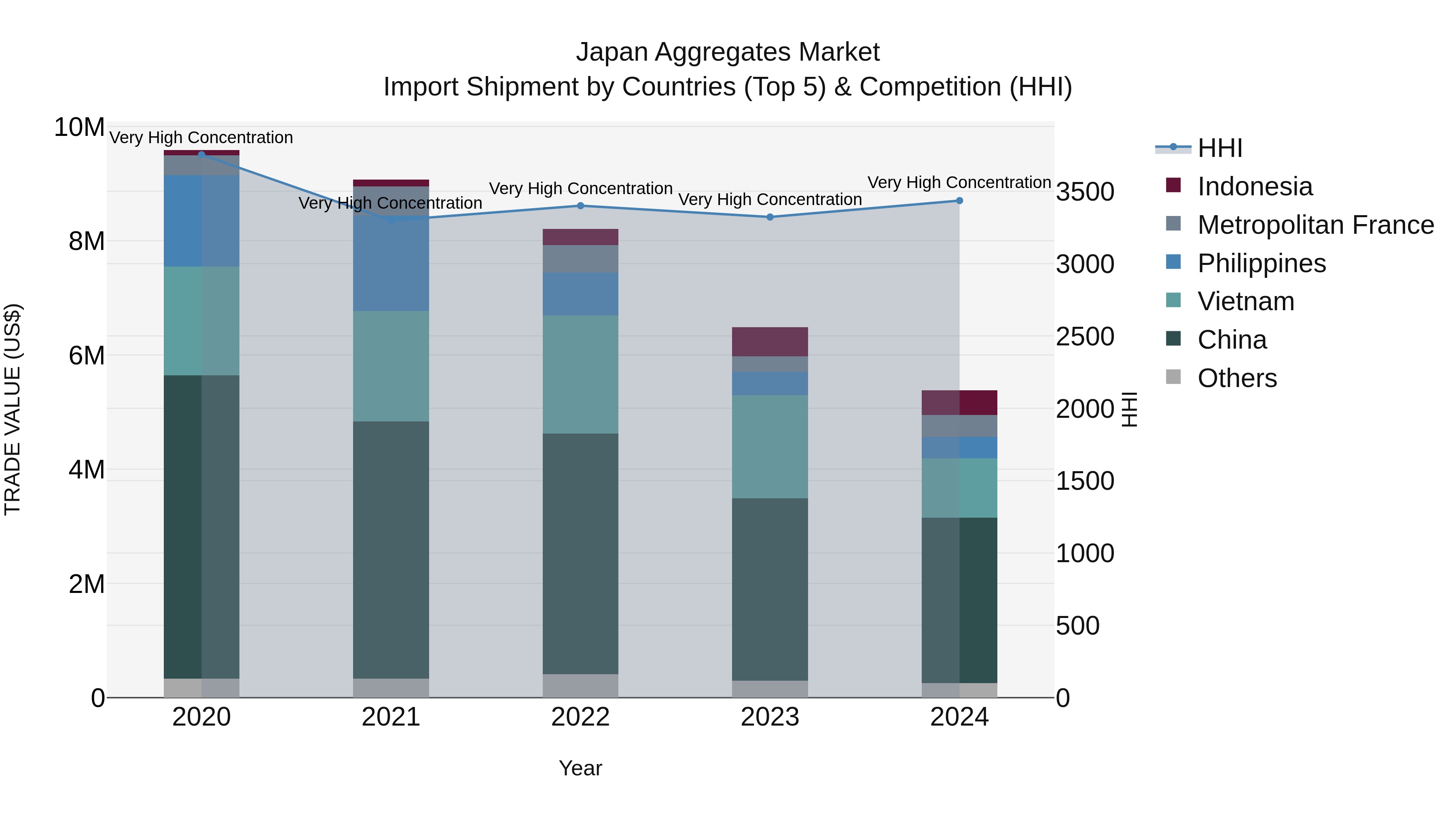
Japan Aggregates Market Import Shipment by Countries (Top 5) & Competition (HHI)
In 2024, Japan continued to heavily rely on imports of aggregates, with top exporting countries being China, Vietnam, Indonesia, Metropolitan France, and the Philippines. The high Herfindahl-Hirschman Index (HHI) indicates a concentrated market. The compound annual growth rate (CAGR) for imports from 2020 to 2024 saw a significant decline of -13.44%, with a further decrease in growth rate from 2023 to 2024 at -16.99%. These figures suggest a challenging market environment for aggregate importers in Japan, highlighting the need for strategic planning and adaptation.
Japan Aggregates Market Overview
The Japan aggregates market is a key sector within the construction industry, encompassing materials such as sand, gravel, crushed stone, and other mineral resources used in the production of concrete, asphalt, and road construction. With a growing demand for infrastructure development and urbanization projects in Japan, the aggregates market is experiencing steady growth. The market is highly fragmented, with numerous small and medium-sized players alongside a few major companies dominating the industry. Environmental regulations and sustainability concerns are driving the market towards more eco-friendly practices, such as recycling and reusing aggregates. Additionally, the government`s focus on disaster-resilient infrastructure and rebuilding efforts post-natural disasters further contribute to the demand for aggregates in Japan.
Japan Aggregates Market Trends
The Japan aggregates market is witnessing several key trends, including a growing demand for sustainable and eco-friendly construction materials. There is a shift towards using recycled aggregates from construction and demolition waste to reduce environmental impact and promote circular economy practices. Additionally, technological advancements in aggregate production processes are improving efficiency and quality control in the industry. Infrastructure development projects, particularly ahead of the 2020 Olympics, are driving the demand for aggregates in Japan. Companies in the market are also focusing on strategic partnerships and mergers to expand their market presence and enhance their product offerings. Overall, the Japan aggregates market is evolving towards more sustainable practices and innovative solutions to meet the increasing demand for construction materials in the country.
Japan Aggregates Market Challenges
In the Japan aggregates market, one of the primary challenges faced is the limited availability of natural resources for aggregate production due to the country`s mountainous terrain and strict regulations on land use. This scarcity of raw materials can lead to increased costs and supply chain disruptions. Additionally, the industry is also grappling with environmental concerns related to quarrying activities, leading to public opposition and regulatory challenges. Competition within the market is intense, with a few major players dominating the sector, making it difficult for smaller companies to enter and compete effectively. Overall, the Japan aggregates market faces obstacles related to resource scarcity, environmental sustainability, regulatory compliance, and market competition.
Japan Aggregates Market Investment Opportunities
The Japan aggregates market presents various investment opportunities due to its steady growth driven by infrastructure development projects, urbanization, and the construction industry. Investors can consider opportunities in companies involved in the production and supply of aggregates such as sand, gravel, and crushed stone, as these materials are essential for construction activities. Additionally, investing in technologies that improve the efficiency of aggregate production, transportation, and usage can be lucrative. With the government`s focus on infrastructure upgrades and sustainable construction practices, there is potential for growth in innovative solutions like recycled aggregates or eco-friendly production methods. Overall, the Japan aggregates market offers diverse investment prospects for those looking to capitalize on the country`s ongoing construction and development projects.
Japan Aggregates Market Government Policy
The Japan aggregates market is influenced by government policies aimed at promoting sustainable development and environmental protection. The government has implemented regulations to ensure responsible mining practices, minimize environmental impact, and promote the use of recycled aggregates to reduce natural resource depletion. Additionally, there are initiatives to encourage the use of aggregates in infrastructure projects to boost economic growth and create job opportunities. The government`s focus on efficient resource management and sustainable development is driving innovation in the aggregates market, leading to the adoption of advanced technologies and processes to meet the growing demand for high-quality aggregates in construction and infrastructure projects.
Japan Aggregates Market Future Outlook
The future outlook for the Japan aggregates market appears promising, driven by ongoing infrastructure development projects, urbanization, and the construction industry`s steady growth. The demand for aggregates, including sand, gravel, and crushed stone, is expected to remain strong as Japan continues to invest in infrastructure upgrades, such as roads, bridges, and buildings. Additionally, the emphasis on sustainable construction practices and the growing adoption of recycled aggregates are likely to shape the market landscape in the coming years. With favorable government initiatives and a focus on environmental conservation, the Japan aggregates market is poised for steady expansion and innovation, presenting opportunities for market players to capitalize on this evolving landscape.
Key Highlights of the Report:
- Japan Aggregates Market Outlook
- Market Size of Japan Aggregates Market, 2024
- Forecast of Japan Aggregates Market, 2031
- Historical Data and Forecast of Japan Aggregates Revenues & Volume for the Period 2021-2031
- Japan Aggregates Market Trend Evolution
- Japan Aggregates Market Drivers and Challenges
- Japan Aggregates Price Trends
- Japan Aggregates Porter's Five Forces
- Japan Aggregates Industry Life Cycle
- Historical Data and Forecast of Japan Aggregates Market Revenues & Volume By Product Type for the Period 2021-2031
- Historical Data and Forecast of Japan Aggregates Market Revenues & Volume By Crushed Stone for the Period 2021-2031
- Historical Data and Forecast of Japan Aggregates Market Revenues & Volume By Sand for the Period 2021-2031
- Historical Data and Forecast of Japan Aggregates Market Revenues & Volume By Gravel for the Period 2021-2031
- Historical Data and Forecast of Japan Aggregates Market Revenues & Volume By Recycled Aggregates for the Period 2021-2031
- Historical Data and Forecast of Japan Aggregates Market Revenues & Volume By Application for the Period 2021-2031
- Historical Data and Forecast of Japan Aggregates Market Revenues & Volume By Construction Materials for the Period 2021-2031
- Historical Data and Forecast of Japan Aggregates Market Revenues & Volume By Road Construction for the Period 2021-2031
- Historical Data and Forecast of Japan Aggregates Market Revenues & Volume By Concrete Production for the Period 2021-2031
- Historical Data and Forecast of Japan Aggregates Market Revenues & Volume By Landscaping for the Period 2021-2031
- Historical Data and Forecast of Japan Aggregates Market Revenues & Volume By End User for the Period 2021-2031
- Historical Data and Forecast of Japan Aggregates Market Revenues & Volume By Construction Industry for the Period 2021-2031
- Historical Data and Forecast of Japan Aggregates Market Revenues & Volume By Residential for the Period 2021-2031
- Historical Data and Forecast of Japan Aggregates Market Revenues & Volume By Commercial for the Period 2021-2031
- Japan Aggregates Import Export Trade Statistics
- Market Opportunity Assessment By Product Type
- Market Opportunity Assessment By Application
- Market Opportunity Assessment By End User
- Japan Aggregates Top Companies Market Share
- Japan Aggregates Competitive Benchmarking By Technical and Operational Parameters
- Japan Aggregates Company Profiles
- Japan Aggregates Key Strategic Recommendations






































