Japan Algorithmic Trading Market Size & Growth Rate (2026-2032)
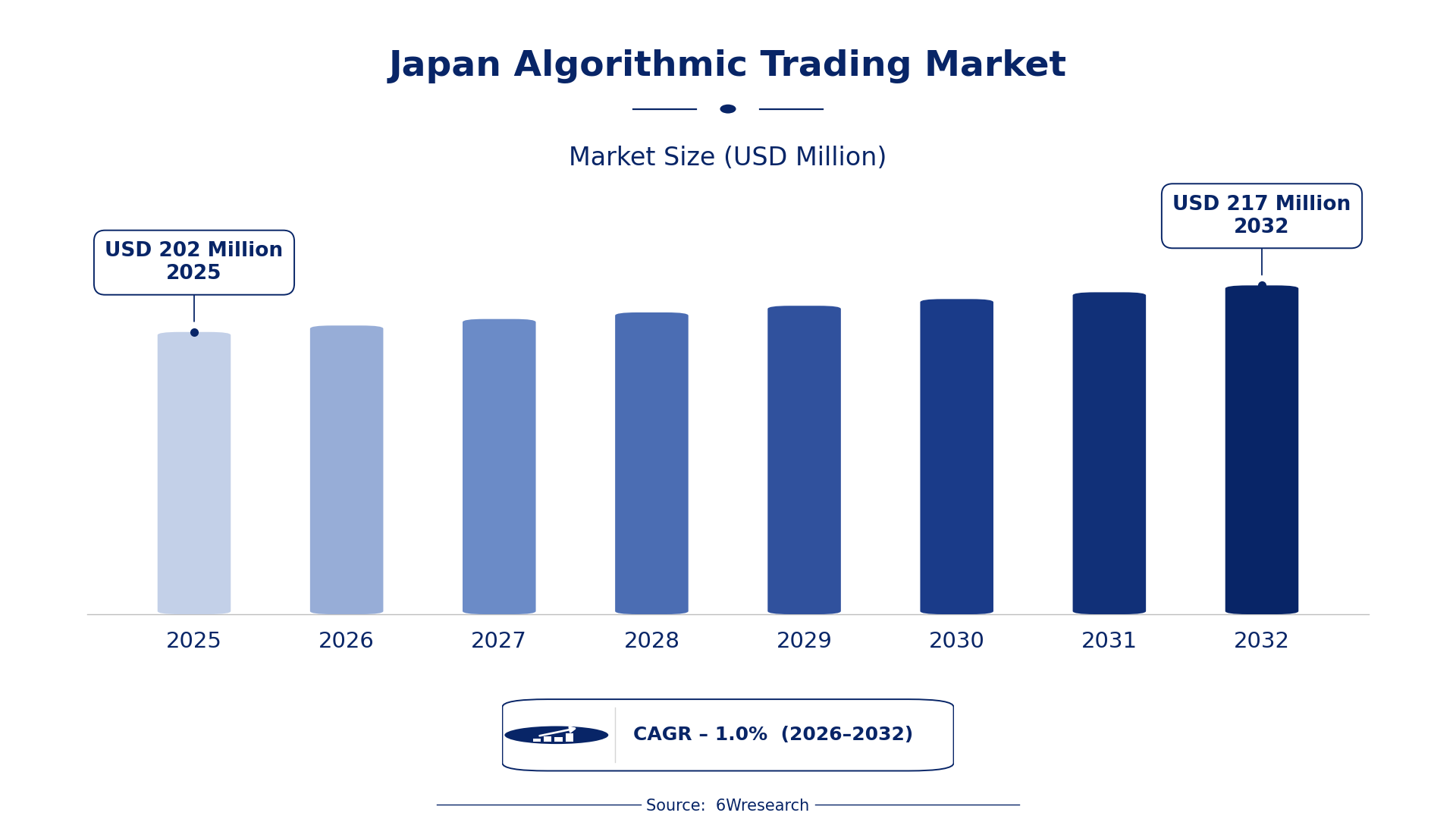
The Japan Algorithmic Trading Market was estimated at USD 202 Million in 2025 and is projected to reach USD 217 Million by 2032, growing at a CAGR of 1.0% from 2026 to 2032.
Japan Algorithmic Trading Market Synopsis
The growth trajectory of the Japan Algorithmic Trading Market is a reflection of its deep integration within the financial sector. As institutions pursue competitive advantages, the reliance on algorithmic trading is intensifying, driven by technological advances and the need for speed.
Japan’s established financial services infrastructure supports this trend, allowing for rapid execution of trades and enhanced market efficiency. With a robust regulatory framework in place, firms are adapting their strategies to leverage artificial intelligence and machine learning, further fueling the market's evolution.
Japan Algorithmic Trading Market Year-wise Growth Rate and Key Drivers
This graph illustrates the annual growth rates of the Japan Algorithmic Trading Market from 2021 to 2032, highlighting a steady upward trajectory and projected expansion over the forecast period.
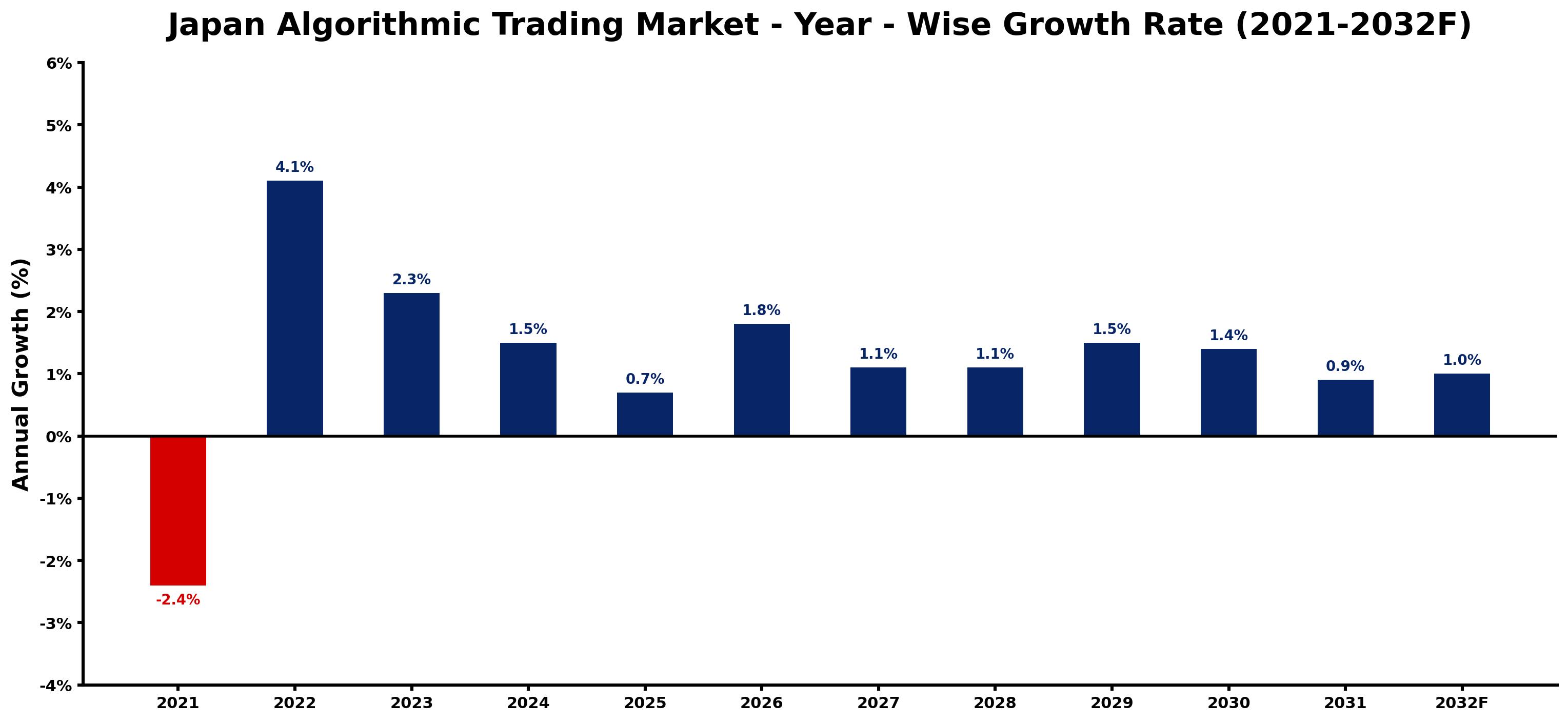
The table below presents the year‑wise growth rates along with the key drivers influencing the market
| Year | Growth Rate | Major Drivers |
| 2021 | -2.4% | Tighter regulations from Japan's Financial Services Agency. |
| 2022 | 4.1% | Increased retail investor participation driven by fintech innovations |
| 2023 | 2.3% | Bank of Japan's continued low-interest rate policies boost trading |
| 2024 | 1.5% | Growing popularity of AI-driven trading algorithms in Japan |
| 2025 | 0.7% | Regulatory support for automated trading systems via JFSA |
| 2026 | 1.8% | Emergence of local blockchain solutions enhancing trading efficiency |
| 2027 | 1.1% | Increased focus on ESG investments among institutional traders |
| 2028 | 1.1% | Enhanced cybersecurity measures fostering investor confidence in trading |
| 2029 | 1.5% | Japan's aging population shifting toward diversified investment strategies |
| 2030 | 1.4% | Integration of 5G technology improving execution speeds in markets |
| 2031 | 0.9% | Tax incentives for technology investments benefiting algorithmic trading |
| 2032 | 1.0% | Collaboration between Japanese fintechs and traditional brokers rising |
Note: Market size estimations and growth projections presented in this report are based on 6Wresearch's proprietary forecasting methodology, utilizing the latest available industry data, government publications, and primary research inputs.
Japan Algorithmic Trading Market Key Takeaways
Below are some of the specific key takeaways from the market, including:
- The market is characterized by the increasing adoption of AI and machine learning technologies.
- High-frequency trading strategies are becoming the norm as speed and efficiency become paramount.
- Regulatory compliance and risk management are critical areas of focus amid evolving guidelines.
- Investment opportunities abound in algorithmic trading software development and data analytics.
- The Japanese government’s initiatives are shaping the market's regulatory environment, enhancing stability.
Evaluation of Restraints in Japan Algorithmic Trading Market
Despite its promising growth, the Japan Algorithmic Trading Market faces notable challenges. One of the most pressing issues is the regulatory landscape, which can be intricate and demanding, making compliance a hurdle for many firms. Additionally, the scarcity of high-quality market data hampers the development of effective trading strategies.
Culturally, there is also a resistance to rapid technological change. Traditional business practices may slow the adoption of algorithmic trading, requiring firms to engage in significant educational initiatives to foster acceptance. Addressing these restraints is essential for realizing the market's full potential.
Japan Algorithmic Trading Market Trends
The trend towards sophisticated algorithmic trading is underpinned by a heightened focus on artificial intelligence and machine learning. These technologies are not merely enhancements; they are redefining how trading strategies are constructed and executed. Firms are increasingly investing in advanced analytics to refine their approach, leading to better performance outcomes.
High-frequency trading continues to gain traction, propelled by the demand for immediate execution and minimal latency. Regulatory bodies are also placing greater emphasis on compliance, pushing firms to adopt robust risk management frameworks. This shift is not only about adhering to rules but about fostering a trustworthy trading environment.
Japan Algorithmic Trading Market Opportunities
Investment opportunities are emerging as financial institutions increasingly embrace automated trading strategies. The demand for cutting-edge algorithmic trading solutions is on the rise, presenting openings for software developers and consultancy firms specializing in this niche.
Additionally, there is an expanding market for data analytics and machine learning services tailored specifically for algorithmic trading applications. Firms that can provide innovative solutions in these areas are well-positioned to capitalize on the evolving landscape.
Government Initiatives in the Japan Algorithmic Trading Market
The Japanese government plays a critical role in shaping the algorithmic trading market through regulatory frameworks and public policy initiatives. The Financial Services Agency (FSA) has been proactive in establishing guidelines that ensure market integrity and investor protection, crucial for fostering trust in automated trading environments.
- A regulatory framework introduced in 2010 mandates firms to maintain robust risk management systems, promoting accountability.
- Current guidelines from the FSA focus on high-frequency trading practices, ensuring they do not compromise market stability.
- In 2018, Japan updated its regulations to align with international standards, enhancing its competitive edge.
- Ongoing assessments by the government aim to adapt to market changes and safeguard investors’ interests.
- Planned initiatives include a comprehensive review of algorithmic trading regulations expected to roll out in the next couple of years.
Future Insights of the Japan Algorithmic Trading Market
Looking ahead to 2026-2032, the Japan Algorithmic Trading Market is set for continued expansion, driven primarily by advances in technology and increased institutional adoption. The integration of artificial intelligence will foster the development of more sophisticated trading algorithms, enhancing execution speed and accuracy.
Regulatory frameworks are likely to evolve, encouraging more firms to participate in algorithmic trading. As the market matures, we can expect a greater emphasis on compliance and risk management, which will ultimately contribute to a healthier trading environment.
Japan Algorithmic Trading Market Latest Developments
In recent months, the Japan Algorithmic Trading Market has seen a flurry of activity as firms adapt to the changing environment. Companies are increasingly launching innovative trading solutions and enhancing their technological capabilities to stay competitive.
- A major technology vendor launched a new algorithmic trading platform in Q1 2025, aimed at improving execution efficiency.
- An ongoing initiative focused on enhancing data accessibility for algorithmic trading began in mid-2025 and continues to evolve.
- By late 2025, a prominent financial institution is expected to roll out a new suite of AI-driven trading algorithms designed for high-frequency trading.
- A collaboration between leading fintech firms to develop standardized trading protocols is underway and projected to be completed by early 2026.
- Upcoming regulations expected to be introduced in 2026 will further clarify compliance requirements for algorithmic trading firms.
Japan Algorithmic Trading Market - Key Attractiveness of the Report
- 10 Years of Market Numbers
- Historical Data Starting from 2022 to 2025
- Base Year: 2025
- Forecast Data until 2032
- Key Performance Indicators Impacting the Market
- Major Upcoming Developments and Projects
Key Highlights of the Report:
- Japan Algorithmic Trading Market Outlook
- Market Size of Japan Algorithmic Trading Market, 2025
- Forecast of Japan Algorithmic Trading Market, 2032
- Historical Data and Forecast of Japan Algorithmic Trading Revenues & Volume for the Period 2022-2032F
- Japan Algorithmic Trading Market Trend Evolution
- Japan Algorithmic Trading Market Drivers and Challenges
- Japan Algorithmic Trading Price Trends
- Japan Algorithmic Trading Porter's Five Forces
- Japan Algorithmic Trading Industry Life Cycle
- Historical Data and Forecast of Japan Algorithmic Trading Market Revenues & Volume By Trading Type for the Period 2022-2032F
- Historical Data and Forecast of Japan Algorithmic Trading Market Revenues & Volume By Foreign Exchange (FOREX) for the Period 2022-2032F
- Historical Data and Forecast of Japan Algorithmic Trading Market Revenues & Volume By Stock Markets for the Period 2022-2032F
- Historical Data and Forecast of Japan Algorithmic Trading Market Revenues & Volume By Exchange-Traded Fund (ETF) for the Period 2022-2032F
- Historical Data and Forecast of Japan Algorithmic Trading Market Revenues & Volume By Bonds for the Period 2022-2032F
- Historical Data and Forecast of Japan Algorithmic Trading Market Revenues & Volume By Cryptocurrencies for the Period 2022-2032F
- Historical Data and Forecast of Japan Algorithmic Trading Market Revenues & Volume By Others for the Period 2022-2032F
- Historical Data and Forecast of Japan Algorithmic Trading Market Revenues & Volume By Deployment Mode for the Period 2022-2032F
- Historical Data and Forecast of Japan Algorithmic Trading Market Revenues & Volume By Cloud for the Period 2022-2032F
- Historical Data and Forecast of Japan Algorithmic Trading Market Revenues & Volume By On-premises for the Period 2022-2032F
- Historical Data and Forecast of Japan Algorithmic Trading Market Revenues & Volume By Component for the Period 2022-2032F
- Historical Data and Forecast of Japan Algorithmic Trading Market Revenues & Volume By Solutions for the Period 2022-2032F
- Historical Data and Forecast of Japan Algorithmic Trading Market Revenues & Volume By Services for the Period 2022-2032F
- Historical Data and Forecast of Japan Algorithmic Trading Market Revenues & Volume By Enterprise Size for the Period 2022-2032F
- Historical Data and Forecast of Japan Algorithmic Trading Market Revenues & Volume By Small and Medium-sized Enterprises (SMEs) for the Period 2022-2032F
- Historical Data and Forecast of Japan Algorithmic Trading Market Revenues & Volume By Large Enterprises for the Period 2022-2032F
- Japan Algorithmic Trading Import Export Trade Statistics
- Market Opportunity Assessment By Trading Type
- Market Opportunity Assessment By Deployment Mode
- Market Opportunity Assessment By Component
- Market Opportunity Assessment By Enterprise Size
- Japan Algorithmic Trading Top Companies Market Share
- Japan Algorithmic Trading Competitive Benchmarking By Technical and Operational Parameters
- Japan Algorithmic Trading Company Profiles
- Japan Algorithmic Trading Key Strategic Recommendations






































