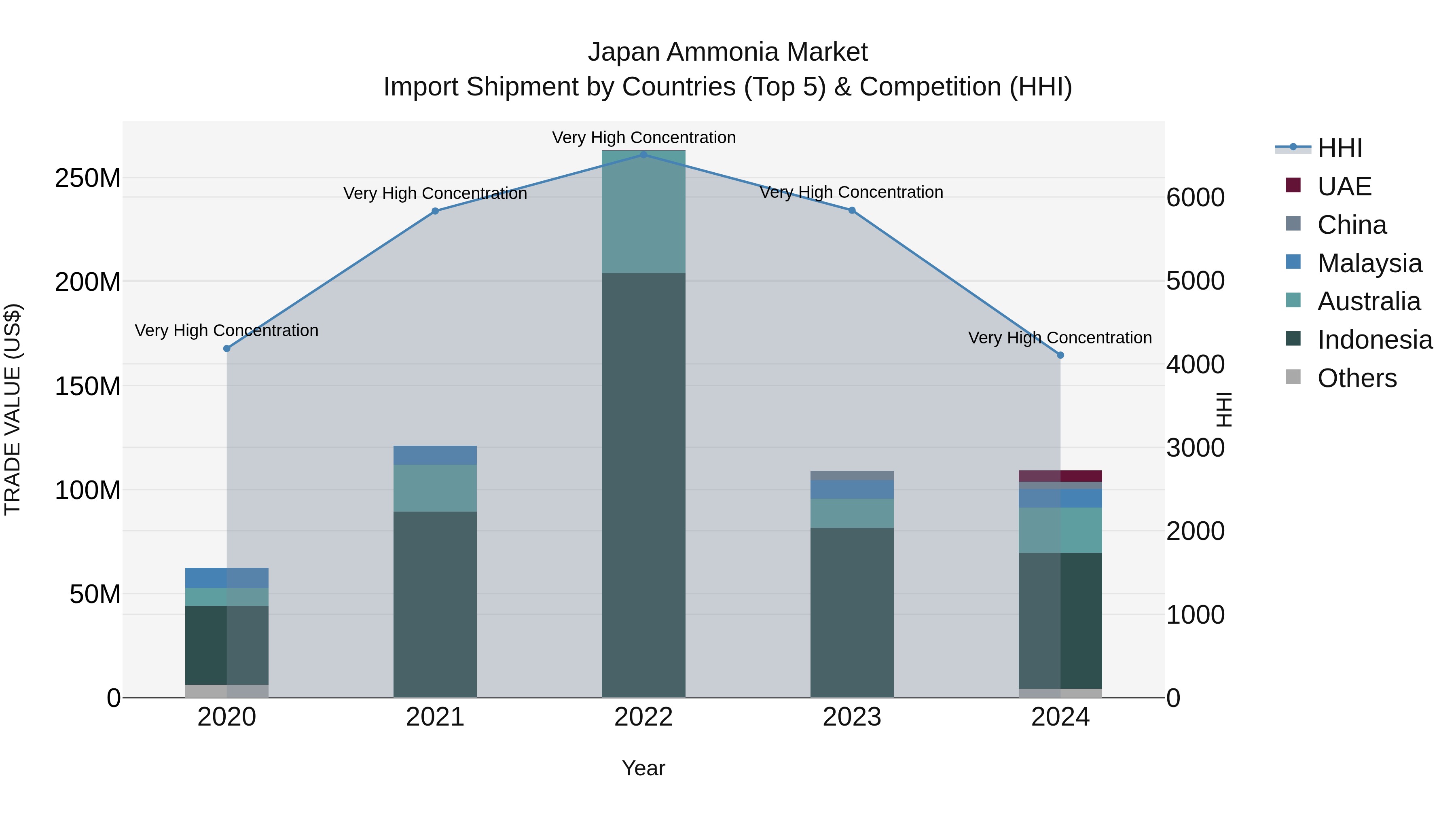
Japan Ammonia Market Import Shipment by Countries (Top 5) & Competition (HHI)
Japan's ammonia import shipments in 2024 continued to be dominated by key exporting countries such as Indonesia, Australia, Malaysia, UAE, and Qatar. The high Herfindahl-Hirschman Index (HHI) indicates a concentrated market structure, emphasizing the significant market share held by these top exporting nations. With a notable compound annual growth rate (CAGR) of 14.99% from 2020 to 2024, the industry experienced steady expansion. Although the growth rate slightly decelerated to 0.21% from 2023 to 2024, the overall positive trend underscores the enduring demand for ammonia imports in Japan.
Japan Ammonia Market Overview
The Japan Ammonia Market is experiencing steady growth, driven primarily by its widespread use in the agricultural sector as a key fertilizer ingredient. With Japan being a major importer of ammonia for agricultural purposes, the market is also influenced by factors such as industrial applications including chemicals, pharmaceuticals, and refrigeration. The country`s focus on reducing carbon emissions and transitioning towards cleaner energy sources is expected to further boost the demand for ammonia as a potential green energy carrier. However, challenges such as volatile global prices, competition from other nitrogen-based fertilizers, and the need for technological advancements in production processes present obstacles to market growth. Overall, the Japan Ammonia Market is poised for expansion, fueled by both traditional agricultural uses and emerging opportunities in sustainable energy applications.
Japan Ammonia Market Trends
The Japan Ammonia Market is currently experiencing significant trends driven by the shift towards green ammonia production. With increasing focus on sustainability and reducing carbon emissions, there is a growing interest in green ammonia production methods, such as electrolysis using renewable energy sources. Additionally, the market is witnessing investments in ammonia as a potential energy carrier for hydrogen fuel cells and as a renewable fuel for power generation. Furthermore, there is an emphasis on improving ammonia production efficiency and reducing environmental impact through technological advancements and process optimizations. Overall, the Japan Ammonia Market is evolving towards a more sustainable and environmentally friendly future, with a focus on green production methods and innovative applications for ammonia.
Japan Ammonia Market Challenges
In the Japan Ammonia Market, some challenges include fluctuating raw material prices, increased competition from other ammonia-producing countries like China and Russia, and the need to comply with strict environmental regulations. The market also faces pressure to adopt more sustainable production methods to reduce greenhouse gas emissions and limit environmental impact. Additionally, the aging infrastructure in Japan`s existing ammonia production facilities poses a challenge in terms of maintaining efficiency and competitiveness in the global market. Overall, the Japan Ammonia Market must navigate these challenges while seeking opportunities for growth and innovation to remain competitive on a global scale.
Japan Ammonia Market Investment Opportunities
The Japan Ammonia Market presents promising investment opportunities due to the country`s increasing focus on sustainability and green energy. With ammonia being considered as a potential clean energy carrier for applications such as power generation and transportation, there is a growing demand for ammonia as a green fuel alternative. Additionally, Japan`s commitment to reducing carbon emissions and transitioning to renewable energy sources further drives the market for ammonia production and distribution. Investing in companies involved in ammonia production, storage, transportation, and related infrastructure development could be lucrative in the long term. Collaborations with research institutions and government initiatives aimed at promoting green technologies can also offer strategic investment opportunities in the Japan Ammonia Market.
Japan Ammonia Market Government Policy
The Japanese government has been actively promoting the use of ammonia as a clean energy source to achieve carbon neutrality by 2050. In line with this goal, various policies have been implemented to support the development and growth of the ammonia market in Japan. These policies include financial incentives such as subsidies and tax breaks for ammonia production facilities, research and development funding for ammonia-related technologies, and regulatory frameworks to ensure the safe handling and transportation of ammonia. Additionally, the government has set ambitious targets for increasing the use of ammonia in various sectors such as power generation, transportation, and industrial applications. Overall, the government`s strong support and focus on ammonia as a key part of its energy transition strategy are expected to drive significant growth in the Japan Ammonia Market in the coming years.
Japan Ammonia Market Future Outlook
The Japan Ammonia Market is anticipated to witness steady growth in the coming years due to increasing demand from various end-use industries such as agriculture, chemicals, and pharmaceuticals. Factors driving this growth include the expanding agricultural sector, rising population leading to higher food demand, and the government`s focus on promoting sustainable farming practices. Additionally, the growing adoption of ammonia as a clean energy carrier for power generation and transportation is expected to further boost market growth. However, challenges such as price volatility of raw materials and stringent regulations on ammonia emissions may hinder market expansion. Overall, with the increasing application of ammonia in diverse industries and ongoing efforts towards sustainability, the Japan Ammonia Market is poised for positive growth in the foreseeable future.
Key Highlights of the Report:
- Japan Ammonia Market Outlook
- Market Size of Japan Ammonia Market, 2021
- Forecast of Japan Ammonia Market, 2031
- Historical Data and Forecast of Japan Ammonia Revenues & Volume for the Period 2018 - 2031
- Japan Ammonia Market Trend Evolution
- Japan Ammonia Market Drivers and Challenges
- Japan Ammonia Price Trends
- Japan Ammonia Porter's Five Forces
- Japan Ammonia Industry Life Cycle
- Historical Data and Forecast of Japan Ammonia Market Revenues & Volume By Type for the Period 2018 - 2031
- Historical Data and Forecast of Japan Ammonia Market Revenues & Volume By Liquid for the Period 2018 - 2031
- Historical Data and Forecast of Japan Ammonia Market Revenues & Volume By Gas for the Period 2018 - 2031
- Historical Data and Forecast of Japan Ammonia Market Revenues & Volume By End-user Industry for the Period 2018 - 2031
- Historical Data and Forecast of Japan Ammonia Market Revenues & Volume By Agriculture for the Period 2018 - 2031
- Historical Data and Forecast of Japan Ammonia Market Revenues & Volume By Textiles for the Period 2018 - 2031
- Historical Data and Forecast of Japan Ammonia Market Revenues & Volume By Mining for the Period 2018 - 2031
- Historical Data and Forecast of Japan Ammonia Market Revenues & Volume By Pharmaceutical for the Period 2018 - 2031
- Historical Data and Forecast of Japan Ammonia Market Revenues & Volume By Refrigeration for the Period 2018 - 2031
- Historical Data and Forecast of Japan Ammonia Market Revenues & Volume By Others for the Period 2018 - 2031
- Japan Ammonia Import Export Trade Statistics
- Market Opportunity Assessment By Type
- Market Opportunity Assessment By End-user Industry
- Japan Ammonia Top Companies Market Share
- Japan Ammonia Competitive Benchmarking By Technical and Operational Parameters
- Japan Ammonia Company Profiles
- Japan Ammonia Key Strategic Recommendations






































