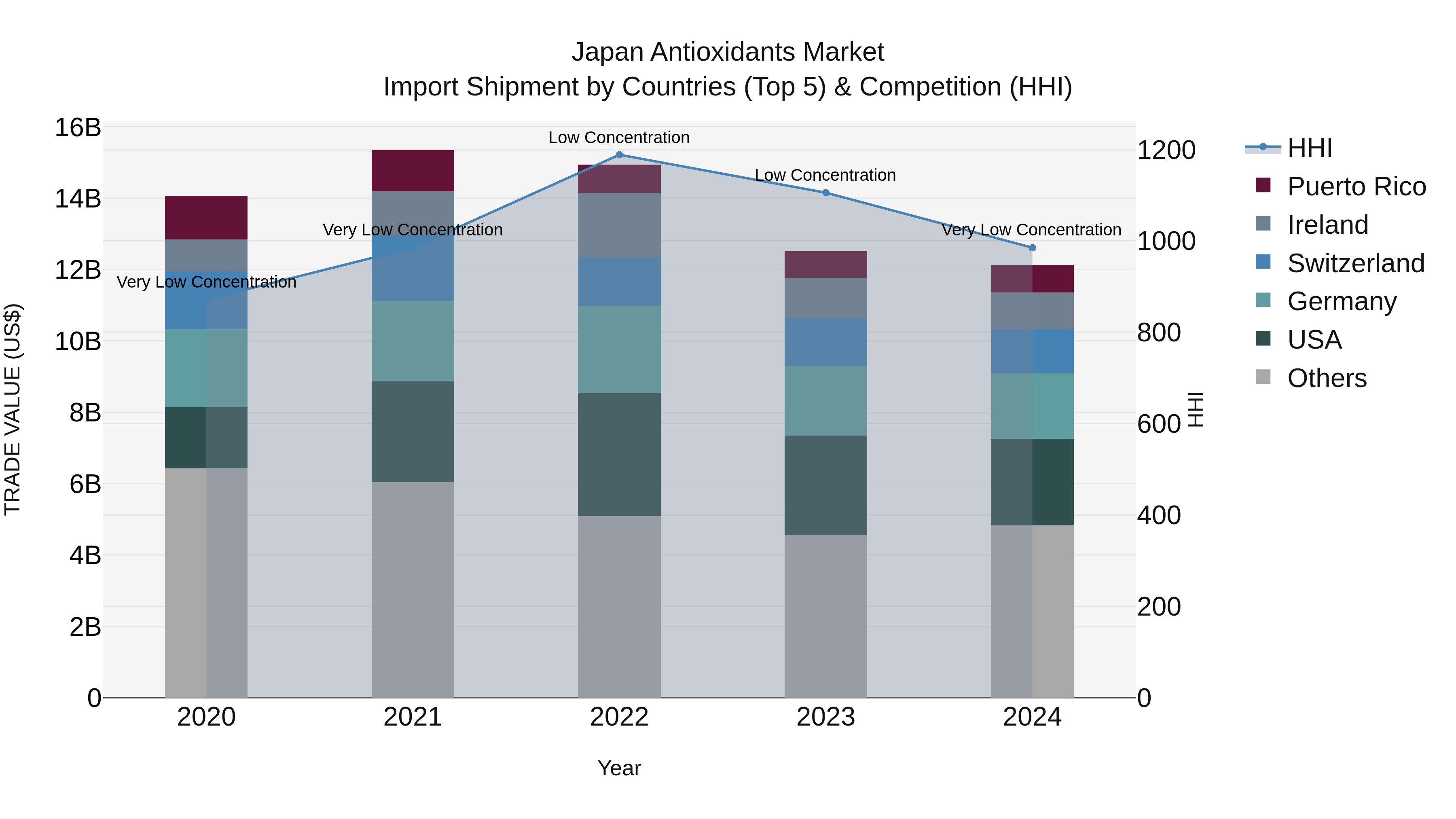
Japan Antioxidants Market Import Shipment by Countries (Top 5) & Competition (HHI)
The Japan antioxidants import market saw a decline in concentration levels from 2023 to 2024, with a very low Herfindahl-Hirschman Index (HHI) indicating a more competitive landscape. Despite this, the top countries exporting to Japan in 2024 remained consistent, with the USA, Germany, Switzerland, Ireland, and Sweden leading the way. The negative compound annual growth rate (CAGR) of -3.67% from 2020 to 2024 reflects challenges in the market, with a further decline in the growth rate of -3.17% from 2023 to 2024 suggesting ongoing difficulties in the sector.
Japan Antioxidants Market Synopsis
The Japan antioxidants market is witnessing steady growth driven by increasing consumer awareness of the health benefits of antioxidants in preventing chronic diseases and promoting overall well-being. Rising demand for natural antioxidants sourced from fruits, vegetables, and herbs is a key trend in the market, with a shift away from synthetic antioxidants due to health concerns. The food and beverage industry is a major consumer of antioxidants in Japan, with manufacturers incorporating these ingredients into a wide range of products such as functional foods, beverages, and supplements. Additionally, the cosmetics and personal care sector is increasingly utilizing antioxidants for their anti-aging and skin-enhancing properties. As the trend towards healthier lifestyles continues to gain momentum, the Japan antioxidants market is expected to expand further in the coming years.
Japan Antioxidants Market Trends
The Japan antioxidants market is experiencing a growing demand for natural antioxidants derived from sources such as fruits, vegetables, and herbs due to the increasing consumer preference for clean label and natural products. There is also a rising awareness among Japanese consumers regarding the health benefits of antioxidants in preventing chronic diseases and promoting overall well-being, driving the market growth. Manufacturers are focusing on developing innovative antioxidant formulations and products to cater to the evolving consumer preferences. Additionally, the food and beverage industry in Japan is incorporating antioxidants into various products such as functional foods, beverages, and supplements to meet the growing demand for healthier options. Overall, the Japan antioxidants market is expected to continue its upward trajectory fueled by the emphasis on health and wellness among consumers.
Japan Antioxidants Market Challenges
In the Japan Antioxidants Market, some challenges that are commonly faced include increasing competition from domestic and international players, evolving consumer preferences towards natural and clean label products, stringent regulatory requirements for food additives, and rising raw material costs. Additionally, there is a growing need for sustainable and eco-friendly antioxidant solutions to align with the country`s environmental goals. Adapting to these market dynamics requires companies to invest in research and development for innovative antioxidant formulations, establish strong distribution networks, and enhance marketing strategies to differentiate their products in a crowded marketplace. Overall, navigating through these challenges while meeting consumer demands and regulatory standards remains crucial for success in the Japan Antioxidants Market.
Japan Antioxidants Market Investment Opportunities
The Japan Antioxidants Market presents several promising investment opportunities due to the increasing consumer awareness about the health benefits of antioxidants. With a growing aging population and rising health concerns, there is a growing demand for antioxidants in various industries such as food and beverage, cosmetics, and pharmaceuticals. Investing in companies that specialize in developing innovative antioxidant products or technologies could be lucrative. Additionally, there is potential for investment in research and development activities to discover new antioxidant compounds or applications. Collaborating with local manufacturers or distributors to enter the Japanese market could also be a strategic investment move. Overall, the Japan Antioxidants Market offers a range of investment opportunities for those looking to capitalize on the rising demand for antioxidant products in the country.
Jordan Agar Market Government Policies
The Japan Antioxidants Market is regulated by various government policies aimed at ensuring product safety and consumer protection. The Japanese Ministry of Health, Labour and Welfare (MHLW) and the Consumer Affairs Agency (CAA) oversee the regulations related to antioxidants in food and dietary supplements. The Food Sanitation Act sets maximum residue limits for antioxidants in food products to ensure they are safe for consumption. Additionally, the Pharmaceutical Affairs Act regulates the use of antioxidants in pharmaceuticals and health supplements. The Japanese government also promotes research and development in the field of antioxidants through various funding programs and initiatives to support innovation in this market. Overall, the government policies in Japan play a crucial role in maintaining the quality and safety standards of antioxidants in the market.
Japan Antioxidants Market Future Outlook
The Japan Antioxidants Market is expected to witness steady growth in the coming years due to the increasing consumer awareness about the health benefits of antioxidants. Factors such as rising health concerns, aging population, and changing lifestyles are driving the demand for antioxidants in various industries including food and beverages, cosmetics, pharmaceuticals, and animal feed. Additionally, the growing trend towards natural and organic products is boosting the demand for natural antioxidants sourced from fruits, vegetables, and herbs. With a focus on research and development to introduce innovative antioxidant products and the presence of key market players in the region, the Japan Antioxidants Market is poised for expansion in the foreseeable future.
Key Highlights of the Report:
- Japan Antioxidants Market Outlook
- Market Size of Japan Antioxidants Market, 2021
- Forecast of Japan Antioxidants Market, 2031
- Historical Data and Forecast of Japan Antioxidants Revenues & Volume for the Period 2018 - 2031
- Japan Antioxidants Market Trend Evolution
- Japan Antioxidants Market Drivers and Challenges
- Japan Antioxidants Price Trends
- Japan Antioxidants Porter's Five Forces
- Japan Antioxidants Industry Life Cycle
- Historical Data and Forecast of Japan Antioxidants Market Revenues & Volume By Type for the Period 2018 - 2031
- Historical Data and Forecast of Japan Antioxidants Market Revenues & Volume By Natural Antioxidants for the Period 2018 - 2031
- Historical Data and Forecast of Japan Antioxidants Market Revenues & Volume By Synthetic Antioxidants for the Period 2018 - 2031
- Historical Data and Forecast of Japan Antioxidants Market Revenues & Volume By Form for the Period 2018 - 2031
- Historical Data and Forecast of Japan Antioxidants Market Revenues & Volume By Dry for the Period 2018 - 2031
- Historical Data and Forecast of Japan Antioxidants Market Revenues & Volume By Liquid for the Period 2018 - 2031
- Historical Data and Forecast of Japan Antioxidants Market Revenues & Volume By Application for the Period 2018 - 2031
- Historical Data and Forecast of Japan Antioxidants Market Revenues & Volume By Food and Feed Additives for the Period 2018 - 2031
- Historical Data and Forecast of Japan Antioxidants Market Revenues & Volume By Pharmaceuticals and Personal Care Products for the Period 2018 - 2031
- Historical Data and Forecast of Japan Antioxidants Market Revenues & Volume By Fuel and Lubricant Additives for the Period 2018 - 2031
- Historical Data and Forecast of Japan Antioxidants Market Revenues & Volume By Plastic for the Period 2018 - 2031
- Historical Data and Forecast of Japan Antioxidants Market Revenues & Volume By Rubber for the Period 2018 - 2031
- Historical Data and Forecast of Japan Antioxidants Market Revenues & Volume By Latex Additives for the Period 2018 - 2031
- Japan Antioxidants Import Export Trade Statistics
- Market Opportunity Assessment By Type
- Market Opportunity Assessment By Form
- Market Opportunity Assessment By Application
- Japan Antioxidants Top Companies Market Share
- Japan Antioxidants Competitive Benchmarking By Technical and Operational Parameters
- Japan Antioxidants Company Profiles
- Japan Antioxidants Key Strategic Recommendations






































