Japan Application Performance Management Market Size & Growth Rate (2026-2032)
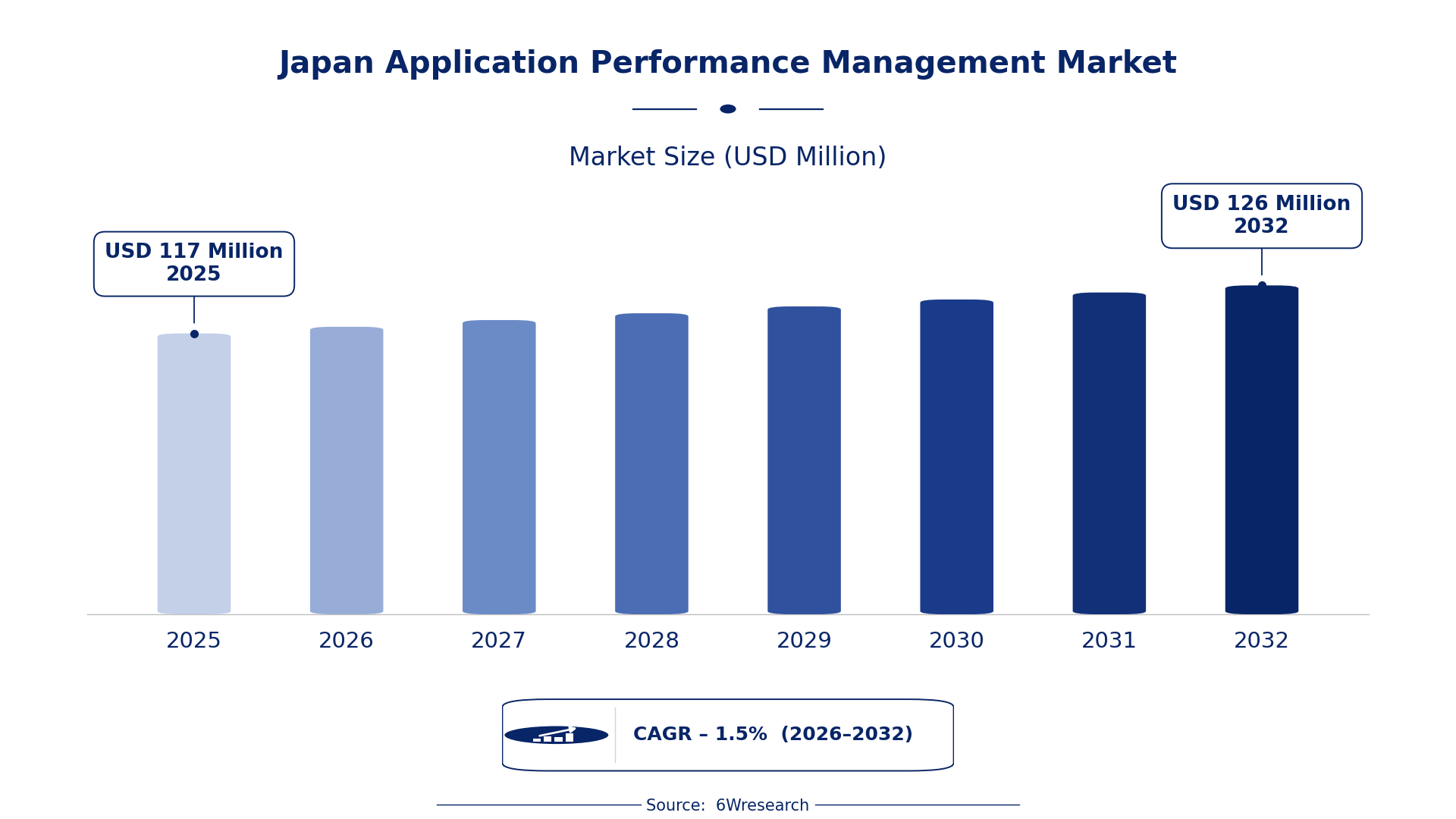
The Japan Application Performance Management Market was estimated at USD 117 Million in 2025 and is projected to reach USD 126 Million by 2032, growing at a CAGR of 1.5% from 2026 to 2032.
Japan Application Performance Management Market Synopsis
The Japan Application Performance Management market is at a crossroads, where historical growth driven by digital transformation efforts is setting the stage for future expansion. As enterprises increasingly rely on complex IT infrastructures and cloud-based services, the demand for sophisticated APM solutions is intensifying, reflecting a shift in focus from mere performance monitoring to comprehensive optimization.
In this environment, organizations are no longer satisfied with basic monitoring tools. Instead, they are seeking advanced solutions that offer predictive analytics and AI-driven insights. This trend underscores a significant opportunity for vendors who can meet the evolving needs of Japanese businesses as they strive to enhance user experience and operational efficiency.
Japan Application Performance Management Market Year-wise Growth Rate and Key Drivers
This graph illustrates the annual growth rates of the Japan Application Performance Management Market from 2021 to 2032, highlighting a steady upward trajectory and projected expansion over the forecast period.
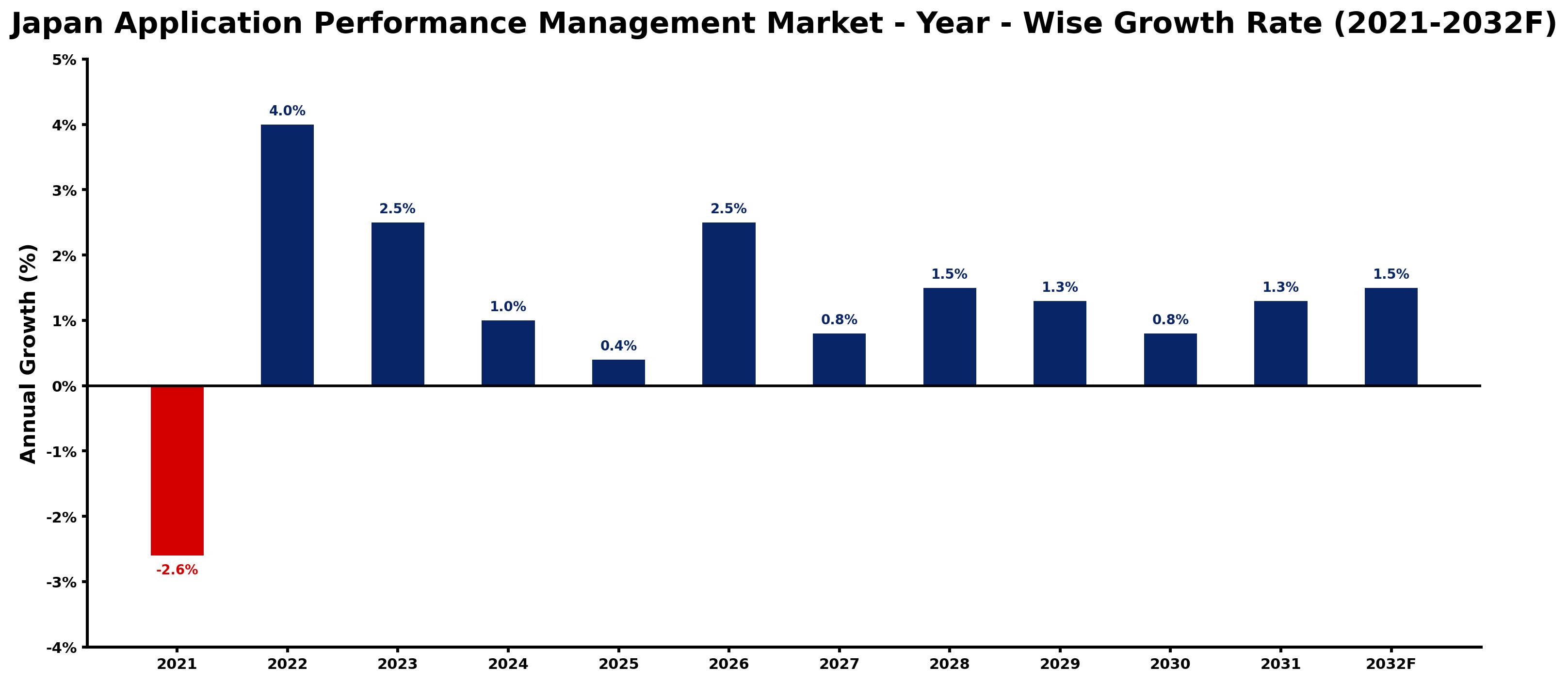
The table below presents the year‑wise growth rates along with the key drivers influencing the market
| Year | Growth Rate | Major Drivers |
| 2021 | -2.6% | Decreased demand from Japanese manufacturing sector downturn. |
| 2022 | 4.0% | Increase in remote work boosting application monitoring demand. |
| 2023 | 2.5% | Japanese enterprises prioritizing digital user experience improvements. |
| 2024 | 1.0% | Growing cloud adoption driving performance management implementations. |
| 2025 | 0.4% | Cybersecurity regulations prompting application performance assessments. |
| 2026 | 2.5% | Investment in AI technologies enhancing performance analytics capabilities. |
| 2027 | 0.8% | Emergence of IoT devices increasing application performance complexity. |
| 2028 | 1.5% | Digital banking growth necessitating robust performance monitoring solutions. |
| 2029 | 1.3% | Rising e-commerce transactions driving need for application optimization. |
| 2030 | 0.8% | Increased digital content consumption requiring performance enhancements. |
| 2031 | 1.3% | Government initiatives supporting smart manufacturing applications. |
| 2032 | 1.5% | Focus on customer experience elevating performance management adoption. |
Note: Market size estimations and growth projections presented in this report are based on 6Wresearch's proprietary forecasting methodology, utilizing the latest available industry data, government publications, and primary research inputs.
Japan Application Performance Management Market Key Takeaways
Below are some of the specific key takeaways from the market, including:
- Increasing complexity of IT environments is driving demand for advanced APM tools.
- Cloud-based APM solutions are becoming the preferred choice among Japanese enterprises.
- AI and machine learning are enhancing the capabilities of APM tools, providing proactive monitoring.
- Government initiatives are supporting the digital transformation of businesses, boosting the APM market.
- Businesses are prioritizing user experience and application reliability in their APM strategies.
Evaluation of Restraints in Japan Application Performance Management Market
Despite the promising growth trajectory, several factors pose challenges to the Japan Application Performance Management market. The complexity of modern IT environments requires solutions that can seamlessly integrate with a wide variety of systems. Many companies prefer in-house developed tools, which can complicate vendor relationships. on top of that, stringent data security regulations and the need for compliance create additional hurdles, compelling vendors to tailor their offerings to meet local requirements. A nuanced understanding of these constraints is essential for market participants aiming to establish a foothold in Japan.
Japan Application Performance Management Market Trends
The Japan Application Performance Management market is witnessing a noticeable shift towards cloud-based solutions, driven by the increasing adoption of cloud services by organizations. This trend is reshaping how businesses approach application performance management, pushing vendors to develop scalable and flexible solutions capable of monitoring applications across diverse environments. Additionally, there is a heightened focus on incorporating AI and machine learning capabilities, allowing for real-time insights and predictive analytics that significantly enhance decision-making processes.
Japan Application Performance Management Market Opportunities
As digital transformation continues to accelerate in Japan, the opportunities for APM solutions are expanding. Companies are seeking comprehensive tools that can provide insights not just into performance but also into user behavior and operational efficiency. Vendors with capabilities in real-time monitoring, advanced analytics, and cloud compatibility are particularly well-positioned to capture market share. on top of that, partnerships with local organizations can enhance market entry and acceptance, paving the way for innovative solutions that address specific needs in the Japanese context.
Government Initiatives in the Japan Application Performance Management Market
Government policies in Japan are actively fostering the growth of the Application Performance Management market. With a focus on digital transformation, initiatives are in place to support technological advancement across various sectors. This regulatory environment creates a conducive atmosphere for APM vendors to thrive.
- A recently completed initiative under the "Society 5.0" program aimed to enhance digital infrastructure across multiple industries.
- A current initiative supports research and development in AI technologies, which is pivotal for the advancement of APM solutions.
- A planned public-private partnership expected to launch by 2027 will focus on improving cloud service accessibility.
- Ongoing regulatory frameworks addressing data privacy are being reinforced to ensure compliance while fostering innovation.
- The government has announced funding for tech startups specializing in performance management solutions, with an emphasis on local talent.
Future Insights of the Japan Application Performance Management Market
Looking ahead to 2026-2032, the Japan Application Performance Management market is set for steady growth. The continued reliance on cloud services, combined with the push for improved user experiences, will sustain demand for advanced APM solutions. As companies strive to optimize their digital operations, the incorporation of AI and machine learning will not only enhance existing tools but also drive innovation in the space. The landscape is ripe for those willing to adapt and innovate, promising a vibrant future for the APM market.
Japan Application Performance Management Market Latest Developments
Recent activity in the Japan Application Performance Management market highlights a significant shift towards more integrated and intelligent solutions. Over the past year, vendors have been focusing on enhancing their offerings to meet the rising expectations of enterprises.
- A major technology vendor launched an upgraded APM solution in early 2025, featuring enhanced real-time monitoring capabilities.
- An initiative that began in mid-2025 is currently underway, focusing on integrating AI-driven analytics into existing APM tools.
- A planned product release for late 2026 aims to introduce cloud-native APM solutions tailored for hybrid environments.
- A regional operator has announced partnerships with local tech firms to enhance their APM offerings, set to roll out by Q1 2026.
Japan Application Performance Management Market - Key Attractiveness of the Report
- 10 Years of Market Numbers
- Historical Data Starting from 2022 to 2025
- Base Year: 2025
- Forecast Data until 2032
- Key Performance Indicators Impacting the Market
- Major Upcoming Developments and Projects
Key Highlights of the Report:
- Japan Application Performance Management Market Outlook
- Market Size of Japan Application Performance Management Market, 2025
- Forecast of Japan Application Performance Management Market, 2032
- Historical Data and Forecast of Japan Application Performance Management Revenues & Volume for the Period 2022-2032F
- Japan Application Performance Management Market Trend Evolution
- Japan Application Performance Management Market Drivers and Challenges
- Japan Application Performance Management Price Trends
- Japan Application Performance Management Porter's Five Forces
- Japan Application Performance Management Industry Life Cycle
- Historical Data and Forecast of Japan Application Performance Management Market Revenues & Volume By Platform for the Period 2022-2032F
- Historical Data and Forecast of Japan Application Performance Management Market Revenues & Volume By Software for the Period 2022-2032F
- Historical Data and Forecast of Japan Application Performance Management Market Revenues & Volume By Services for the Period 2022-2032F
- Historical Data and Forecast of Japan Application Performance Management Market Revenues & Volume By Access type for the Period 2022-2032F
- Historical Data and Forecast of Japan Application Performance Management Market Revenues & Volume By Web for the Period 2022-2032F
- Historical Data and Forecast of Japan Application Performance Management Market Revenues & Volume By Mobile for the Period 2022-2032F
- Historical Data and Forecast of Japan Application Performance Management Market Revenues & Volume By Deployment Mode for the Period 2022-2032F
- Historical Data and Forecast of Japan Application Performance Management Market Revenues & Volume By On-premise for the Period 2022-2032F
- Historical Data and Forecast of Japan Application Performance Management Market Revenues & Volume By Cloud for the Period 2022-2032F
- Historical Data and Forecast of Japan Application Performance Management Market Revenues & Volume By Hybrid for the Period 2022-2032F
- Historical Data and Forecast of Japan Application Performance Management Market Revenues & Volume By Vertical for the Period 2022-2032F
- Historical Data and Forecast of Japan Application Performance Management Market Revenues & Volume By BFSI for the Period 2022-2032F
- Historical Data and Forecast of Japan Application Performance Management Market Revenues & Volume By Manufacturing for the Period 2022-2032F
- Historical Data and Forecast of Japan Application Performance Management Market Revenues & Volume By Government for the Period 2022-2032F
- Historical Data and Forecast of Japan Application Performance Management Market Revenues & Volume By Healthcare for the Period 2022-2032F
- Historical Data and Forecast of Japan Application Performance Management Market Revenues & Volume By Retail for the Period 2022-2032F
- Historical Data and Forecast of Japan Application Performance Management Market Revenues & Volume By IT and telecom for the Period 2022-2032F
- Historical Data and Forecast of Japan Application Performance Management Market Revenues & Volume By Logistics for the Period 2022-2032F
- Historical Data and Forecast of Japan Application Performance Management Market Revenues & Volume By Media and entertainment for the Period 2022-2032F
- Japan Application Performance Management Import Export Trade Statistics
- Market Opportunity Assessment By Platform
- Market Opportunity Assessment By Access type
- Market Opportunity Assessment By Deployment Mode
- Market Opportunity Assessment By Vertical
- Japan Application Performance Management Top Companies Market Share
- Japan Application Performance Management Competitive Benchmarking By Technical and Operational Parameters
- Japan Application Performance Management Company Profiles
- Japan Application Performance Management Key Strategic Recommendations






































