Japan Application Release Automation Market Size & Growth Rate (2026-2032)
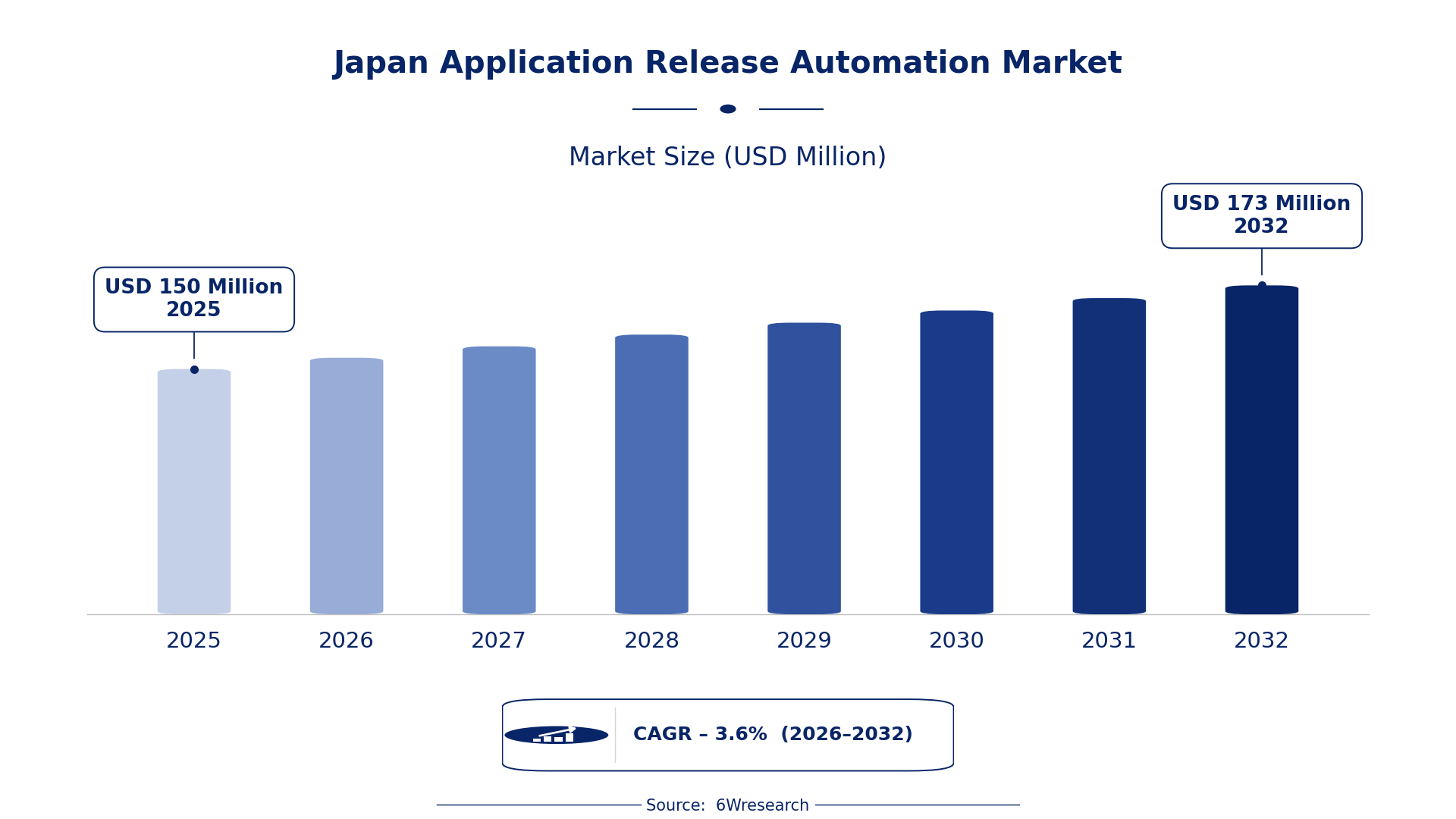
The Japan Application Release Automation Market was estimated at USD 150 Million in 2025 and is projected to reach USD 173 Million by 2032, growing at a CAGR of 3.6% from 2026 to 2032.
Japan Application Release Automation Market Synopsis
In recent years, the Japan Application Release Automation market has gained momentum, driven by the increasing adoption of DevOps practices and a strong push for automation in software deployment. Organizations are recognizing the need for efficiency and speed, and this trend is set against a backdrop of traditional business practices that often favor stability over rapid change.
Looking ahead, the market is poised for continued growth as businesses strive to remain competitive in a digital-first economy. The shift toward cloud-based solutions and the integration of advanced technologies like AI and machine learning into automation tools are expected to redefine the release processes, making them more agile and responsive.
Japan Application Release Automation Market Year-wise Growth Rate and Key Drivers
This graph illustrates the annual growth rates of the Japan Application Release Automation Market from 2021 to 2032, highlighting a steady upward trajectory and projected expansion over the forecast period.
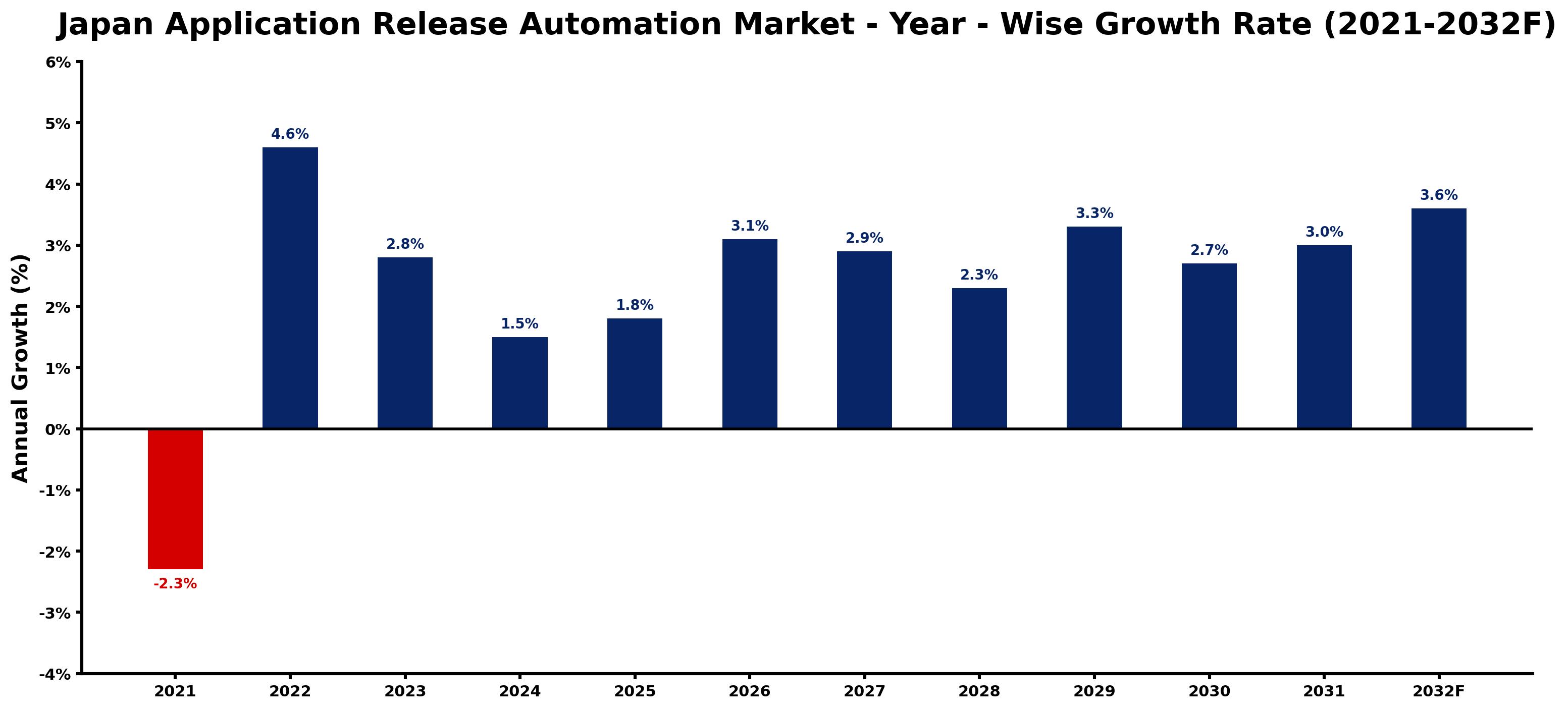
The table below presents the year‑wise growth rates along with the key drivers influencing the market
| Year | Growth Rate | Major Drivers |
| 2021 | -2.3% | Delays due to rigorous METI regulatory approvals process. |
| 2022 | 4.6% | Increased adoption of DevOps practices in Japanese tech firms. |
| 2023 | 2.8% | Government push for digital transformation in local enterprises. |
| 2024 | 1.5% | Growing remote work trends necessitating streamlined application deployment. |
| 2025 | 1.8% | Rise in mobile app development fueling automation needs. |
| 2026 | 3.1% | Enhanced focus on software quality assurance in tech companies. |
| 2027 | 2.9% | Supportive regulatory environment for agile software development. |
| 2028 | 2.3% | Local startups driving innovation in application release tools. |
| 2029 | 3.3% | Increased collaboration between tech giants and SMEs for automation. |
| 2030 | 2.7% | Emergence of AI tools optimizing application release workflows. |
| 2031 | 3.0% | Growing focus on cybersecurity boosting automation adoption. |
| 2032 | 3.6% | Japanese enterprises enhancing operational efficiency through automation. |
Note: Market size estimations and growth projections presented in this report are based on 6Wresearch's proprietary forecasting methodology, utilizing the latest available industry data, government publications, and primary research inputs.
Japan Application Release Automation Market Key Takeaways
Below are some of the specific key takeaways from the market, including:
- Increasing adoption of DevOps practices is a major driver of market growth.
- Cloud-based automation solutions are becoming the preferred choice for organizations.
- Integration of AI and machine learning is enhancing the capabilities of automation tools.
- Investment opportunities are emerging in testing and compliance automation solutions.
- Cultural resistance to change remains a significant barrier to automation adoption.
Evaluation of Restraints in Japan Application Release Automation Market
Despite the positive growth trajectory, the Japan Application Release Automation market faces notable restraints. The complexity of legacy systems presents significant integration challenges, often requiring additional resources and time to align with modern automation solutions. on top of that, a cultural inclination towards stability can lead to resistance against adopting innovative technologies. This reluctance, combined with a shortage of skilled professionals proficient in automation tools, hampers the effective implementation of these systems. Addressing these issues necessitates focused education, robust change management strategies, and collaboration between technology providers and businesses.
Japan Application Release Automation Market Trends
The current trends in the Japan Application Release Automation market highlight a pronounced shift toward cloud-based solutions, which are increasingly preferred for their scalability and flexibility. Organizations are not just focusing on automation for deployment; they are also seeking solutions that enhance collaboration between development and operations teams. The incorporation of AI and machine learning into these tools is gaining traction, allowing for predictive capabilities that enhance the reliability of software releases and reduce errors in the process.
Japan Application Release Automation Market Opportunities
The landscape presents substantial investment opportunities, particularly in areas that streamline deployment processes and foster collaboration between development and operations teams. There is a strong demand for solutions that automate testing, monitoring, and compliance activities, which can significantly enhance the reliability of application releases. Additionally, consulting services aimed at helping organizations implement and optimize their automation strategies are ripe for investment, given the ongoing need for expertise in this evolving market.
Government Initiatives in the Japan Application Release Automation Market
The Japanese government has adopted a proactive approach toward digital transformation, which significantly influences the Application Release Automation market. Policies aimed at enhancing productivity and competitiveness encourage businesses to invest in automation solutions. Recent initiatives reflect a strong commitment to creating a conducive environment for technological advancement, making government policy a crucial factor in market dynamics.
- A regulatory framework introduced in 2025 that encourages the adoption of innovative software solutions.
- A national digital infrastructure upgrade program now in its rollout phase to improve technological accessibility.
- Current efforts by the Digital Agency to facilitate collaboration between private and public sectors on technology adoption.
- Planned public-private initiatives expected to enhance the skills and training for automation specialists by 2027.
Future Insights of the Japan Application Release Automation Market
The Japan Application Release Automation market is set to evolve significantly between 2026 and 2032, as companies increasingly prioritize speed and efficiency in their software delivery processes. The growing need for enhanced collaboration between development and operations teams will drive demand for advanced automation solutions. on top of that, the continuous push for digital transformation across various sectors will further catalyze the adoption of innovative release automation tools, fostering a more agile and responsive software development environment.
Japan Application Release Automation Market Latest Developments
Recent months have seen a flurry of activity in the Japan Application Release Automation market, with organizations actively seeking to upgrade their systems and processes. This trend is indicative of the urgency to enhance efficiency and reduce time-to-market in software development.
- A major technology vendor launched a new cloud-based automation tool in Q1 2025, aimed at improving deployment efficiency.
- An initiative that began in mid-2025 focuses on integrating AI capabilities into existing automation frameworks, enhancing predictive analytics for release processes.
- In early 2025, a partnership was formed between several leading firms to develop a collaborative platform for DevOps practices.
- A planned rollout expected to begin in the second half of 2026 aims to expand access to training programs for automation professionals.
Japan Application Release Automation Market - Key Attractiveness of the Report
- 10 Years of Market Numbers
- Historical Data Starting from 2022 to 2025
- Base Year: 2025
- Forecast Data until 2032
- Key Performance Indicators Impacting the Market
- Major Upcoming Developments and Projects
Key Highlights of the Report:
- Japan Application Release Automation Market Outlook
- Market Size of Japan Application Release Automation Market, 2025
- Forecast of Japan Application Release Automation Market, 2032
- Historical Data and Forecast of Japan Application Release Automation Revenues & Volume for the Period 2022-2032F
- Japan Application Release Automation Market Trend Evolution
- Japan Application Release Automation Market Drivers and Challenges
- Japan Application Release Automation Price Trends
- Japan Application Release Automation Porter's Five Forces
- Japan Application Release Automation Industry Life Cycle
- Historical Data and Forecast of Japan Application Release Automation Market Revenues & Volume By Component for the Period 2022-2032F
- Historical Data and Forecast of Japan Application Release Automation Market Revenues & Volume By Tool for the Period 2022-2032F
- Historical Data and Forecast of Japan Application Release Automation Market Revenues & Volume By Services for the Period 2022-2032F
- Historical Data and Forecast of Japan Application Release Automation Market Revenues & Volume By Vertical for the Period 2022-2032F
- Historical Data and Forecast of Japan Application Release Automation Market Revenues & Volume By BFSI for the Period 2022-2032F
- Historical Data and Forecast of Japan Application Release Automation Market Revenues & Volume By ITEs for the Period 2022-2032F
- Historical Data and Forecast of Japan Application Release Automation Market Revenues & Volume By Telecommunications for the Period 2022-2032F
- Historical Data and Forecast of Japan Application Release Automation Market Revenues & Volume By Manufacturing for the Period 2022-2032F
- Historical Data and Forecast of Japan Application Release Automation Market Revenues & Volume By Deployment Type for the Period 2022-2032F
- Historical Data and Forecast of Japan Application Release Automation Market Revenues & Volume By On-Premises for the Period 2022-2032F
- Historical Data and Forecast of Japan Application Release Automation Market Revenues & Volume By Cloud for the Period 2022-2032F
- Historical Data and Forecast of Japan Application Release Automation Market Revenues & Volume By Organization Size for the Period 2022-2032F
- Japan Application Release Automation Import Export Trade Statistics
- Market Opportunity Assessment By Component
- Market Opportunity Assessment By Vertical
- Market Opportunity Assessment By Deployment Type
- Market Opportunity Assessment By Organization Size
- Japan Application Release Automation Top Companies Market Share
- Japan Application Release Automation Competitive Benchmarking By Technical and Operational Parameters
- Japan Application Release Automation Company Profiles
- Japan Application Release Automation Key Strategic Recommendations






































