Japan Artificial Intelligence as a Service Market Size & Growth Rate (2026-2032)
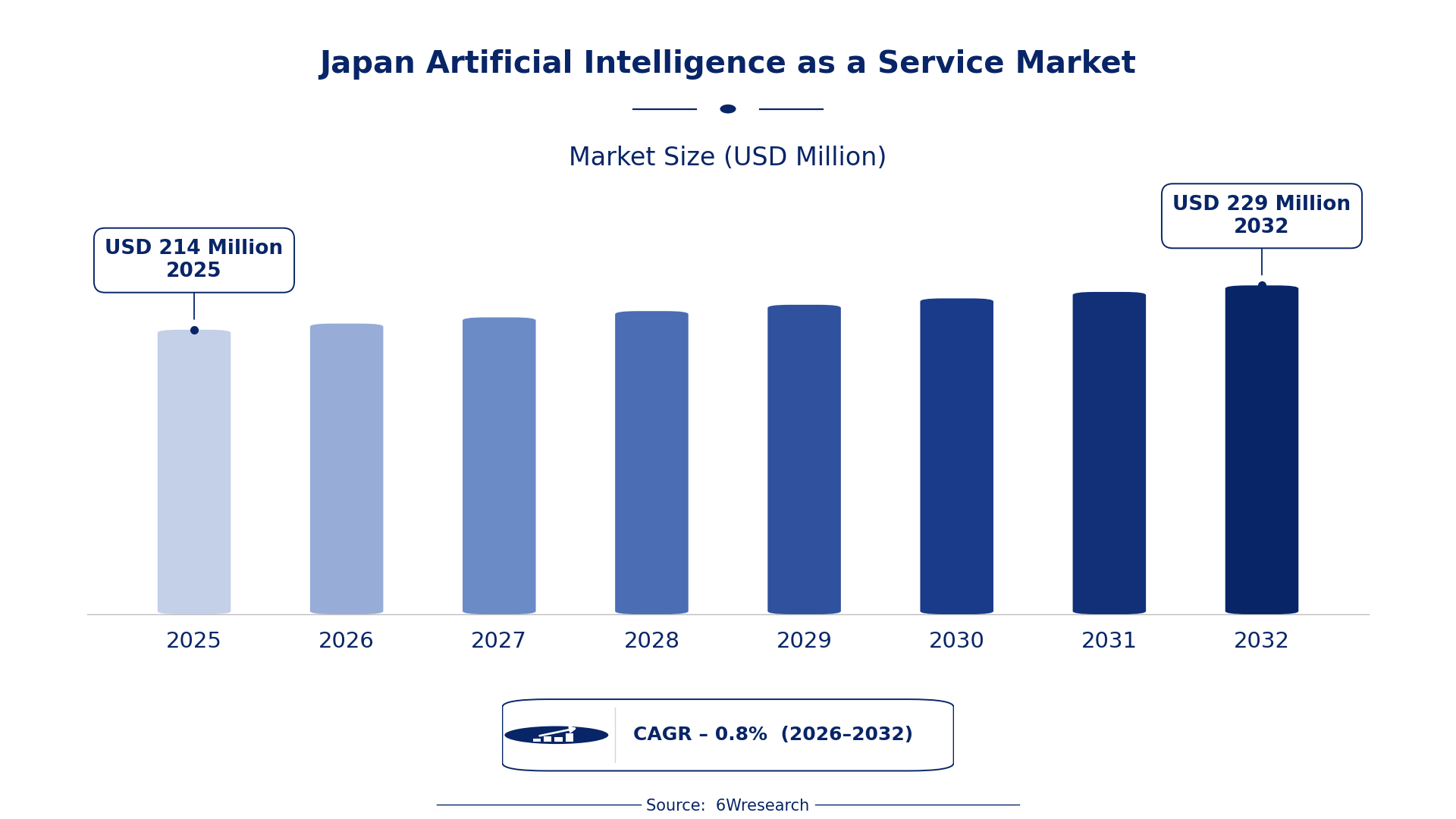
The Japan Artificial Intelligence as a Service Market was estimated at USD 214 Million in 2025 and is projected to reach USD 229 Million by 2032, growing at a CAGR of 0.8% from 2026 to 2032.
Japan Artificial Intelligence as a Service Market Synopsis
The demand for Artificial Intelligence as a Service (AIaaS) in Japan is being propelled by a growing recognition of the technology's potential to transform business operations across sectors. Industries such as healthcare and finance are particularly keen on integrating AI capabilities to improve service delivery and operational efficiency.
Companies are increasingly turning to AIaaS solutions, which offer scalable and cost-effective ways to implement AI without the need for deep in-house expertise. This shift is indicative of a broader trend towards embracing technology-driven solutions for competitive advantage in the Japanese market.
Japan Artificial Intelligence as a Service Market Year-wise Growth Rate and Key Drivers
This graph illustrates the annual growth rates of the Japan Artificial Intelligence as a Service Market from 2021 to 2032, highlighting a steady upward trajectory and projected expansion over the forecast period.
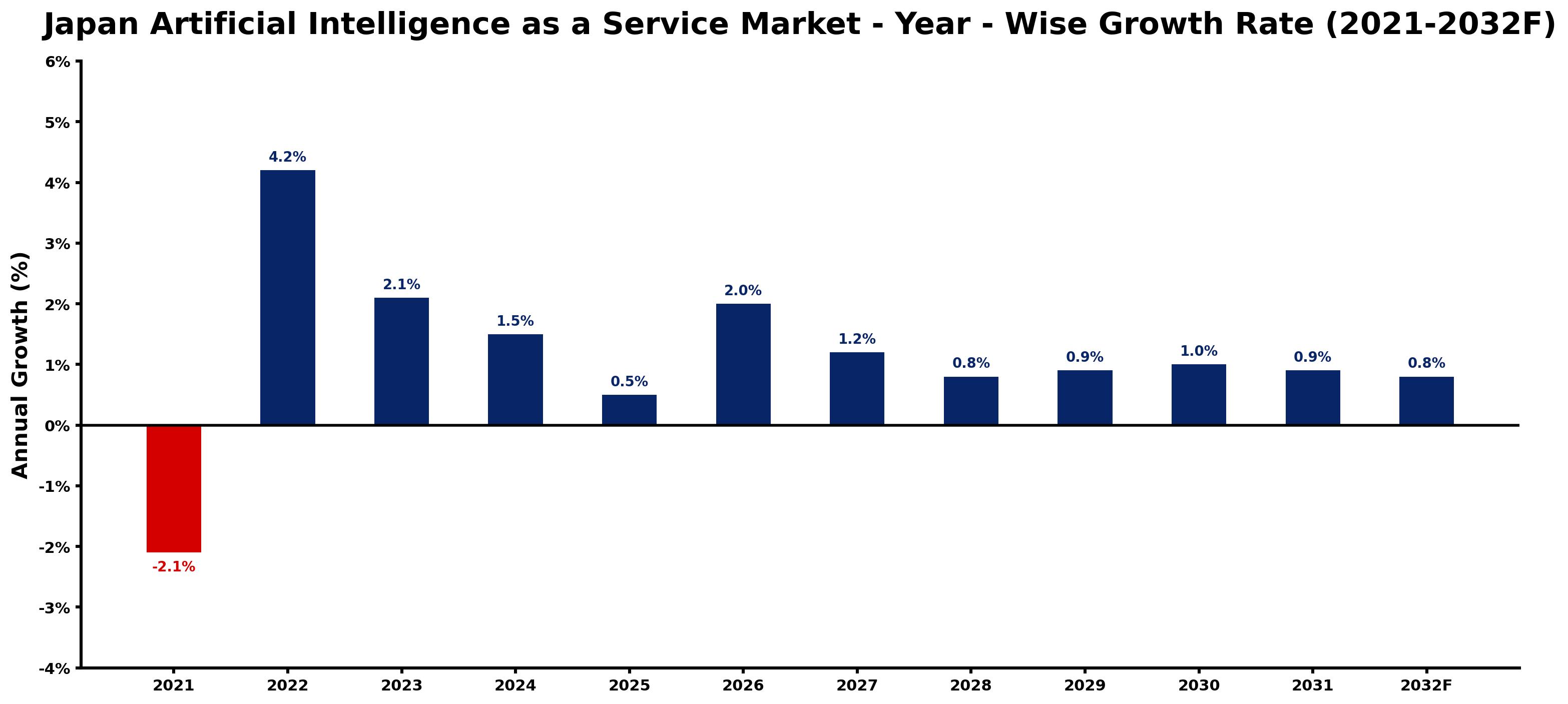
The table below presents the year‑wise growth rates along with the key drivers influencing the market
| Year | Growth Rate | Major Drivers |
| 2021 | -2.1% | Shortage of AI talent due to strict immigration policies. |
| 2022 | 4.2% | Local tech startups leveraging AI for business innovations. |
| 2023 | 2.1% | Government's push for AI integration in manufacturing systems. |
| 2024 | 1.5% | Growing interest in AI-driven personalized marketing strategies. |
| 2025 | 0.5% | Emerging AI educational initiatives by Japanese universities. |
| 2026 | 2.0% | Increased AI-driven automation in the logistics sector. |
| 2027 | 1.2% | Rise of AI in local smart agriculture practices. |
| 2028 | 0.8% | Japan's aging population driving AI elder care solutions. |
| 2029 | 0.9% | Demand for AI in cybersecurity solutions increasing steadily. |
| 2030 | 1.0% | Adoption of AI for disaster management and preparedness. |
| 2031 | 0.9% | AI enhancing customer service in retail industries rapidly. |
| 2032 | 0.8% | Government incentives for AI in environmental sustainability projects. |
Note: Market size estimations and growth projections presented in this report are based on 6Wresearch's proprietary forecasting methodology, utilizing the latest available industry data, government publications, and primary research inputs.
Japan Artificial Intelligence as a Service Market Key Takeaways
Below are some of the specific key takeaways from the market, including:
- The market is expanding as organizations seek advanced analytics and automation capabilities.
- Investment in AIaaS is vital for enhancing customer engagement and operational efficiencies.
- Data privacy concerns are a significant barrier to widespread AI adoption in Japan.
- Government initiatives are paving the way for a more favorable regulatory environment.
- Emerging technologies, including IoT integration, are driving innovation in AIaaS offerings.
Evaluation of Restraints in Japan Artificial Intelligence as a Service Market
The Japan AIaaS market faces several barriers that could limit its growth trajectory. Data privacy remains a critical concern, given Japan's stringent regulations on personal information handling. This regulatory landscape can be complex for AIaaS providers to navigate, often leading to compliance challenges. on top of that, there is a notable shortage of skilled professionals in AI, which hampers the development and effective deployment of these technologies. Cultural skepticism towards AI, stemming from fears about job displacement, further complicates acceptance and integration within organizations.
Japan Artificial Intelligence as a Service Market Trends
Key trends in the Japan AIaaS market reveal a shift towards personalized solutions that cater to unique business needs. The growing emphasis on customer experience is driving demand for AI technologies that streamline interactions and enhance service delivery. Additionally, businesses are increasingly integrating AI with cloud computing and IoT, creating more sophisticated applications that can analyze data in real-time.
The focus on data security and compliance with privacy regulations is also shaping AIaaS offerings. As organizations prioritize secure AI implementations, vendors are adapting their solutions to address these concerns, making security a core component of their service propositions.
Japan Artificial Intelligence as a Service Market Opportunities
The AIaaS market in Japan presents numerous opportunities for growth and investment. As businesses increasingly seek ways to optimize operations and enhance efficiency, those providing tailored AI solutions are likely to find a receptive audience. Areas such as predictive analytics, natural language processing, and image recognition are particularly promising for innovative applications.
Partnerships with local startups can also offer investors access to cutting-edge technologies and a stronger foothold in the burgeoning AI ecosystem in Japan. The drive for digital transformation across industries opens a plethora of avenues for growth, making this an attractive market for investment.
Government Initiatives in the Japan Artificial Intelligence as a Service Market
The Japanese government is actively fostering the development of the AIaaS market through various strategic initiatives. By prioritizing AI technology in public policy, Japan aims to enhance its competitive edge globally. This includes funding for research and development and creating frameworks that encourage collaboration between businesses and academic institutions.
- A national AI Strategy launched in 2019 aims to position Japan as a leader in AI technology.
- Currently ongoing initiatives include the AI Business Expansion Support Program, which provides resources and funding for startups.
- Recently completed guidelines for ethical AI development ensure responsible usage of AI technologies.
- A planned public-private initiative is expected to enhance infrastructure for AI development by 2027.
- The establishment of a national AI research center is currently in the implementation phase, promoting collaboration across sectors.
Future Insights of the Japan Artificial Intelligence as a Service Market
Looking ahead to 2026-2032, the Japan AIaaS market is set to experience considerable growth as organizations continue to embrace automation and data analytics. The integration of AI into everyday business processes will become increasingly common, driven by the need for enhanced efficiency and customer satisfaction. As the technology matures, we can expect more sophisticated AI solutions that address specific industry challenges, ultimately leading to a more competitive market.
Japan Artificial Intelligence as a Service Market Latest Developments
In the past year, the Japan Artificial Intelligence as a Service market has seen a surge in activity, with companies and institutions investing in new technologies and partnerships. The focus has been on creating solutions that not only enhance operational capabilities but also prioritize data security and compliance with regulatory standards.
- A leading technology vendor launched a new AI platform in early 2025 that focuses on predictive analytics for financial services.
- An initiative that began in mid-2025 to integrate AI with IoT devices is currently underway, aimed at optimizing supply chain operations.
- A partnership between several universities and private companies was established in early 2025 to advance AI research in healthcare applications.
- A rollout expected to begin in the second half of 2026 will introduce AIaaS solutions tailored for small and medium-sized enterprises.
Japan Artificial Intelligence as a Service Market - Key Attractiveness of the Report
- 10 Years of Market Numbers
- Historical Data Starting from 2022 to 2025
- Base Year: 2025
- Forecast Data until 2032
- Key Performance Indicators Impacting the Market
- Major Upcoming Developments and Projects
Key Highlights of the Report:
- Japan Artificial Intelligence as a Service Market Outlook
- Market Size of Japan Artificial Intelligence as a Service Market, 2025
- Forecast of Japan Artificial Intelligence as a Service Market, 2032
- Historical Data and Forecast of Japan Artificial Intelligence as a Service Revenues & Volume for the Period 2022-2032F
- Japan Artificial Intelligence as a Service Market Trend Evolution
- Japan Artificial Intelligence as a Service Market Drivers and Challenges
- Japan Artificial Intelligence as a Service Price Trends
- Japan Artificial Intelligence as a Service Porter's Five Forces
- Japan Artificial Intelligence as a Service Industry Life Cycle
- Historical Data and Forecast of Japan Artificial Intelligence as a Service Market Revenues & Volume By Service Type for the Period 2022-2032F
- Historical Data and Forecast of Japan Artificial Intelligence as a Service Market Revenues & Volume By Software Tools for the Period 2022-2032F
- Historical Data and Forecast of Japan Artificial Intelligence as a Service Market Revenues & Volume By Services for the Period 2022-2032F
- Historical Data and Forecast of Japan Artificial Intelligence as a Service Market Revenues & Volume By Software Tool for the Period 2022-2032F
- Historical Data and Forecast of Japan Artificial Intelligence as a Service Market Revenues & Volume By Data Storage and Archiving for the Period 2022-2032F
- Historical Data and Forecast of Japan Artificial Intelligence as a Service Market Revenues & Volume By Modeler and Processing for the Period 2022-2032F
- Historical Data and Forecast of Japan Artificial Intelligence as a Service Market Revenues & Volume By Cloud and Web-Based Application Programming Interface (APIs) for the Period 2022-2032F
- Historical Data and Forecast of Japan Artificial Intelligence as a Service Market Revenues & Volume By Others for the Period 2022-2032F
- Historical Data and Forecast of Japan Artificial Intelligence as a Service Market Revenues & Volume By Service for the Period 2022-2032F
- Historical Data and Forecast of Japan Artificial Intelligence as a Service Market Revenues & Volume By Professional Services for the Period 2022-2032F
- Historical Data and Forecast of Japan Artificial Intelligence as a Service Market Revenues & Volume By Managed Services for the Period 2022-2032F
- Historical Data and Forecast of Japan Artificial Intelligence as a Service Market Revenues & Volume By Technology for the Period 2022-2032F
- Historical Data and Forecast of Japan Artificial Intelligence as a Service Market Revenues & Volume By Machine Learning (ML) and Deep Learning for the Period 2022-2032F
- Historical Data and Forecast of Japan Artificial Intelligence as a Service Market Revenues & Volume By Natural Language Processing (NLP) for the Period 2022-2032F
- Historical Data and Forecast of Japan Artificial Intelligence as a Service Market Revenues & Volume By Organizations Size for the Period 2022-2032F
- Historical Data and Forecast of Japan Artificial Intelligence as a Service Market Revenues & Volume By Large Enterprises for the Period 2022-2032F
- Historical Data and Forecast of Japan Artificial Intelligence as a Service Market Revenues & Volume By Small and Medium-sized Enterprises (SMEs) for the Period 2022-2032F
- Historical Data and Forecast of Japan Artificial Intelligence as a Service Market Revenues & Volume By Vertical for the Period 2022-2032F
- Historical Data and Forecast of Japan Artificial Intelligence as a Service Market Revenues & Volume By Banking, Financial, and Insurance (BFSI) for the Period 2022-2032F
- Historical Data and Forecast of Japan Artificial Intelligence as a Service Market Revenues & Volume By Healthcare and Life Sciences for the Period 2022-2032F
- Historical Data and Forecast of Japan Artificial Intelligence as a Service Market Revenues & Volume By Retail for the Period 2022-2032F
- Historical Data and Forecast of Japan Artificial Intelligence as a Service Market Revenues & Volume By Telecommunications for the Period 2022-2032F
- Historical Data and Forecast of Japan Artificial Intelligence as a Service Market Revenues & Volume By Government and defense for the Period 2022-2032F
- Historical Data and Forecast of Japan Artificial Intelligence as a Service Market Revenues & Volume By Manufacturing for the Period 2022-2032F
- Historical Data and Forecast of Japan Artificial Intelligence as a Service Market Revenues & Volume By Energy for the Period 2022-2032F
- Historical Data and Forecast of Japan Artificial Intelligence as a Service Market Revenues & Volume By Others for the Period 2022-2032F
- Japan Artificial Intelligence as a Service Import Export Trade Statistics
- Market Opportunity Assessment By Service Type
- Market Opportunity Assessment By Software Tool
- Market Opportunity Assessment By Service
- Market Opportunity Assessment By Technology
- Market Opportunity Assessment By Organizations Size
- Market Opportunity Assessment By Vertical
- Japan Artificial Intelligence as a Service Top Companies Market Share
- Japan Artificial Intelligence as a Service Competitive Benchmarking By Technical and Operational Parameters
- Japan Artificial Intelligence as a Service Company Profiles
- Japan Artificial Intelligence as a Service Key Strategic Recommendations






































