Japan Artificial Intelligence in Accounting Market Size & Growth Rate (2026-2032)
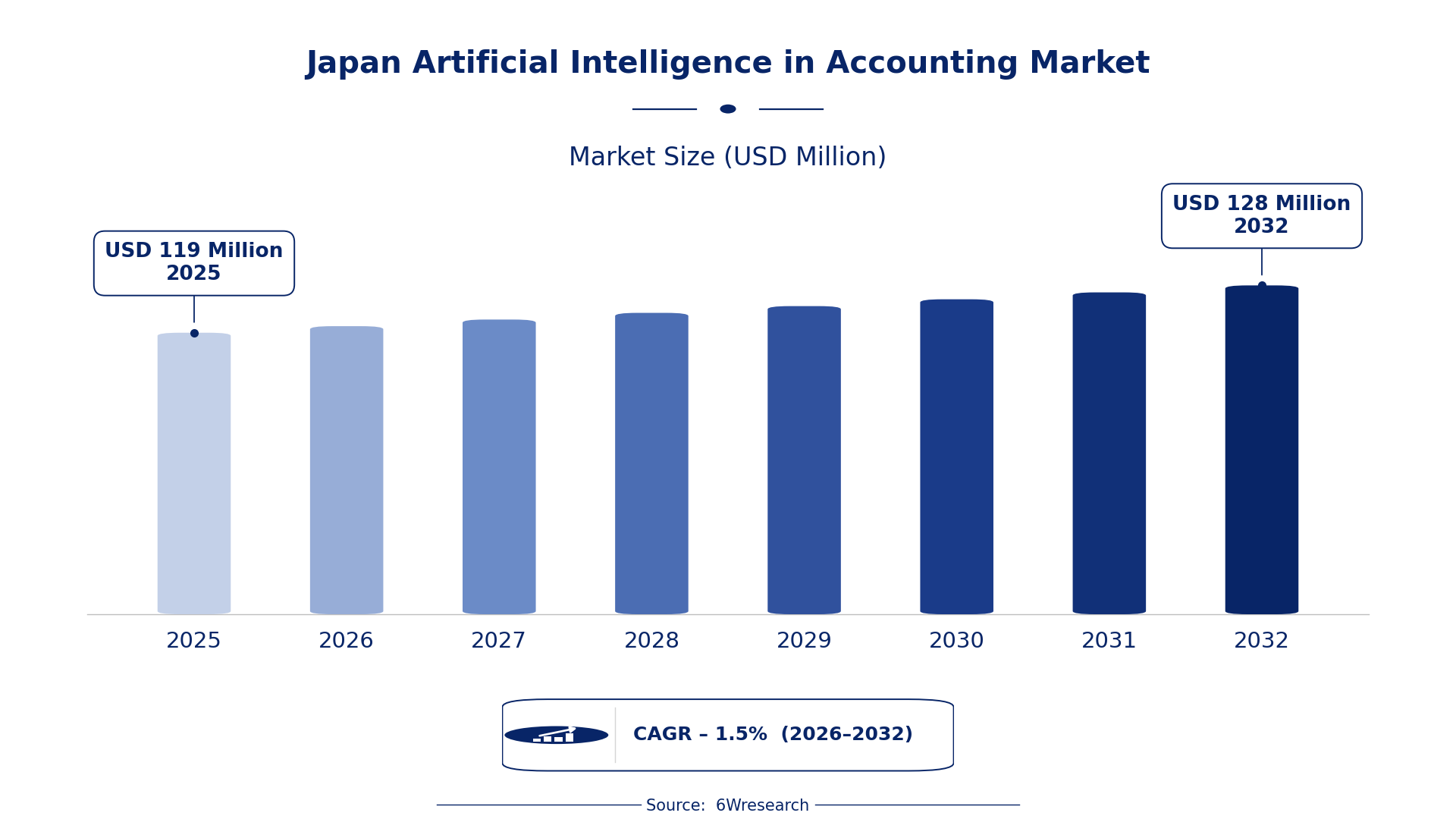
The Japan Artificial Intelligence in Accounting Market was estimated at USD 119 Million in 2025 and is projected to reach USD 128 Million by 2032, growing at a CAGR of 1.5% from 2026 to 2032.
Japan Artificial Intelligence in Accounting Market Synopsis
The integration of artificial intelligence in accounting is not just a trend but a transformative movement shaping the future of financial practices in Japan. As companies grapple with data-intensive processes, AI technologies are increasingly seen as essential tools to enhance efficiency and precision in accounting operations.
Japanese firms are adopting AI solutions for various tasks such as automated data entry, fraud detection, and financial forecasting. This shift is not merely driven by technological capability but is also a strategic response to the growing demands for accuracy and cost management in a competitive business environment.
Japan Artificial Intelligence in Accounting Market Year-wise Growth Rate and Key Drivers
This graph illustrates the annual growth rates of the Japan Artificial Intelligence in Accounting Market from 2021 to 2032, highlighting a steady upward trajectory and projected expansion over the forecast period.
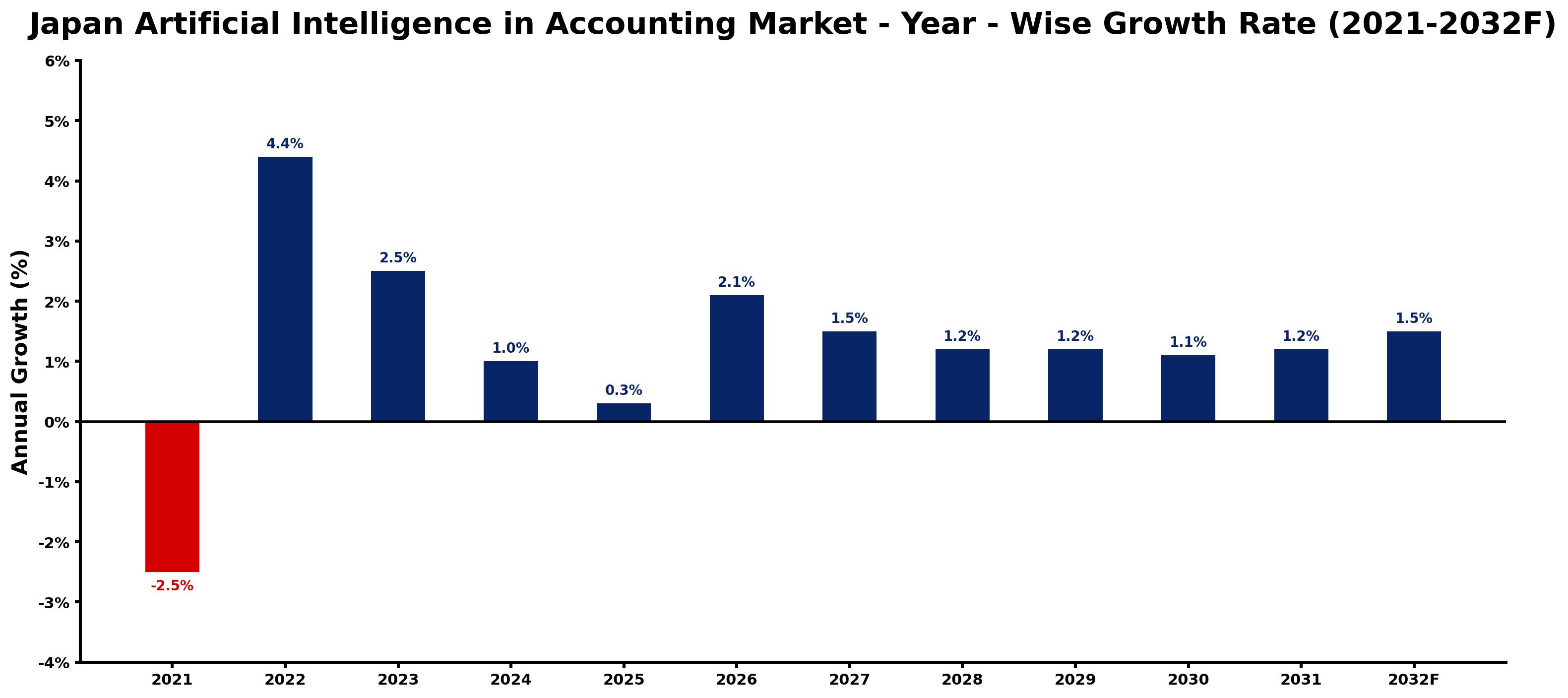
The table below presents the year‑wise growth rates along with the key drivers influencing the market
| Year | Growth Rate | Major Drivers |
| 2021 | -2.5% | Slow adoption of AI due to strict Japanese regulations. |
| 2022 | 4.4% | AICPA Japan promoting AI adoption in accounting practices. |
| 2023 | 2.5% | Tremendous growth in SMEs adopting AI for efficiency. |
| 2024 | 1.0% | Government grants supporting technology integration in accounting. |
| 2025 | 0.3% | Increased demand for AI compliance solutions amid regulations. |
| 2026 | 2.1% | Corporate tax incentives for adopting AI technologies. |
| 2027 | 1.5% | Rising necessity for remote audit solutions post-COVID. |
| 2028 | 1.2% | Growing reliance on data analytics in financial reporting. |
| 2029 | 1.2% | Enhanced AI education programs fostering skilled workforce supply. |
| 2030 | 1.1% | Increased investment in fintech driving AI accounting tools. |
| 2031 | 1.2% | Pressure to comply with stricter financial regulations advancing technology. |
| 2032 | 1.5% | Growth in digital payment processing enhancing accounting automation. |
Note: Market size estimations and growth projections presented in this report are based on 6Wresearch's proprietary forecasting methodology, utilizing the latest available industry data, government publications, and primary research inputs.
Japan Artificial Intelligence in Accounting Market Key Takeaways
Below are some of the specific key takeaways from the market, including:
- The market is on a steady growth trajectory, driven by increased AI adoption in accounting processes.
- Government initiatives are significantly influencing the integration of AI technologies in the accounting sector.
- Cloud-based AI solutions are becoming increasingly popular, offering businesses scalable accounting tools.
- Data privacy and compliance challenges remain critical issues for firms implementing AI solutions.
- Investment opportunities are abundant for companies developing innovative AI applications in accounting.
Evaluation of Restraints in Japan Artificial Intelligence in Accounting Market
The primary constraints facing the Japan Artificial Intelligence in Accounting Market stem from stringent data privacy regulations and security concerns. Companies are often hesitant to adopt AI solutions due to fears about compliance with laws like the Personal Information Protection Law, which governs the handling of sensitive financial data. on top of that, the absence of standardized guidelines for AI applications in accounting makes it challenging for businesses to navigate the integration process effectively. Initial investment costs also pose a barrier, as firms must balance the need for technological upgrades with budgetary constraints.
Japan Artificial Intelligence in Accounting Market Trends
A few notable trends are shaping the Japan Artificial Intelligence in Accounting Market. First, there's a marked shift toward the use of AI-driven automation tools that streamline repetitive tasks, enhancing operational efficiency. Companies are increasingly relying on machine learning algorithms to analyze vast amounts of financial data, providing actionable insights for strategic decision-making.
Additionally, there is a growing emphasis on cloud-based solutions, which offer businesses greater flexibility and accessibility. As compliance requirements become more stringent, firms are also prioritizing data security, making AI solutions that emphasize these aspects particularly appealing.
Japan Artificial Intelligence in Accounting Market Opportunities
The landscape is ripe with opportunities for investment in the Japan Artificial Intelligence in Accounting Market. As companies seek to enhance efficiency and accuracy, there’s a significant demand for innovative AI software solutions tailored to accounting needs. This presents attractive prospects for AI software developers and consulting firms specializing in AI integration.
on top of that, partnerships between AI tech providers and established accounting firms can lead to the creation of bespoke solutions that address evolving market demands. Investors should focus on companies that are pioneering these integrations to capitalize on the burgeoning market potential.
Government Initiatives in the Japan Artificial Intelligence in Accounting Market
The Japanese government is playing a crucial role in advancing the adoption of AI within the accounting sector through a range of strategic initiatives. Policies aimed at fostering digital transformation are critical for enhancing the competitiveness of Japan's accounting industry, which is increasingly reliant on innovative technologies.
- A recently launched Artificial Intelligence Accounting System Promotion Consortium by the Ministry of Economy, Trade and Industry (METI) focuses on accelerating AI technology implementation in accounting.
- Current initiatives include tax incentives and subsidies designed to encourage businesses to invest in AI solutions for accounting purposes.
- New guidelines from the Financial Services Agency (FSA) ensure ethical use of AI in financial services, including accounting practices.
- Upcoming plans involve a national digital infrastructure upgrade aimed at facilitating better access to AI technologies for accounting firms across Japan.
Future Insights of the Japan Artificial Intelligence in Accounting Market
Looking ahead to 2026-2032, the Japan Artificial Intelligence in Accounting Market is expected to continue its upward trajectory as businesses increasingly recognize the value of AI technologies. Enhanced capabilities in machine learning and natural language processing will further drive market growth, enabling more sophisticated applications in accounting.
As companies strive to remain compliant with evolving regulations, the demand for AI solutions that offer precision and efficiency will only intensify. The integration of AI with existing accounting software will pave the way for innovative solutions tailored specifically to Japanese businesses, enhancing decision-making processes and operational efficiency.
Japan Artificial Intelligence in Accounting Market Latest Developments
Over the past year, the Japan Artificial Intelligence in Accounting Market has witnessed significant activity as firms race to integrate AI into their operations. The momentum is driven by technological advancements and a clear recognition of the need for greater efficiency in accounting practices.
- An AI-driven financial forecasting tool was successfully launched in early 2025, streamlining the budgeting process for several mid-sized enterprises.
- A major technology vendor has rolled out an AI-powered reconciliation system that is currently undergoing implementation at various financial institutions across Japan.
- In Q3 2025, a consortium of leading Japanese firms announced a collaborative initiative to develop AI solutions focused on enhancing fraud detection capabilities.
- Upcoming plans include the launch of a comprehensive training program aimed at upskilling accountants in AI technologies, expected to commence by early 2026.
Japan Artificial Intelligence in Accounting Market - Key Attractiveness of the Report
- 10 Years of Market Numbers
- Historical Data Starting from 2022 to 2025
- Base Year: 2025
- Forecast Data until 2032
- Key Performance Indicators Impacting the Market
- Major Upcoming Developments and Projects
Key Highlights of the Report:
- Japan Artificial Intelligence in Accounting Market Outlook
- Market Size of Japan Artificial Intelligence in Accounting Market, 2025
- Forecast of Japan Artificial Intelligence in Accounting Market, 2032
- Historical Data and Forecast of Japan Artificial Intelligence in Accounting Revenues & Volume for the Period 2022-2032F
- Japan Artificial Intelligence in Accounting Market Trend Evolution
- Japan Artificial Intelligence in Accounting Market Drivers and Challenges
- Japan Artificial Intelligence in Accounting Price Trends
- Japan Artificial Intelligence in Accounting Porter's Five Forces
- Japan Artificial Intelligence in Accounting Industry Life Cycle
- Historical Data and Forecast of Japan Artificial Intelligence in Accounting Market Revenues & Volume By Application for the Period 2022-2032F
- Historical Data and Forecast of Japan Artificial Intelligence in Accounting Market Revenues & Volume By Automated Bookkeeping for the Period 2022-2032F
- Historical Data and Forecast of Japan Artificial Intelligence in Accounting Market Revenues & Volume By Invoice Classification and Approvals for the Period 2022-2032F
- Historical Data and Forecast of Japan Artificial Intelligence in Accounting Market Revenues & Volume By Fraud and Risk Management for the Period 2022-2032F
- Historical Data and Forecast of Japan Artificial Intelligence in Accounting Market Revenues & Volume By Reporting for the Period 2022-2032F
- Historical Data and Forecast of Japan Artificial Intelligence in Accounting Market Revenues & Volume By Others for the Period 2022-2032F
- Historical Data and Forecast of Japan Artificial Intelligence in Accounting Market Revenues & Volume By Component for the Period 2022-2032F
- Historical Data and Forecast of Japan Artificial Intelligence in Accounting Market Revenues & Volume By Solutions for the Period 2022-2032F
- Historical Data and Forecast of Japan Artificial Intelligence in Accounting Market Revenues & Volume By Services for the Period 2022-2032F
- Historical Data and Forecast of Japan Artificial Intelligence in Accounting Market Revenues & Volume By Technology for the Period 2022-2032F
- Historical Data and Forecast of Japan Artificial Intelligence in Accounting Market Revenues & Volume By Machine Learning (ML) and Deep Learning for the Period 2022-2032F
- Historical Data and Forecast of Japan Artificial Intelligence in Accounting Market Revenues & Volume By NLP for the Period 2022-2032F
- Historical Data and Forecast of Japan Artificial Intelligence in Accounting Market Revenues & Volume By Deployment Mode for the Period 2022-2032F
- Historical Data and Forecast of Japan Artificial Intelligence in Accounting Market Revenues & Volume By On-premises for the Period 2022-2032F
- Historical Data and Forecast of Japan Artificial Intelligence in Accounting Market Revenues & Volume By Cloud for the Period 2022-2032F
- Historical Data and Forecast of Japan Artificial Intelligence in Accounting Market Revenues & Volume By Enterprise Size for the Period 2022-2032F
- Historical Data and Forecast of Japan Artificial Intelligence in Accounting Market Revenues & Volume By Large Enterprises for the Period 2022-2032F
- Historical Data and Forecast of Japan Artificial Intelligence in Accounting Market Revenues & Volume By Small and Medium-Sized Enterprises (SMEs) for the Period 2022-2032F
- Japan Artificial Intelligence in Accounting Import Export Trade Statistics
- Market Opportunity Assessment By Application
- Market Opportunity Assessment By Component
- Market Opportunity Assessment By Technology
- Market Opportunity Assessment By Deployment Mode
- Market Opportunity Assessment By Enterprise Size
- Japan Artificial Intelligence in Accounting Top Companies Market Share
- Japan Artificial Intelligence in Accounting Competitive Benchmarking By Technical and Operational Parameters
- Japan Artificial Intelligence in Accounting Company Profiles
- Japan Artificial Intelligence in Accounting Key Strategic Recommendations






































