Japan Artificial Intelligence in Retail Market Size & Growth Rate (2026-2032)
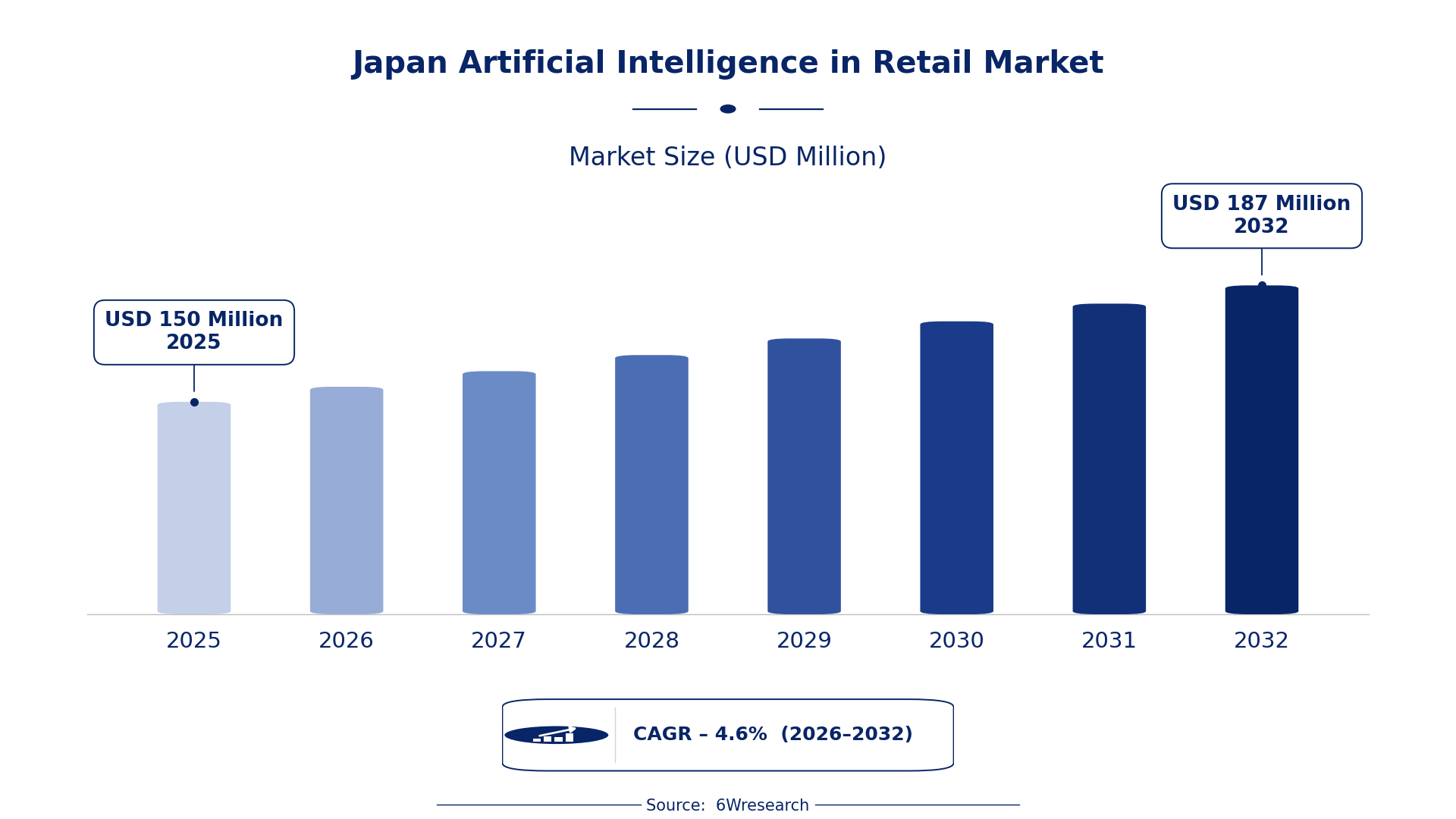
The Japan Artificial Intelligence in Retail Market was estimated at USD 150 Million in 2025 and is projected to reach USD 187 Million by 2032, growing at a CAGR of 4.6% from 2026 to 2032.
Japan Artificial Intelligence in Retail Market Synopsis
Retailers in Japan are increasingly turning to artificial intelligence to meet the evolving expectations of tech-savvy consumers. This shift is particularly evident in the adoption of AI-driven customer service solutions and personalized shopping experiences, which are becoming essential for competitive differentiation.
With a high internet penetration rate and a penchant for advanced technology, Japanese consumers are driving demand for innovative retail solutions. Retailers are implementing AI technologies such as predictive analytics and recommendation systems to optimize inventory management and enhance customer engagement.
Japan Artificial Intelligence in Retail Market Year-wise Growth Rate and Key Drivers
This graph illustrates the annual growth rates of the Japan Artificial Intelligence in Retail Market from 2021 to 2032, highlighting a steady upward trajectory and projected expansion over the forecast period.
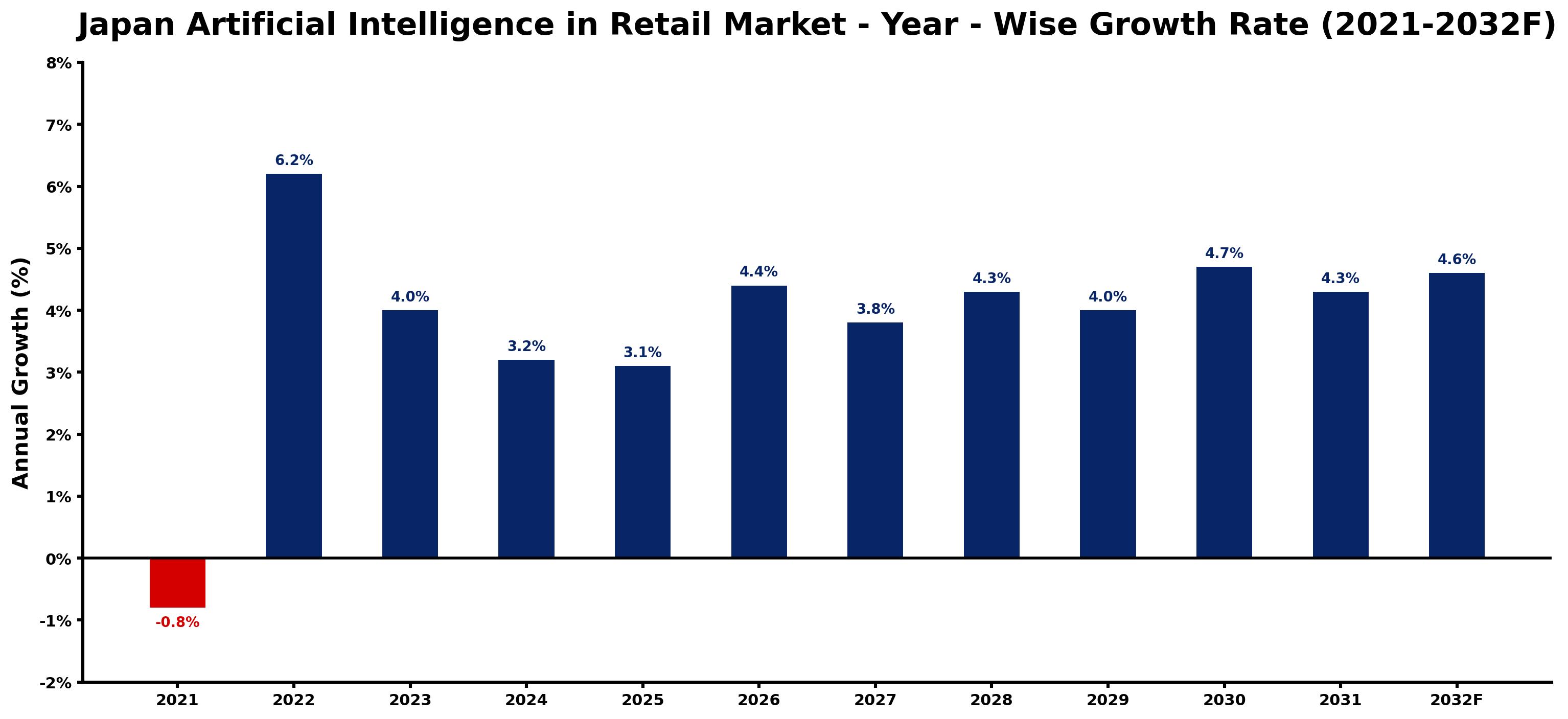
The table below presents the year‑wise growth rates along with the key drivers influencing the market
| Year | Growth Rate | Major Drivers |
| 2021 | -0.8% | AIST funding cuts hindered AI technology advancements. |
| 2022 | 6.2% | Japan's Ministry of Economy promotes AI retail innovations. |
| 2023 | 4.0% | Surge in contactless shopping technology adoption during pandemic. |
| 2024 | 3.2% | Growing e-commerce sector enhances AI-driven customer insights. |
| 2025 | 3.1% | Local retailers investing in AI for inventory management. |
| 2026 | 4.4% | Government subsidies for AI solutions in traditional retail. |
| 2027 | 3.8% | Rise in demographic tech-savvy millennial consumers in Japan. |
| 2028 | 4.3% | Adoption of AI chatbots improves retail customer service. |
| 2029 | 4.0% | Increased focus on omnichannel retail strategies post-COVID. |
| 2030 | 4.7% | AI applications enhancing in-store experiences for consumers. |
| 2031 | 4.3% | Collaborations between retailers and AI startups expanding capabilities. |
| 2032 | 4.6% | Retail analytics demand driven by competitive market landscape. |
Note: Market size estimations and growth projections presented in this report are based on 6Wresearch's proprietary forecasting methodology, utilizing the latest available industry data, government publications, and primary research inputs.
Japan Artificial Intelligence in Retail Market Key Takeaways
Below are some of the specific key takeaways from the market, including:
- The market is characterized by strong growth, driven by the increasing integration of AI technologies in retail operations.
- AI applications like chatbots and demand forecasting are becoming standard practices among retailers.
- Data privacy regulations present both challenges and opportunities for AI adoption in retail.
- Investment in personalized marketing and customer engagement tools is expected to surge.
- The government's active support for AI initiatives is shaping a favorable environment for market growth.
Evaluation of Restraints in Japan Artificial Intelligence in Retail Market
Despite its promising trajectory, the Japan Artificial Intelligence in Retail Market faces several constraints. One of the most pressing issues is data privacy. Strict regulations in Japan require retailers to tread carefully when implementing AI solutions that rely on customer data. Additionally, the unique shopping behaviors of Japanese consumers may not always align with AI-generated recommendations, limiting the effectiveness of some applications. Integrating AI into existing retail systems is complex, often requiring substantial investment and time, which can deter smaller retailers from adopting these technologies.
Japan Artificial Intelligence in Retail Market Trends
Several trends are shaping the Japan Artificial Intelligence in Retail Market. The rise of AI-powered chatbots for customer service is making interactions more efficient and personalized. Retailers are also increasingly utilizing recommendation engines to provide tailored product suggestions, enhancing the shopping experience. on top of that, computer vision technology is gaining traction, enabling cashier-less stores to streamline operations. Demand forecasting and inventory management powered by AI are crucial for retailers aiming to reduce costs and improve efficiency, making these technologies essential for competitiveness.
Japan Artificial Intelligence in Retail Market Opportunities
Investment opportunities are abundant in the Japan Artificial Intelligence in Retail Market. Retailers can benefit from AI-driven personalized marketing solutions that effectively target customer preferences. Predictive analytics tools for inventory management are also seeing increased interest, as they promise to enhance operational efficiency. on top of that, deploying chatbots and virtual assistants can significantly improve customer engagement, fostering loyalty and repeat business. Given Japan's advanced technological ecosystem, the potential for AI integration in retail operations remains vast, attracting investors keen on capitalizing on these developments.
Government Initiatives in the Japan Artificial Intelligence in Retail Market
The Japanese government is actively fostering the adoption of artificial intelligence within the retail sector, emphasizing innovation and operational efficiency. Initiatives aimed at integrating AI technologies align with broader national goals to enhance competitiveness and consumer experience. These policies create a supportive framework for businesses seeking to implement AI solutions in their operations.
- A recently launched initiative focuses on funding for small and medium-sized enterprises (SMEs) to adopt AI solutions in their retail operations.
- Current efforts include an ongoing public-private partnership aimed at developing a national standard for AI-driven customer service applications.
- A planned policy rollout expected by 2026 aims to simplify regulations surrounding data usage in AI, promoting greater transparency.
- The "Society 5.0" initiative is actively promoting AI integration across various sectors, including retail, to create a more human-centered economy.
- Recent legislation has been introduced to enhance cybersecurity measures for businesses utilizing AI technologies in retail.
Future Insights of the Japan Artificial Intelligence in Retail Market
Looking ahead, the Japan Artificial Intelligence in Retail Market is expected to thrive, fueled by continuous advancements in technology and increasing retailer adoption. The focus will likely shift towards further integration of AI solutions that enhance customer experiences and operational efficiency. As online shopping continues to gain traction, retailers will increasingly rely on AI to adapt to changing consumer preferences and maintain competitiveness in a rapidly evolving market.
Japan Artificial Intelligence in Retail Market Latest Developments
Over the past year, the Japan Artificial Intelligence in Retail Market has witnessed dynamic developments as retailers and technology providers collaborate to enhance consumer experiences. The focus has been on implementing innovative AI solutions that streamline operations and provide personalized services.
- A major technology vendor launched a new AI-driven recommendation engine in early 2025, aimed at improving customer engagement in online retail.
- An initiative that began in mid-2025 is currently underway to integrate AI chatbots into customer service departments of several large retailers.
- A rollout expected to begin in Q3 2025 will introduce AI-enhanced inventory management systems across multiple retail chains.
- A pilot program for cashier-less stores, leveraging computer vision technology, is being tested and is anticipated to complete by late 2026.
- A partnership between retail giants and AI firms is currently focused on developing personalized shopping experiences, expected to launch in early 2026.
Japan Artificial Intelligence in Retail Market - Key Attractiveness of the Report
- 10 Years of Market Numbers
- Historical Data Starting from 2022 to 2025
- Base Year: 2025
- Forecast Data until 2032
- Key Performance Indicators Impacting the Market
- Major Upcoming Developments and Projects
Key Highlights of the Report:
- Japan Artificial Intelligence in Retail Market Outlook
- Market Size of Japan Artificial Intelligence in Retail Market, 2025
- Forecast of Japan Artificial Intelligence in Retail Market, 2032
- Historical Data and Forecast of Japan Artificial Intelligence in Retail Revenues & Volume for the Period 2022-2032F
- Japan Artificial Intelligence in Retail Market Trend Evolution
- Japan Artificial Intelligence in Retail Market Drivers and Challenges
- Japan Artificial Intelligence in Retail Price Trends
- Japan Artificial Intelligence in Retail Porter's Five Forces
- Japan Artificial Intelligence in Retail Industry Life Cycle
- Historical Data and Forecast of Japan Artificial Intelligence in Retail Market Revenues & Volume By Type for the Period 2022-2032F
- Historical Data and Forecast of Japan Artificial Intelligence in Retail Market Revenues & Volume By Online for the Period 2022-2032F
- Historical Data and Forecast of Japan Artificial Intelligence in Retail Market Revenues & Volume By Offline for the Period 2022-2032F
- Historical Data and Forecast of Japan Artificial Intelligence in Retail Market Revenues & Volume By Service for the Period 2022-2032F
- Historical Data and Forecast of Japan Artificial Intelligence in Retail Market Revenues & Volume By Professional for the Period 2022-2032F
- Historical Data and Forecast of Japan Artificial Intelligence in Retail Market Revenues & Volume By Managed for the Period 2022-2032F
- Historical Data and Forecast of Japan Artificial Intelligence in Retail Market Revenues & Volume By Technology for the Period 2022-2032F
- Historical Data and Forecast of Japan Artificial Intelligence in Retail Market Revenues & Volume By Machine Learning for the Period 2022-2032F
- Historical Data and Forecast of Japan Artificial Intelligence in Retail Market Revenues & Volume By Deep Learning for the Period 2022-2032F
- Historical Data and Forecast of Japan Artificial Intelligence in Retail Market Revenues & Volume By NLP for the Period 2022-2032F
- Japan Artificial Intelligence in Retail Import Export Trade Statistics
- Market Opportunity Assessment By Type
- Market Opportunity Assessment By Service
- Market Opportunity Assessment By Technology
- Japan Artificial Intelligence in Retail Top Companies Market Share
- Japan Artificial Intelligence in Retail Competitive Benchmarking By Technical and Operational Parameters
- Japan Artificial Intelligence in Retail Company Profiles
- Japan Artificial Intelligence in Retail Key Strategic Recommendations






































