Japan Augmented Reality in Retail Market Size & Growth Rate
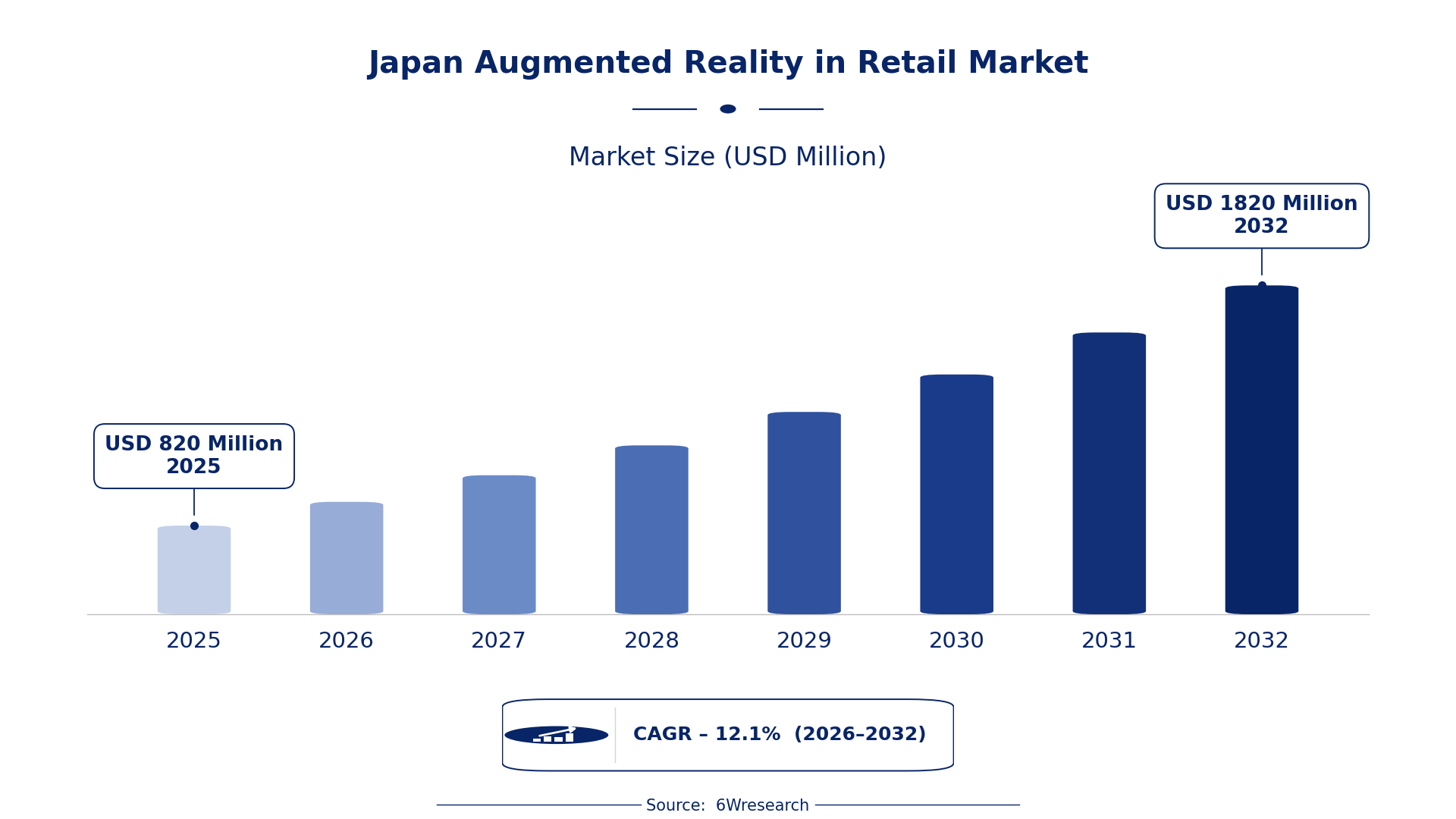
According to 6Wresearch internal database and industry insights, the Japan Augmented Reality in Retail Market was valued at USD 820 Million in 2025 and is projected to reach USD 1,820 Million by 2032, growing at a CAGR of approximately 12.1% during 2026–2032.
Japan Augmented Reality in Retail Market Highlights
| Report Metric | Details |
| Report Name | Japan Augmented Reality in Retail Market (2026-2032) |
| Market Size 2025 | USD 820 Million |
| Market Size 2032 | USD 1,820 Million |
| Absolute Growth 2025–2032 | USD 1,000 Million |
| CAGR 2026–2032 | 12.1% |
| Peak Annual Growth | 14.4% in 2026 |
| Forecast Period | 2026–2032 |
| Historical Data | 2022–2025 |
| Base Year | 2025 |
| Leading Offering, 2025 | Hardware (66% share) |
| Leading Device Type, 2025 | Head-Mounted Display (HMD) (54% share) |
| Leading Application, 2025 | Advertising and Marketing (37% share) |
| Leading Technology, 2025 | Marker-based Augmented Reality (61% share) |
| Leading Retail Type, 2025 | Jewelry (32% share) |
| Fastest-Growing Offering | Software (16.5% CAGR) |
| Fastest-Growing Device Type | Smart AR Mirror (16.6% CAGR) |
| Fastest-Growing Application | Try-on Solutions (16.0% CAGR) |
| Fastest-Growing Technology | Marker-less Augmented Reality (15.7% CAGR) |
| Fastest-Growing Retail Type | Beauty and Cosmetics (17.1% CAGR) |
| Growing Sector | Beauty and Cosmetics |
| Key End Users | Retailers, beauty brands, apparel manufacturers, advertising agencies |
Japan Augmented Reality in Retail Market Year-wise Growth Rate and Key Drivers (2022–2032)
This graph illustrates the annual growth rates of the market from 2022 to 2032, highlighting a steady upward trajectory and projected market expansion over the forecast period.
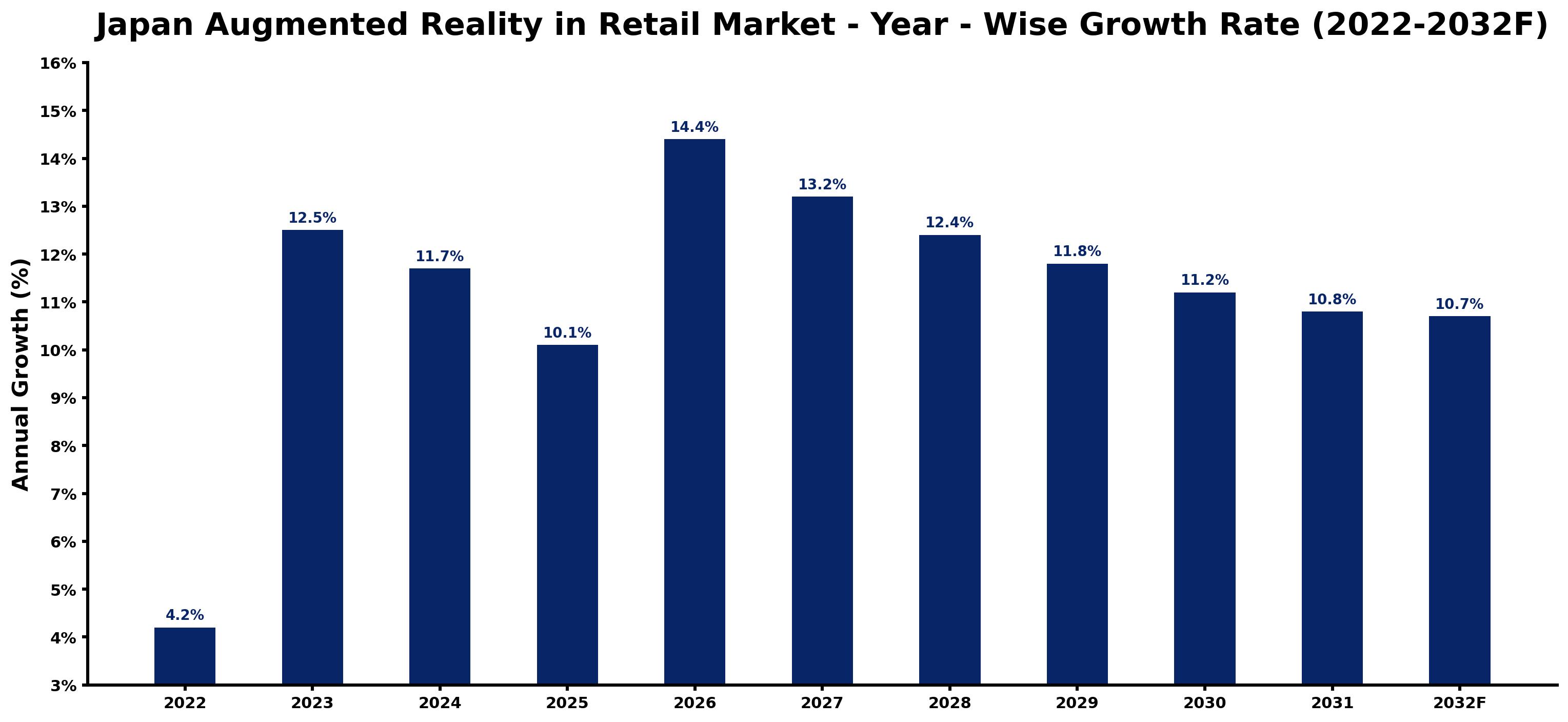
Below, each year's estimated growth is shown next to the factor that most influenced it.
| Year | Estimated Annual Growth (%) | Market Rationale |
| 2022 | 4.2 | The market exhibited steady growth as retailers began integrating AR technologies into their offerings. |
| 2023 | 12.5 | Growth accelerated due to increased consumer engagement with AR experiences in urban retail settings. |
| 2024 | 11.7 | A slowdown occurred as the market adjusted to the rapid adoption rates observed in the previous year. |
| 2025 | 10.1 | Continued growth was observed as retailers expanded their AR applications, particularly in the beauty sector. |
| 2026 | 14.4 | The market is expected to surge as major retail events showcase new AR solutions, driving consumer interest. |
| 2027 | 13.2 | Growth will slow as the market matures, with retailers focusing on optimising existing AR technologies. |
| 2028 | 12.4 | A further slowdown is projected as competition intensifies among AR solution providers in retail. |
| 2029 | 11.8 | The market will continue to grow, albeit at a slower pace, as retailers refine their AR strategies. |
| 2030 | 11.2 | Growth is expected to remain steady as consumer familiarity with AR applications increases across various retail sectors. |
| 2031 | 10.8 | Another slowdown is anticipated as the market approaches saturation in urban areas. |
| 2032 | 10.7 | The market is expected to maintain growth as new AR technologies emerge to attract consumers. |
Note: Market size estimations and growth projections presented in this report are based on 6Wresearch's proprietary forecasting methodology, utilizing the latest available industry data, government publications, and primary research inputs.
Japan Augmented Reality in Retail Market Synopsis
Augmented Reality in retail overlays digital information onto the real world, enabling virtual try-ons, interactive advertising, and immersive shopping experiences. The Japan Augmented Reality in Retail Market is expanding due to increased consumer engagement, particularly in urban areas, where the average consumer interacts with AR experiences three times a month. The beauty market is projected to adopt AR solutions by 30% by 2025, prompting retailers to improve customer interactions and satisfaction through advanced technologies.
Market Dynamics Impact Analysis (2026–2032)
| Factor | Type | Impact | Primary Segment Affected |
| Increased consumer engagement with AR applications | Driver | High | Advertising and Marketing |
| Growing adoption of AR solutions in the beauty sector | Driver | High | Beauty and Cosmetics |
| Expansion of AR applications in urban retail environments | Opportunity | High | Try-on Solutions |
| Rising demand for interactive shopping experiences | Opportunity | Medium | Handheld Device |
| High development costs for AR technologies | Restraint | High | Software |
| Limited practical use of Head-Mounted Displays in retail | Restraint | Medium | Head-Mounted Display (HMD) |
| Challenges in integrating AR with existing retail systems | Challenge | High | Marker-based Augmented Reality |
| Compliance with evolving AR technology standards | Challenge | Medium | Marker-less Augmented Reality |
Evaluation of Drivers in Japan Augmented Reality in Retail Market (2026–2032)
The main growth drivers and the segments they affect most are set out below.
| Drivers | Primary Segment Affected | Why It Matters (Evidence) |
| Increased consumer engagement with AR advertising campaigns | Advertising and Marketing | AR-enhanced campaigns have shown a 25% increase in consumer engagement, leading retailers to invest more in these technologies. |
| Growing adoption of AR solutions in the beauty sector | Beauty and Cosmetics | The Japanese beauty market is expected to adopt AR solutions by 30% by 2025, encouraging brands to improve virtual try-on capabilities. |
| Expansion of AR applications in urban retail environments | Try-on Solutions | Tokyo accounted for 45% of AR retail applications in 2023, driving demand for innovative shopping experiences. |
| Rising demand for interactive shopping experiences | Handheld Device | Urban consumers engage with AR retail experiences three times a month, prompting retailers to enhance their offerings. |
| Advancements in Marker-less AR technology | Marker-less Augmented Reality | Marker-less AR is gaining traction in apparel fitting solutions, allowing for more versatile applications in retail. |
Most of the extra volume comes from heightened consumer engagement with AR advertising, which has shown a 25% increase in effectiveness. The beauty sector is also driving demand, with a projected 30% adoption of AR solutions by 2025. Urban areas, particularly Tokyo, accounted for 45% of AR retail applications in 2023, indicating a strong market presence. Urban consumers engage with AR experiences three times monthly, prompting retailers to improve their offerings. Marker-less AR technology is gaining traction in apparel fitting, further boosting demand.
Evaluation of Restraints in Japan Augmented Reality in Retail Market
These are the pressures that could keep growth below its potential.
| Market Restraint | Primary Segment Affected | Why It Matters (Evidence) |
| High development costs for AR technologies | Software | The average investment in AR software development can exceed JPY 10 million, limiting accessibility for smaller retailers. |
| Limited practical use of Head-Mounted Displays in retail | Head-Mounted Display (HMD) | Practicality issues have resulted in HMDs being used in less than 10% of retail applications, hindering broader adoption. |
| Integration difficulties with existing retail systems | Marker-based Augmented Reality | Integration challenges can delay AR implementation timelines by up to six months, affecting retailers' competitive edge. |
| Compliance with evolving AR technology standards | Marker-less Augmented Reality | Retailers must navigate complex standards set by the Japan Electronics and Information Technology Industries Association, which can slow down deployment. |
| Consumer scepticism regarding AR effectiveness | Try-on Solutions | Some consumers doubt the accuracy of virtual try-ons, impacting their willingness to engage with AR features. |
Japan Augmented Reality in Retail Market Challenges
In 2023, 45% of AR retail applications were concentrated in the Tokyo region, creating an accessibility issue for buyers in rural areas who struggle to access advanced technologies. This urban-centric focus limits the reach of AR solutions, delaying adoption and reducing competitive edge for retailers outside major cities. A lack of clear AR technology standards from the Japan Electronics and Information Technology Industries Association leads to inconsistent quality, causing producers to incur higher development costs of up to 15%. Skills shortages in AR development restrict suppliers' ability to meet demand, resulting in project delays that can extend timelines by up to six months for retailers eager to implement these technologies.
Trends in the Japan Augmented Reality in Retail Market
These developments are changing demand patterns in the Japan Augmented Reality in Retail Market.
- Shift to Marker-less AR Technology: Marker-less AR technology is gaining traction in retail, particularly in apparel fitting solutions. This shift allows for more versatile applications, with an estimated 30% increase in adoption by 2025, as retailers seek to improve customer experiences.
- Increase in AR Usage at Major Retail Events: Major retail events, such as Tokyo Fashion Week 2023, showcased multiple AR applications, resulting in a 25% increase in consumer interest. This trend highlights the growing importance of AR in retail marketing strategies.
- Expansion of AR in the Beauty Sector: The beauty sector is rapidly adopting AR solutions, with over 200 beauty stores using Smart AR Mirrors. This trend is expected to drive a 30% increase in AR adoption by 2025, improving customer interaction.
- Rise of Interactive Advertising: Interactive advertising through AR is becoming more prevalent, with campaigns showing a 25% increase in engagement. This trend reflects a shift in how retailers connect with consumers and promote products.
Investment Opportunities in the Japan Augmented Reality in Retail Market
The following opportunities in the Japan Augmented Reality in Retail Market pair current demand with a clear way in.
- Investment in Smart AR Mirrors: Smart AR Mirrors are widely used in over 200 beauty stores across Japan, presenting an opportunity for suppliers to invest in this technology. With a projected 30% adoption increase by 2025, retailers are keen to improve virtual try-on experiences.
- Supply of Marker-less AR Solutions: With the increasing interest in Marker-less AR for apparel fitting, suppliers can capitalise on this trend. Retailers in urban areas are seeking new solutions to improve customer interactions, making this a timely investment.
- Focus on Interactive Shopping Experiences: The average consumer engages with AR retail experiences three times a month, indicating a need for more interactive solutions. Retailers are looking to improve these experiences, creating opportunities for technology providers.
- Expansion of AR in Advertising: As AR-enhanced advertising campaigns show a 25% increase in consumer engagement, suppliers can invest in developing AR advertising solutions. Retailers are eager to adopt these technologies to attract and retain customers.
Government Initiatives in the Japan Augmented Reality in Retail Market
The implementation of the AI Promotion Act in 2025 establishes a framework for the development and use of AI technologies, impacting AR in retail by encouraging innovation and integration of AI-driven solutions. The Digital Agency, established in September 2021, plays a crucial role in leading government digital transformation, ensuring that AR technologies meet common system standards and enhancing their adoption across various retail sectors.
The Ministry of Economy, Trade and Industry (METI) funds initiatives aimed at advancing AR technology, supporting projects that enhance consumer experiences in retail. The agency's backing for AR development initiatives is expected to increase the number of AR applications in retail, fostering a more competitive environment and improving the overall quality of AR solutions available to retailers.
Future Insight of the Japan Augmented Reality in Retail Market
By 2032, policy-driven shifts will enhance AR technology integration across retail sectors, driven by initiatives from the Ministry of Economy, Trade and Industry. The beauty market's anticipated adoption of AR solutions will encourage other segments to follow suit, resulting in broader implementation. Urban consumers will engage with AR experiences more frequently, with an expected increase in overall AR use. Advertising campaigns are projected to significantly boost consumer engagement, prompting suppliers to innovate and expand their offerings.
Market Segmentation Analysis
Japan Augmented Reality in Retail Market report covers a detailed analysis of the following market segments:
By Offering – Hardware Leads, Software Expected to Grow Fastest
According to Dhaval Chaurasia, Assistant Manager at 6Wresearch, the largest offering category in 2025 was Hardware, at 66% of revenue. Hardware holds the largest share as it is essential for delivering AR experiences in retail environments. The Smart AR Mirror, used in over 200 beauty stores across Japan, exemplifies the critical role hardware plays in this market. Software is set to record the highest CAGR in this split, 16.5% over 2026–2032. Software is experiencing rapid growth because it is crucial for developing AR applications that enhance customer experiences. With over 150 AR applications focused on retail, the demand for software solutions is clearly robust. Suppliers should focus on software development to meet the increasing demand in the retail sector.
By Device Type – Head-Mounted Display (HMD) Leads, Smart AR Mirror Expected to Grow Fastest
Head-Mounted Display (HMD) held 54% of the Japan Augmented Reality in Retail Market by device type in 2025. Head-Mounted Displays lead the device type segment due to their immersive capabilities in select retail scenarios. While their practical use is limited, they cater to niche markets that seek high engagement experiences. The quickest growth will come from Smart AR Mirror, forecast to expand at a CAGR of 16.6% between 2026 and 2032. Smart AR Mirrors are growing quickly as they are widely adopted for virtual try-ons in the cosmetics and fashion sectors. This technology is becoming increasingly popular as consumers desire more interactive shopping experiences. Retailers should consider integrating Smart AR Mirrors to attract tech-savvy consumers and enhance their shopping experience.
By Application – Advertising and Marketing Leads, Try-on Solutions Expected to Grow Fastest
With 37% of application revenue in 2025, Advertising and Marketing was the largest category. Advertising and Marketing is the leading application because it plays a vital role in engaging customers through immersive AR experiences. The success of AR-enhanced advertising campaigns, which have shown a 25% increase in consumer engagement, underscores its importance. Try-on Solutions are projected to grow fastest, at a CAGR of 16.0% during 2026–2032. Try-on Solutions are the fastest-growing application due to their popularity in enhancing customer interaction with products. The projected 30% adoption of AR solutions in the beauty market by 2025 indicates strong demand for these applications. Marketers should invest in try-on solutions to leverage the growing trend of AR in retail advertising.
By Technology – Marker-based Augmented Reality Leads, Marker-less Augmented Reality Expected to Grow Fastest
In 2025, Marker-based Augmented Reality led the technology split with a 61% share. Marker-based Augmented Reality leads the technology segment as it is specifically employed for applications requiring physical markers, which are prevalent in retail. This technology remains relevant for targeted marketing strategies that depend on physical interactions. Over 2026–2032, Marker-less Augmented Reality is expected to post the fastest growth, at a CAGR of 15.7%. Marker-less Augmented Reality is growing rapidly due to its versatility and broader adoption in retail applications. Its capacity to provide seamless experiences without the need for physical markers makes it attractive to retailers. Retailers should adopt marker-less AR technologies to enhance customer engagement and streamline the shopping experience.
By Retail Type – Jewelry Leads, Beauty and Cosmetics Expected to Grow Fastest
Jewelry took 32% of retail type revenue in 2025, more than any other category. Jewelry is the leading retail type for AR applications as it enhances the shopping experience by allowing virtual try-ons, appealing to consumers. This sector has integrated AR effectively to facilitate informed purchasing decisions. Beauty and Cosmetics are set to record the highest CAGR in this split, 17.1% over 2026–2032. Beauty and Cosmetics are experiencing the fastest growth in AR adoption, driven by high demand for virtual makeup applications. The anticipated increase in AR adoption within this market highlights its importance in consumer engagement. Retailers in the beauty sector should prioritise AR solutions to meet consumer expectations for interactive shopping experiences.
Key Attractiveness of the Report
- 10 Years of Market Numbers
- Historical Data Starting from 2022 to 2025
- Base Year 2025
- Forecast Data until 2032
- Key Performance Indicators Impacting the Market
- Major Upcoming Developments and Projects
Key Highlights of the Report:
- Japan Augmented Reality in Retail Market Outlook
- Market Size of Japan Augmented Reality in Retail Market, 2025
- Forecast of Japan Augmented Reality in Retail Market, 2032
- Historical Data and Forecast of Japan Augmented Reality in Retail Revenues & Volume for the Period 2022-2032
- Japan Augmented Reality in Retail Market Trend Evolution
- Japan Augmented Reality in Retail Market Drivers and Challenges
- Japan Augmented Reality in Retail Price Trends
- Japan Augmented Reality in Retail Porter's Five Forces
- Japan Augmented Reality in Retail Industry Life Cycle
- Historical Data and Forecast of Japan Augmented Reality in Retail Market Revenues & Volume By Offering for the Period 2022-2032
- Historical Data and Forecast of Japan Augmented Reality in Retail Market Revenues & Volume By Hardware for the Period 2022-2032
- Historical Data and Forecast of Japan Augmented Reality in Retail Market Revenues & Volume By Software for the Period 2022-2032
- Historical Data and Forecast of Japan Augmented Reality in Retail Market Revenues & Volume By Device Type for the Period 2022-2032
- Historical Data and Forecast of Japan Augmented Reality in Retail Market Revenues & Volume By Head-Mounted Display (HMD) for the Period 2022-2032
- Historical Data and Forecast of Japan Augmented Reality in Retail Market Revenues & Volume By Smart AR Mirror for the Period 2022-2032
- Historical Data and Forecast of Japan Augmented Reality in Retail Market Revenues & Volume By Handheld Device for the Period 2022-2032
- Historical Data and Forecast of Japan Augmented Reality in Retail Market Revenues & Volume By Application for the Period 2022-2032
- Historical Data and Forecast of Japan Augmented Reality in Retail Market Revenues & Volume By Advertising and Marketing for the Period 2022-2032
- Historical Data and Forecast of Japan Augmented Reality in Retail Market Revenues & Volume By Try-on Solutions for the Period 2022-2032
- Historical Data and Forecast of Japan Augmented Reality in Retail Market Revenues & Volume By Planning and Designing for the Period 2022-2032
- Historical Data and Forecast of Japan Augmented Reality in Retail Market Revenues & Volume By Information Systems for the Period 2022-2032
- Historical Data and Forecast of Japan Augmented Reality in Retail Market Revenues & Volume By Technology for the Period 2022-2032
- Historical Data and Forecast of Japan Augmented Reality in Retail Market Revenues & Volume By Marker-based Augmented Reality for the Period 2022-2032
- Historical Data and Forecast of Japan Augmented Reality in Retail Market Revenues & Volume By Marker-less Augmented Reality for the Period 2022-2032
- Historical Data and Forecast of Japan Augmented Reality in Retail Market Revenues & Volume By Retail Type for the Period 2022-2032
- Historical Data and Forecast of Japan Augmented Reality in Retail Market Revenues & Volume By Jewelry for the Period 2022-2032
- Historical Data and Forecast of Japan Augmented Reality in Retail Market Revenues & Volume By Beauty and Cosmetics for the Period 2022-2032
- Historical Data and Forecast of Japan Augmented Reality in Retail Market Revenues & Volume By Apparel Fitting for the Period 2022-2032
- Historical Data and Forecast of Japan Augmented Reality in Retail Market Revenues & Volume By Furniture and Lighting for the Period 2022-2032
- Historical Data and Forecast of Japan Augmented Reality in Retail Market Revenues & Volume By Grocery Shopping for the Period 2022-2032
- Historical Data and Forecast of Japan Augmented Reality in Retail Market Revenues & Volume By Footwear for the Period 2022-2032
- Historical Data and Forecast of Japan Augmented Reality in Retail Market Revenues & Volume By Others for the Period 2022-2032
- Japan Augmented Reality in Retail Import Export Trade Statistics
- Market Opportunity Assessment By Offering
- Market Opportunity Assessment By Device Type
- Market Opportunity Assessment By Application
- Market Opportunity Assessment By Technology
- Market Opportunity Assessment By Retail Type
- Japan Augmented Reality in Retail Top Companies Market Share
- Japan Augmented Reality in Retail Competitive Benchmarking By Technical and Operational Parameters
- Japan Augmented Reality in Retail Company Profiles
- Japan Augmented Reality in Retail Key Strategic Recommendations
Market Covered
This report examines the market across the segments below.
By Offering
- Hardware
- Software
By Device Type
- Head-Mounted Display (HMD)
- Smart AR Mirror
- Handheld Device
By Application
- Advertising and Marketing
- Try-on Solutions
- Planning and Designing
- Information Systems
By Technology
- Marker-based Augmented Reality
- Marker-less Augmented Reality
By Retail Type
- Jewelry
- Beauty and Cosmetics
- Apparel Fitting
- Furniture and Lighting
- Grocery Shopping
- Footwear
- Others































