Japan Auto Parts And Accessories Market Size, Share & Growth Rate
The Japan Auto Parts And Accessories Market was estimated at USD 206 Million in 2025 and is projected to reach USD 221 Million by 2032, growing at a CAGR of 1.0% from 2026 to 2032. This steady growth trajectory is primarily driven by the ongoing advancements in automotive technology, particularly in the fields of electric and hybrid vehicles. Furthermore, the increasing consumer demand for enhanced safety features and connected car technologies plays a significant role in propelling the market forward.
Japan Auto Parts And Accessories Market Year-wise Growth Rate and Key Drivers
This graph highlights how the Japan Auto Parts And Accessories Market has steadily grown over the years, supported by major growth factors.
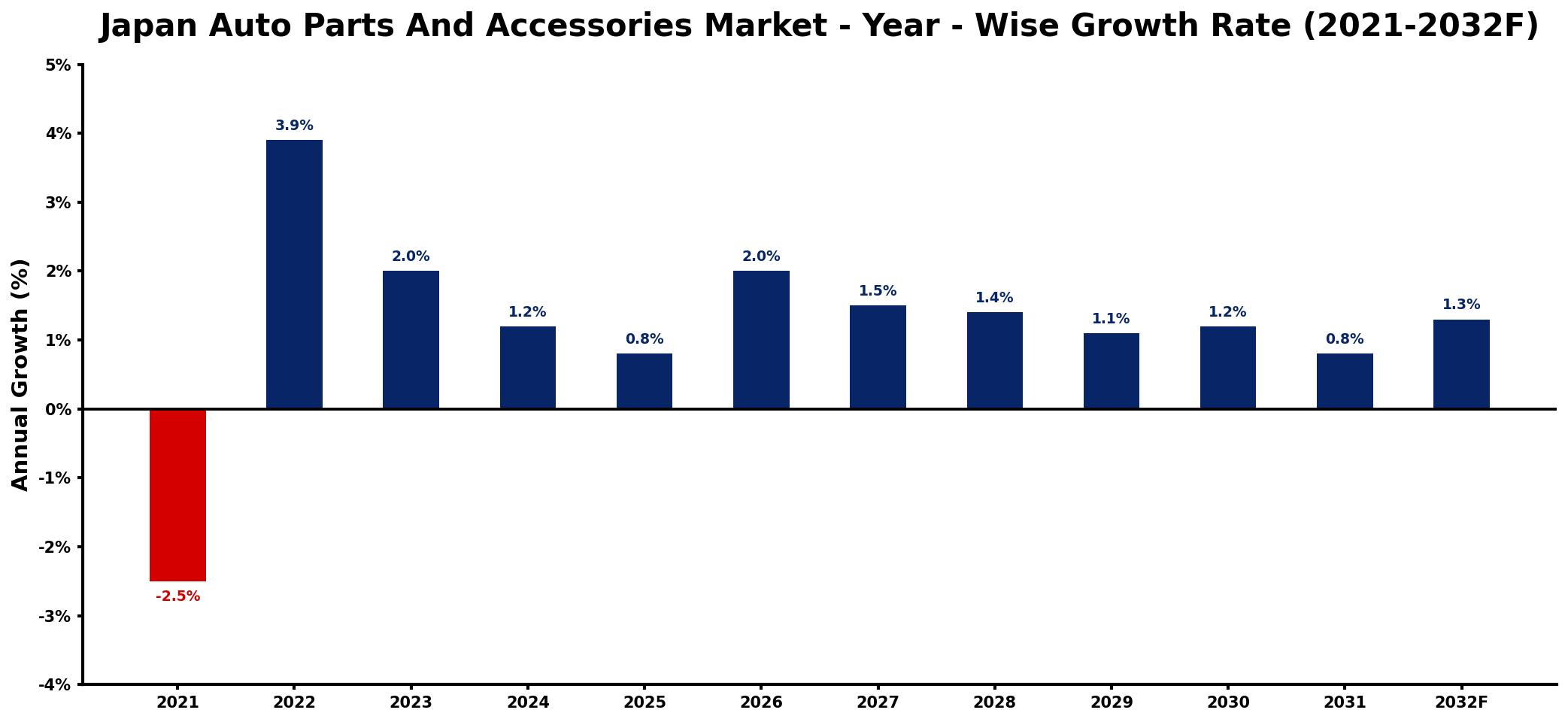
The table below presents the year‑wise growth rates along with the key drivers influencing the market
| Year | Growth Rate | Major Drivers |
| 2021 | -2.5% | Supply chain disruptions impact availability |
| 2022 | 3.9% | Increased consumer spending on vehicles |
| 2023 | 2.0% | Technological advancements drive innovation |
| 2024 | 1.2% | Growing demand for electric vehicles |
| 2025 | 0.8% | Rising interest in sustainability practices |
| 2026 | 2.0% | Expansion of manufacturing capabilities |
| 2027 | 1.5% | Investment in research and development |
| 2028 | 1.4% | Growth in online retail platforms |
| 2029 | 1.1% | Strengthening of domestic production facilities |
| 2030 | 1.2% | Emergence of new market entrants |
| 2031 | 0.8% | Increased collaboration with suppliers |
| 2032 | 1.3% | Focus on enhancing customer experience |
Note: Market size estimations and growth projections presented in this report are based on 6Wresearch's proprietary forecasting methodology, utilizing the latest available industry data, government publications, and primary research inputs.
Japan Auto Parts And Accessories Market Synopsis
A pivotal force shaping the Japan Auto Parts And Accessories Market is the nation's commitment to innovation, particularly within the electric vehicle (EV) sector. As Japan transitions towards cleaner transportation options, the demand for specialized components, including batteries and electric powertrains, is surging, reinforcing the countrys position within the global automotive supply chain.
In addition, the market is marked by a competitive landscape where quality and technology are paramount. Renowned for their reliability and performance, Japanese auto parts and accessories cater to both domestic needs and international markets, reflecting a blend of traditional craftsmanship and modern engineering excellence.
Japan Auto Parts And Accessories Market Key Takeaways
- The market is experiencing a notable shift towards electric and hybrid vehicle components.
- Technological advancements are leading to increased demand for safety and automation features.
- Customization trends in vehicles are boosting aftermarket parts and accessories sales.
- Government regulations emphasize sustainability, driving innovation and eco-friendly product development.
- The aging population presents unique market dynamics and shifting consumer preferences.
Evaluation of Restraints in Japan Auto Parts And Accessories Market
Despite its growth potential, the Japan Auto Parts And Accessories Market faces certain restraints that could hinder its overall expansion. The intense competition among manufacturers—both domestic and international—results in pricing pressures that challenge profitability. Coupled with strict regulations surrounding quality and safety standards, the burden of compliance can escalate production costs, complicating operational efficiencies. Additionally, evolving consumer preferences toward environmentally-friendly options require significant investment in research and development, presenting a challenge for companies aiming to stay competitive in this dynamic landscape.
Japan Auto Parts And Accessories Market Trends
The current trends shaping the Japan Auto Parts and Accessories Market reflect a significant move towards sustainability and innovation. As electric and hybrid vehicles gain traction, there's an escalating demand for related components such as advanced batteries and charging systems. Simultaneously, the emergence of connected vehicle technologies and advanced safety features is driving the integration of sensors, cameras, and sophisticated software into auto parts. Consumers are also leaning towards personalization, driving an increase in the aftermarket segment as they seek unique modifications and enhancements for their vehicles.
Japan Auto Parts And Accessories Market Opportunities
Investment opportunities abound within the Japan Auto Parts and Accessories Market, particularly for those focusing on electric vehicle technologies. The rise of electric and hybrid models offers promising prospects for companies involved in manufacturing related components. Additionally, as the demand for connectivity and autonomous driving features grows, companies specializing in advanced safety systems and software solutions stand to benefit significantly. The markets focus on innovation and quality positions it well for investors looking for long-term growth in the evolving automotive landscape.
Government Initiatives in the Japan Auto Parts And Accessories Market
Government policies play a crucial role in the evolution of the Japan Auto Parts and Accessories Market, promoting both innovation and environmental sustainability. The Japanese government has enforced stringent emissions and safety regulations that compel manufacturers to enhance their technology and product quality. Initiatives encouraging research and development further support advancements in automotive manufacturing, while incentives for electric and hybrid vehicles are significantly fueling demand for related auto parts. Such governmental support not only shapes market dynamics but also fosters a competitive environment conducive to growth.
Future Insights of the Japan Auto Parts And Accessories Market
Looking ahead to 2026-2032, the Japan Auto Parts and Accessories Market is expected to experience robust growth driven by technological advancements and a heightened focus on sustainability. As the transition towards electric vehicles accelerates, opportunities will arise for specialized components that cater to evolving consumer needs. The increasing integration of autonomous systems and connectivity technologies promises to further enhance market demand. In this landscape, Japan's reputation for high-quality automotive parts will continue to attract both domestic and international partnerships, solidifying its role in the global supply chain.
Japan Auto Parts And Accessories Market Latest Developments (2025 - 2026)
Recent developments within the Japan Auto Parts and Accessories Market indicate a heightened focus on sustainability and technological innovation. Many companies are ramping up their research efforts to create eco-friendly components and advanced safety systems. Additionally, collaborations between automakers and tech firms are on the rise, fostering innovation in areas like autonomous driving and vehicle connectivity. This trend reflects the industry's commitment to meeting consumer demands and regulatory standards, ensuring its competitiveness in a rapidly evolving landscape.
Japan Auto Parts And Accessories Market - Key Attractiveness of the Report
- 10 Years of Market Numbers
- Historical Data Starting from 2022 to 2025
- Base Year: 2025
- Forecast Data until 2032
- Key Performance Indicators Impacting the Market
- Major Upcoming Developments and Projects
Key Highlights of the Report:
- Japan Auto Parts And Accessories Market Outlook
- Market Size of Japan Auto Parts And Accessories Market, 2025
- Forecast of Japan Auto Parts And Accessories Market, 2032
- Historical Data and Forecast of Japan Auto Parts And Accessories Revenues & Volume for the Period 2022-2032F
- Japan Auto Parts And Accessories Market Trend Evolution
- Japan Auto Parts And Accessories Market Drivers and Challenges
- Japan Auto Parts And Accessories Price Trends
- Japan Auto Parts And Accessories Porter's Five Forces
- Japan Auto Parts And Accessories Industry Life Cycle
- Historical Data and Forecast of Japan Auto Parts And Accessories Market Revenues & Volume By Product for the Period 2022-2032F
- Historical Data and Forecast of Japan Auto Parts And Accessories Market Revenues & Volume By Driveline & Powertrain for the Period 2022-2032F
- Historical Data and Forecast of Japan Auto Parts And Accessories Market Revenues & Volume By Interiors & Exteriors for the Period 2022-2032F
- Historical Data and Forecast of Japan Auto Parts And Accessories Market Revenues & Volume By Electronics for the Period 2022-2032F
- Historical Data and Forecast of Japan Auto Parts And Accessories Market Revenues & Volume By Bodies & Chassis for the Period 2022-2032F
- Historical Data and Forecast of Japan Auto Parts And Accessories Market Revenues & Volume By Wheel & Tires for the Period 2022-2032F
- Historical Data and Forecast of Japan Auto Parts And Accessories Market Revenues & Volume By Others for the Period 2022-2032F
- Historical Data and Forecast of Japan Auto Parts And Accessories Market Revenues & Volume By Application for the Period 2022-2032F
- Historical Data and Forecast of Japan Auto Parts And Accessories Market Revenues & Volume By OEMs for the Period 2022-2032F
- Historical Data and Forecast of Japan Auto Parts And Accessories Market Revenues & Volume By Aftermarket for the Period 2022-2032F
- Japan Auto Parts And Accessories Import Export Trade Statistics
- Market Opportunity Assessment By Product
- Market Opportunity Assessment By Application
- Japan Auto Parts And Accessories Top Companies Market Share
- Japan Auto Parts And Accessories Competitive Benchmarking By Technical and Operational Parameters
- Japan Auto Parts And Accessories Company Profiles
- Japan Auto Parts And Accessories Key Strategic Recommendations






































