Japan Ballast Water Treatment Market Size, Share & Growth Rate
The Japan Ballast Water Treatment Market was estimated at USD 226 Million in 2025 and is projected to reach USD 244 Million by 2032, growing at a CAGR of 1.1% from 2026 to 2032. This growth trajectory is largely driven by the increasing regulatory pressures from both the Japanese government and international bodies, aimed at mitigating the environmental impact of ballast water discharge. Shipowners and operators are actively seeking effective treatment systems that not only ensure compliance but also contribute to sustainable maritime practices, reflecting a broader commitment to ecological stewardship.
Japan Ballast Water Treatment Market Year-wise Growth Rate and Key Drivers
This graph highlights how the Japan Ballast Water Treatment Market has steadily grown over the years, supported by major growth factors.
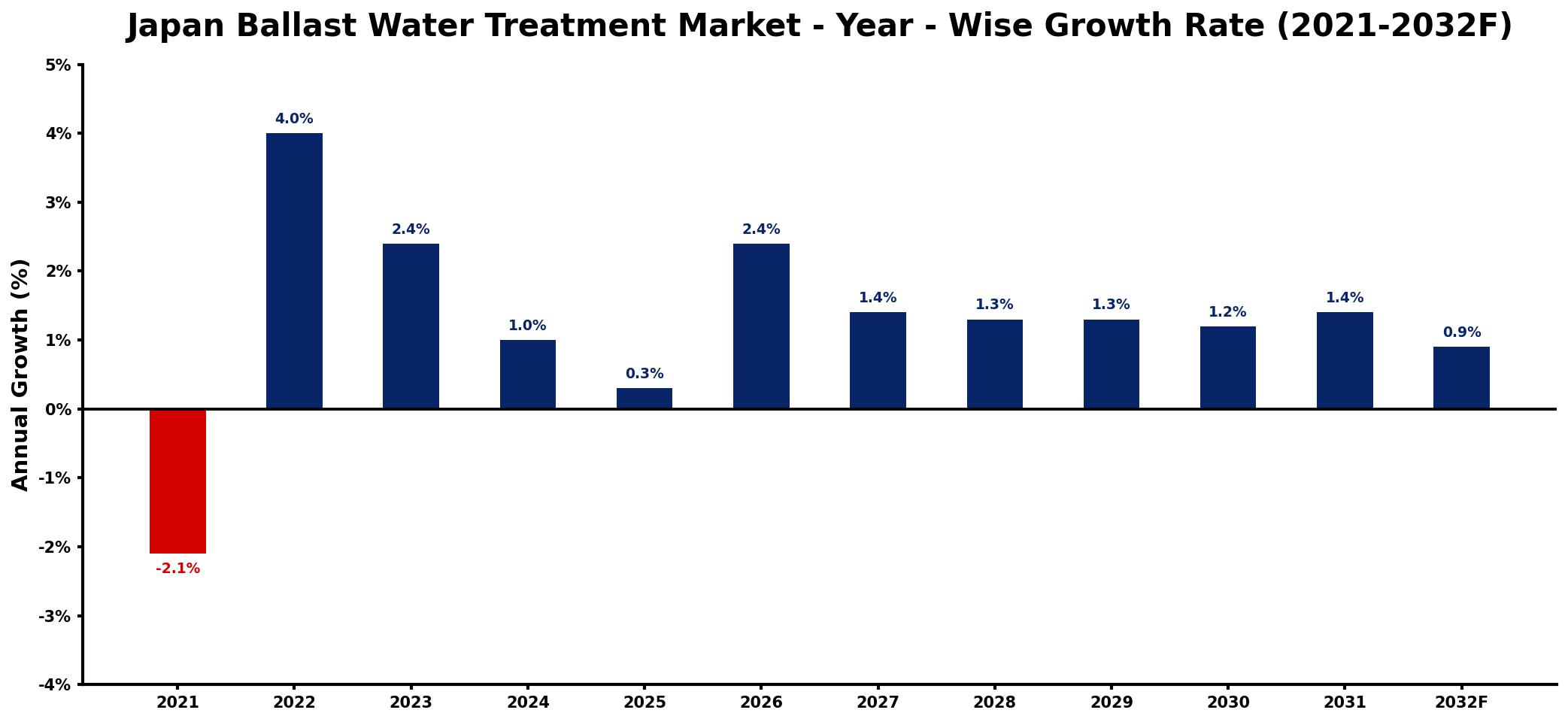
The table below presents the year‑wise growth rates along with the key drivers influencing the market
| Year | Growth Rate | Major Drivers |
| 2021 | -2.1% | decreased maritime regulatory compliance |
| 2022 | 4.0% | rising environmental sustainability focus |
| 2023 | 2.4% | increased shipping industry investments |
| 2024 | 1.0% | growing international trade volumes |
| 2025 | 0.3% | expansion of coastal infrastructure projects |
| 2026 | 2.4% | enhanced technological advancements adoption |
| 2027 | 1.4% | increased public awareness campaigns |
| 2028 | 1.3% | strengthened global environmental policies |
| 2029 | 1.3% | growing demand for eco-friendly solutions |
| 2030 | 1.2% | increased collaboration among stakeholders |
| 2031 | 1.4% | growing emerging market penetration |
| 2032 | 0.9% | rising investments in green technology |
Note: Market size estimations and growth projections presented in this report are based on 6Wresearch's proprietary forecasting methodology, utilizing the latest available industry data, government publications, and primary research inputs.
Japan Ballast Water Treatment Market Synopsis
The Japan Ballast Water Treatment Market is gaining momentum as awareness grows regarding the ecological ramifications of untreated ballast water discharges. In response, the government and international organizations like the IMO have enacted strict regulations, compelling the shipping industry to adopt advanced treatment technologies.
Key players in this market are innovating various treatment methods, such as chemical, physical, and biological solutions, to facilitate compliance while minimizing environmental footprints. This focus on technology development underscores Japan's commitment to preserving its marine ecosystems amid growing maritime activities.
Japan Ballast Water Treatment Market Key Takeaways
- Regulatory compliance is a primary driver of demand for ballast water treatment systems in Japan.
- Investments in chemical-free treatment technologies are on the rise, reflecting a shift towards sustainability.
- Partnerships between technology providers and shipping firms are increasingly common to enhance system implementation.
- Compact and energy-efficient solutions are becoming essential for meeting the constraints faced by maritime vessels.
- Ongoing research and development efforts are critical in overcoming technological limitations in treatment solutions.
Evaluation of Restraints in Japan Ballast Water Treatment Market
Despite its growth potential, the Japan Ballast Water Treatment Market is hindered by several notable restraints. For one, the initial costs associated with installing treatment systems can be prohibitive for many shipowners, particularly smaller operators. Additionally, there are ongoing challenges related to technological efficacy—existing solutions may not effectively manage all types of aquatic organisms, limiting their effectiveness. Furthermore, the market faces a general lack of awareness among shipowners regarding the critical importance of ballast water treatment, which may delay compliance and implementation efforts. Continuous monitoring and maintenance requirements also pose operational challenges that cannot be overlooked.
Japan Ballast Water Treatment Market Trends
The market is witnessing a marked trend towards advanced technologies that align with stringent regulatory standards. Notably, there is a growing preference for chemical-free treatment solutions such as ultraviolet (UV) and electrochlorination systems. Additionally, the demand for compact and energy-efficient treatment systems is increasing as vessels confront space and power constraints. Collaborations between technology providers and shipping companies are becoming commonplace, facilitating smoother implementation of ballast water management systems. Overall, a notable shift towards eco-friendly solutions is redefining the market landscape.
Japan Ballast Water Treatment Market Opportunities
The Japan Ballast Water Treatment Market presents various investment opportunities driven by tightening regulations concerning ballast water discharge. The nations status as a major maritime hub means that the need for ballast water treatment systems will only increase. Investors can explore avenues in the manufacturing of innovative treatment technologies or retrofitting existing vessels to meet compliance standards. Furthermore, forging strategic partnerships with shipping companies and collaborating with research institutions for the development of cutting-edge solutions can yield significant returns in this dynamic market.
Government Initiatives in the Japan Ballast Water Treatment Market
The Japanese government has instituted rigorous regulations to manage ballast water discharge, having ratified the International Maritime Organization's Ballast Water Management Convention in 2017. The Ministry of Land, Infrastructure, Transport, and Tourism oversees the compliance and enforcement of these standards. Additionally, the government offers various subsidies and incentives to promote the adoption of environmentally friendly ballast water treatment technologies, thereby supporting the transition towards sustainable maritime practices.
Future Insights of the Japan Ballast Water Treatment Market
As we look towards 2026-2032, the Japan Ballast Water Treatment Market is poised for steady growth, significantly influenced by stringent governmental regulations aimed at curbing the spread of invasive species through ballast water. The increasing adoption of treatment systems by shipping companies to meet both national and international standards will further bolster demand. Rising environmental awareness and technological advancements will also play crucial roles in shaping the future, as the maritime industry transitions towards more sustainable operational practices.
Japan Ballast Water Treatment Market Latest Developments (2025 - 2026)
Recent industry directions have showcased a surge in investments focused on enhancing ballast water treatment technologies. Companies are prioritizing the development of systems that are both cost-effective and efficient, while partnerships between shipping firms and technology developers have become increasingly strategic. These collaborations aim to improve the implementation of treatment systems and drive innovation across the sector. Ongoing research efforts are also emphasizing the creation of solutions that can better accommodate the diverse aquatic organisms found in ballast water.
Japan Ballast Water Treatment Market - Key Attractiveness of the Report
- 10 Years of Market Numbers
- Historical Data Starting from 2022 to 2025
- Base Year: 2025
- Forecast Data until 2032
- Key Performance Indicators Impacting the Market
- Major Upcoming Developments and Projects
Key Highlights of the Report:
- Japan Ballast Water Treatment Market Outlook
- Market Size of Japan Ballast Water Treatment Market, 2025
- Forecast of Japan Ballast Water Treatment Market, 2032
- Historical Data and Forecast of Japan Ballast Water Treatment Revenues & Volume for the Period 2022-2032F
- Japan Ballast Water Treatment Market Trend Evolution
- Japan Ballast Water Treatment Market Drivers and Challenges
- Japan Ballast Water Treatment Price Trends
- Japan Ballast Water Treatment Porter's Five Forces
- Japan Ballast Water Treatment Industry Life Cycle
- Historical Data and Forecast of Japan Ballast Water Treatment Market Revenues & Volume By Technology for the Period 2022-2032F
- Historical Data and Forecast of Japan Ballast Water Treatment Market Revenues & Volume By Physical Disinfection for the Period 2022-2032F
- Historical Data and Forecast of Japan Ballast Water Treatment Market Revenues & Volume By Mechanical Method for the Period 2022-2032F
- Historical Data and Forecast of Japan Ballast Water Treatment Market Revenues & Volume By Chemical Method for the Period 2022-2032F
- Historical Data and Forecast of Japan Ballast Water Treatment Market Revenues & Volume By Service for the Period 2022-2032F
- Historical Data and Forecast of Japan Ballast Water Treatment Market Revenues & Volume By Installation & Calibration for the Period 2022-2032F
- Historical Data and Forecast of Japan Ballast Water Treatment Market Revenues & Volume By Performance Measurement for the Period 2022-2032F
- Historical Data and Forecast of Japan Ballast Water Treatment Market Revenues & Volume By Recommissioning for the Period 2022-2032F
- Japan Ballast Water Treatment Import Export Trade Statistics
- Market Opportunity Assessment By Technology
- Market Opportunity Assessment By Service
- Japan Ballast Water Treatment Top Companies Market Share
- Japan Ballast Water Treatment Competitive Benchmarking By Technical and Operational Parameters
- Japan Ballast Water Treatment Company Profiles
- Japan Ballast Water Treatment Key Strategic Recommendations






































