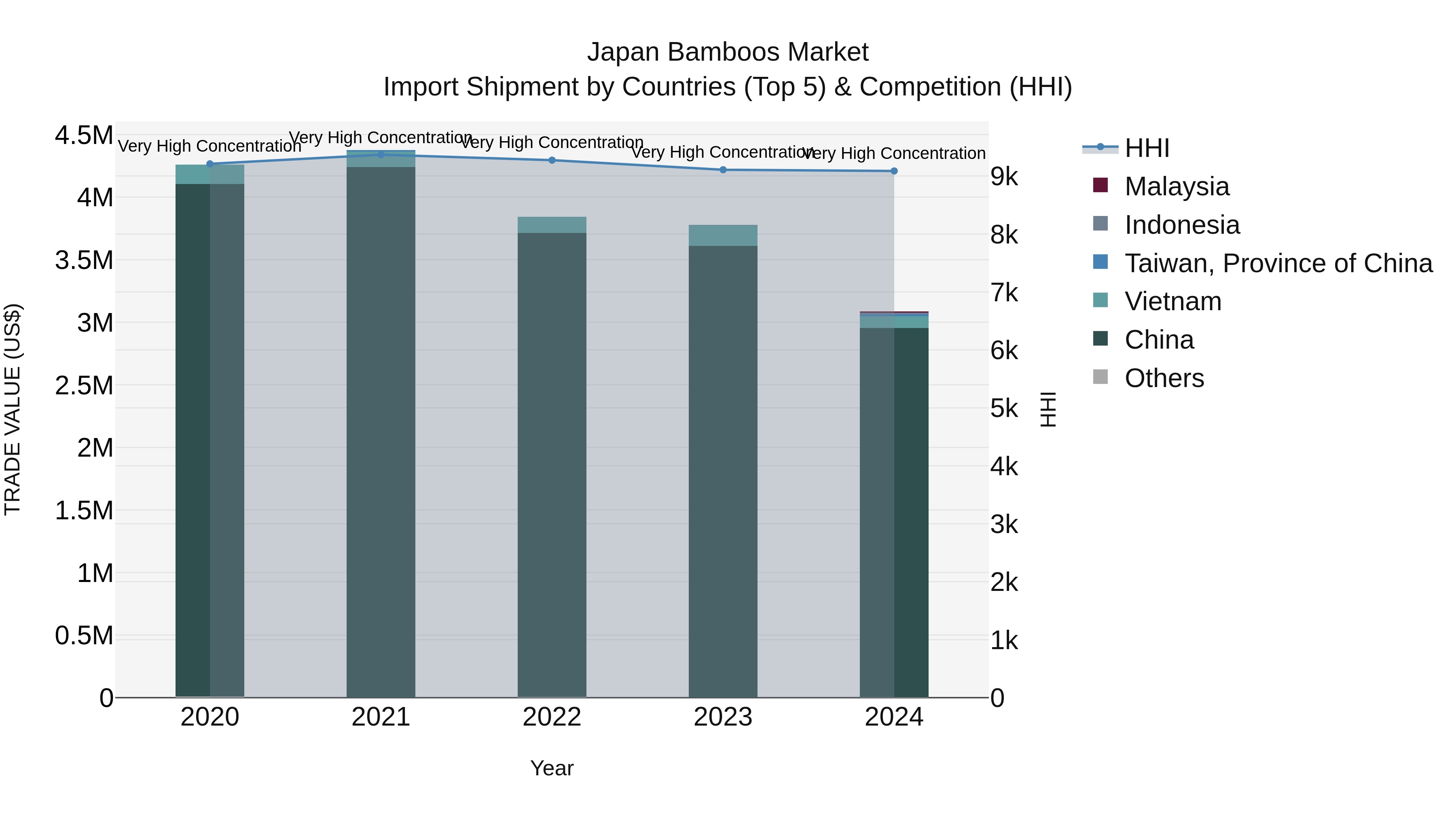
Japan Bamboos Market Import Shipment by Countries (Top 5) & Competition (HHI)
In 2024, Japan continued to import bamboos predominantly from China, Vietnam, Taiwan, Malaysia, and Indonesia. Despite a high concentration with a high Herfindahl-Hirschman Index (HHI), the market experienced a significant decline with a negative Compound Annual Growth Rate (CAGR) of -7.73% from 2020 to 2024. The growth rate plummeted even further in 2024 with a sharp decline of -18.27% compared to the previous year. This trend suggests a challenging landscape for bamboo importers in Japan, necessitating strategic adjustments to navigate the market dynamics effectively.
Japan Bamboos Market Overview
The Japan bamboos market is witnessing steady growth driven by increasing demand for sustainable and eco-friendly materials in various industries such as construction, furniture, and handicrafts. Bamboo`s versatility, strength, and rapid growth make it a popular choice among consumers looking for environmentally friendly alternatives. The market is also benefiting from government initiatives promoting bamboo cultivation and its use in diverse applications. Key players in the Japan bamboo market include manufacturers of bamboo flooring, furniture, and paper products. With a growing focus on sustainability and environmentally conscious choices, the Japan bamboos market is expected to expand further in the coming years, offering opportunities for both domestic and international players to capitalize on the trend.
Japan Bamboos Market Trends
The Japan Bamboos Market is experiencing a surge in demand due to the growing popularity of sustainable and eco-friendly products. Bamboo, known for its fast growth and versatility, is being increasingly utilized in various industries such as construction, textiles, and furniture. The market is witnessing a trend towards innovative bamboo-based products, including bamboo flooring, clothing, and even packaging materials. Consumers are also showing a preference for bamboo products due to their durability, natural aesthetic appeal, and environmentally friendly properties. As sustainability becomes a key focus for consumers and businesses alike, the Japan Bamboos Market is expected to continue its growth trajectory in the coming years.
Japan Bamboos Market Challenges
In the Japan Bamboos Market, one of the key challenges faced is the threat of overharvesting and unsustainable harvesting practices leading to deforestation and depletion of bamboo resources. This is exacerbated by the increasing demand for bamboo products both domestically and internationally. Another challenge is the competition from synthetic materials and alternative resources which offer similar properties to bamboo. Additionally, there are issues related to quality control and standardization of bamboo products, as well as the need for more research and innovation in bamboo cultivation techniques to enhance productivity and sustainability in the long run. Overall, sustainable management practices, effective regulations, and technological advancements are crucial to address these challenges and ensure the long-term viability of the Japan Bamboos Market.
Japan Bamboos Market Investment Opportunities
The Japan Bamboos Market presents various investment opportunities due to the increasing demand for sustainable and eco-friendly products. Bamboo is a versatile and renewable resource used in construction, furniture, textiles, and even as a food source. Investing in bamboo cultivation and processing companies in Japan can yield significant returns as the country is known for its high-quality bamboo products. Additionally, with the global shift towards sustainable practices, there is a growing market for bamboo-based products worldwide. Investing in research and development of new bamboo applications, as well as promoting sustainable farming practices, could also be lucrative in the long term. Overall, the Japan Bamboos Market offers promising investment opportunities for those looking to capitalize on the growing demand for environmentally friendly alternatives.
Japan Bamboos Market Government Policy
In Japan, government policies related to the bamboo market focus on promoting sustainable bamboo cultivation and utilization while preserving the environment. The government encourages research and development in bamboo cultivation techniques, supports the establishment of bamboo plantations, and provides subsidies to promote the use of bamboo in various industries such as construction, textiles, and crafts. Additionally, there are regulations in place to ensure responsible harvesting practices to prevent deforestation and protect bamboo forests` ecosystems. The government also promotes the use of bamboo as an eco-friendly alternative to traditional materials, emphasizing its carbon sequestration benefits and potential contribution to mitigating climate change. Overall, Japan`s policies aim to harness the economic and environmental potential of bamboo while ensuring its long-term sustainability.
Japan Bamboos Market Future Outlook
The Japan Bamboos Market is expected to witness steady growth in the coming years, driven by increasing demand for sustainable and eco-friendly materials in various industries such as construction, agriculture, and furniture. With the rising awareness about the environmental benefits of bamboo as a renewable resource and its versatility in product applications, the market is projected to expand further. Additionally, the government initiatives to promote bamboo cultivation and usage in various sectors are likely to boost market growth. Technological advancements in bamboo processing techniques and the development of innovative bamboo-based products are also anticipated to drive market opportunities. Overall, the Japan Bamboos Market is poised for growth in the foreseeable future, presenting lucrative prospects for industry players and investors.
Key Highlights of the Report:
- Japan Bamboos Market Outlook
- Market Size of Japan Bamboos Market, 2021
- Forecast of Japan Bamboos Market, 2031
- Historical Data and Forecast of Japan Bamboos Revenues & Volume for the Period 2018 - 2031
- Japan Bamboos Market Trend Evolution
- Japan Bamboos Market Drivers and Challenges
- Japan Bamboos Price Trends
- Japan Bamboos Porter's Five Forces
- Japan Bamboos Industry Life Cycle
- Historical Data and Forecast of Japan Bamboos Market Revenues & Volume By Application for the Period 2018 - 2031
- Historical Data and Forecast of Japan Bamboos Market Revenues & Volume By Raw Materials for the Period 2018 - 2031
- Historical Data and Forecast of Japan Bamboos Market Revenues & Volume By Industrial Products for the Period 2018 - 2031
- Historical Data and Forecast of Japan Bamboos Market Revenues & Volume By Furniture for the Period 2018 - 2031
- Historical Data and Forecast of Japan Bamboos Market Revenues & Volume By Shoots for the Period 2018 - 2031
- Historical Data and Forecast of Japan Bamboos Market Revenues & Volume By Others for the Period 2018 - 2031
- Japan Bamboos Import Export Trade Statistics
- Market Opportunity Assessment By Application
- Japan Bamboos Top Companies Market Share
- Japan Bamboos Competitive Benchmarking By Technical and Operational Parameters
- Japan Bamboos Company Profiles
- Japan Bamboos Key Strategic Recommendations






































