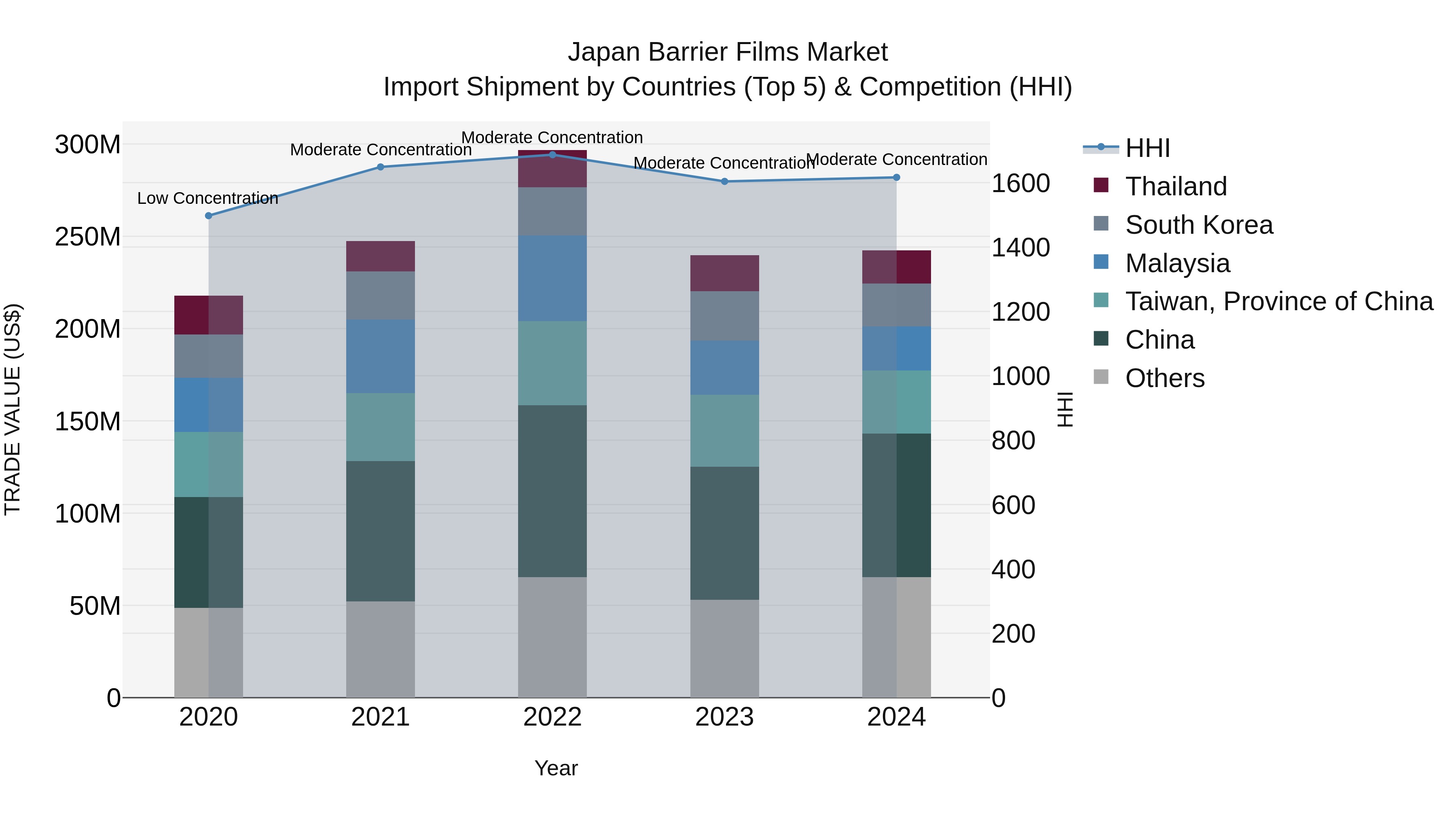
Japan Barrier Films Market Import Shipment by Countries (Top 5) & Competition (HHI)
The Japan barrier films import market continues to show steady growth, with key exporting countries in 2024 being China, Taiwan, Malaysia, South Korea, and Indonesia. The market exhibits moderate concentration with a stable Herfindahl-Hirschman Index (HHI) in 2024. The Compound Annual Growth Rate (CAGR) from 2020 to 2024 is at 2.72%, indicating sustained expansion. Moreover, the growth rate from 2023 to 2024 is at 1.15%, reflecting a positive trajectory for the industry. These trends suggest a promising outlook for Japan's barrier films import market in the coming years.
Japan Barrier Films Market Overview
The Japan Barrier Films Market is witnessing steady growth driven by increasing demand in various industries such as food packaging, electronics, and pharmaceuticals. Barrier films are used to protect products from moisture, oxygen, and other external factors, extending their shelf life and maintaining product quality. The market is characterized by the presence of key players like Mitsubishi Chemical Holdings Corporation, Toppan Printing Co., Ltd., and Dai Nippon Printing Co., Ltd., who are investing in research and development activities to innovate and introduce advanced barrier film technologies. The growing awareness of sustainable packaging solutions and stringent regulations regarding food safety are also contributing to the market`s growth. Overall, the Japan Barrier Films Market is expected to continue expanding as industries increasingly prioritize product protection and preservation.
Japan Barrier Films Market Trends and Opportunities
The Japan Barrier Films Market is witnessing a growing demand for high-performance packaging solutions driven by the increasing focus on food safety and sustainability. The market is experiencing a trend towards the adoption of advanced barrier films with enhanced properties such as extended shelf life, improved barrier protection against moisture, oxygen, and other external factors. Sustainable packaging solutions, including recyclable and biodegradable barrier films, are gaining traction in response to environmental concerns. Opportunities in the Japan Barrier Films Market lie in the development of innovative materials and technologies to meet the evolving consumer preferences for convenient, eco-friendly, and visually appealing packaging solutions. Collaboration with research institutions and investments in R&D are crucial for market players to stay competitive and capitalize on the growing demand for barrier films in Japan.
Japan Barrier Films Market Challenges
In the Japan Barrier Films Market, some key challenges include intense competition from domestic and international players, leading to price pressures and margin squeezes. Additionally, the market faces issues related to the fluctuating prices of raw materials, such as resins and additives, which can impact production costs and overall profitability. Another challenge is the need for continuous research and development to meet evolving customer demands for high-performance barrier films that offer improved shelf-life extension and protection for various products. Moreover, environmental concerns and regulations regarding the disposal and recyclability of barrier films add another layer of complexity for market players to navigate in Japan. Overall, addressing these challenges requires a strategic approach focusing on innovation, cost-efficiency, and sustainability practices.
Japan Barrier Films Market Drivers
The Japan Barrier Films Market is primarily driven by the growing demand for advanced packaging solutions in the food and beverage industry to extend the shelf life of products and maintain their freshness. The increasing focus on sustainability and environmentally friendly packaging materials is also fueling the adoption of barrier films in Japan. Additionally, the rising consumption of packaged goods, especially in the e-commerce sector, is boosting the demand for high-quality barrier films to ensure product protection during transportation and storage. Technological advancements in barrier film materials and manufacturing processes are further contributing to market growth by offering improved barrier properties and cost-effective solutions for various applications in the packaging industry.
Japan Barrier Films Market Government Policy
In Japan, government policies related to the barrier films market focus on promoting sustainability and innovation. The government has implemented various regulations to reduce the environmental impact of packaging materials, encouraging the use of eco-friendly barrier films. Additionally, there are initiatives to support research and development in advanced barrier film technologies to enhance product performance and cater to evolving market demands. The government also provides incentives and subsidies to companies investing in sustainable packaging solutions to drive adoption and stimulate growth in the barrier films industry. Overall, Japan`s government policies aim to create a more environmentally conscious and competitive market for barrier films through regulatory measures and support for innovation.
Japan Barrier Films Market Future Outlook
The Japan Barrier Films Market is expected to witness steady growth in the coming years due to increasing demand from industries such as food packaging, electronics, and pharmaceuticals. The market is driven by the growing need for extended shelf-life of products, improved barrier protection against moisture and oxygen, and sustainability concerns. With advancements in technology leading to the development of innovative barrier films with enhanced properties, such as high barrier performance, transparency, and recyclability, the market is poised for expansion. Additionally, stringent regulations regarding food safety and environmental sustainability are likely to further drive the adoption of barrier films in Japan. Overall, the Japan Barrier Films Market is anticipated to experience sustained growth opportunities in the foreseeable future.
Key Highlights of the Report:
- Japan Barrier Films Market Outlook
- Market Size of Japan Barrier Films Market, 2024
- Forecast of Japan Barrier Films Market, 2031
- Historical Data and Forecast of Japan Barrier Films Revenues & Volume for the Period 2021 - 2031
- Japan Barrier Films Market Trend Evolution
- Japan Barrier Films Market Drivers and Challenges
- Japan Barrier Films Price Trends
- Japan Barrier Films Porter's Five Forces
- Japan Barrier Films Industry Life Cycle
- Historical Data and Forecast of Japan Barrier Films Market Revenues & Volume By Material for the Period 2021 - 2031
- Historical Data and Forecast of Japan Barrier Films Market Revenues & Volume By PE for the Period 2021 - 2031
- Historical Data and Forecast of Japan Barrier Films Market Revenues & Volume By PET for the Period 2021 - 2031
- Historical Data and Forecast of Japan Barrier Films Market Revenues & Volume By PP for the Period 2021 - 2031
- Historical Data and Forecast of Japan Barrier Films Market Revenues & Volume By Polyamide for the Period 2021 - 2031
- Historical Data and Forecast of Japan Barrier Films Market Revenues & Volume By Organic Coatings for the Period 2021 - 2031
- Historical Data and Forecast of Japan Barrier Films Market Revenues & Volume By Inorganic Oxide Coatings for the Period 2021 - 2031
- Historical Data and Forecast of Japan Barrier Films Market Revenues & Volume By End Use Industry for the Period 2021 - 2031
- Historical Data and Forecast of Japan Barrier Films Market Revenues & Volume By Food & Beverage Packaging for the Period 2021 - 2031
- Historical Data and Forecast of Japan Barrier Films Market Revenues & Volume By Pharmaceutical Packaging for the Period 2021 - 2031
- Historical Data and Forecast of Japan Barrier Films Market Revenues & Volume By Agriculture for the Period 2021 - 2031
- Japan Barrier Films Import Export Trade Statistics
- Market Opportunity Assessment By Material
- Market Opportunity Assessment By End Use Industry
- Japan Barrier Films Top Companies Market Share
- Japan Barrier Films Competitive Benchmarking By Technical and Operational Parameters
- Japan Barrier Films Company Profiles
- Japan Barrier Films Key Strategic Recommendations






































