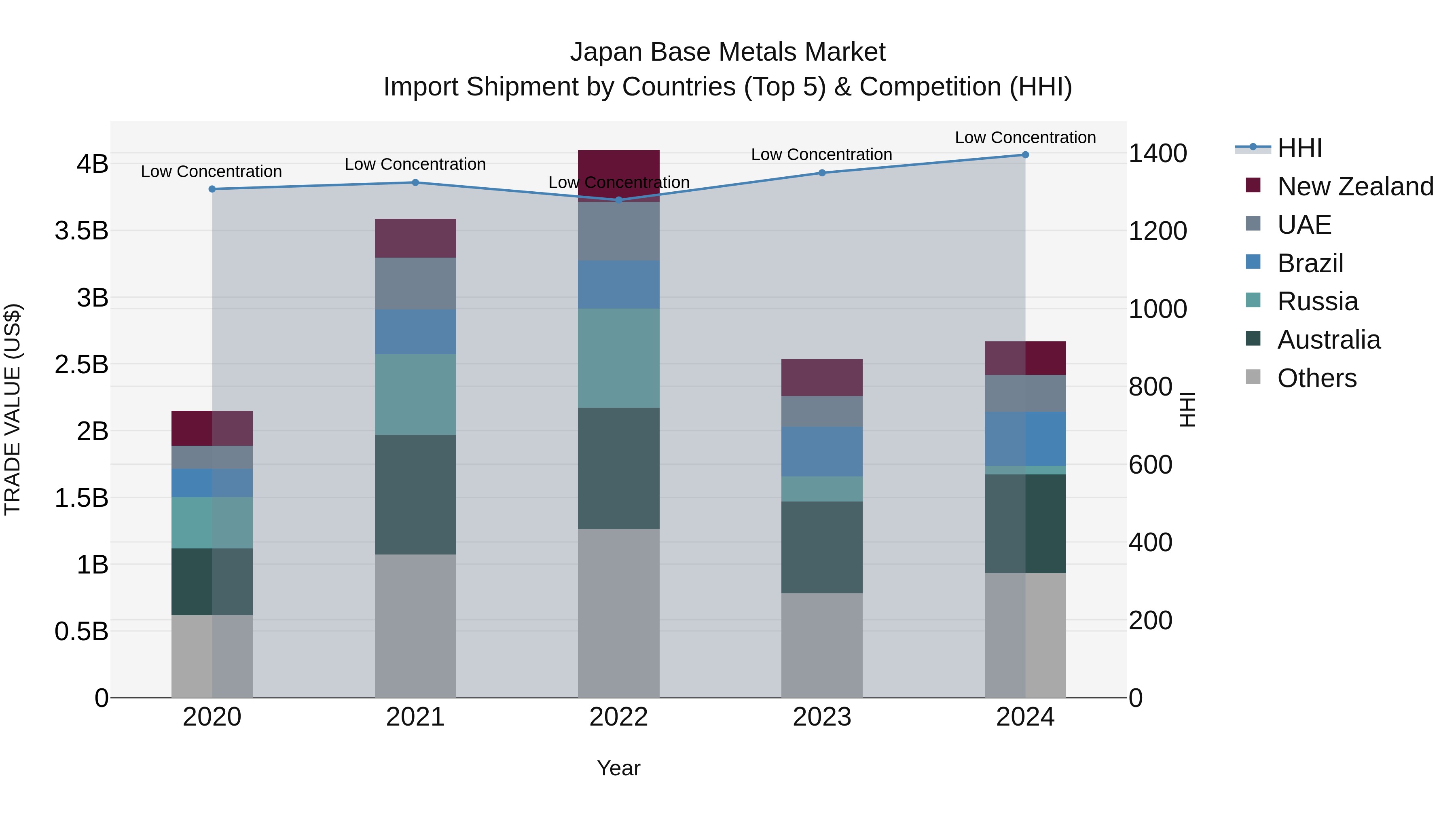
Japan Base Metals Market Import Shipment by Countries (Top 5) & Competition (HHI)
In 2024, Japan's base metals import shipments continued to show steady growth with a 5.6% CAGR from 2020 to 2024. The top exporting countries to Japan, including Australia, Brazil, UAE, India, and New Zealand, contributed significantly to this growth. Despite the strong performance, the Herfindahl-Hirschman Index (HHI) indicated low concentration in the market, allowing for healthy competition among suppliers. The growth rate of 5.28% from 2023 to 2024 further highlights the resilience and attractiveness of Japan's base metals import market.
Japan Base Metals Market Synopsis
The Japan Base Metals Market is a key segment of the country`s industrial sector, encompassing metals such as copper, aluminum, zinc, and nickel. With Japan being a major global player in manufacturing and electronics industries, the demand for base metals remains robust. The market is influenced by factors such as infrastructure development, automotive production, and technological advancements. Japan`s strict environmental regulations also impact base metals production and consumption patterns. The country relies on imports to meet a significant portion of its base metals requirements. As a highly industrialized nation, Japan`s base metals market is intricately tied to global economic trends and trade dynamics, making it essential for market participants to closely monitor international developments to anticipate market shifts and opportunities.
Japan Base Metals Market Trends
The Japan Base Metals Market is currently experiencing a shift towards sustainable practices and technologies, driven by increasing environmental concerns. There is a growing focus on recycling and reducing the carbon footprint associated with base metals production. Additionally, the demand for base metals in electric vehicles and renewable energy sectors is on the rise, leading to a potential supply shortage and price volatility. Market players are also closely monitoring geopolitical developments and trade policies that could impact the import and export of base metals. Overall, the Japan Base Metals Market is navigating a complex landscape of sustainability, technological advancements, and market dynamics to ensure long-term growth and stability.
Japan Base Metals Market Challenges
In the Japan Base Metals Market, some of the key challenges faced include fluctuations in global demand and prices, regulatory changes impacting import/export policies, and competition from other regional markets. The market is highly dependent on external factors such as economic conditions in major consuming countries, making it susceptible to volatility. Additionally, environmental regulations and sustainability concerns are becoming increasingly important, requiring companies to invest in more eco-friendly practices which can add to production costs. Moreover, the industry is facing pressure to adopt new technologies and innovate to stay competitive in the global market. Overall, navigating these challenges requires companies in the Japan Base Metals Market to stay agile, adaptable, and well-informed about market trends and regulations.
Japan Base Metals Market Investment Opportunities
Investment opportunities in the Japan Base Metals Market include the potential for growth driven by infrastructure projects, technological advancements, and increasing demand from industries such as automotive and electronics. With Japan being a major player in the global manufacturing sector, there is a steady demand for base metals like copper, zinc, and aluminum. Additionally, the country`s focus on sustainability and energy efficiency is driving the adoption of electric vehicles and renewable energy technologies, further boosting the demand for base metals. Investors can consider opportunities in mining companies, metal producers, and exchange-traded funds (ETFs) focused on base metals to capitalize on the growth potential in the Japan Base Metals Market. However, it is important to closely monitor market trends, geopolitical factors, and regulatory developments to make informed investment decisions.
Japan Base Metals Market Future Outlook
The future outlook for the Japan Base Metals Market appears positive, supported by ongoing industrial growth and infrastructure development in the country. The demand for base metals such as copper, aluminum, and zinc is expected to remain robust due to increasing construction activities, automotive production, and electronics manufacturing in Japan. Additionally, the government`s focus on sustainable and green technologies is likely to drive the demand for base metals used in renewable energy applications. However, challenges such as global economic uncertainties and fluctuating commodity prices may impact the market in the short term. Overall, the Japan Base Metals Market is poised for steady growth in the coming years, with opportunities for market players to capitalize on the increasing demand for these essential commodities.
Key Highlights of the Report:
- Japan Base Metals Market Outlook
- Market Size of Japan Base Metals Market, 2024
- Forecast of Japan Base Metals Market, 2031
- Historical Data and Forecast of Japan Base Metals Revenues & Volume for the Period 2021 - 2031
- Japan Base Metals Market Trend Evolution
- Japan Base Metals Market Drivers and Challenges
- Japan Base Metals Price Trends
- Japan Base Metals Porter's Five Forces
- Japan Base Metals Industry Life Cycle
- Historical Data and Forecast of Japan Base Metals Market Revenues & Volume By Type for the Period 2021 - 2031
- Historical Data and Forecast of Japan Base Metals Market Revenues & Volume By Copper for the Period 2021 - 2031
- Historical Data and Forecast of Japan Base Metals Market Revenues & Volume By Zinc for the Period 2021 - 2031
- Historical Data and Forecast of Japan Base Metals Market Revenues & Volume By Lead for the Period 2021 - 2031
- Historical Data and Forecast of Japan Base Metals Market Revenues & Volume By Nickel for the Period 2021 - 2031
- Historical Data and Forecast of Japan Base Metals Market Revenues & Volume By Aluminum for the Period 2021 - 2031
- Historical Data and Forecast of Japan Base Metals Market Revenues & Volume By Tin for the Period 2021 - 2031
- Historical Data and Forecast of Japan Base Metals Market Revenues & Volume By End-user Industry for the Period 2021 - 2031
- Historical Data and Forecast of Japan Base Metals Market Revenues & Volume By Construction for the Period 2021 - 2031
- Historical Data and Forecast of Japan Base Metals Market Revenues & Volume By Automotive and Transportation for the Period 2021 - 2031
- Historical Data and Forecast of Japan Base Metals Market Revenues & Volume By Electrical and Electronics for the Period 2021 - 2031
- Historical Data and Forecast of Japan Base Metals Market Revenues & Volume By Consumer Products for the Period 2021 - 2031
- Historical Data and Forecast of Japan Base Metals Market Revenues & Volume By Medical Devices for the Period 2021 - 2031
- Historical Data and Forecast of Japan Base Metals Market Revenues & Volume By Others for the Period 2021 - 2031
- Japan Base Metals Import Export Trade Statistics
- Market Opportunity Assessment By Type
- Market Opportunity Assessment By End-user Industry
- Japan Base Metals Top Companies Market Share
- Japan Base Metals Competitive Benchmarking By Technical and Operational Parameters
- Japan Base Metals Company Profiles
- Japan Base Metals Key Strategic Recommendations






































