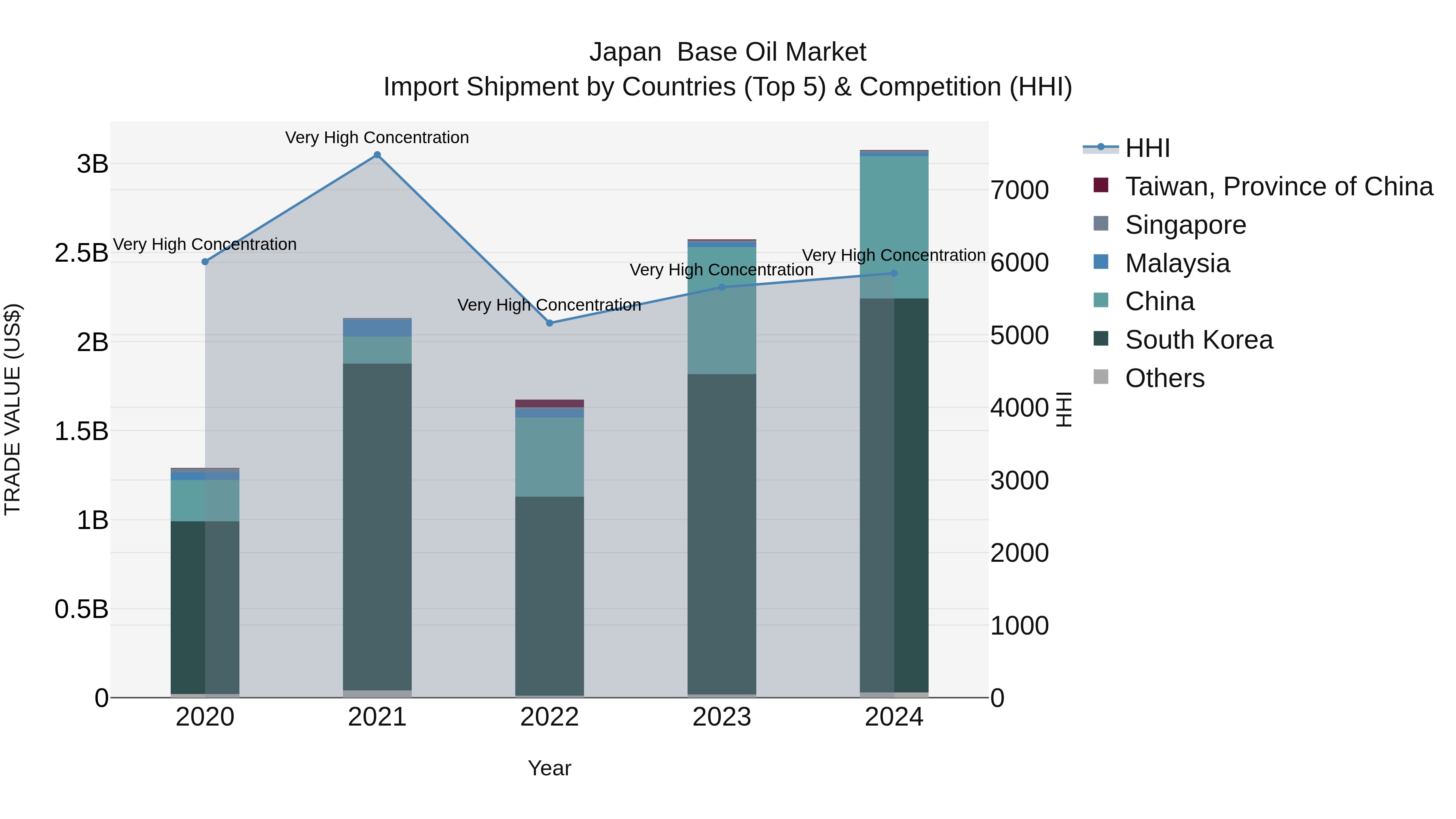
Japan Base Oil Market Import Shipment by Countries (Top 5) & Competition (HHI)
Japan's base oil import shipments in 2024 were dominated by key exporters including South Korea, China, Malaysia, Singapore, and Belgium. The High Herfindahl-Hirschman Index (HHI) indicates a concentrated market, while the impressive Compound Annual Growth Rate (CAGR) of 24.26% from 2020 to 2024 underscores the sector's robust expansion. Moreover, the notable growth rate of 19.53% from 2023 to 2024 highlights the continued momentum in base oil imports to Japan, reflecting ongoing demand dynamics and trade relationships with these top exporting countries.
Japan Base Oil Market Growth Rate
According to 6Wresearch internal database and industry insights, the Japan Base Oil Market is growing at a compound annual growth rate (CAGR) of 4.75% during the forecast period (2026-2032).
Topics Covered in the Japan Base Oil Market Report
The Japan Base Oil Market report thoroughly covers the market by group and applications. The market report provides an unbiased and detailed analysis of ongoing market trends, opportunities/high growth areas, and market drivers, which would help stakeholders devise and align their market strategies according to the current and future market dynamics.
Japan Base Oil Market Highlights
| Report Name | Japan Base Oil Market |
| Forecast Period | 2026-2032 |
| CAGR | 0.0475 |
| Growing Sector | Automotive Applications |
Japan Base Oil Market Synopsis
The Japan Base Oil Market is expected to grow steadily due to increasing demand for high-quality lubricants from automotive and industrial sectors. The market is also led by government initiatives that support the use of eco-friendly base oils. Furthermore, the rising trend of adopting Group II and III base oils, especially in automotive applications, is predicted to improve market’s growth. Moreover, an increased production capacity and technological innovations in the refining processes are anticipated to meet the growing demand for top-tier base oils across various industries.
Evaluation of Growth Drivers in the Japan Base Oil Market Growth Rate
Below mentioned are some growth drivers and their impact on market dynamics:
| Drivers | Primary Segments Affected | Why It Matters |
| Government Support & Regulatory Frameworks | Automotive, Industrial Applications | Promotes the use of eco-friendly and high-quality base oils, aiding market growth. |
| Increasing Demand for High-Quality Lubricants | Automotive, Industrial Applications | Rising demand for more efficient, long-lasting lubricants enhances the need for top-tier base oils. |
| Technological Advancements in Refining | Group II, Group III, Group IV, Group V | Refines base oil quality, while enabling a better performance and wider application range. |
| Growth in Automotive and Industrial Sectors | Automotive, Industrial Applications | Expands the demand for base oils as both sectors experience such growth in production and use. |
| Adoption of Eco-Friendly Formulations | Automotive, Industrial Applications | Contributes to environmental sustainability and drives regulatory compliance in base oil production. |
The Japan Base Oil Market is expected to grow significantly, with a CAGR of 4.75% during the forecast period of 2026-2032. The market is fueled by a strong demand for high-quality lubricants, especially in the automotive and industrial sectors, and increasing government support for eco-friendly base oils. Furthermore, the technological innovations in refining processes, together with a rising production capacity, will continue to contribute to the steady market’s growth.
Evaluation of Restraints in the Japan Base Oil Market
Below mentioned are some major restraints and their influence on market dynamics:
| Restraints | Primary Segments Affected | What This Means |
| High Production Costs | Group I, Group II, Group III | Limits the affordability and expansion of base oil production. |
| Limited Availability of Raw Materials | All Segments | Affects the supply chain, limiting base oil production and consistency. |
| Regulatory Compliance Issues | Group I, Group III, Group IV | Increases production complexity and cost for compliance with environmental regulations. |
| Competition from Synthetic Lubricants | All Segments | Limits demand for the conventional base oils as synthetic oils gain market share. |
| Environmental Concerns | Group I, Group II | Pushes producers to adopt more sustainable methods, which could increase costs. |
Japan Base Oil Market Challenges
The Japan Base Oil Market has several challenges, such as high production costs which limits the affordability and expansion of base oil production. And competition from synthetic oils, and regulatory hurdles that limits the raw material availability which affects the consistency of supply, while growing environmental concerns push the industry toward more sustainable but costly production methods. As a result, these manufacturers are under pressure to innovate and meet consumer demand for both affordable and eco-friendly base oil options.
Japan Base Oil Market Trends
Some major trends contributing to the Japan Base Oil Market Growth are:
- Shift Toward Eco-Friendly Base Oils: The growth in environmental concerns are pushing the industry to adopt more sustainable base oils, while also contributing to market’s expansion.
- Technological Advancements in Oil Refining: With the continuous improvements in enhancing technologies are improving the quality and performance of base oils, making them suitable for more applications.
- Automotive Sector Growth: The increase in demand for innovative lubricants in the automotive sector is leading the need for high-quality base oils.
Investment Opportunities in the Japan Base Oil Market
Here are some investment opportunities in the Japan Base Oil Industry:
- Sustainable Base Oil Production: By investing in eco-friendly and sustainable base oil production methods will appeal to environmentally focused customers and align with government policies.
- Advanced Refining Technologies: By capitalizing on some cutting-edge refining technologies will enhance the performance of base oils and raise market’s competitiveness.
- Synthetic Base Oil Development: By investing in the development of synthetic base oils can help manufacturers to get along with increasing consumer demand for high-performance lubricants.
Top 5 Leading Players in the Japan Base Oil Market
Here are some top companies contributing to Japan Base Oil Market Share:
ExxonMobil Corporation
| Company Name | ExxonMobil Corporation |
| Established Year | 1880 |
| Headquarters | Tokyo, Japan |
| Official Website | Click Here |
ExxonMobil is a leading producer of high-quality base oils, offering a wide range of Group II and Group III base oils used in various automotive and industrial applications. Their technological advancements in refining processes allow them to maintain a strong position in the market.
SHELL International B.V.
| Company Name | SHELL International B.V. |
| Established Year | 1907 |
| Headquarters | Tokyo, Japan |
| Official Website | Click Here |
Shell produces premium base oils and lubricants that meet the growing demands of both automotive and industrial sectors. Their advanced refining technologies and commitment to sustainable practices ensure they remain a key player in the region.
Chevron Corporation
| Company Name | Chevron Corporation |
| Established Year | 1879 |
| Headquarters | Tokyo, Japan |
| Official Website | Click Here |
Chevron’s premium Group II and III base oils are well-regarded in the industry for their performance and environmental compatibility. They focus on innovation and customer-driven solutions across automotive and industrial markets.
S-Oil Corporation
| Company Name | S-Oil Corporation |
| Established Year | 1976 |
| Headquarters | Seoul, South Korea |
| Official Website | Click Here |
S-Oil specializes in refining and supplying high-quality Group III base oils, with a strong emphasis on meeting environmental standards and satisfying customer requirements for superior lubricants.
SK Lubricants Co., Ltd.
| Company Name | SK Lubricants Co., Ltd. |
| Established Year | 1962 |
| Headquarters | Seoul, South Korea |
| Official Website | Click Here |
SK Lubricants is a leading manufacturer of Group II and III base oils used in a variety of applications. They focus on producing high-performance lubricants and enhancing production technologies to meet market demands.
Government Regulations Introduced in the Japan Base Oil Market
According to Japanese government data, the development of the Japan Base Oil Market is heavily influenced by regulations such as the Japanese Industrial Standards (JIS) and environmental guidelines set by the Japan Ministry of the Environment. These guidelines ensure the production of high-quality base oils that meet strict performance and environmental standards. Moreover, the government policies aimed at promoting cleaner technologies and sustainable manufacturing processes further lead to the market’s growth, which also encourages the manufacturers to adopt eco-friendly practices while maintaining competitiveness.
Future Insights of the Japan Base Oil Market
The upcoming years for the Japan Base Oil Market seems to be favorable, with a steady growth predicted throughout the forecast period. The market is led by advancements in refining technologies, with increasing demand for eco-friendly base oils, and growing automotive and industrial sectors. Along with that, the government policies promoting sustainability and environmental responsibility will play an essential role in shaping the future landscape of the market. Furthermore, the increasing shift towards synthetic and high-performance lubricants will provide substantial opportunities for innovation and investment.
Market Segmentation Analysis
The report offers a comprehensive study of the subsequent market segments and their leading categories.
Group II Base Oils to Dominate the Market: By Type
According to Kanak Phartiyal, Senior Research Analyst at 6Wresearch, group II base oils dominate the market, owing to their superior performance compared to Group I oils and their increasing adoption in automotive and industrial applications for higher efficiency and lower emissions.
Automotive Applications to Dominate the Market: By Application
Automotive applications dominate the market as the demand for high-quality lubricants in modern vehicles continues to rise, driving the need for premium base oils in engine oils, transmission fluids, and other automotive lubricants.
Key attractiveness of the report
- 10 Years Market Numbers.
- Historical Data Starting from 2022 to 2025.
- Base Year: 2025
- Forecast Data until 2032.
- Key Performance Indicators Impacting the Market.
- Major Upcoming Developments and Projects.
Key Highlights of the Report:
- Japan Asia-Pacific Base Oil Market Outlook
- Market Size of Japan Asia-Pacific Base Oil Market, 2025
- Forecast of Japan Asia-Pacific Base Oil Market, 2032
- Historical Data and Forecast of Japan Asia-Pacific Base Oil Revenues & Volume for the Period 2022 - 2032
- Japan Asia-Pacific Base Oil Market Trend Evolution
- Japan Asia-Pacific Base Oil Market Drivers and Challenges
- Japan Asia-Pacific Base Oil Price Trends
- Japan Asia-Pacific Base Oil Porter's Five Forces
- Japan Asia-Pacific Base Oil Industry Life Cycle
- Historical Data and Forecast of Japan Asia-Pacific Base Oil Market Revenues & Volume By Type for the Period 2022 - 2032
- Historical Data and Forecast of Japan Asia-Pacific Base Oil Market Revenues & Volume By Group I for the Period 2022 - 2032
- Historical Data and Forecast of Japan Asia-Pacific Base Oil Market Revenues & Volume By Group II for the Period 2022 - 2032
- Historical Data and Forecast of Japan Asia-Pacific Base Oil Market Revenues & Volume By Group III for the Period 2022 - 2032
- Historical Data and Forecast of Japan Asia-Pacific Base Oil Market Revenues & Volume By Group IV for the Period 2022 - 2032
- Historical Data and Forecast of Japan Asia-Pacific Base Oil Market Revenues & Volume By Group V for the Period 2022 - 2032
- Historical Data and Forecast of Japan Asia-Pacific Base Oil Market Revenues & Volume By Application for the Period 2022 - 2032
- Historical Data and Forecast of Japan Asia-Pacific Base Oil Market Revenues & Volume By Automotive for the Period 2022 - 2032
- Historical Data and Forecast of Japan Asia-Pacific Base Oil Market Revenues & Volume By IndustrialApplication for the Period 2022 - 2032
- Historical Data and Forecast of Japan Asia-Pacific Base Oil Market Revenues & Volume By Others for the Period 2022 - 2032
- Japan Asia-Pacific Base Oil Import Export Trade Statistics
- Market Opportunity Assessment By Type
- Market Opportunity Assessment By Application
- Japan Asia-Pacific Base Oil Top Companies Market Share
- Japan Asia-Pacific Base Oil Competitive Benchmarking By Technical and Operational Parameters
- Japan Asia-Pacific Base Oil Company Profiles
- Japan Asia-Pacific Base Oil Key Strategic Recommendations
Market covered
The report subsequently covers the market by the following segments and subsegments.
By Type
- Group I
- Group II
- Group III
- Group IV
- Group V
By Application
- Automotive
- Industrial Application
- Others






































