Japan Big Data Market Size & Growth Rate (2026-2032)
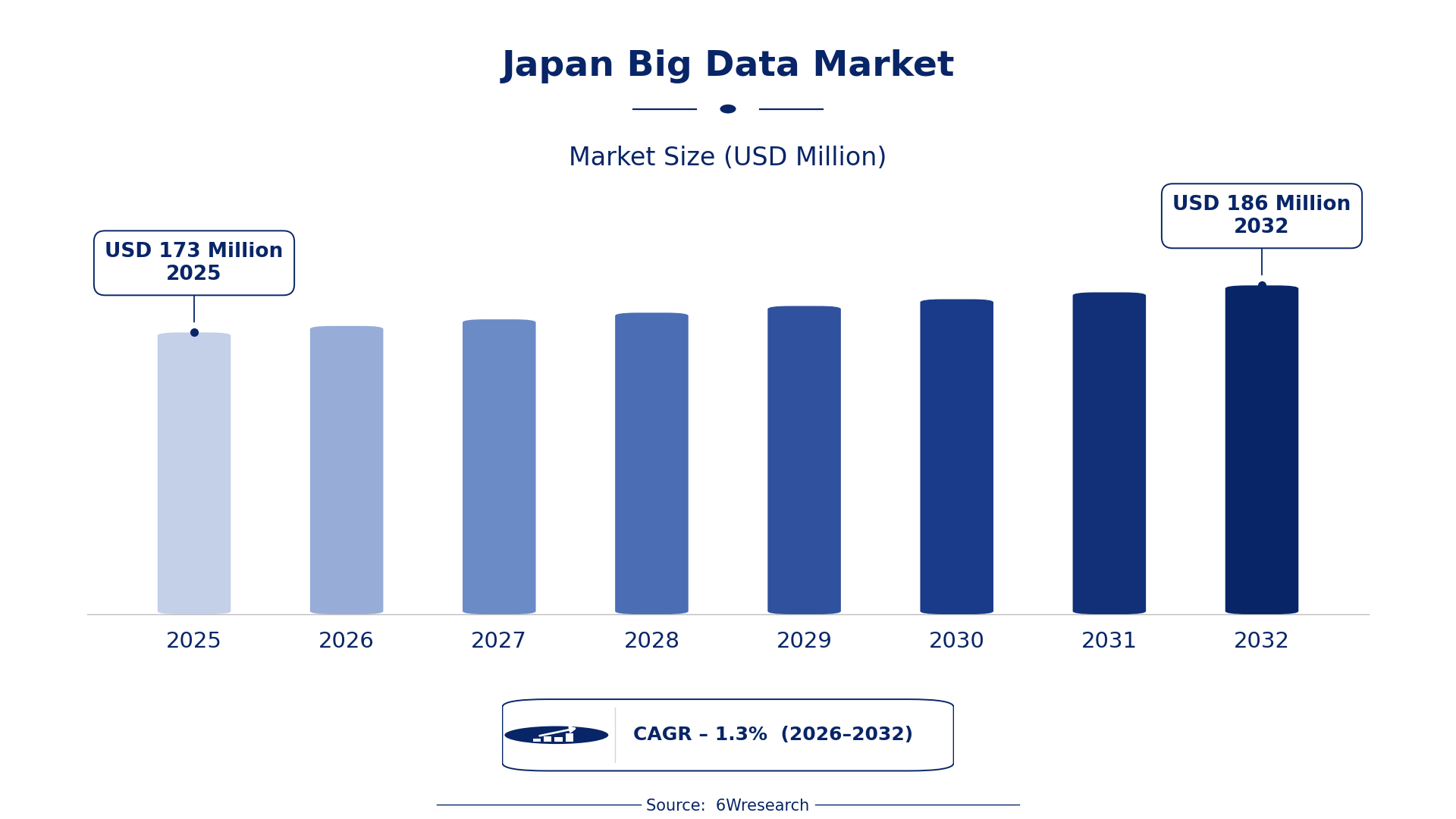
The Japan Big Data Market was estimated at USD 173 Million in 2025 and is projected to reach USD 186 Million by 2032, growing at a CAGR of 1.3% from 2026 to 2032.
Japan Big Data Market Synopsis
The key force shaping the Japan Big Data Market is the surging demand for real-time analytics. Businesses are under immense pressure to extract actionable insights from vast data sets swiftly, driving the adoption of advanced analytics and machine learning technologies across multiple sectors.
Finance, healthcare, and manufacturing lead the charge in leveraging big data, seeking efficiency and innovation. The regulatory environment surrounding data privacy is intensifying, prompting companies to prioritize compliance alongside their technological investments.
Japan Big Data Market Year-wise Growth Rate and Key Drivers
This graph illustrates the annual growth rates of the Japan Big Data Market from 2021 to 2032, highlighting a steady upward trajectory and projected expansion over the forecast period.
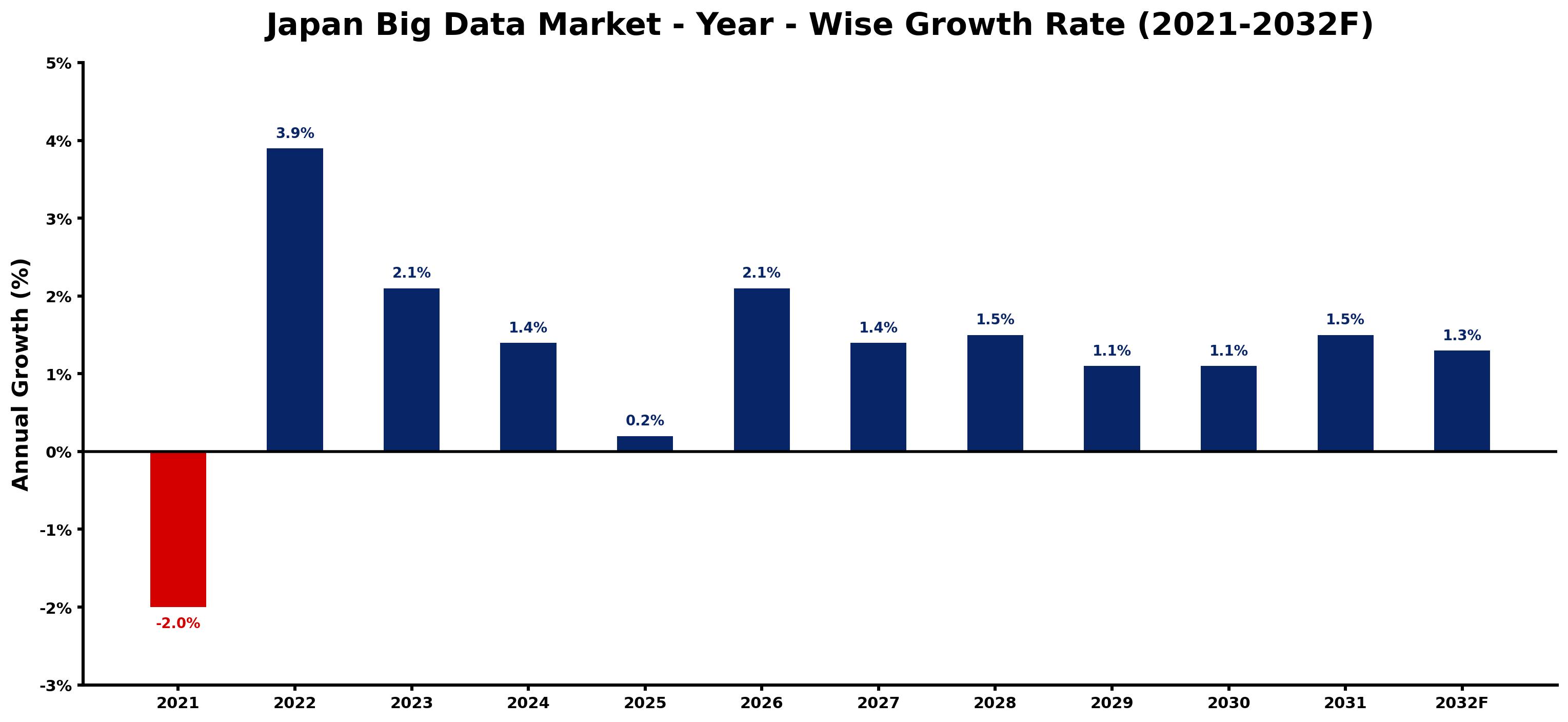
The table below presents the year‑wise growth rates along with the key drivers influencing the market
| Year | Growth Rate | Major Drivers |
| 2021 | -2.0% | Declining investment in AI integration strategies within enterprises. |
| 2022 | 3.9% | Government's AI strategy boosts big data analytics adoption. |
| 2023 | 2.1% | Increased demand for personalized marketing analytics solutions. |
| 2024 | 1.4% | Rising interest in data-driven healthcare solutions post-COVID. |
| 2025 | 0.2% | Corporate data compliance boosts big data investments. |
| 2026 | 2.1% | Growing IoT device integration increases data generation. |
| 2027 | 1.4% | Matrix of new data privacy laws drives analytics demand. |
| 2028 | 1.5% | Surge in remote work accelerates demand for data insights. |
| 2029 | 1.1% | Local startups leverage big data for smarter retail strategies. |
| 2030 | 1.1% | Emerging trends in e-commerce drive analytics expansion. |
| 2031 | 1.5% | Japan's aging population necessitates data for healthcare insights. |
| 2032 | 1.3% | Technology collaborations enhance big data ecosystem efficiencies. |
Note: Market size estimations and growth projections presented in this report are based on 6Wresearch's proprietary forecasting methodology, utilizing the latest available industry data, government publications, and primary research inputs.
Japan Big Data Market Key Takeaways
Below are some of the specific key takeaways from the market, including:
- Rapid growth in demand for real-time data analytics solutions across key sectors.
- Increasing investment in artificial intelligence and machine learning tools for enhanced decision-making.
- Cloud-based big data solutions are becoming the preferred choice for scalability and cost-effectiveness.
- Stringent regulations are reshaping companies' approaches to data privacy and security.
- A shortage of skilled professionals in big data analytics is constraining market potential.
Evaluation of Restraints in Japan Big Data Market
The Japan Big Data Market faces notable challenges that can hinder its growth trajectory. Chief among these are stringent data privacy regulations that create compliance hurdles for businesses. Cultural reluctance to share data further complicates matters, stifling collaboration that could enhance insights. on top of that, the integration of diverse data sources presents a significant hurdle, as organizations struggle to ensure data quality. Smaller enterprises are particularly hampered by the high costs associated with building and maintaining robust big data infrastructures, limiting their ability to compete effectively.
Japan Big Data Market Trends
The market is witnessing a pronounced shift towards real-time data processing. Companies are increasingly recognizing the value of immediate insights to make timely decisions. on top of that, the integration of IoT devices is amplifying data generation, which in turn drives the need for advanced analytics solutions. There's also a notable focus on enhancing customer experiences through personalized data-driven strategies, as businesses aim to create more relevant interactions.
Japan Big Data Market Opportunities
Investment opportunities abound in sectors such as finance and healthcare, where big data analytics can significantly enhance operational efficiencies. The demand for data management and security solutions is on the rise, driven by compliance requirements. on top of that, consulting services that help organizations navigate big data strategies are gaining traction. As businesses continue to invest in technology to harness big data, the market is positioned for promising growth.
Government Initiatives in the Japan Big Data Market
Government policy plays a crucial role in shaping the Japan Big Data Market, with initiatives aimed at fostering a supportive environment for data-driven innovation. The focus is on creating frameworks that promote data sharing while ensuring privacy and security, which is vital for public trust and market growth.
- A recently launched "Data Free Flow with Trust" initiative aims to facilitate cross-border data movement while protecting user privacy.
- Current efforts include the "Society 5.0" strategy, which emphasizes leveraging technologies like big data for economic and social advancements.
- Ongoing funding allocations for research and development in big data technologies are intended to spur innovation.
- Future initiatives plan to enhance public-private partnerships to improve data infrastructure across the country.
- Regulatory frameworks are being established to mandate transparency in data handling practices, enhancing accountability.
Future Insights of the Japan Big Data Market
Looking ahead to 2026-2032, the Japan Big Data Market is set for sustained growth driven by the increasing integration of IoT and digital technologies in various sectors. The emphasis on data-driven decision-making will likely lead to heightened investments in analytics, AI, and machine learning solutions. As companies strive for operational excellence and competitive differentiation, they will continue to prioritize big data capabilities, setting the stage for a dynamic market evolution.
Japan Big Data Market Latest Developments
Recent activity in the Japan Big Data Market has highlighted a significant focus on enhancing technological capabilities and compliance measures. As organizations adapt to regulatory changes, innovation remains at the forefront of their strategies, leading to a variety of new initiatives and partnerships.
- A major technology vendor launched an advanced analytics platform in Q2 2025, designed to streamline data processing and improve user accessibility.
- An ongoing collaboration between key industry players is focused on developing a comprehensive data management solution aimed at SMEs, which began in early 2025.
- A rollout expected in late 2026 will introduce a public-private initiative enhancing data security measures across critical sectors.
- A pilot program initiated in mid-2025 is testing new machine learning algorithms for predictive analytics in healthcare settings.
- A planned upgrade to national digital infrastructure is set to commence in early 2027, aiming to improve data accessibility and security nationwide.
Japan Big Data Market - Key Attractiveness of the Report
- 10 Years of Market Numbers
- Historical Data Starting from 2022 to 2025
- Base Year: 2025
- Forecast Data until 2032
- Key Performance Indicators Impacting the Market
- Major Upcoming Developments and Projects
Key Highlights of the Report:
- Japan Big Data Market Outlook
- Market Size of Japan Big Data Market, 2025
- Forecast of Japan Big Data Market, 2032
- Historical Data and Forecast of Japan Big Data Revenues & Volume for the Period 2022-2032F
- Japan Big Data Market Trend Evolution
- Japan Big Data Market Drivers and Challenges
- Japan Big Data Price Trends
- Japan Big Data Porter's Five Forces
- Japan Big Data Industry Life Cycle
- Historical Data and Forecast of Japan Big Data Market Revenues & Volume By Business Function for the Period 2022-2032F
- Historical Data and Forecast of Japan Big Data Market Revenues & Volume By Finance for the Period 2022-2032F
- Historical Data and Forecast of Japan Big Data Market Revenues & Volume By Marketing and Sales for the Period 2022-2032F
- Historical Data and Forecast of Japan Big Data Market Revenues & Volume By Human Resources for the Period 2022-2032F
- Historical Data and Forecast of Japan Big Data Market Revenues & Volume By Operations for the Period 2022-2032F
- Historical Data and Forecast of Japan Big Data Market Revenues & Volume By Industry Vertical for the Period 2022-2032F
- Historical Data and Forecast of Japan Big Data Market Revenues & Volume By BFSI for the Period 2022-2032F
- Historical Data and Forecast of Japan Big Data Market Revenues & Volume By Government and Defense for the Period 2022-2032F
- Historical Data and Forecast of Japan Big Data Market Revenues & Volume By Healthcare and Life Sciences for the Period 2022-2032F
- Historical Data and Forecast of Japan Big Data Market Revenues & Volume By Manufacturing for the Period 2022-2032F
- Historical Data and Forecast of Japan Big Data Market Revenues & Volume By Retail and Consumer Goods for the Period 2022-2032F
- Historical Data and Forecast of Japan Big Data Market Revenues & Volume By Media and Entertainment for the Period 2022-2032F
- Historical Data and Forecast of Japan Big Data Market Revenues & Volume By Telecommunications and IT for the Period 2022-2032F
- Historical Data and Forecast of Japan Big Data Market Revenues & Volume By Transportation and Logistics for the Period 2022-2032F
- Historical Data and Forecast of Japan Big Data Market Revenues & Volume By Component for the Period 2022-2032F
- Historical Data and Forecast of Japan Big Data Market Revenues & Volume By Solutions for the Period 2022-2032F
- Historical Data and Forecast of Japan Big Data Market Revenues & Volume By Big Data Analytics for the Period 2022-2032F
- Historical Data and Forecast of Japan Big Data Market Revenues & Volume By Data Discovery for the Period 2022-2032F
- Historical Data and Forecast of Japan Big Data Market Revenues & Volume By Data Visualization for the Period 2022-2032F
- Historical Data and Forecast of Japan Big Data Market Revenues & Volume By Data Management for the Period 2022-2032F
- Historical Data and Forecast of Japan Big Data Market Revenues & Volume By Services for the Period 2022-2032F
- Historical Data and Forecast of Japan Big Data Market Revenues & Volume By Deployment Mode for the Period 2022-2032F
- Historical Data and Forecast of Japan Big Data Market Revenues & Volume By Cloud for the Period 2022-2032F
- Historical Data and Forecast of Japan Big Data Market Revenues & Volume By Public Cloud for the Period 2022-2032F
- Historical Data and Forecast of Japan Big Data Market Revenues & Volume By Private Cloud for the Period 2022-2032F
- Historical Data and Forecast of Japan Big Data Market Revenues & Volume By Hybrid Cloud for the Period 2022-2032F
- Historical Data and Forecast of Japan Big Data Market Revenues & Volume By On-premises for the Period 2022-2032F
- Historical Data and Forecast of Japan Big Data Market Revenues & Volume By Organization Size for the Period 2022-2032F
- Historical Data and Forecast of Japan Big Data Market Revenues & Volume By Small and Medium-Sized Enterprises for the Period 2022-2032F
- Historical Data and Forecast of Japan Big Data Market Revenues & Volume By Large Enterprises for the Period 2022-2032F
- Japan Big Data Import Export Trade Statistics
- Market Opportunity Assessment By Business Function
- Market Opportunity Assessment By Industry Vertical
- Market Opportunity Assessment By Component
- Market Opportunity Assessment By Deployment Mode
- Market Opportunity Assessment By Organization Size
- Japan Big Data Top Companies Market Share
- Japan Big Data Competitive Benchmarking By Technical and Operational Parameters
- Japan Big Data Company Profiles
- Japan Big Data Key Strategic Recommendations






































