Japan Bottle Filling Machine Market Size, Share & Growth Rate
The Japan Bottle Filling Machine Market was estimated at USD 98 Million in 2025 and is projected to reach USD 105 Million by 2032, growing at a CAGR of 1.0% from 2026 to 2032. This steady trajectory is bolstered by the rising demand for bottled beverages, driven particularly by a shift towards convenience and ready-to-drink options among consumers. Coupled with stringent hygiene and quality standards in Japan, manufacturers are increasingly investing in automated and efficient filling solutions that can adapt to various production needs.
Japan Bottle Filling Machine Market Year-wise Growth Rate and Key Drivers
This graph highlights how the Japan Bottle Filling Machine Market has steadily grown over the years, supported by major growth factors.
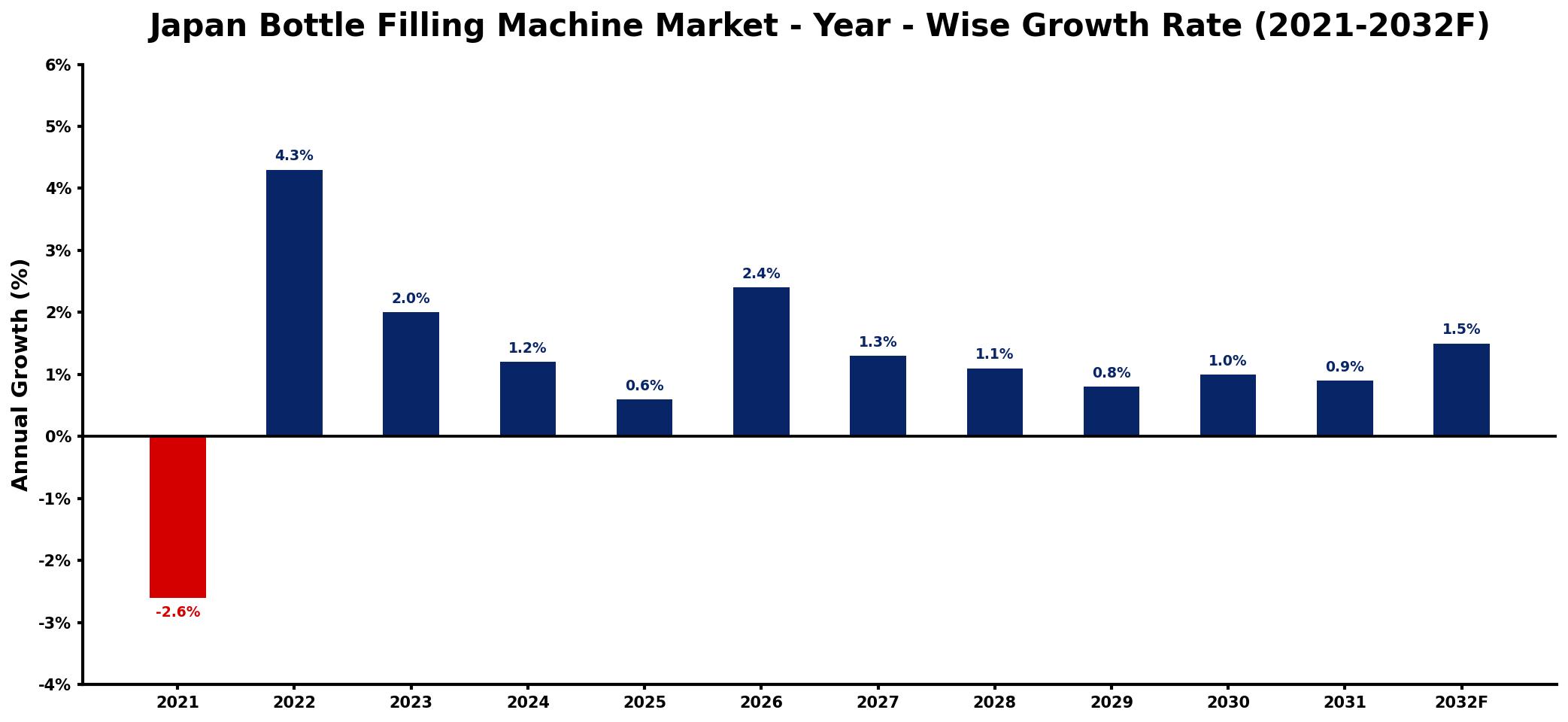
The table below presents the year‑wise growth rates along with the key drivers influencing the market
| Year | Growth Rate | Major Drivers |
| 2021 | -2.6% | decreased investments in manufacturing capacity |
| 2022 | 4.3% | rising demand for sustainable packaging |
| 2023 | 2.0% | expansion of beverage production facilities |
| 2024 | 1.2% | growth in health beverage sector |
| 2025 | 0.6% | increased automation in production lines |
| 2026 | 2.4% | surge in eco-friendly initiatives |
| 2027 | 1.3% | higher demand for premium products |
| 2028 | 1.1% | advancements in technology integration |
| 2029 | 0.8% | emergence of new market players |
| 2030 | 1.0% | increased focus on operational efficiency |
| 2031 | 0.9% | growing regional consumption patterns |
| 2032 | 1.5% | rising consumer preference for convenience |
Note: Market size estimations and growth projections presented in this report are based on 6Wresearch's proprietary forecasting methodology, utilizing the latest available industry data, government publications, and primary research inputs.
Japan Bottle Filling Machine Market Synopsis
The demand for innovative and flexible bottle filling machines is surging, fueled by the diverse needs of the beverage and food industries. As consumer preferences evolve towards unique and varied beverage choices, manufacturers are tasked with providing machines capable of handling an array of bottle sizes and designs.
In addition, the market is witnessing an increased focus on sustainability. As environmental consciousness rises, there is a strong push for filling machines that minimize energy consumption and waste, aligning with broader corporate sustainability goals.
Japan Bottle Filling Machine Market Key Takeaways
- The market is characterized by a shift towards automation, driven by advancements in IoT and robotics.
- Environmental concerns are leading to heightened demand for energy-efficient and sustainable filling solutions.
- Customization capabilities in filling machines are becoming increasingly critical to cater to diverse production requirements.
- Regulatory compliance presents ongoing challenges for manufacturers, necessitating continuous innovation.
- The market's growth trajectory is supported by government initiatives aimed at promoting technological advancement in the manufacturing sector.
Evaluation of Restraints in Japan Bottle Filling Machine Market
Despite the positive growth outlook, the Japan Bottle Filling Machine Market faces several constraints. One primary concern is the ever-increasing demand for machine customization to handle an extensive range of bottle shapes and sizes. This challenge necessitates significant investment in research and development, placing financial pressure on manufacturers. Additionally, rigorous regulatory compliance regarding quality and safety standards can complicate production processes. The competitive landscape also features international players offering technologically advanced and cost-efficient solutions, further intensifying the pressure on local manufacturers to keep pace with innovation and quality assurance.
Japan Bottle Filling Machine Market Trends
The Japan Bottle Filling Machine Market is currently experiencing transformative trends that are shaping both technology and demand. A notable shift towards automation and digitization is enabling manufacturers to achieve higher efficiency and accuracy in filling operations. The integration of IoT technologies is enhancing real-time monitoring and data analytics, thereby reducing downtime and enhancing operational efficiency. Additionally, the growing demand for versatile filling machines that can accommodate a variety of bottle types is pushing manufacturers towards more modular and customizable designs.
Japan Bottle Filling Machine Market Opportunities
Investment opportunities abound in the Japan Bottle Filling Machine Market, particularly as industries increasingly prioritize automation and efficiency. By investing in innovative technologies, such as IoT-enabled and robotic filling systems, companies can cater to the diverse needs of the beverage and food sectors. Furthermore, with sustainability becoming a central theme in manufacturing, there is a clear pathway for investment in eco-friendly filling machines that not only meet regulatory demands but also align with consumer preferences for environmentally responsible packaging solutions.
Government Initiatives in the Japan Bottle Filling Machine Market
Japanese government policies are playing a pivotal role in shaping the Bottle Filling Machine Market. Regulations aimed at reducing plastic waste are driving demand for more efficient and sustainable filling solutions. Furthermore, government initiatives promoting automation and the adoption of advanced technologies are encouraging manufacturers to invest in state-of-the-art filling machinery. Support for small and medium-sized enterprises through financial incentives and technical assistance is also fueling growth, ensuring that the market remains competitive and innovative.
Future Insights of the Japan Bottle Filling Machine Market
Looking ahead to the 2026-2032 period, the Japan Bottle Filling Machine Market is set to witness continued growth, supported by the increasing demand for bottled beverages. The market is expected to thrive on technological advancements that enhance production efficiency while adhering to stringent quality standards. As consumer trends lean towards convenience and variety, manufacturers will need to adapt their filling solutions accordingly. The emphasis on hygiene and quality control will further bolster the demand for sophisticated filling machines tailored to meet the evolving needs of the industry.
Japan Bottle Filling Machine Market Latest Developments (2025 - 2026)
In recent months, the Japan Bottle Filling Machine Market has seen a notable increase in the deployment of automated solutions aimed at improving production efficiency. Manufacturers are focusing on incorporating smart technologies into their filling machines, resulting in enhanced operational capabilities. Additionally, industry discussions surrounding sustainable practices are gaining traction, with several companies announcing plans to invest in eco-friendly filling technologies. The emphasis on customization is also becoming a focal point, as manufacturers seek to meet the diverse needs of their clients in an increasingly competitive landscape.
Japan Bottle Filling Machine Market - Key Attractiveness of the Report
- 10 Years of Market Numbers
- Historical Data Starting from 2022 to 2025
- Base Year: 2025
- Forecast Data until 2032
- Key Performance Indicators Impacting the Market
- Major Upcoming Developments and Projects
Key Highlights of the Report:
- Japan Bottle Filling Machine Market Outlook
- Market Size of Japan Bottle Filling Machine Market, 2025
- Forecast of Japan Bottle Filling Machine Market, 2032
- Historical Data and Forecast of Japan Bottle Filling Machine Revenues & Volume for the Period 2022-2032F
- Japan Bottle Filling Machine Market Trend Evolution
- Japan Bottle Filling Machine Market Drivers and Challenges
- Japan Bottle Filling Machine Price Trends
- Japan Bottle Filling Machine Porter's Five Forces
- Japan Bottle Filling Machine Industry Life Cycle
- Historical Data and Forecast of Japan Bottle Filling Machine Market Revenues & Volume By Bottle Type for the Period 2022-2032F
- Historical Data and Forecast of Japan Bottle Filling Machine Market Revenues & Volume By PET Bottles for the Period 2022-2032F
- Historical Data and Forecast of Japan Bottle Filling Machine Market Revenues & Volume By Glass Bottles for the Period 2022-2032F
- Historical Data and Forecast of Japan Bottle Filling Machine Market Revenues & Volume By Others for the Period 2022-2032F
- Historical Data and Forecast of Japan Bottle Filling Machine Market Revenues & Volume By Application for the Period 2022-2032F
- Historical Data and Forecast of Japan Bottle Filling Machine Market Revenues & Volume By Food Products for the Period 2022-2032F
- Historical Data and Forecast of Japan Bottle Filling Machine Market Revenues & Volume By Beverages for the Period 2022-2032F
- Historical Data and Forecast of Japan Bottle Filling Machine Market Revenues & Volume By Chemicals & Pharmaceuticals for the Period 2022-2032F
- Historical Data and Forecast of Japan Bottle Filling Machine Market Revenues & Volume By Cosmetics for the Period 2022-2032F
- Japan Bottle Filling Machine Import Export Trade Statistics
- Market Opportunity Assessment By Bottle Type
- Market Opportunity Assessment By Application
- Japan Bottle Filling Machine Top Companies Market Share
- Japan Bottle Filling Machine Competitive Benchmarking By Technical and Operational Parameters
- Japan Bottle Filling Machine Company Profiles
- Japan Bottle Filling Machine Key Strategic Recommendations






































