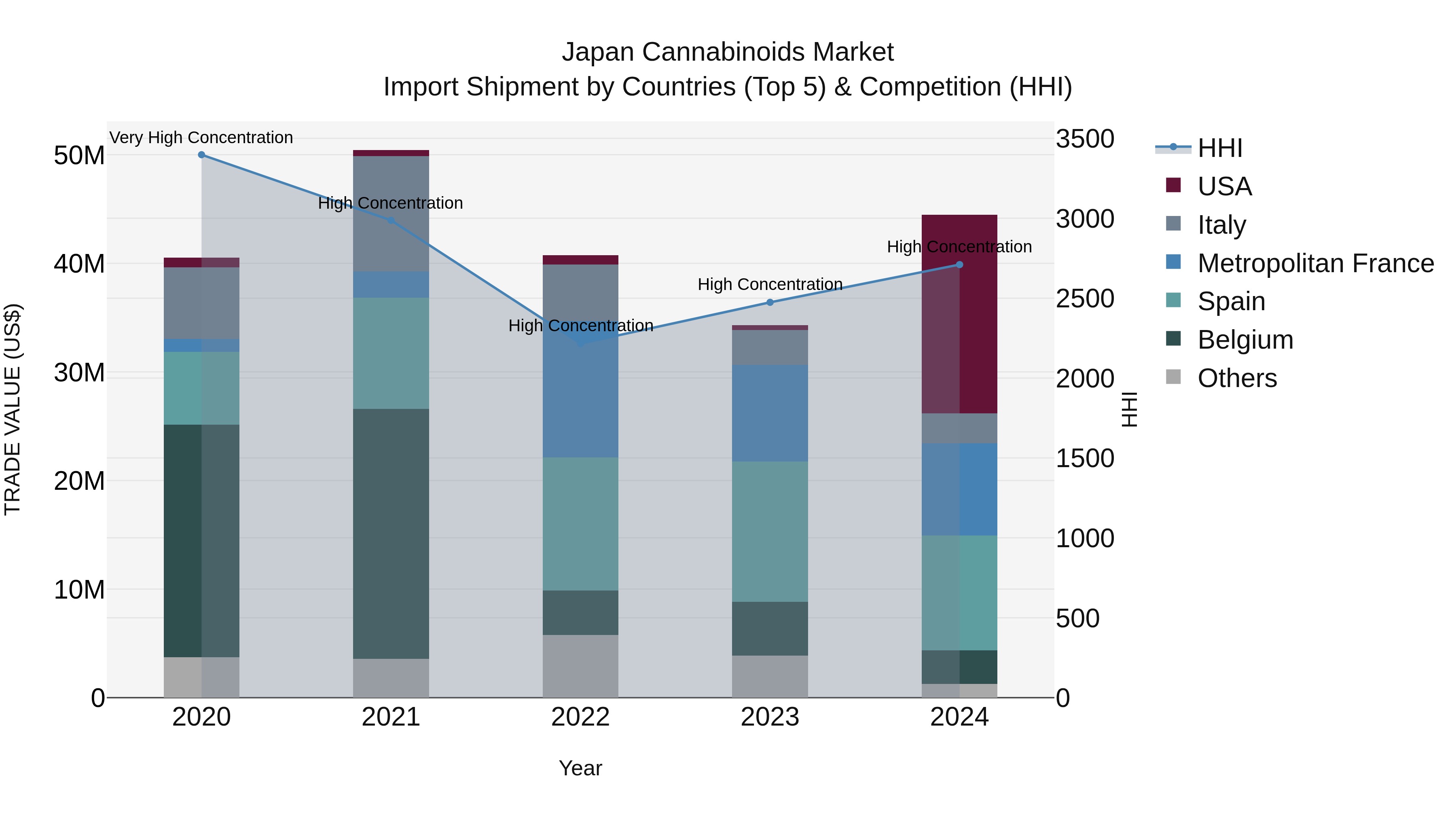
Japan Cannabinoids Market Import Shipment by Countries (Top 5) & Competition (HHI)
In 2024, Japan's import of cannabinoids saw significant growth, with top exporters including the USA, Spain, Metropolitan France, Belgium, and Italy. The market continued to exhibit high concentration, as indicated by the high Herfindahl-Hirschman Index (HHI). The compound annual growth rate (CAGR) from 2020 to 2024 stood at 2.35%, showing steady expansion. Notably, the growth rate from 2023 to 2024 spiked to 29.65%, reflecting a surge in demand for cannabinoids in Japan. This trend underscores the increasing importance and popularity of cannabinoids within the Japanese market.
Japan Cannabinoids Market Overview
The Japan cannabinoids market is experiencing significant growth driven by increasing awareness and acceptance of cannabis-derived products for medical and wellness purposes. The market is primarily dominated by CBD products due to their non-psychoactive properties and legal status in Japan. Key factors contributing to market expansion include the rising prevalence of chronic diseases, growing elderly population seeking alternative therapies, and the increasing adoption of cannabinoids in beauty and personal care products. The regulatory landscape in Japan is evolving, with the government allowing limited use of cannabinoids for medical and research purposes. However, strict regulations and societal stigma around cannabis continue to pose challenges for market growth. Overall, the Japan cannabinoids market shows promising potential, with opportunities for innovation and diversification across various industries.
Japan Cannabinoids Market Trends
The Japan cannabinoids market is experiencing a growing interest in CBD products, driven by increasing awareness of their potential health benefits and regulatory changes allowing for the sale of CBD products with low THC content. Consumers in Japan are seeking out CBD products for various purposes such as pain relief, stress management, and overall wellness. The market is witnessing a rise in the availability of CBD-infused products ranging from oils and tinctures to skincare and beverages. Additionally, there is a trend towards premium and high-quality CBD products, with an emphasis on transparency in sourcing and manufacturing processes. As the market continues to evolve, there is a growing opportunity for both domestic and international companies to capitalize on the demand for cannabinoids in Japan.
Japan Cannabinoids Market Challenges
In the Japan cannabinoids market, one of the main challenges is the strict regulatory environment surrounding cannabis-derived products. While hemp-derived CBD is legal in Japan with certain restrictions, products containing THC are strictly prohibited. This regulatory framework creates uncertainty for businesses looking to enter the market and limits the variety of products available to consumers. Additionally, there is a lack of clear guidance on labeling requirements and quality standards for cannabinoids products, leading to confusion among both businesses and consumers. These regulatory challenges, coupled with cultural stigma surrounding cannabis, pose significant barriers to the growth and development of the cannabinoids market in Japan.
Japan Cannabinoids Market Investment Opportunities
The Japan cannabinoids market presents promising investment opportunities due to recent regulatory changes allowing for the use of cannabinoids in certain products. With a growing interest in CBD products for health and wellness, there is a potential for significant market growth. Investors could consider opportunities in companies involved in the cultivation, extraction, and distribution of cannabinoids, as well as those focusing on research and development of innovative cannabinoid-based products tailored to the Japanese market. Additionally, investing in companies that provide testing services, regulatory consulting, and marketing solutions for cannabinoid products could also be lucrative. Given the evolving regulatory landscape and increasing consumer acceptance, the Japan cannabinoids market offers a diverse range of investment possibilities for those looking to capitalize on the growing demand for cannabinoid products.
Japan Cannabinoids Market Government Policy
In Japan, the use and possession of cannabinoids, including marijuana, are strictly regulated and illegal under the Cannabis Control Law. The law prohibits the production, distribution, and possession of marijuana, with severe penalties for violators, including imprisonment and fines. However, the government has allowed limited research on cannabinoids for medical purposes under strict regulations. In 2015, Japan approved clinical trials for the use of CBD oil to treat epilepsy, marking a small step towards potential medical applications of cannabinoids in the country. Despite the growing global trend towards legalization and regulation of cannabinoids, Japan maintains a conservative stance on the issue, with strict enforcement and limited access to cannabinoids for medical research purposes only.
Japan Cannabinoids Market Future Outlook
The future outlook for the Japan cannabinoids market is promising, with increasing acceptance and legalization of medical cannabis in the country. As the Japanese government continues to explore the potential benefits of cannabinoids for various health conditions, including chronic pain and epilepsy, the market is expected to experience significant growth. With a growing aging population and rising awareness of alternative medicine, there is a growing demand for cannabinoid-based products in Japan. However, strict regulations and cultural attitudes towards cannabis may still pose challenges to market expansion. Overall, the Japan cannabinoids market is poised for growth as more research is conducted, and regulations become more favorable towards cannabinoid products.
Key Highlights of the Report:
- Japan Cannabinoids Market Outlook
- Market Size of Japan Cannabinoids Market,2024
- Forecast of Japan Cannabinoids Market, 2031
- Historical Data and Forecast of Japan Cannabinoids Revenues & Volume for the Period 2021-2031
- Japan Cannabinoids Market Trend Evolution
- Japan Cannabinoids Market Drivers and Challenges
- Japan Cannabinoids Price Trends
- Japan Cannabinoids Porter's Five Forces
- Japan Cannabinoids Industry Life Cycle
- Historical Data and Forecast of Japan Cannabinoids Market Revenues & Volume By Product Type for the Period 2021-2031
- Historical Data and Forecast of Japan Cannabinoids Market Revenues & Volume By CBD for the Period 2021-2031
- Historical Data and Forecast of Japan Cannabinoids Market Revenues & Volume By THC for the Period 2021-2031
- Historical Data and Forecast of Japan Cannabinoids Market Revenues & Volume By CBG for the Period 2021-2031
- Historical Data and Forecast of Japan Cannabinoids Market Revenues & Volume By Application for the Period 2021-2031
- Historical Data and Forecast of Japan Cannabinoids Market Revenues & Volume By Pain Management for the Period 2021-2031
- Historical Data and Forecast of Japan Cannabinoids Market Revenues & Volume By Appetite Stimulation for the Period 2021-2031
- Historical Data and Forecast of Japan Cannabinoids Market Revenues & Volume By Skin Health for the Period 2021-2031
- Historical Data and Forecast of Japan Cannabinoids Market Revenues & Volume By End User for the Period 2021-2031
- Historical Data and Forecast of Japan Cannabinoids Market Revenues & Volume By Consumers for the Period 2021-2031
- Historical Data and Forecast of Japan Cannabinoids Market Revenues & Volume By Patients for the Period 2021-2031
- Historical Data and Forecast of Japan Cannabinoids Market Revenues & Volume By E-commerce for the Period 2021-2031
- Historical Data and Forecast of Japan Cannabinoids Market Revenues & Volume By Source for the Period 2021-2031
- Historical Data and Forecast of Japan Cannabinoids Market Revenues & Volume By Cannabis for the Period 2021-2031
- Historical Data and Forecast of Japan Cannabinoids Market Revenues & Volume By Hemp for the Period 2021-2031
- Historical Data and Forecast of Japan Cannabinoids Market Revenues & Volume By Plant-Based for the Period 2021-2031
- Historical Data and Forecast of Japan Cannabinoids Market Revenues & Volume By Technology for the Period 2021-2031
- Historical Data and Forecast of Japan Cannabinoids Market Revenues & Volume By Nanoemulsion for the Period 2021-2031
- Historical Data and Forecast of Japan Cannabinoids Market Revenues & Volume By Microencapsulation for the Period 2021-2031
- Historical Data and Forecast of Japan Cannabinoids Market Revenues & Volume By Advanced Extraction for the Period 2021-2031
- Japan Cannabinoids Import Export Trade Statistics
- Market Opportunity Assessment By Product Type
- Market Opportunity Assessment By Application
- Market Opportunity Assessment By End User
- Market Opportunity Assessment By Source
- Market Opportunity Assessment By Technology
- Japan Cannabinoids Top Companies Market Share
- Japan Cannabinoids Competitive Benchmarking By Technical and Operational Parameters
- Japan Cannabinoids Company Profiles
- Japan Cannabinoids Key Strategic Recommendations






































