Japan Cannula Market Size Growth Rate
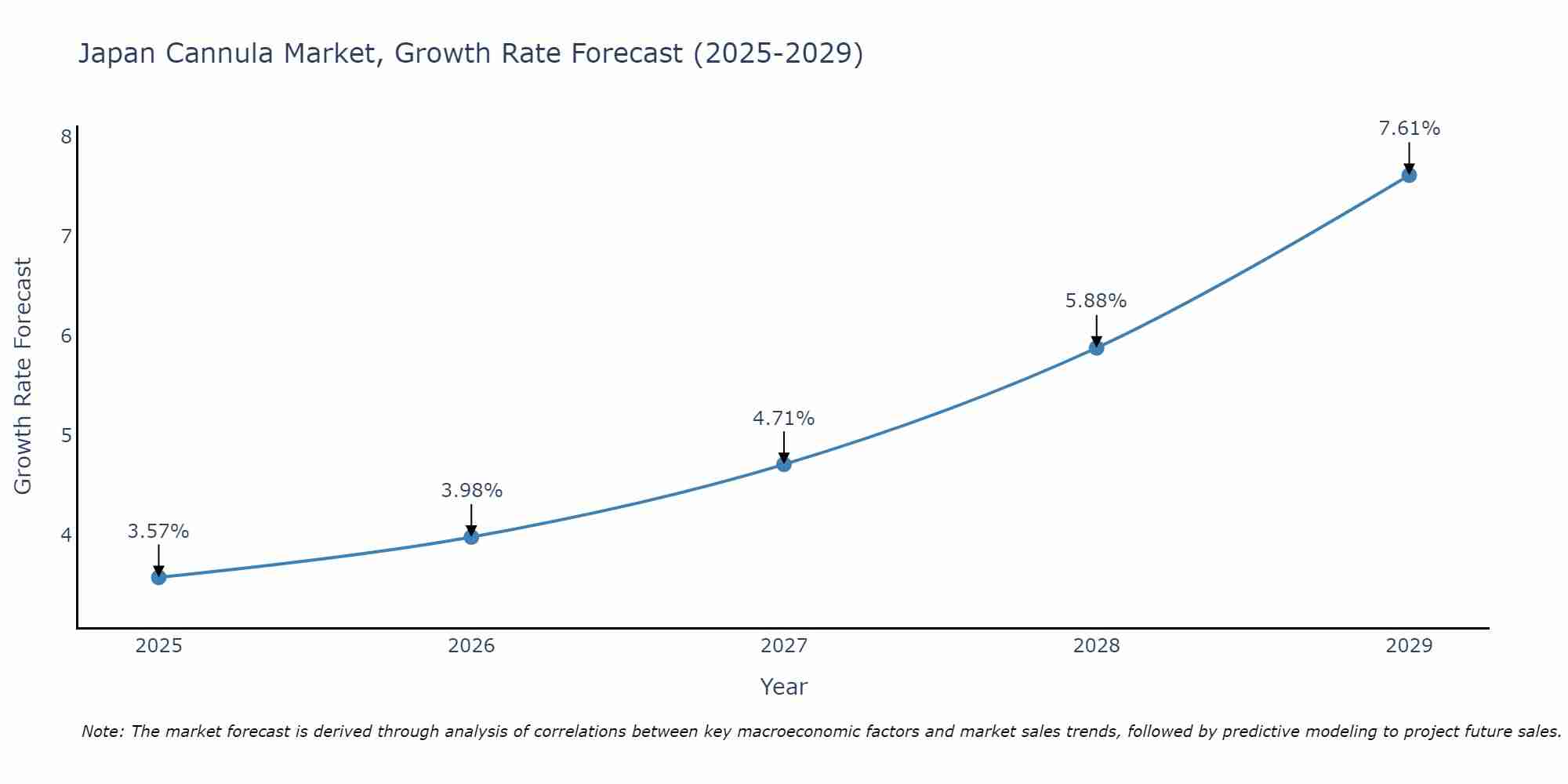
The Japan Cannula Market is poised for steady growth rate improvements from 2025 to 2029. Commencing at 3.57% in 2025, growth builds up to 7.61% by 2029.
Japan Cannula Market Overview
The Japan Cannula Market is witnessing steady growth driven by factors such as increasing surgical procedures, growing prevalence of chronic diseases, and advancements in healthcare infrastructure. Cannulas, which are thin tubes inserted into blood vessels or body cavities for fluid delivery or extraction, are widely used in various medical procedures such as cardiovascular surgeries, cosmetic surgeries, and IV therapy. The market is characterized by the presence of key players like Smiths Medical, Becton Dickinson and Company, and Terumo Corporation, who are constantly innovating to introduce technologically advanced cannulas to meet the evolving healthcare needs. Additionally, the rising geriatric population in Japan, along with the increasing demand for minimally invasive procedures, is expected to further drive the growth of the cannula market in the country.
Japan Cannula Market Trends
The Japan Cannula Market is experiencing significant growth driven by various factors such as the increasing prevalence of chronic diseases, rising geriatric population, and the growing demand for minimally invasive procedures. There is a notable trend towards the development of advanced cannulas with features like improved flexibility, better precision, and reduced risk of complications. Additionally, the market is witnessing a shift towards disposable cannulas due to concerns regarding infection control and patient safety. Companies in the Japan Cannula Market are focusing on expanding their product portfolios through strategic partnerships, mergers, and acquisitions to gain a competitive edge in the market. Overall, the Japan Cannula Market is expected to continue its growth trajectory with a focus on innovation and technological advancements.
Japan Cannula Market Challenges
The Japan Cannula Market faces several challenges, including stringent regulatory requirements for medical devices, increasing competition from both domestic and international manufacturers, and a rapidly aging population leading to higher demand for healthcare services. Additionally, pricing pressures and the need for continuous technological advancements to meet evolving healthcare needs pose challenges for market players. Ensuring product quality and safety while complying with regulatory standards can be particularly demanding in the highly regulated healthcare market in Japan. Furthermore, establishing strong distribution networks and building relationships with healthcare providers are crucial for market penetration and growth. Overall, navigating these challenges requires strategic planning, innovation, and a deep understanding of the unique dynamics of the Japanese healthcare industry.
Japan Cannula Market Investment Opportunities
The Japan Cannula Market presents promising investment opportunities due to the increasing adoption of minimally invasive procedures and the rising prevalence of chronic diseases requiring medical interventions. Key areas for investment include the development of advanced cannula technologies that improve precision and reduce patient discomfort, as well as the expansion of product offerings to cater to a growing elderly population in Japan. Additionally, investing in research and development to create innovative cannula designs for specialized medical procedures can provide a competitive edge in the market. Collaborating with healthcare providers and institutions to understand their specific needs and preferences can also lead to successful investments in the Japan Cannula Market. Overall, the market offers potential for growth and profitability for investors seeking opportunities in the medical device industry.
Japan Cannula Market Government Policy
Government policies related to the Japan Cannula Market primarily focus on ensuring the safety and quality of medical devices, including cannulas. The Pharmaceutical and Medical Device Act (PMD Act) in Japan regulates the manufacturing, import, and distribution of medical devices, including cannulas, to ensure their safety and efficacy. The Act requires manufacturers to adhere to strict quality standards, obtain certifications, and maintain proper documentation throughout the product lifecycle. Additionally, the Ministry of Health, Labour and Welfare (MHLW) oversees the approval process for medical devices, including cannulas, to ensure they meet regulatory requirements. These policies aim to protect public health, maintain high-quality standards in the medical device industry, and promote innovation in healthcare technologies in Japan.
Japan Cannula Market Future Outlook
The Japan Cannula Market is poised for steady growth in the coming years, driven by factors such as the increasing prevalence of chronic diseases, advancements in medical technology, and the growing elderly population in the country. The demand for minimally invasive procedures and surgical techniques is also expected to boost the market for cannulas. Additionally, the rising focus on precision medicine and personalized healthcare is likely to create opportunities for innovative cannula products catering to specific patient needs. With a strong healthcare infrastructure and a robust regulatory environment, Japan is well-positioned to witness sustained market growth in the cannula sector, with key players focusing on product development and strategic collaborations to meet the evolving demands of the healthcare industry in the region.
Key Highlights of the Report:
- Japan Cannula Market Outlook
- Market Size of Japan Cannula Market, 2021
- Forecast of Japan Cannula Market, 2027
- Historical Data and Forecast of Japan Cannula Revenues & Volume for the Period 2018 - 2027
- Japan Cannula Market Trend Evolution
- Japan Cannula Market Drivers and Challenges
- Japan Cannula Price Trends
- Japan Cannula Porter's Five Forces
- Japan Cannula Industry Life Cycle
- Historical Data and Forecast of Japan Cannula Market Revenues & Volume By Product Type for the Period 2018 - 2027
- Historical Data and Forecast of Japan Cannula Market Revenues & Volume By Nasal cannula for the Period 2018 - 2027
- Historical Data and Forecast of Japan Cannula Market Revenues & Volume By Straight cannula for the Period 2018 - 2027
- Historical Data and Forecast of Japan Cannula Market Revenues & Volume By Winged cannula for the Period 2018 - 2027
- Historical Data and Forecast of Japan Cannula Market Revenues & Volume By Cannulas with wings and ports for the Period 2018 - 2027
- Historical Data and Forecast of Japan Cannula Market Revenues & Volume By Cannulas with integrated stop cock for the Period 2018 - 2027
- Historical Data and Forecast of Japan Cannula Market Revenues & Volume By Others for the Period 2018 - 2027
- Historical Data and Forecast of Japan Cannula Market Revenues & Volume By Material for the Period 2018 - 2027
- Historical Data and Forecast of Japan Cannula Market Revenues & Volume By Plastic for the Period 2018 - 2027
- Historical Data and Forecast of Japan Cannula Market Revenues & Volume By Silicone for the Period 2018 - 2027
- Historical Data and Forecast of Japan Cannula Market Revenues & Volume By Others for the Period 2018 - 2027
- Historical Data and Forecast of Japan Cannula Market Revenues & Volume By Patient for the Period 2018 - 2027
- Historical Data and Forecast of Japan Cannula Market Revenues & Volume By Adult for the Period 2018 - 2027
- Historical Data and Forecast of Japan Cannula Market Revenues & Volume By Paediatric for the Period 2018 - 2027
- Historical Data and Forecast of Japan Cannula Market Revenues & Volume By End-use for the Period 2018 - 2027
- Historical Data and Forecast of Japan Cannula Market Revenues & Volume By Hospitals for the Period 2018 - 2027
- Historical Data and Forecast of Japan Cannula Market Revenues & Volume By Ambulatory surgical centers for the Period 2018 - 2027
- Historical Data and Forecast of Japan Cannula Market Revenues & Volume By Diagnostic laboratories for the Period 2018 - 2027
- Historical Data and Forecast of Japan Cannula Market Revenues & Volume By Clinics for the Period 2018 - 2027
- Historical Data and Forecast of Japan Cannula Market Revenues & Volume By Others for the Period 2018 - 2027
- Japan Cannula Import Export Trade Statistics
- Market Opportunity Assessment By Product Type
- Market Opportunity Assessment By Material
- Market Opportunity Assessment By Patient
- Market Opportunity Assessment By End-use
- Japan Cannula Top Companies Market Share
- Japan Cannula Competitive Benchmarking By Technical and Operational Parameters
- Japan Cannula Company Profiles
- Japan Cannula Key Strategic Recommendations






































