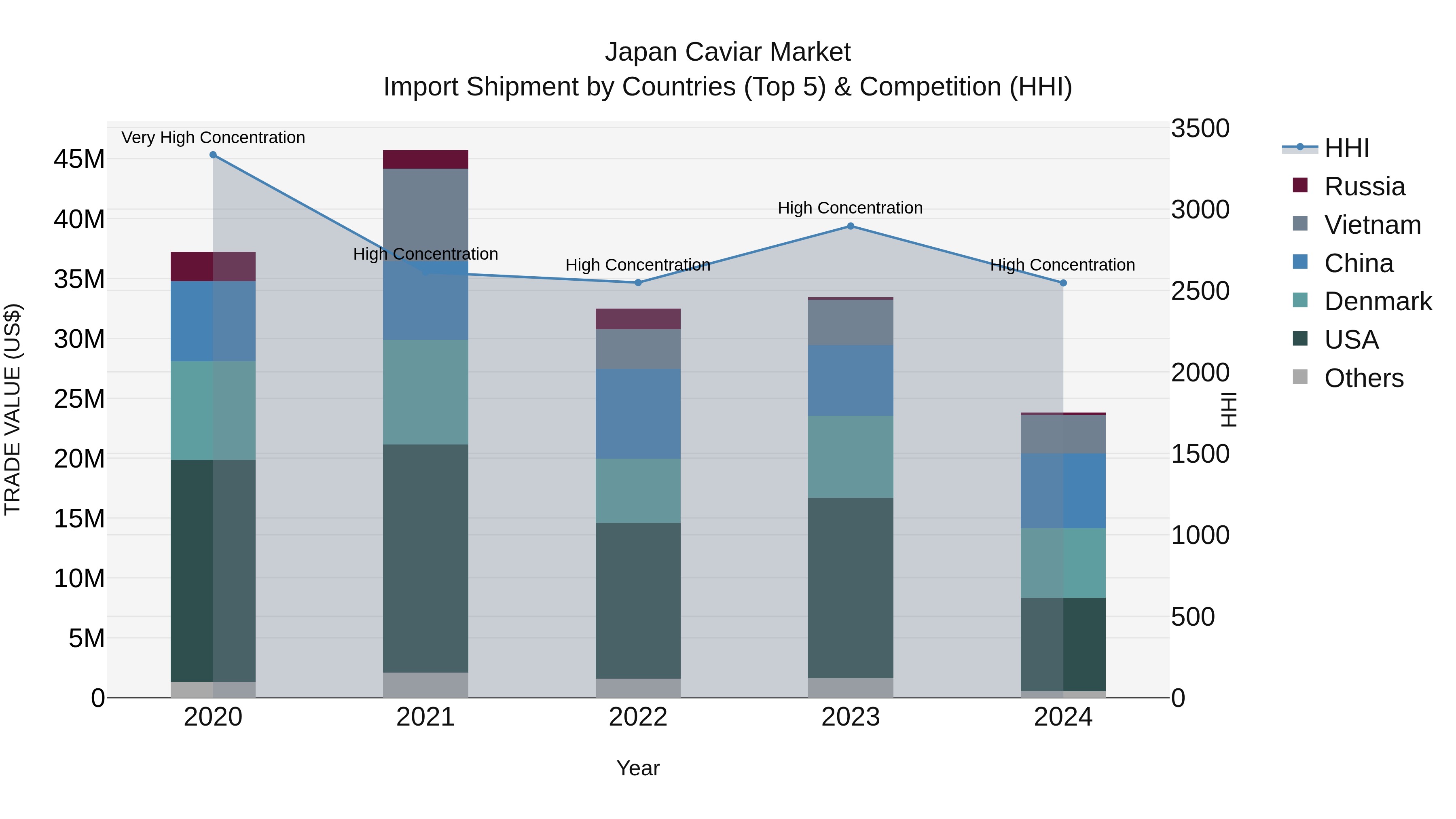
Japan Caviar Market Import Shipment by Countries (Top 5) & Competition (HHI)
Despite a high concentration with the Herfindahl-Hirschman Index (HHI) remaining elevated in 2024, Japan's caviar import sector saw a concerning decline. The top exporting countries to Japan, including the USA, China, Denmark, Vietnam, and Finland, faced challenges with a negative Compound Annual Growth Rate (CAGR) of -10.58% from 2020-2024. The growth rate plummeted further in 2024 with a notable -28.81% decrease from the previous year. These trends suggest a significant setback in the caviar import market in Japan, indicating potential shifts in consumer preferences or supply chain disruptions.
Japan Caviar Market Overview
The Japan caviar market is experiencing steady growth due to increasing consumer demand for luxury food products. Caviar, traditionally considered a delicacy, has gained popularity in Japan as a symbol of status and sophistication. The market is primarily driven by a rising number of affluent consumers with a taste for premium food items. Japanese consumers are also becoming more health-conscious, leading to a growing interest in the nutritional benefits of caviar, which is rich in Omega-3 fatty acids and proteins. Additionally, the trend of gourmet dining and culinary exploration is boosting the demand for caviar in high-end restaurants and hotels across Japan. Key players in the market are focusing on product innovation and quality to cater to the discerning tastes of Japanese consumers, contributing to the overall growth of the caviar market in Japan.
Japan Caviar Market Trends
The Japan caviar market is experiencing a trend towards increased consumer interest in sustainable and ethically sourced caviar products. There is a growing demand for caviar from sturgeon farms that prioritize environmentally friendly practices and animal welfare. Additionally, there is a shift towards more accessible and affordable caviar options, with an emphasis on domestic production to support local economies. Health-conscious consumers are also driving the trend towards caviar as a nutritious and gourmet food choice, leading to a rise in caviar consumption for its perceived health benefits. Overall, the Japan caviar market is evolving towards a more sustainable, ethical, and diverse landscape to meet the changing preferences and values of consumers.
Japan Caviar Market Challenges
In the Japan caviar market, some challenges include high import tariffs on foreign caviar, leading to higher prices for consumers. Additionally, there is a limited domestic production of caviar in Japan, which results in a reliance on imported products. This can sometimes lead to issues with quality control and authenticity of the caviar being sold. Another challenge is the perception of caviar as a luxury product, which may limit its appeal to a broader consumer base. Overall, the Japan caviar market faces obstacles related to pricing, supply chain complexities, and consumer preferences that can impact the growth and competitiveness of the industry.
Japan Caviar Market Investment Opportunities
The Japan caviar market presents promising investment opportunities due to the increasing demand for luxury food products in the country. With a growing number of affluent consumers willing to spend on high-end culinary experiences, there is a rising interest in premium caviar as a gourmet delicacy. Investing in caviar production facilities, distribution channels, or luxury food retail businesses could prove lucrative in tapping into this niche market segment. Additionally, promoting sustainable caviar farming practices and highlighting the uniqueness of Japanese caviar varieties can attract both domestic and international consumers seeking premium quality products. Collaborating with local caviar producers and leveraging Japan`s reputation for food excellence can further enhance the investment potential in the thriving caviar market.
Japan Caviar Market Government Policy
Government policies related to the Japan Caviar Market primarily focus on sustainable harvesting practices and conservation of sturgeon populations to ensure the long-term viability of the industry. Japan has strict regulations in place to control the fishing and farming of sturgeon for caviar production, with measures such as size limits, quotas, and licensing requirements to prevent overfishing and protect endangered species. The government also promotes research and development in aquaculture techniques to support domestic caviar production and reduce reliance on imports. Additionally, there are efforts to promote transparency in labeling and traceability to ensure consumers are informed about the origin and quality of caviar products in the market. Overall, these policies aim to balance economic interests with environmental sustainability in the Japan Caviar Market.
Japan Caviar Market Future Outlook
The Japan Caviar Market is expected to experience steady growth in the coming years due to increasing consumer interest in luxury and gourmet food products. Factors such as rising disposable incomes, evolving taste preferences, and a growing awareness of the health benefits of caviar are driving the market expansion. Additionally, the trend of dining out and indulging in premium culinary experiences is further fueling the demand for caviar in Japan. As the market continues to mature, there is also a growing focus on sustainable sourcing practices and ethical production methods, which could influence consumer purchasing decisions. Overall, the Japan Caviar Market is poised for a positive trajectory, with opportunities for both domestic producers and international suppliers to capitalize on the growing demand for this high-end delicacy.
Key Highlights of the Report:
- Japan Caviar Market Outlook
- Market Size of Japan Caviar Market, 2024
- Forecast of Japan Caviar Market, 2031
- Historical Data and Forecast of Japan Caviar Revenues & Volume for the Period 2018 - 2031
- Japan Caviar Market Trend Evolution
- Japan Caviar Market Drivers and Challenges
- Japan Caviar Price Trends
- Japan Caviar Porter's Five Forces
- Japan Caviar Industry Life Cycle
- Historical Data and Forecast of Japan Caviar Market Revenues & Volume By Product for the Period 2018 - 2031
- Historical Data and Forecast of Japan Caviar Market Revenues & Volume By Sevruga for the Period 2018 - 2031
- Historical Data and Forecast of Japan Caviar Market Revenues & Volume By Osetra for the Period 2018 - 2031
- Historical Data and Forecast of Japan Caviar Market Revenues & Volume By Salmon for the Period 2018 - 2031
- Historical Data and Forecast of Japan Caviar Market Revenues & Volume By Sushi for the Period 2018 - 2031
- Historical Data and Forecast of Japan Caviar Market Revenues & Volume By Others for the Period 2018 - 2031
- Historical Data and Forecast of Japan Caviar Market Revenues & Volume By Form for the Period 2018 - 2031
- Historical Data and Forecast of Japan Caviar Market Revenues & Volume By Fresh for the Period 2018 - 2031
- Historical Data and Forecast of Japan Caviar Market Revenues & Volume By Dried for the Period 2018 - 2031
- Historical Data and Forecast of Japan Caviar Market Revenues & Volume By Preserved & Frozen for the Period 2018 - 2031
- Historical Data and Forecast of Japan Caviar Market Revenues & Volume By Application for the Period 2018 - 2031
- Historical Data and Forecast of Japan Caviar Market Revenues & Volume By Restaurants for the Period 2018 - 2031
- Historical Data and Forecast of Japan Caviar Market Revenues & Volume By Household for the Period 2018 - 2031
- Japan Caviar Import Export Trade Statistics
- Market Opportunity Assessment By Product
- Market Opportunity Assessment By Form
- Market Opportunity Assessment By Application
- Japan Caviar Top Companies Market Share
- Japan Caviar Competitive Benchmarking By Technical and Operational Parameters
- Japan Caviar Company Profiles
- Japan Caviar Key Strategic Recommendations






































