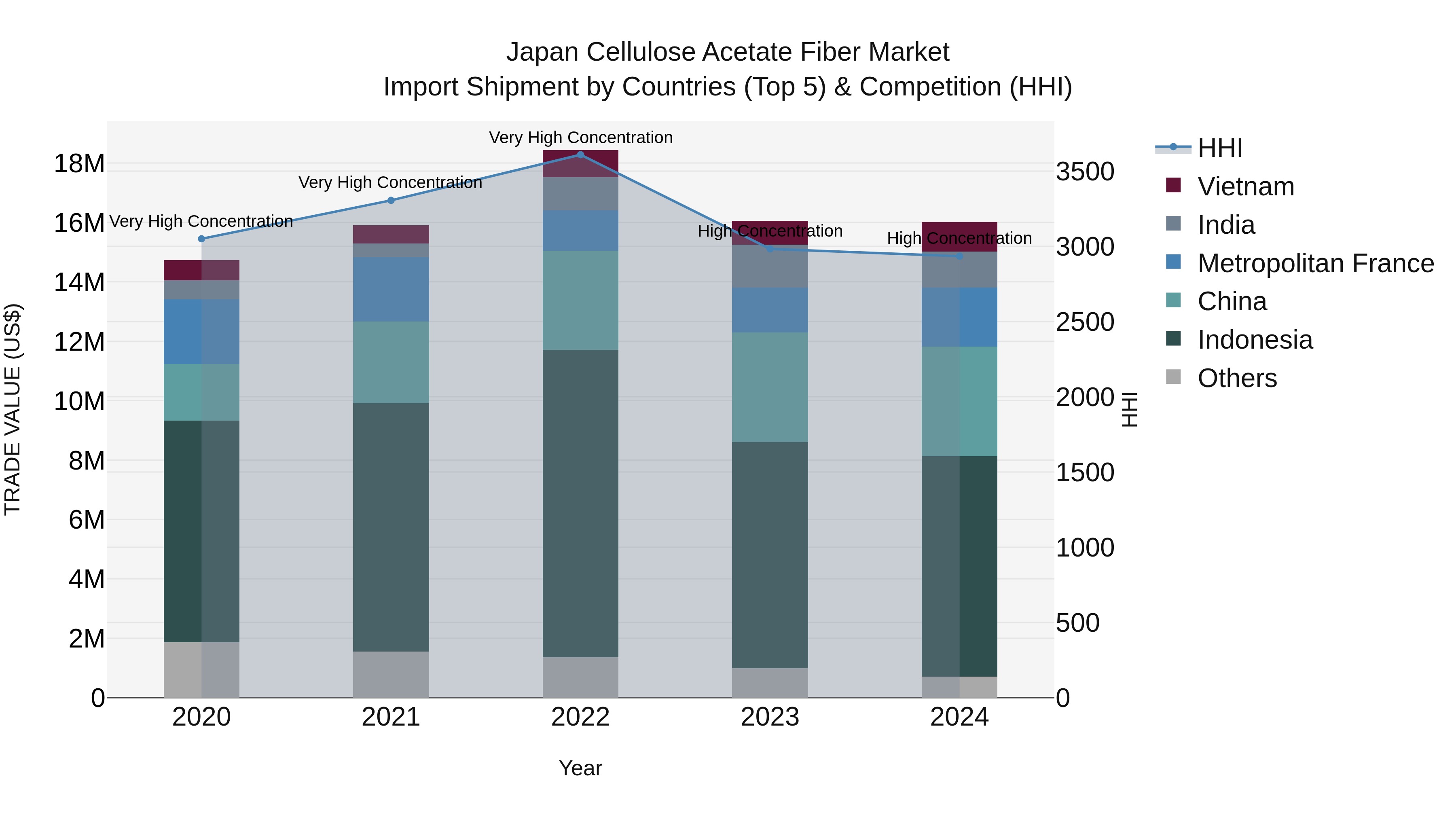
Japan Cellulose Acetate Fiber Market Import Shipment by Countries (Top 5) & Competition (HHI)
In 2024, Japan continued to rely on imports of cellulose acetate fiber, with top exporting countries being Indonesia, China, Metropolitan France, India, and Vietnam. Despite a slight decline in growth rate from 2023 to 2024, the compound annual growth rate (CAGR) for the period 2020-24 remained positive at 2.11%. The high concentration of market share among these key exporting countries indicates a competitive landscape in the Japanese market for cellulose acetate fiber imports. This data suggests a stable demand for this type of fiber in Japan, with potential for further growth in the coming years.
Japan Cellulose Acetate Fiber Market Overview
The Japan Cellulose Acetate Fiber market is a significant segment within the country`s textile industry, characterized by a steady demand for high-quality fibers known for their softness, silk-like texture, and excellent draping qualities. Cellulose acetate fibers are widely used in the production of clothing, including blouses, dresses, and linings, as well as in the manufacturing of cigarette filters and industrial products. The market is driven by the growing preference for eco-friendly and sustainable materials, leading to increased adoption of cellulose acetate fibers as a biodegradable alternative to synthetic fibers. Key players in the Japan Cellulose Acetate Fiber market include Mitsubishi Rayon, Daicel Corporation, and Celanese Corporation, who are focused on product innovation and technological advancements to cater to evolving consumer preferences and industry trends.
Japan Cellulose Acetate Fiber Market Trends
The Japan Cellulose Acetate Fiber Market is experiencing growth due to the increasing demand for sustainable and eco-friendly textiles. Manufacturers are focusing on developing innovative cellulose acetate fibers that are biodegradable and renewable, appealing to environmentally conscious consumers. The market is also benefiting from the rising awareness of the harmful effects of synthetic fibers on the environment and human health, driving the shift towards natural and sustainable alternatives. Additionally, the versatile properties of cellulose acetate fibers, such as their softness, durability, and dyeability, are making them popular among textile manufacturers for a wide range of applications including apparel, home textiles, and technical textiles. Overall, the Japan Cellulose Acetate Fiber Market is poised for further growth as sustainability continues to be a key driving factor in the textile industry.
Japan Cellulose Acetate Fiber Market Challenges
In the Japan Cellulose Acetate Fiber market, challenges include strong competition from synthetic fibers, such as polyester and nylon, which offer similar properties at lower costs. Additionally, fluctuating raw material prices and supply chain disruptions can impact the production and pricing of cellulose acetate fiber products. Consumer preferences shifting towards sustainable and eco-friendly materials present a challenge for cellulose acetate fibers, as they are derived from wood pulp and may not be perceived as completely sustainable compared to natural fibers like cotton or linen. Moreover, the need for continuous innovation and product development to meet changing market demands and stay competitive adds another layer of challenge for companies operating in the Japan Cellulose Acetate Fiber market.
Japan Cellulose Acetate Fiber Market Investment Opportunities
The Japan Cellulose Acetate Fiber Market presents promising investment opportunities due to the growing demand for sustainable and eco-friendly textiles in the country. With increasing awareness about environmental issues, there is a shift towards renewable and biodegradable fibers, making cellulose acetate fibers an attractive option for investors. The market is witnessing innovation in production processes and product development to enhance the performance and versatility of cellulose acetate fibers, further driving their adoption in various applications such as textiles, apparel, and industrial materials. Additionally, the government`s initiatives to promote sustainable practices and reduce carbon footprint are expected to support the growth of the cellulose acetate fiber market in Japan, making it a lucrative investment prospect for those looking to capitalize on the sustainability trend in the textile industry.
Japan Cellulose Acetate Fiber Market Government Policy
The Japan Cellulose Acetate Fiber Market is influenced by government policies aimed at promoting sustainability and reducing environmental impact. The Japanese government has implemented regulations to ensure the responsible sourcing of raw materials and the adherence to strict production standards within the industry. Additionally, there are initiatives to support the development and adoption of eco-friendly technologies in the manufacturing process of cellulose acetate fibers. These policies are designed to enhance the competitiveness of Japanese cellulose acetate fiber producers in the global market while also addressing environmental concerns. Overall, government regulations and support programs play a crucial role in shaping the growth and sustainability of the Japan Cellulose Acetate Fiber Market.
Japan Cellulose Acetate Fiber Market Future Outlook
The Japan Cellulose Acetate Fiber market is expected to witness steady growth in the coming years, driven by increasing demand for eco-friendly and sustainable textile materials. The rising awareness among consumers regarding the environmental impact of synthetic fibers is leading to a shift towards natural and biodegradable alternatives like cellulose acetate. Additionally, the textile industry`s focus on innovation and development of advanced cellulose acetate fibers with improved properties such as durability, moisture-wicking, and breathability is further fueling market growth. With a growing emphasis on sustainability and quality in the textile sector, Japan is poised to see a continued expansion of the Cellulose Acetate Fiber market, offering opportunities for manufacturers and suppliers to capitalize on the increasing demand for eco-conscious textile materials.
Key Highlights of the Report:
- Japan Cellulose Acetate Fiber Market Outlook
- Market Size of Japan Cellulose Acetate Fiber Market, 2024
- Forecast of Japan Cellulose Acetate Fiber Market, 2031
- Historical Data and Forecast of Japan Cellulose Acetate Fiber Revenues & Volume for the Period 2021 - 2031
- Japan Cellulose Acetate Fiber Market Trend Evolution
- Japan Cellulose Acetate Fiber Market Drivers and Challenges
- Japan Cellulose Acetate Fiber Price Trends
- Japan Cellulose Acetate Fiber Porter's Five Forces
- Japan Cellulose Acetate Fiber Industry Life Cycle
- Historical Data and Forecast of Japan Cellulose Acetate Fiber Market Revenues & Volume By Type for the Period 2021 - 2031
- Historical Data and Forecast of Japan Cellulose Acetate Fiber Market Revenues & Volume By Plastic for the Period 2021 - 2031
- Historical Data and Forecast of Japan Cellulose Acetate Fiber Market Revenues & Volume By Fiber for the Period 2021 - 2031
- Historical Data and Forecast of Japan Cellulose Acetate Fiber Market Revenues & Volume By Application for the Period 2021 - 2031
- Historical Data and Forecast of Japan Cellulose Acetate Fiber Market Revenues & Volume By Photographic Films for the Period 2021 - 2031
- Historical Data and Forecast of Japan Cellulose Acetate Fiber Market Revenues & Volume By Cigarette Filters for the Period 2021 - 2031
- Historical Data and Forecast of Japan Cellulose Acetate Fiber Market Revenues & Volume By Tapes & Labels for the Period 2021 - 2031
- Historical Data and Forecast of Japan Cellulose Acetate Fiber Market Revenues & Volume By Textiles & Apparel for the Period 2021 - 2031
- Japan Cellulose Acetate Fiber Import Export Trade Statistics
- Market Opportunity Assessment By Type
- Market Opportunity Assessment By Application
- Japan Cellulose Acetate Fiber Top Companies Market Share
- Japan Cellulose Acetate Fiber Competitive Benchmarking By Technical and Operational Parameters
- Japan Cellulose Acetate Fiber Company Profiles
- Japan Cellulose Acetate Fiber Key Strategic Recommendations






































