Japan Cellulose Fiber Market Size Growth Rate
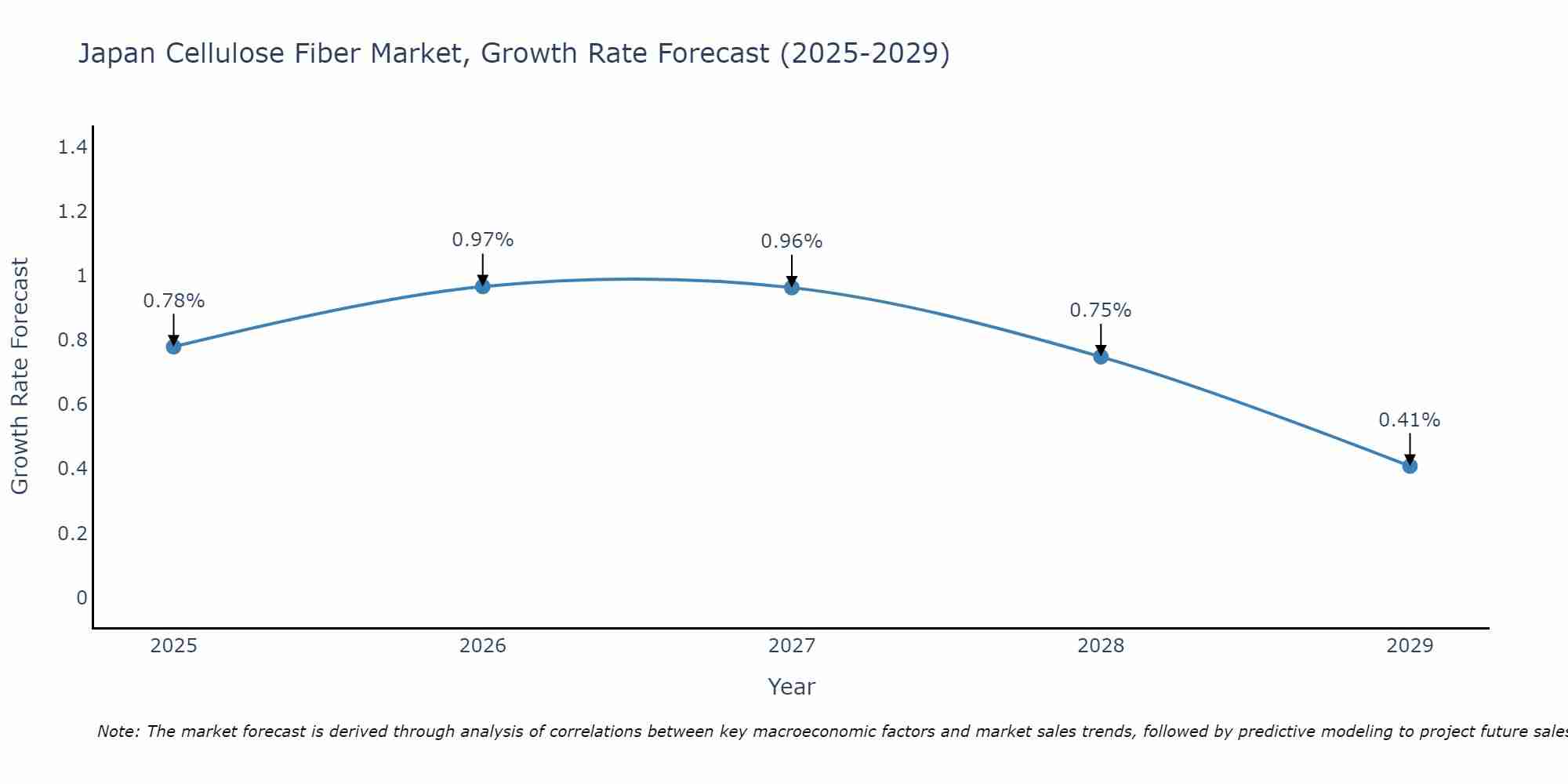
The Japan Cellulose Fiber Market is projected to witness mixed growth rate patterns during 2025 to 2029. The growth rate begins at 0.78% in 2025, climbs to a high of 0.97% in 2026, and moderates to 0.41% by 2029.
Japan Cellulose Fiber Market Overview
The Japan Cellulose Fiber Market is experiencing steady growth driven by the increasing demand for sustainable, eco-friendly materials in various industries. Cellulose fibers are derived from natural sources such as wood pulp, cotton, and other plant-based materials, making them biodegradable and renewable. The market is witnessing a shift towards cellulose fibers in applications such as textiles, hygiene products, and industrial applications due to their favorable properties such as absorbency, softness, and breathability. Key players in the market are focusing on research and development to enhance the quality and performance of cellulose fibers, as well as investing in sustainable production processes. With a growing emphasis on environmental sustainability and regulations promoting the use of eco-friendly materials, the Japan Cellulose Fiber Market is poised for further expansion in the coming years.
Japan Cellulose Fiber Market Trends
The Japan Cellulose Fiber Market is currently experiencing a shift towards sustainability and eco-friendly products, driven by increasing consumer awareness and regulatory initiatives. There is a growing demand for cellulose fibers derived from renewable sources such as bamboo and wood pulp, as consumers seek environmentally responsible alternatives to synthetic fibers. Additionally, there is a rising interest in innovative technologies that enhance the performance and functionality of cellulose fibers, catering to diverse applications including textiles, nonwovens, and industrial products. Manufacturers in the Japan Cellulose Fiber Market are investing in research and development to create biodegradable and compostable fibers, aligning with the global trend towards circular economy practices. Overall, sustainability, innovation, and eco-consciousness are key trends shaping the Japan Cellulose Fiber Market.
Japan Cellulose Fiber Market Challenges
In the Japan Cellulose Fiber Market, challenges include increasing competition from synthetic fibers, fluctuating raw material prices, and environmental concerns related to the production process. The market is also impacted by changing consumer preferences towards sustainable and eco-friendly products, which puts pressure on manufacturers to adopt more environmentally-friendly practices. Additionally, the aging population in Japan presents a challenge as demand for certain types of cellulose fibers may decrease. Overall, companies in the Japan Cellulose Fiber Market need to constantly innovate, optimize production processes, and develop strategies to differentiate themselves in a competitive landscape while meeting evolving consumer expectations and sustainability requirements.
Japan Cellulose Fiber Market Investment Opportunities
The Japan Cellulose Fiber Market presents promising investment opportunities due to the growing demand for sustainable and eco-friendly textiles. With increasing consumer awareness about environmental issues, the market for cellulose fibers derived from sources such as wood pulp, bamboo, and cotton is expanding rapidly. Investments in research and development of innovative cellulose fiber technologies, as well as collaborations with fashion brands looking to incorporate sustainable materials in their products, could be lucrative. Additionally, the Japanese government`s initiatives to promote sustainable practices and reduce carbon footprint further support the growth of the cellulose fiber market. Investing in companies involved in the production, processing, and distribution of cellulose fibers in Japan could offer long-term potential for investors seeking exposure to the sustainable fashion industry.
Japan Cellulose Fiber Market Government Policy
The Japanese government has implemented various policies to support the cellulose fiber market in the country. These policies focus on promoting sustainable production practices, encouraging innovation in manufacturing processes, and ensuring environmental protection. The government provides subsidies and incentives to companies that adopt eco-friendly technologies and invest in research and development for producing high-quality cellulose fiber products. Additionally, regulations are in place to ensure the sustainable sourcing of raw materials and the reduction of carbon emissions in the manufacturing process. Overall, the government`s policies aim to strengthen the competitiveness of the Japanese cellulose fiber market while also contributing to the country`s environmental goals.
Japan Cellulose Fiber Market Future Outlook
The Japan Cellulose Fiber Market is expected to witness steady growth in the coming years due to increasing environmental awareness and a shift towards sustainable textile materials. With a focus on eco-friendly production processes and the rising demand for natural fibers in the textile industry, cellulose fibers are gaining traction in Japan. Additionally, the government`s initiatives to promote the use of sustainable materials and reduce carbon footprint are likely to further drive the market growth. Innovation in cellulose fiber technology, such as the development of new blends and applications, is also expected to contribute to market expansion. Overall, the Japan Cellulose Fiber Market is poised for a positive outlook, driven by sustainability trends and consumer preference for environmentally friendly products.
Key Highlights of the Report:
- Japan Cellulose Fiber Market Outlook
- Market Size of Japan Cellulose Fiber Market, 2024
- Forecast of Japan Cellulose Fiber Market, 2031
- Historical Data and Forecast of Japan Cellulose Fiber Revenues & Volume for the Period 2018 - 2031
- Japan Cellulose Fiber Market Trend Evolution
- Japan Cellulose Fiber Market Drivers and Challenges
- Japan Cellulose Fiber Price Trends
- Japan Cellulose Fiber Porter's Five Forces
- Japan Cellulose Fiber Industry Life Cycle
- Historical Data and Forecast of Japan Cellulose Fiber Market Revenues & Volume By Fiber Type for the Period 2018 - 2031
- Historical Data and Forecast of Japan Cellulose Fiber Market Revenues & Volume By Introduction for the Period 2018 - 2031
- Historical Data and Forecast of Japan Cellulose Fiber Market Revenues & Volume By Natural Cellulose Fibers for the Period 2018 - 2031
- Historical Data and Forecast of Japan Cellulose Fiber Market Revenues & Volume By Man-made Cellulose Fibers for the Period 2018 - 2031
- Historical Data and Forecast of Japan Cellulose Fiber Market Revenues & Volume By Others for the Period 2018 - 2031
- Historical Data and Forecast of Japan Cellulose Fiber Market Revenues & Volume By Applications for the Period 2018 - 2031
- Historical Data and Forecast of Japan Cellulose Fiber Market Revenues & Volume By Introduction for the Period 2018 - 2031
- Historical Data and Forecast of Japan Cellulose Fiber Market Revenues & Volume By Apparel for the Period 2018 - 2031
- Historical Data and Forecast of Japan Cellulose Fiber Market Revenues & Volume By Home Textile for the Period 2018 - 2031
- Historical Data and Forecast of Japan Cellulose Fiber Market Revenues & Volume By Industrial for the Period 2018 - 2031
- Historical Data and Forecast of Japan Cellulose Fiber Market Revenues & Volume By Others for the Period 2018 - 2031
- Japan Cellulose Fiber Import Export Trade Statistics
- Market Opportunity Assessment By Fiber Type
- Market Opportunity Assessment By Applications
- Japan Cellulose Fiber Top Companies Market Share
- Japan Cellulose Fiber Competitive Benchmarking By Technical and Operational Parameters
- Japan Cellulose Fiber Company Profiles
- Japan Cellulose Fiber Key Strategic Recommendations






































