Japan Chandeliers & Pendant Lights Market Summary
The japan chandeliers & pendant lights market was estimated at USD 189 Million in 2025 and is projected to reach USD 203 Million by 2032, growing at a CAGR of 2.0% from 2026 to 2032.
Japan Chandeliers & Pendant Lights Market Year-wise Growth Rate and Key Drivers
This graph highlights how the Japan Chandeliers & Pendant Lights Market has steadily grown over the past five years, supported by major growth factors.
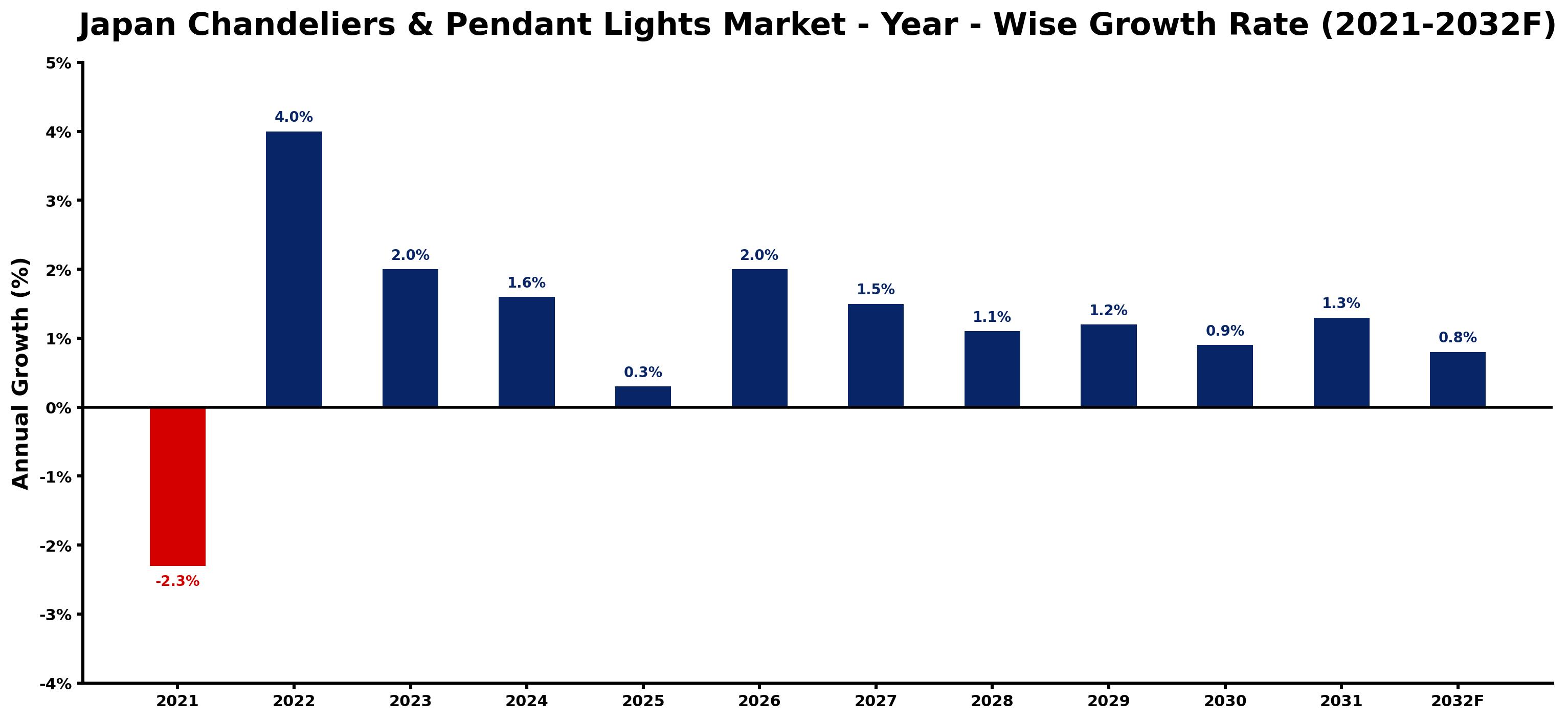
The table below presents the year wise growth rates along with the key drivers influencing the market
| Year | Growth Rate | Major Drivers |
| 2021 | -2.3% | Supply chain disruptions hindered product availability, leading to decreased sales in the lighting sector. |
| 2022 | 4.0% | Sustainability trends spurred interest in eco-friendly materials and energy-efficient lighting options. |
| 2023 | 2.0% | Urban renewal projects revitalized city spaces, enhancing the demand for decorative lighting solutions. |
| 2024 | 1.6% | Technological integration made smart lighting systems more attractive to modern homeowners. |
| 2025 | 0.3% | Home renovation activities surged, leading to increased purchases of stylish chandeliers and pendant lights. |
| 2026 | 2.0% | E-commerce platforms expanded, making designer lighting accessible to a broader audience. |
| 2027 | 1.5% | Interior design trends favored multifunctional spaces, driving demand for adaptable lighting solutions. |
| 2028 | 1.1% | Luxury property developments emphasized unique lighting features, elevating market expectations and standards. |
| 2029 | 1.2% | Japan's hospitality sector revitalized, prompting investments in dramatic lighting installations for ambiance. |
| 2030 | 0.9% | Cultural events and festivals increasingly utilized elaborate lighting displays, boosting seasonal demand. |
| 2031 | 1.3% | Home automation trends continued, with integrated lighting systems appealing to tech-savvy consumers. |
| 2032 | 0.8% | Artisanal craftsmanship gained attention, encouraging consumers to seek bespoke chandelier designs. |
Note - Market size estimations and growth projections presented in this report are based on 6Wresearch's advanced forecasting approach, validated with industry datasets as of June 2026.
Japan Chandeliers & Pendant Lights Market Synopsis
The Japan Chandeliers Pendant Lights Market is projected to reach 2.0% and witness significant growth during the forecast period (2026-2032). This growth is primarily attributed to urbanization trends, increased disposable incomes, and evolving consumer preferences toward premium and luxury lighting solutions. As the demand for sophisticated and aesthetically pleasing lighting products rises, the market is poised to benefit from technological advancements and innovative designs, particularly in the realm of energy-efficient LED lighting.
Japan Chandeliers & Pendant Lights Market Growth Drivers
The growth of the Japan Chandeliers & Pendant Lights Market can be attributed to several key factors:
- The increasing rate of urbanization in Japan leads to more residential and commercial constructions, consequently amplifying the demand for stylish lighting fixtures such as chandeliers and pendant lights.
- Rising disposable incomes among consumers enable the purchase of high-quality and luxurious lighting products, further driving the market.
- Contemporary lifestyle trends, which lean toward aesthetic enhancements in home and office decor, further stimulate interest in premium lighting solutions.
- Technological advancements in LED lighting are prompting manufacturers to innovate, producing energy-efficient products that also appeal to environmentally conscious consumers.
- Infrastructure development investments by both public and private sectors create new opportunities for lighting firms to supply versatile lighting solutions across various applications.
Japan Chandeliers & Pendant Lights Market Trends and Opportunities
The Japan Chandeliers & Pendant Lights Market is evolving with several notable trends that present opportunities for growth:
- There is a growing trend toward customization, with consumers seeking unique and tailored lighting solutions that reflect their personal style and preferences.
- The integration of smart technology within pendant lights and chandeliers is gaining traction, allowing users to control lighting remotely and enhance energy efficiency.
- Design trends are shifting towards minimalistic and contemporary styles, making way for innovative designs that cater to modern aesthetics.
- The increasing popularity of sustainable and eco-friendly materials in production is appealing to consumers interested in reducing their ecological footprint.
- Expanding online retail platforms are making premium chandeliers and pendant lights more accessible to a broader consumer base, encouraging market growth.
Japan Chandeliers & Pendant Lights Market Challenges and Restraints
Despite the positive outlook for the Japan Chandeliers & Pendant Lights Market, several challenges may hinder growth:
- The high initial cost associated with premium lighting fixtures may deter price-sensitive consumers, limiting potential market penetration.
- Competition from alternative lighting products, such as recessed lighting and other affordable options, could pose a threat to sales of chandeliers and pendant lights.
- Supply chain disruptions and increased costs of raw materials, particularly due to global economic factors, may impact pricing and availability of products.
- Market saturation in urban areas may limit growth prospects as many consumers are already equipped with adequate lighting solutions.
- The need for continuous innovation demands substantial investment in research and development, which may challenge smaller firms in the industry.
Japan Chandeliers & Pendant Lights Market Government Investment and Initiatives
The Japanese government has initiated several policies aimed at promoting energy-efficient lighting solutions, which, in turn, positively impacts the chandeliers and pendant lights market:
- Government initiatives focusing on sustainable urban development emphasize the importance of modern lighting solutions that comply with energy-saving standards.
- Public spending on infrastructure improvements often includes the integration of advanced lighting systems, offering opportunities for pendant light manufacturers.
- Incentives for energy-efficient appliances encourage consumers to invest in LED chandeliers and pendant lights, thereby stimulating market growth.
- Educational campaigns regarding the benefits of energy-efficient lighting drive consumer awareness and acceptance of modern lighting options.
- Partnerships between government and industry stakeholders aim to foster innovation in lighting technology, further enhancing market attractiveness.
Japan Chandeliers & Pendant Lights Market Latest Developments (May 2025 - June 2026)
Recent developments in the Japan Chandeliers & Pendant Lights Market indicate a shift towards innovative and energy-efficient designs. Between May 2025 and June 2026, the industry saw a surge in the introduction of smart lighting solutions that can be integrated into home automation systems. Manufacturers are also focusing on sustainability by exploring eco-friendly materials and production techniques. Furthermore, collaborations among companies for research into advanced lighting technologies have become more prevalent, aiming to meet the evolving demands of consumers. Additionally, the trend toward online consumer purchasing is reshaping distribution channels, prioritizing flexibility and customer engagement.
Japan Chandeliers & Pendant Lights Market - Key Attractiveness of the Report
- 10 Years of Market Numbers
- Historical Data Starting from 2022 to 2025
- Base Year: 2025
- Forecast Data until 2032
- Key Performance Indicators Impacting the Market
- Major Upcoming Developments and Projects
Key Highlights of the Report:
- Japan Chandeliers & Pendant Lights Market Outlook
- Market Size of Japan Chandeliers & Pendant Lights Market, 2025
- Forecast of Japan Chandeliers & Pendant Lights Market, 2032F
- Historical Data and Forecast of Japan Chandeliers & Pendant Lights Revenues & Volume for the Period 2022-2032F
- Japan Chandeliers & Pendant Lights Market Trend Evolution
- Japan Chandeliers & Pendant Lights Market Drivers and Challenges
- Japan Chandeliers & Pendant Lights Price Trends
- Japan Chandeliers & Pendant Lights Porter's Five Forces
- Japan Chandeliers & Pendant Lights Industry Life Cycle
- Historical Data and Forecast of Japan Chandeliers & Pendant Lights Market Revenues & Volume By Product Type for the Period 2022-2032F
- Historical Data and Forecast of Japan Chandeliers & Pendant Lights Market Revenues & Volume By Traditional for the Period 2022-2032F
- Historical Data and Forecast of Japan Chandeliers & Pendant Lights Market Revenues & Volume By Transitional for the Period 2022-2032F
- Historical Data and Forecast of Japan Chandeliers & Pendant Lights Market Revenues & Volume By Modern for the Period 2022-2032F
- Historical Data and Forecast of Japan Chandeliers & Pendant Lights Market Revenues & Volume By Applications for the Period 2022-2032F
- Historical Data and Forecast of Japan Chandeliers & Pendant Lights Market Revenues & Volume By Commercial for the Period 2022-2032F
- Historical Data and Forecast of Japan Chandeliers & Pendant Lights Market Revenues & Volume By Residential for the Period 2022-2032F
- Historical Data and Forecast of Japan Chandeliers & Pendant Lights Market Revenues & Volume By Distribution Channel for the Period 2022-2032F
- Historical Data and Forecast of Japan Chandeliers & Pendant Lights Market Revenues & Volume By Online for the Period 2022-2032F
- Historical Data and Forecast of Japan Chandeliers & Pendant Lights Market Revenues & Volume By Offline for the Period 2022-2032F
- Japan Chandeliers & Pendant Lights Import Export Trade Statistics
- Market Opportunity Assessment By Product Type
- Market Opportunity Assessment By Applications
- Market Opportunity Assessment By Distribution Channel
- Japan Chandeliers & Pendant Lights Top Companies Market Share
- Japan Chandeliers & Pendant Lights Competitive Benchmarking By Technical and Operational Parameters
- Japan Chandeliers & Pendant Lights Company Profiles
- Japan Chandeliers & Pendant Lights Key Strategic Recommendations






































