Japan Cloud Encryption Market Size & Growth Rate (2026-2032)
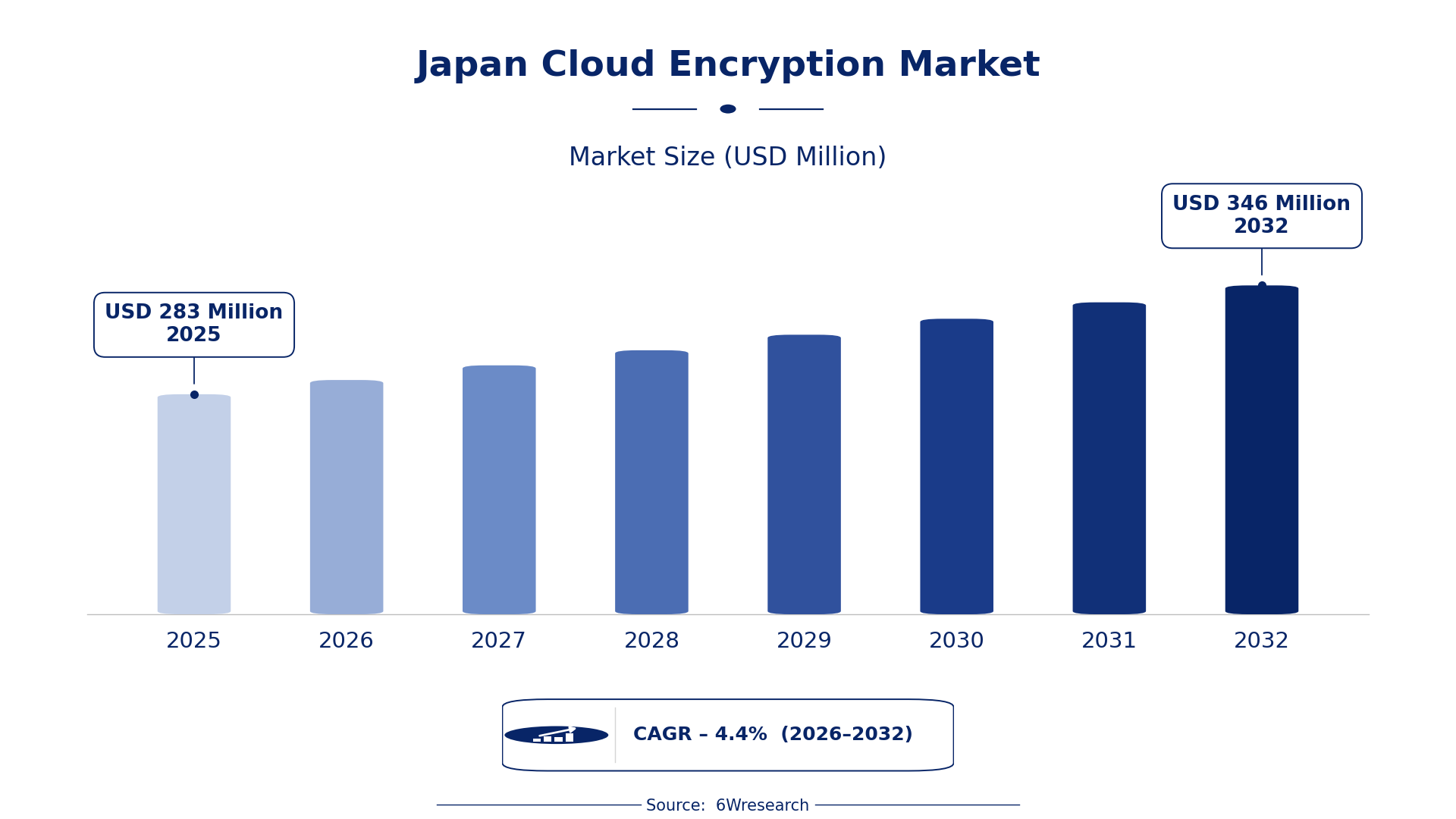
The Japan Cloud Encryption Market was estimated at USD 283 Million in 2025 and is projected to reach USD 346 Million by 2032, growing at a CAGR of 4.4% from 2026 to 2032.
Japan Cloud Encryption Market Synopsis
Japan's cloud encryption market is at a critical juncture. Heightened concerns regarding data privacy and the surge in cyber threats are fostering a climate ripe for significant growth. As businesses adapt to a stringent regulatory environment, the demand for reliable cloud encryption solutions has reached unprecedented levels.
Looking ahead, the trajectory indicates continued adoption of advanced encryption technologies. Innovations such as end-to-end encryption and tokenization are gaining traction, reshaping how organizations approach data protection in the cloud. The need for compliance with the Personal Information Protection Law is driving more businesses to seek encryption solutions tailored to their unique operational requirements.
Japan Cloud Encryption Market Year-wise Growth Rate and Key Drivers
This graph illustrates the annual growth rates of the Japan Cloud Encryption Market from 2021 to 2032, highlighting a steady upward trajectory and projected expansion over the forecast period.
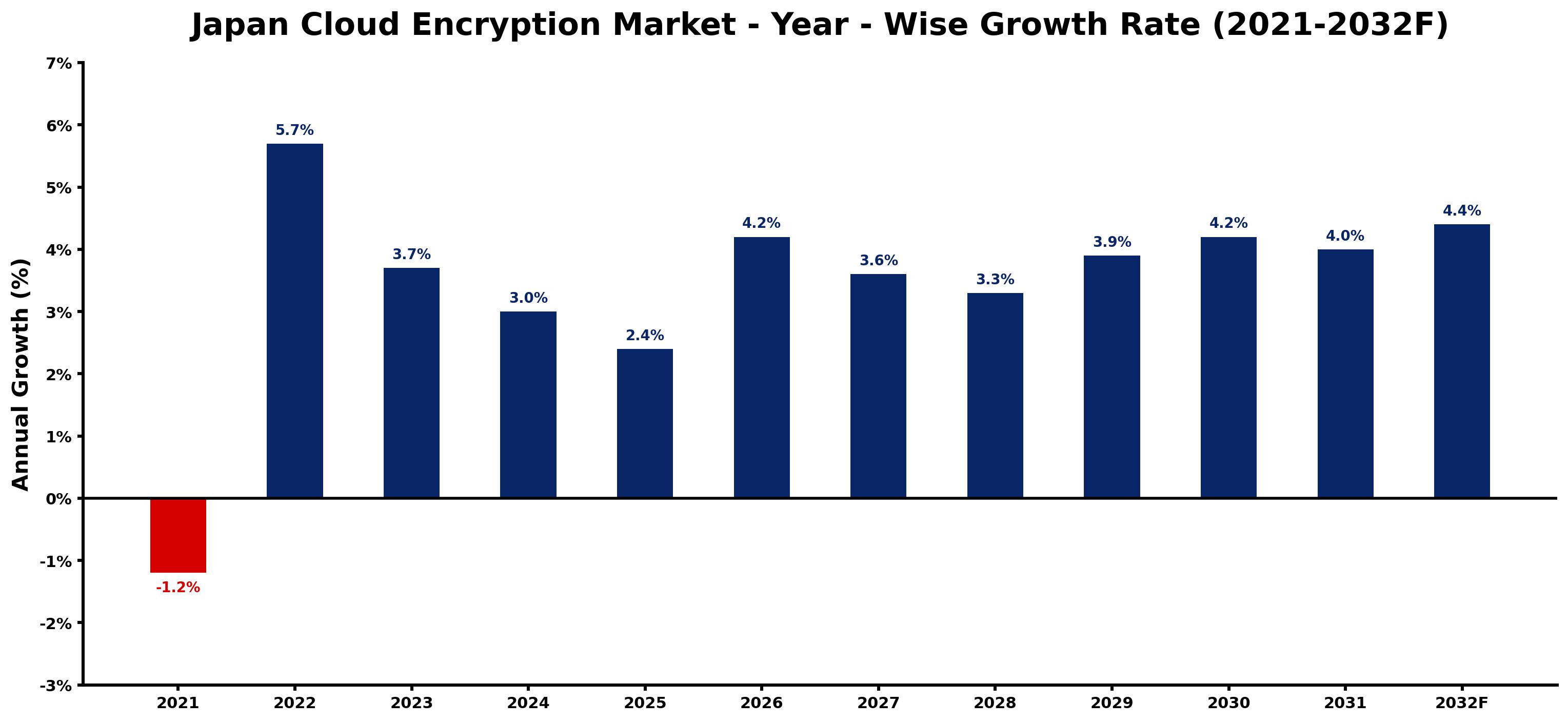
The table below presents the year‑wise growth rates along with the key drivers influencing the market
| Year | Growth Rate | Major Drivers |
| 2021 | -1.2% | Data localization laws limiting foreign cloud services availability. |
| 2022 | 5.7% | Active promotion of digital transformation by METI. |
| 2023 | 3.7% | Surge in IoT device integration in smart homes. |
| 2024 | 3.0% | Supportive cloud initiatives by the Council of Digital Economy. |
| 2025 | 2.4% | Increased data localization requirements from Japanese government. |
| 2026 | 4.2% | Robust growth of SaaS platforms in local startups. |
| 2027 | 3.6% | Rising investment in AI-driven security solutions. |
| 2028 | 3.3% | Increased collaboration among industry leaders on encryption standards. |
| 2029 | 3.9% | Corporate migration to hybrid cloud environments enhancing security needs. |
| 2030 | 4.2% | New privacy laws incentivizing enhanced data encryption. |
| 2031 | 4.0% | Growing partnership opportunities in tech ecosystems. |
| 2032 | 4.4% | Local demand for secure data exchange in finance. |
Note: Market size estimations and growth projections presented in this report are based on 6Wresearch's proprietary forecasting methodology, utilizing the latest available industry data, government publications, and primary research inputs.
Japan Cloud Encryption Market Key Takeaways
Below are some of the specific key takeaways from the market, including:
- The market is expected to grow steadily as cybersecurity threats increase.
- Integration of encryption with other security technologies is becoming a priority for businesses.
- Emerging solutions are tailored specifically for cloud environments.
- Investment in user-friendly encryption tools is on the rise, promoting collaboration without compromising security.
- Regulatory compliance, particularly with the APPI, is driving adoption rates.
Evaluation of Restraints in Japan Cloud Encryption Market
Several factors limit the growth potential in Japan's cloud encryption market. Data residency issues present a significant barrier, as strict regulations dictate where sensitive information can reside. Companies must ensure compliance with local laws while managing encryption processes. Additionally, the complexity involved in maintaining encryption keys in a cloud setting can deter some organizations from fully implementing encryption solutions.
Japan Cloud Encryption Market Trends
Current trends point towards a rise in end-to-end encryption solutions that allow organizations to secure their data from the ground up. There's a notable push for integrating encryption with access control measures and key management systems, enhancing overall data protection strategies. The development of cloud-native encryption technologies designed specifically for the unique demands of cloud computing is increasingly common. on top of that, businesses are focusing on developing intuitive encryption tools that facilitate secure collaboration among teams.
Japan Cloud Encryption Market Opportunities
The expanding adoption of cloud services opens numerous avenues for investment in Japan's cloud encryption market. Organizations are keenly aware of the imperative to safeguard sensitive information against rising cyber threats. Companies providing innovative encryption technologies, alongside those specializing in secure cloud storage, are well-positioned for growth. Collaborations with local enterprises to ensure compliance with Japanese regulations can further enhance market presence and competitiveness.
Government Initiatives in the Japan Cloud Encryption Market
The Japanese government is prioritizing data privacy and encryption to bolster cybersecurity across industries. The Act on the Protection of Personal Information (APPI) establishes stringent guidelines for handling sensitive data, pushing organizations to adopt encryption technologies. This focus aligns with Japan's broader digital strategy, ensuring businesses have the support and infrastructure necessary to adopt effective encryption measures.
- A national initiative launched in 2023 focuses on enhancing cybersecurity measures in public sector data management.
- The Japanese government is currently revising the APPI to introduce stricter encryption requirements for cloud-stored sensitive data, which is expected to take effect in late 2025.
- Ongoing workshops and guidance programs by the Japan Information-Technology Promotion Agency (IPA) help organizations implement encryption strategies effectively.
- Planned public-private partnerships aim to improve cloud infrastructure security and encourage encryption technology investments by 2026.
Future Insights of the Japan Cloud Encryption Market
The future of the Japan Cloud Encryption Market appears bright as organizations continue to navigate the complexities of data security. With an increasing reliance on cloud services, businesses will require advanced encryption solutions to protect sensitive information. As threats evolve, the demand for innovative technologies, such as homomorphic encryption, is expected to rise, signaling a shift towards more sophisticated data protection strategies.
Japan Cloud Encryption Market Latest Developments
In the last year, there has been a flurry of activity in the Japan Cloud Encryption Market. Organizations are intensifying their efforts to adopt encryption technologies that align with evolving regulatory requirements and enhance data security measures. Various developments signal an industry increasingly focused on robust encryption solutions.
- A major technology vendor launched a new encryption service designed specifically for cloud platforms in Q1 2025, improving security for enterprise customers.
- An ongoing initiative by a regional cybersecurity firm aims to provide encryption solutions tailored for SMEs, which began in early 2025 and continues to expand.
- A planned upgrade of cloud service infrastructure is expected to integrate advanced encryption protocols by late 2026, enhancing overall data security.
- In mid-2025, a consortium of tech companies announced a collaboration to develop an open-source encryption framework, promoting interoperability across cloud environments.
Japan Cloud Encryption Market - Key Attractiveness of the Report
- 10 Years of Market Numbers
- Historical Data Starting from 2022 to 2025
- Base Year: 2025
- Forecast Data until 2032
- Key Performance Indicators Impacting the Market
- Major Upcoming Developments and Projects
Key Highlights of the Report:
- Japan Cloud Encryption Market Outlook
- Market Size of Japan Cloud Encryption Market, 2025
- Forecast of Japan Cloud Encryption Market, 2032
- Historical Data and Forecast of Japan Cloud Encryption Revenues & Volume for the Period 2022-2032F
- Japan Cloud Encryption Market Trend Evolution
- Japan Cloud Encryption Market Drivers and Challenges
- Japan Cloud Encryption Price Trends
- Japan Cloud Encryption Porter's Five Forces
- Japan Cloud Encryption Industry Life Cycle
- Historical Data and Forecast of Japan Cloud Encryption Market Revenues & Volume By Component for the Period 2022-2032F
- Historical Data and Forecast of Japan Cloud Encryption Market Revenues & Volume By Solution for the Period 2022-2032F
- Historical Data and Forecast of Japan Cloud Encryption Market Revenues & Volume By Service for the Period 2022-2032F
- Historical Data and Forecast of Japan Cloud Encryption Market Revenues & Volume By Service Model for the Period 2022-2032F
- Historical Data and Forecast of Japan Cloud Encryption Market Revenues & Volume By Infrastructure-as-a-Service for the Period 2022-2032F
- Historical Data and Forecast of Japan Cloud Encryption Market Revenues & Volume By Software-as-a-Service for the Period 2022-2032F
- Historical Data and Forecast of Japan Cloud Encryption Market Revenues & Volume By Platform-as-a-Service for the Period 2022-2032F
- Historical Data and Forecast of Japan Cloud Encryption Market Revenues & Volume By Organization Size for the Period 2022-2032F
- Historical Data and Forecast of Japan Cloud Encryption Market Revenues & Volume By Large Enterprises for the Period 2022-2032F
- Historical Data and Forecast of Japan Cloud Encryption Market Revenues & Volume By Small and Medium-sized Enterprises (SMEs) for the Period 2022-2032F
- Historical Data and Forecast of Japan Cloud Encryption Market Revenues & Volume By Vertical for the Period 2022-2032F
- Historical Data and Forecast of Japan Cloud Encryption Market Revenues & Volume By Banking, Financial Services, and Insurance (BFSI) for the Period 2022-2032F
- Historical Data and Forecast of Japan Cloud Encryption Market Revenues & Volume By Healthcare for the Period 2022-2032F
- Historical Data and Forecast of Japan Cloud Encryption Market Revenues & Volume By Government and Public Utilities for the Period 2022-2032F
- Historical Data and Forecast of Japan Cloud Encryption Market Revenues & Volume By Telecom and IT for the Period 2022-2032F
- Historical Data and Forecast of Japan Cloud Encryption Market Revenues & Volume By Retail for the Period 2022-2032F
- Historical Data and Forecast of Japan Cloud Encryption Market Revenues & Volume By Aerospace and Defense for the Period 2022-2032F
- Historical Data and Forecast of Japan Cloud Encryption Market Revenues & Volume By Others (manufacturing, education, and media and entertainment) for the Period 2022-2032F
- Japan Cloud Encryption Import Export Trade Statistics
- Market Opportunity Assessment By Component
- Market Opportunity Assessment By Service Model
- Market Opportunity Assessment By Organization Size
- Market Opportunity Assessment By Vertical
- Japan Cloud Encryption Top Companies Market Share
- Japan Cloud Encryption Competitive Benchmarking By Technical and Operational Parameters
- Japan Cloud Encryption Company Profiles
- Japan Cloud Encryption Key Strategic Recommendations






































